
The U.S. Attorney’s Office for Wyoming said Friday its top prosecutor made comments to grand jurors that were “ill advised,” but not prejudicial enough to sabotage eight felony-level cases — including one first-degree murder case — filed in the U.S. District Court for Wyoming.
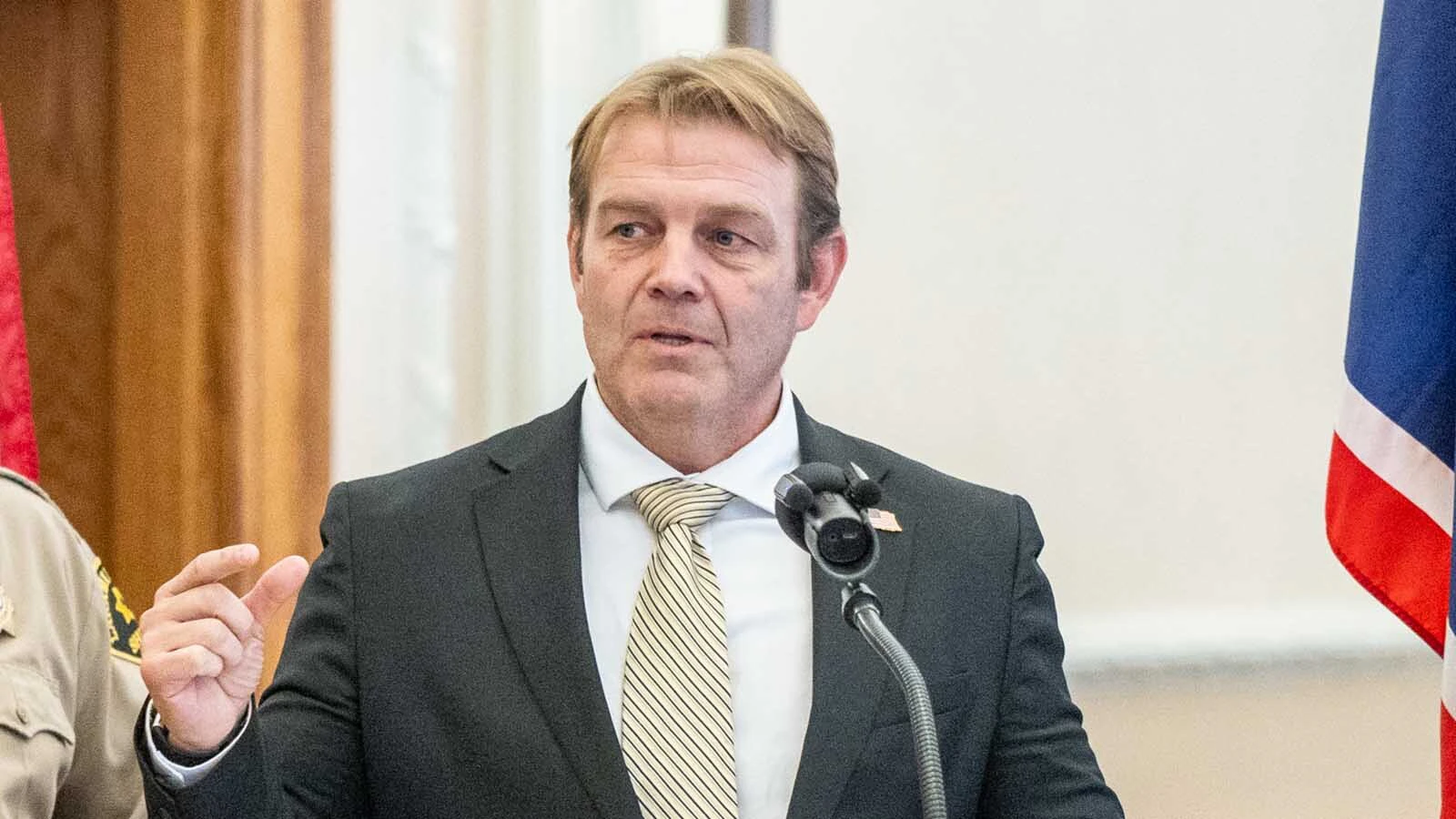
That’s after President Donald Trump-nominated U.S. Attorney Darin Smith, whose official confirmation vote is set for Monday in the U.S. Senate, visited with grand jurors March 16 and maligned defendants in the process, court documents say.
In late April and early May, multiple attorneys filed motions to dismiss what were originally at least nine felony-level cases.
The motions are similar.
Coupled with an investigator’s account of statements from witnesses, they say Smith poisoned the well of March 16 grand jury proceedings in the U.S. District Court for Wyoming’s Casper-based courthouse.
Federal Public Defender’s investigator Loana Dominguez wrote in a witness statement summary that one of the grand jurors watched Smith stand before the grand jury members that day as they waited for U.S. District Court Judge Kelly Rankin to enter.
The summary says Smith asked where everyone was from. He asked if anyone had questions about the process. Then he said the defendants were not going to be run-of-the-mill criminals seen in state court.
Smith said they were “bad guys” who “did what you are going to hear about” and were “murderers,” the investigator’s summary asserts.
The deliberations “won’t take long,” Smith added, according to the summary.
The Reservation-Area Protest
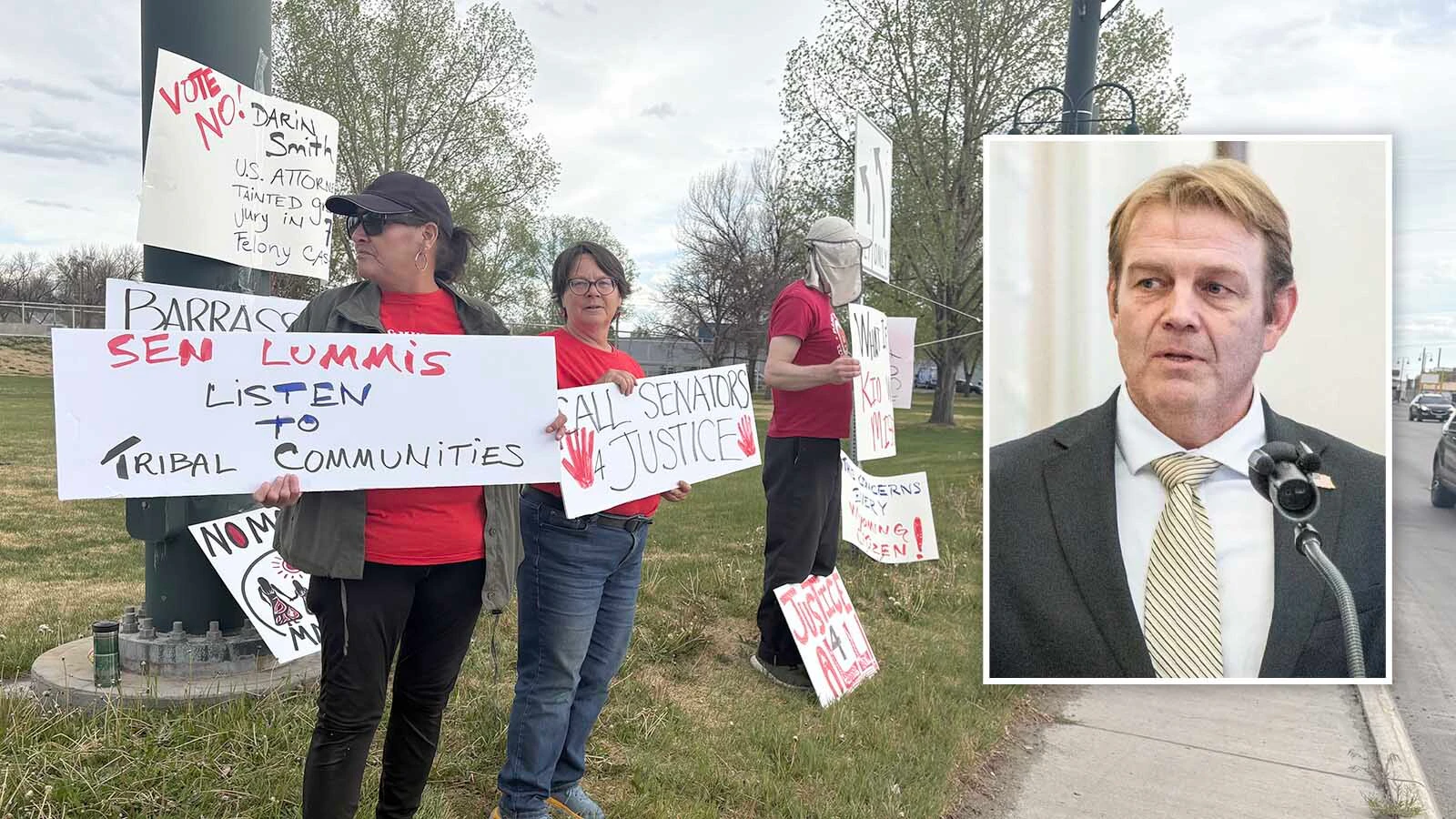
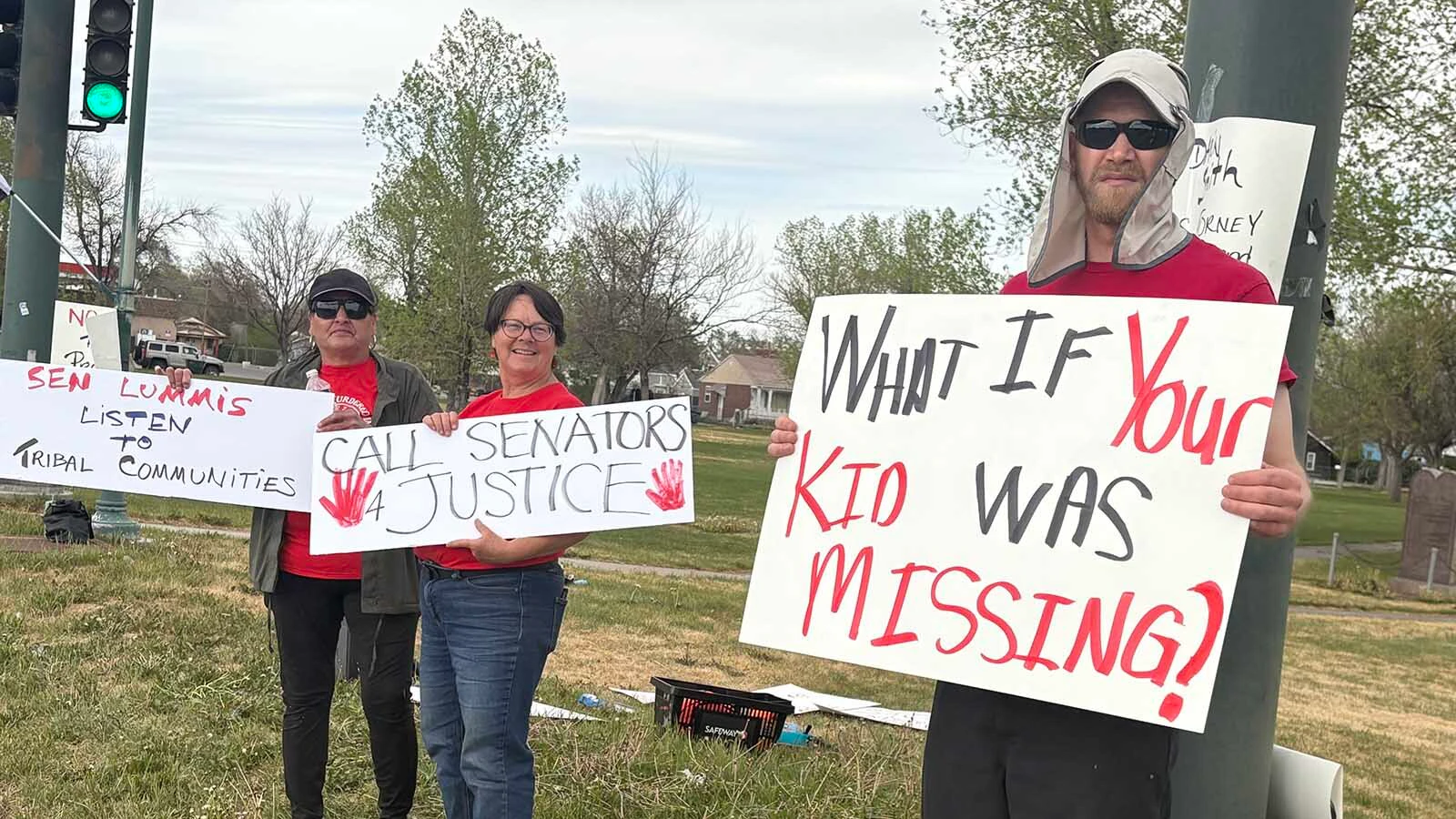
Three protestors gathered at Riverton City Park on Friday afternoon, urging passersby to contact U.S. Sens. John Barrasso and Cynthia Lummis, and to tell them to vote against Smith’s confirmation.
"Vote No! Darin Smith U.S. attorney tainted grand jury in 7 felony cases," reads one of their protest signs. "Call Senators 4 Justice," says another.
“Our tribal communities deserve better, and Wyoming overall deserves better,” said Nicole Wagon, one of the three protestors. “You can still make noise and make a difference, and that’s not OK.”
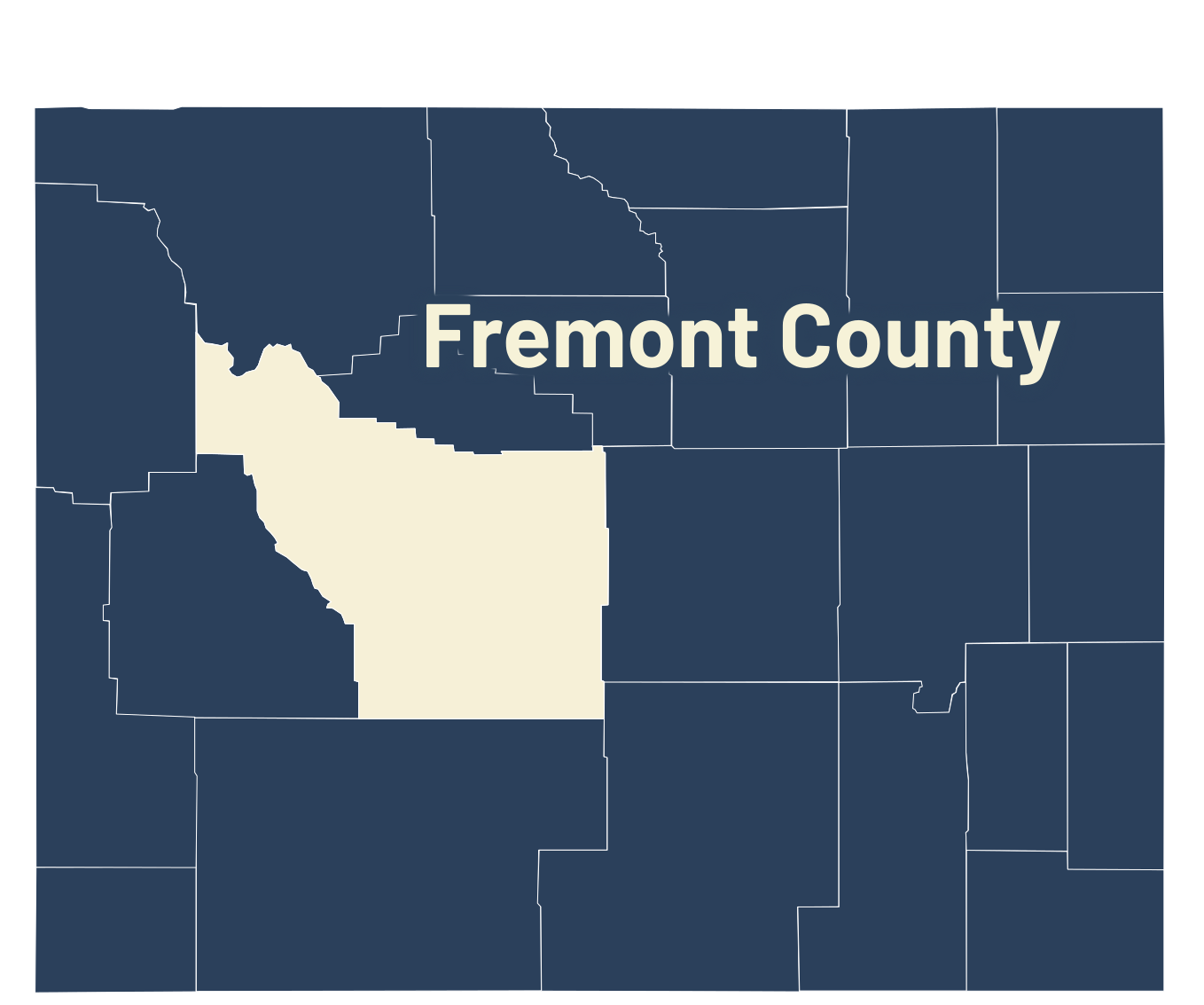
The federal prosecutor’s office generally charges felony-level crimes involving tribal members on the Wind River Indian Reservation.
Wyoming chooses its state-level prosecutors off the reservation in a different way — by having county-wide elections.
The difference, then, is that often tribal members implicated in reservation-based felony crimes are prosecuted by someone the president chose, rather than someone they elected.
Riverton sits next to the Wind River Indian Reservation.
‘Flagrant Attempt'
This polluted the grand jury proceeding, multiple attorneys alleged across their motions to dismiss.
“By addressing the prospective grand jurors before voir dire with highly inflammatory declarations of the defendants’ guilt and explicitly pressuring them to return a true bill (indictment) in a matter of minutes, the government obliterated the structural independence of the grand jury,” says an April 24 filing signed by P. Craig Silva, assistant federal public defender.
“This flagrant attempt to unfairly sway the panel constitutes a fundamental error that rendered the proceedings inherently unfair from their inception,” the filing adds.
Though there were originally nine defendants alleging misconduct, one of them — Cameron Justin Agee — has settled his case. He’s accused of possessing a gun and ammunition, and a stolen gun, despite being a felon.
A plea agreement was filed in his case in late April but, as is typical with Wyoming federal prosecutors’ plea agreements, it wasn’t filed publicly.
A minutes sheet from Agee’s May 7 change-of-plea hearing says he pleaded guilty to knowingly possessing a firearm and ammunition, and is set for sentencing July 20.
Smith’s office declined Friday to comment on the allegations made about the grand jury cases and Agee’s settlement, pointing to the court files.
Before his nomination, Smith served part of one term as a state Senator representing part of Laramie and all of Platte County.
Including One Murder Case
Assistant U.S. Attorney Christyne Martens argued Friday for the court to keep all eight remaining cases alive rather than dismiss them.
“While USA Smith’s comments were ill advised, they were not as offensive as the Defendant contends when fairly viewed in context,” wrote Martens in the filings. “But even taken at face value, Defendant’s allegations are not the type that could result in the dismissal of the indictment against him.”
The grand jurors were educated on their independent roles and took an oath to exercise that judgment, the filings add.
Martens asked to consolidate all eight cases into one hearing, for any court hearing on this matter.
The defendants alleging prosecutorial misconduct and asking for dismissal from the March 16 grand jury are:
• Jose Benito Ocon, who is accused of fatally shooting a man in the head “without provocation” in a vehicle before pointing a gun at two women who were also in the vehicle.
• Brian Johnson, who is accused of possessing a pistol despite being a felon, and whom court documents say pointed a pistol at a Riverton Police Department officer in February while police responded to a report of a male assaulting two females.
• Dennison Antelope, who is accused of possessing a gun despite being a felon.
• Wolf Elkins Duran, who is accused of keeping child pornography of prepubescent children and bestiality on his phone.
• Matthew Miller Jr, who’s accused of possessing and intending to distribute drugs.
• Cheyenne Swett, who is accused of possessing guns despite being a felon, which police say they discovered after Swett shot himself in the abdomen.
• Michael Hopper, who’s accused of possessing pistols despite being a felon.
• Mathew Jacoby, who’s accused of possessing and intending to distribute a “burrito” like package of meth.
A Little Law
The defense attorneys’ motion to dismiss these cases emphasize that the Fifth Amendment to the U.S. Constitution guarantees the right to an unbiased grand jury.
The Ninth Circuit Court of appeals in 1986 read that to mean a prosecutor can’t circumvent that process with overreaching conduct that impinges on the grand jury’s autonomy and interferes with its unbiased judgment, court documents relate.
Defendants can ask the court to dismiss an indictment that stems from such circumstances, documents add.
But courts should first decide whether the grand jury proceedings were fundamentally or structurally unfair, or if they suffered from nonstructural errors.
It’s easier to win dismissal if the grand jury proceedings were structurally flawed since the defendant only needs to show that there was an error. But if the error was nonstructural, the defendant also has to show that the error prejudiced him.
Martens argues in all eight remaining cases that the defendants can’t show they were prejudiced from what actually happened.
Martens argued that what happened wasn’t a structural error and didn’t rise to the level of structural error found in a case addressing that concept.
“So the court must examine the allegations for prejudice before considering dismissal as a remedy,” she wrote.
She pointed to 10th Circuit Court of Appeals cases in which the court said courts may dismiss indictment for prosecutorial misconduct “flagrant to the point that there is some significant infringement on the grand jury’s ability to exercise independent judgment.”
She wrote that the 10th Circuit has said that, “at bottom, this court must find that prosecutorial misconduct overbore the will of the grand jury so that the decision to indict was no longer its own.”
Dismissal is generally not an appropriate remedy to sanction “bad conduct by the government,” she continued, because dismissals don’t necessarily punish the prosecutor, while they do punish the victims and damage the public’s interest in holding criminals responsible.
She argued that Smith’s comments aren’t of the kind that overbear the will of the grand jury.
Candor
Still, the U.S. Attorney’s Office saw fit under the Wyoming Rules of Professional Conduct to disclose certain events. The rules call for candor, truthfulness, and avoiding misconduct, Martens wrote. Those disclosures are as follows:
• During a break, an assistant U.S. attorney saw Smith handing out business cards and inviting the grand jury panel members to reach out to him. Smith said no grand jurors have reached out to him, the filing adds.
• The foreman of the grand jury asked between cases something like, “are you going to give us a hard case?” and Smith stood and said something like, “Like I told you guys before, we’re only giving you ‘slam dunks.’” The assistant prosecutor who saw this corrected the statement by telling the grand jury there would be hard cases, and then left the room, says the filing.
• Smith asked for the list of grand jurors, but reports he hasn’t done anything with it.
These cases are ongoing.
Clair McFarland can be reached at clair@cowboystatedaily.com.


