
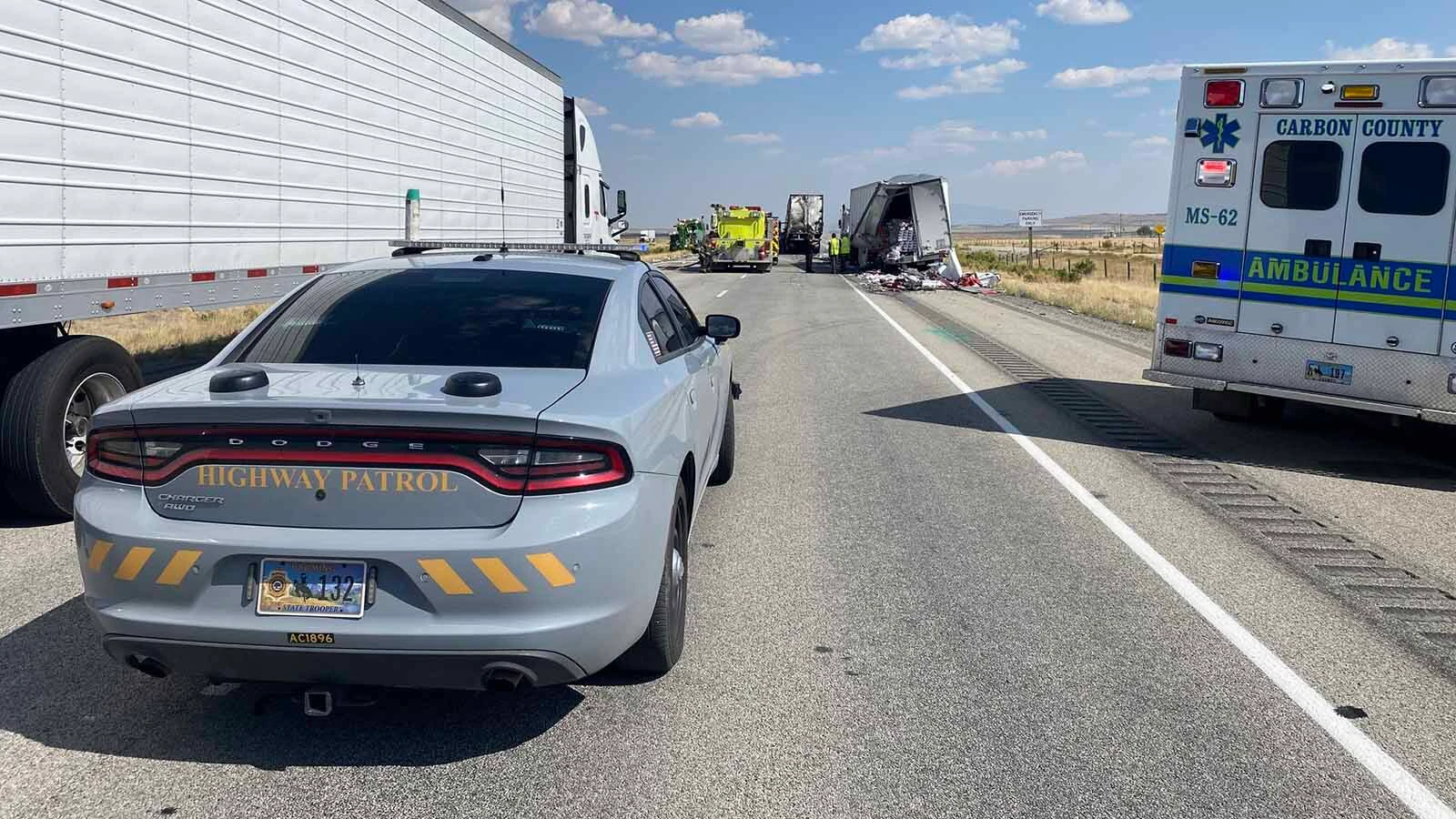
Staff and budget shortages at the Wyoming Highway Patrol are stretching troopers thin across nearly 7,000 miles of state highways, slowing response times and straining local and county agencies to make up for the gaps in service.
Earlier this year, the WHP launched a review after blowing past its overtime budget by roughly $2.5 million.
Col. Tim Cameron, who was the WHP and has since retired, didn’t mince words , attributing the spike to “unchecked, unfettered misuse of overtime by all levels of personnel.”
State legislators, current troopers, and a recently retired dispatcher suggest the problem runs deeper than time sheets into years of understaffing, shifting policies and an agency trying to police one of the largest, most rural states in the country with too few people.
That’s left Wyoming counties to pick up some of the slack when there aren’t enough WHP troopers available.
‘It Hit A Boiling Point’
State Rep. Landon Brown, R-Cheyenne, said concerns about the Wyoming Highway Patrol had been simmering long before the department’s budget crisis spilled into public view.
“It has been bubbling up for some time,” Brown said. “It hit a boiling point when Colonel Cameron decided to retire, which is an unfortunate situation.”
Cameron’s retirement was effective March 31, less than a month after the overtime crisis made headlines.
Brown pointed to a combination of low pay, policy shifts and geography all converging to leave fewer troopers covering more ground than ever.
The WHP reported that in 2025, only 15-20 troopers at any given time could have been patrolling the state’s 6,859 miles of state roads, while dispatchers handled more than 150,000 calls for service.
“I do think we need more staffing,” Brown said. “Not only do we not have enough troopers, but we also have those few troopers covering larger distances than we ever have before.”
That reality is increasingly bleeding into local jurisdictions, he said.
“Yes, I do believe that is impacting the ability of troopers to respond,” Brown said. “I have heard from those sheriffs across the state as well.”
On The Other End Of The Radio
For nearly four decades, dispatcher Missy Moellenberg was often the first voice people heard when something went wrong on a Wyoming highway — and the one left explaining why help wasn’t there yet.
“When troopers are stretched thin across large areas … it creates a little bit of anxiety,” she said. “Especially when people keep calling back and saying, ‘They’re not here yet. Where are they? When are they gonna get here?’”
Moellenberg retired in December after almost 40 years behind the console. She said relying on local agencies wasn’t the exception, it was often necessary.
“We’ve absolutely had to rely on them,” she said of Wyoming sheriff’s offices and local police. “They are gracious enough to help cover us when they have the manpower.”
In some parts of the state, she said, coverage could come down to a single trooper responsible for vast stretches of highway.
“The Big Horn Basin is one of those,” she said, describing a reorganization that merged multiple patrol areas. “There’s a trooper covering from Thermopolis to Cody or Lovell — there might only be one trooper to do that.”
Local Agencies Filling The Gaps
Laramie County Sheriff Brian Kozak said his office hasn’t yet felt significant strain, but he knows others have.
“Some of the other counties, I know the deputies are having to kind of step up and respond to crashes on interstates and highways,” Kozak said.
That's showing up in other parts of the state as well.
Platte County Sheriff Krotz said his agency has had to step up interstate coverage because of the trooper shortage, even as his own office faces staffing challenges.
When deputies are tied up responding to incidents on the interstate, he said they’re pulled away from their usual patrol areas, including county roads and community calls.
So far, Krotz said the situation hasn’t created a direct public safety risk, but it has increased tension inside the agency.
“It’s a frustration,” he said, adding that he believes there are “brighter days ahead.”
Kozak also raised concerns about leadership stability, noting the WHP does not expect to fill its top position until October.
That leadership vacuum, combined with staffing shortages, has left some questioning who’s steering the agency through one of its most turbulent periods in years.
In response to the overtime crisis, the Highway Patrol has moved to clamp down on spending, eliminating most overtime and shifting how troopers patrol.
One directive limits driving to about 400 miles per week unless necessary, encouraging troopers to focus on high-risk areas instead of constant highway coverage.
Brown said the move could save around $1 million, but acknowledged that comes with a tradeoff.
That kind of targeted enforcement may make financial sense, he said, but it can also mean longer waits in remote areas when something goes wrong.
‘Minimal Coverage’
Lt. Matt Arnell, president of the Wyoming Highway Patrol Association, said the agency is now short more than 35 troopers.
That means “we can cover the state minimally,” Arnell said.
With overtime largely eliminated, even routine incidents can ripple into staffing gaps.
“If a trooper winds up working over their shift to cover a crash or an arrest, that time has to be flexed out later,” he said.
That often means troopers are effectively on call — heading out from home when emergencies hit.
“They get dressed and go wherever they’re needed,” Arnell said. “That can be tough on a trooper and on their families.”
Moellenberg said that pressure has been building for years and peaked during periods of mandatory overtime.
“It was just another thing to add to your sleep deprivation,” she said. “There was really no ability to relax because you had to be on pretty much all the time.”
The Agency Response
Wyoming Highway Patrol spokesman Aaron Brown said the agency has 208 authorized trooper positions, with about 35 vacancies — an improvement from previous years.
That’s 36 counting another trooper who hung up his hat on Friday, according to Arnell.
“While we do have vacancies, it is a vast improvement from vacancies in 2023,” Aaron Brown said.
He emphasized that public safety remains the agency’s top priority and pushed back on the idea that responsibilities are being shifted elsewhere.
“We are still performing our mission through schedule adjustments,” he said. “We are not passing on emergency calls to other agencies.”
Taken together, the accounts paint a picture of an agency trying to do more with less — tightening its budget while covering huge distances with a shrinking workforce.
In February, Aaron Brown said he expected the WHP's projected burn rate was going lead to an overrun of the agency's budget by $8.5 million.
Since enacting a strict no-overtime policy in December, the WHP has already seen a measurable decrease in payroll expenses, he said.
Kolby Fedore can be reached at kolby@cowboystatedaily.com.


