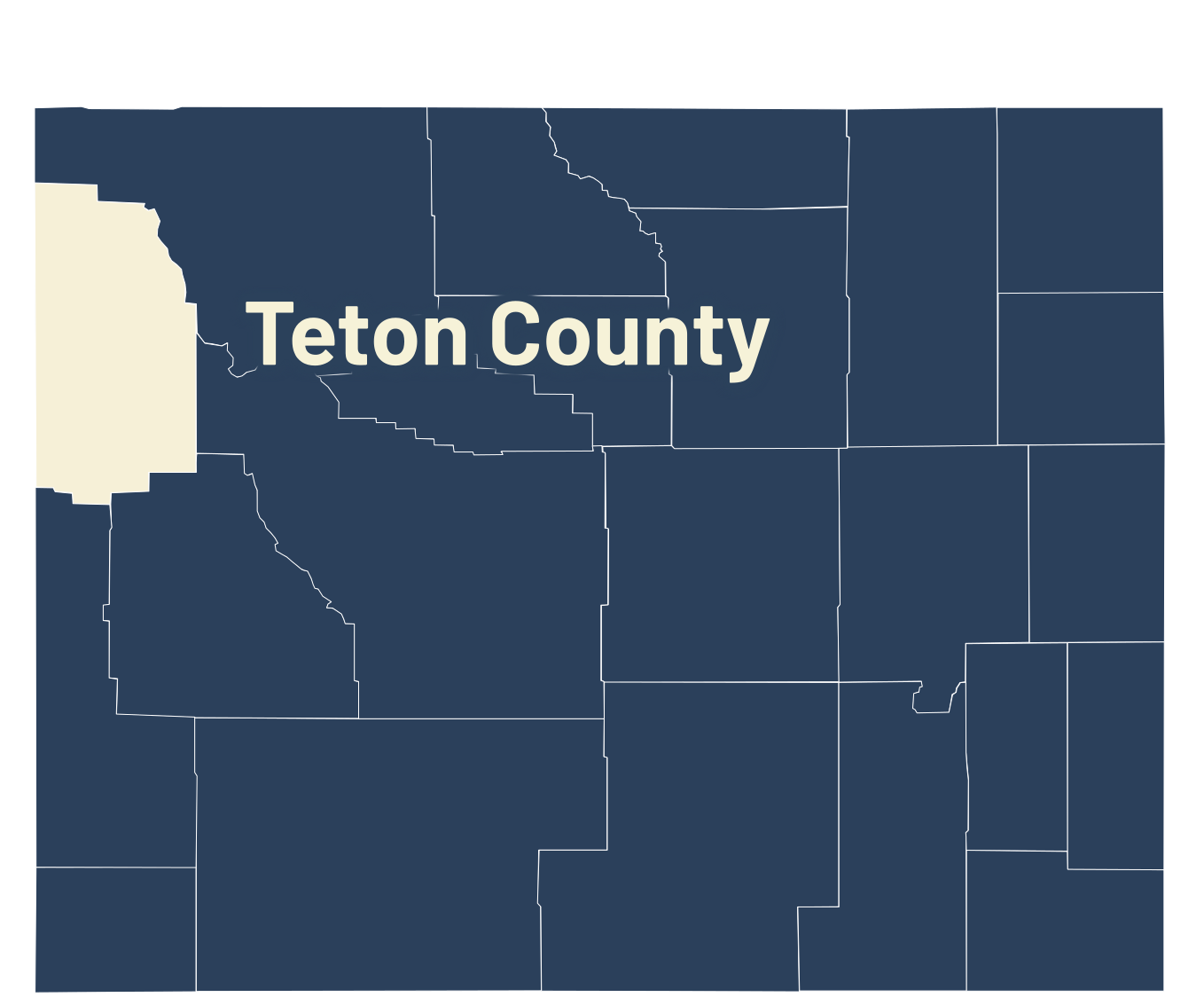
Teton County residents will benefit the most if the 50% residential property tax cut ballot initiative passes, data shows.
The people of Teton County would save $27.05 million if the measure, called Proposition One, passes the people’s vote at the Nov. 3 general election.
That’s 24.7% of the projected statewide savings, of $109.4 million.
“This is a dream for Teton County,” Sen. Cale Case, who chairs the Senate Revenue Committee, told Cowboy State Daily on Wednesday. “For part-time residents that can afford it, their taxes are less (by rate) than they would be for other jurisdictions. I mean, it is a dang dream.”
“And Teton County almost doesn’t care,” continued Case, a Lander-based Republican. He noted that most of Wyoming’s counties assess as much in property taxes as they can lawfully.
Yet Teton County pulls just over half of the lawful maximum: 7.879 out of 12 mills allowed, Teton County Assessor Mel Shinkle confirmed Wednesday to Cowboy State Daily.
Meaningful Taxation Method
Wyoming Republican Party Chair Bryan Miller told Cowboy State Daily that Teton County’s figures make for a striking, “red meat” news story, but Teton is “not the only county in the state where housing prices have gone crazy.”
“It looks bigger because they’re a highlight, I get it,” said Miller, who supports Prop 1.
The state party leadership officially supports the measure as well.
“But Prop 1 will help an enormous number of people,” he said. “It will help young people trying to buy homes, it’ll help folks stay in their homes. If I had my way, I’d try to get rid of the whole property tax thing in general.”
Miller cast property taxation as a less-moral revenue mechanism because people might still have to pay it – and could lose their homes for failure to pay – long after paying off their homes.
On the other hand, Case said it’s a meaningful taxation method because residential property tax money funds county entities. So it tethers people’s money to their local interests, and local officials’ choices, he said.
“It’ll just come from Cheyenne, and you really won’t care,” said Case. “People will become more and more separated from caring about how their money goes.”
Property taxes also fund public schools, but that money is redistributed on a more even basis to shield schoolchildren from disparities between different counties’ wealth.
Sixty-nine percent of property taxes fund K-12 schools, 17% fund county operations, 8% fund special districts like solid waste and fire departments, 2% goes to cities and towns, and 4% goes to community colleges.
What The Heck Is A Mill?
To crunch residential property taxes, assessors first determine a property’s fair-market value. They take 9.5% of that to apply the lawful assessment rate.
Then they multiply that result by the number of mills the area lifts to fund its various local services. A mill is one-1,000th of the value.
If an area lifts 58 mills, for example, the assessor would multiply the new value by the fraction 58/1000 to calculate the final tax bill.
The per-county savings figures are according to a chart the Legislative Service Office compiled from assessment data, recent property tax exemptions and a projected 2% home value increase heading into 2027.
Teton County’s $27.05 million savings figure is nearly three times greater than the next-highest Prop 1 tax break, found in Natrona County at $9.86 million.
Niobrara County residents are expected to save the least: $78 per capita and $180,000 total, but that’s also Wyoming’s least-populous county.
Breaking these figures out by population, Teton County homeowners still win, with a per capita savings of $1,162.
The average of all counties is $193 savings per capita.
The average of all counties without Teton is $149.
Lincoln County residents are slated to save the second-most per capita, at $319. That’s $6.7 million in savings countywide, if Prop 1 passes.
Savings
Miller noted that the state had an unexpected surplus this year, and keeps billions of dollars in investment funds and savings combined. He said the Legislature should rework any needed backfill distributions from those.
“I understand it’s complicated. Uncomplicate it,” said Miller.
Prop 1 doesn’t specify any backfill to replace the $109.4 million in decreases it could cause. This is a chance for the Legislature to show some creativity and truly serve people, Miller said.
Miller cast local governmental officials’ lobbying against Prop 1 as self-interested.
The initiative is “out there because a lot of people across the state signed a petition to get it out there,” he said.
“And to have all these government agencies say, ‘No, no, no, you shouldn’t be petitioning against the government because it’s too hard, you’re going to make our lives miserable,’” added Miller, “That’s not a public servant attitude. It’s a self-serving attitude. And it’s unacceptable in government work, my opinion.”
Case said Prop 1, rather, has self-interested drivers.
“It kinda turns us into trust-fund babies, you know,” he said, noting that other kinds of taxes, like the sales tax, are largely homogenized statewide and distributed out of Cheyenne.
Case said many of the investments and savings accounts Miller references are bound up by statute or constitutional provisions.
Case also called Prop 1 a “red meat” energy-generator for former governor’s candidate Brent Bien, who spearheaded the petition that got the measure onto the ballot.
Bien and allies were “throwing red meat at people in a time when they wanted red meat,” said Case.
Bien did not respond by publication to a voicemail request for comment. He told Cowboy State Daily previously that he’s ready to take a break from running for governor.
He ran in two Republican primary election cycles, losing in 2022 to Gov. Mark Gordon and in 2026 to Sen. Eric Barlow.
Miller had also noted that counties tend to have reserves of their own.
Laramie County reported in 2025 that it had $92.4 million in reserves, down roughly $4.5 million from the prior fiscal year. The county clerk did not respond to a voicemail by publication for more recent figures.
Miller theorized another potential backfill: That people who’ve saved money on property taxes will spend more money, which will lead to a spike in sales tax revenues.
Thanks, COVID
Wyoming average residential sale prices grew 71% between 2020 and 2025, according to LSO data taken from the Department of Revenue and assessor values.
The average residential sale price in 2020 was $321,299, and in 2025 it was $550,448.
Only Weston County saw a drop from 2020 to 2025. Its sale price fell from $238,524 average to $234,635.
The already-exorbitant Teton County values roughly doubled, from $2.48 million in 2020 to $5.07 million in 2025.
Case attributes these growths to Wyoming homes growing attractive during COVID.
Wyoming was among the least-restrictive states in pandemic policies.
Because property tax values are based on value assessments, those also grew.
The Legislature acted, passing a 25% property tax exemption up to the first $1 million in home value for homes and land belonging to people who live on site for eight months or more.
The Legislature also passed a 4% growth cap on property taxes’ increase from year to year. And it passed a 50% long-term homeowner exemption up to the first $3 million in home value for people 65 and older, who have paid residential property taxes for at least 25 years in Wyoming, and whose property is their primary home.
Homeowners can’t claim both the long term and 25% exemptions.
If Prop 1 passes, people can switch from one of those exemptions from the 50% cut on structures, which doesn’t apply to land. Prop 1 would apply to a homeowner showing he lived in the home for at least six months, and in Wyoming for at least one year.
Clair McFarland can be reached at clair@cowboystatedaily.com.