
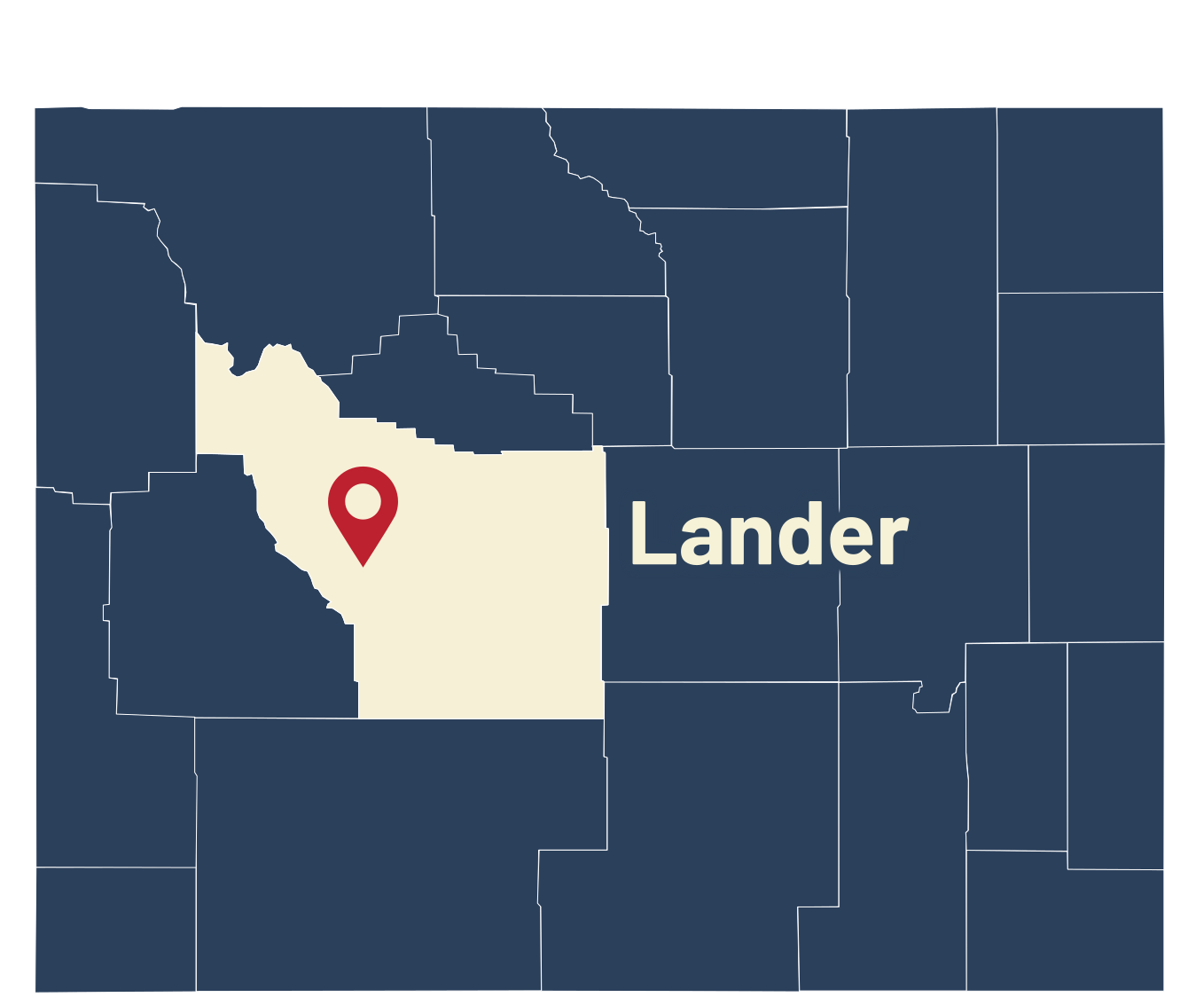
A Lander man is the champion of the Mammoth 200, an arduous race through central California’s mountainous terrain.
Gabe Joyes, a professional ultramarathoner, ran 220 miles in 51 hours, 35 minutes, and 11 seconds to a first-place finish. It was his first 200-mile-plus race.
“I’m still processing the feeling,” Joyes told Cowboy State Daily. “I would say it felt very satisfying to have the sort of race performance I knew I could have, and it felt wonderful to be really supported by family, friends, and community members.”
As Joyes spoke, he was on the floor of Denver International Airport, feet propped up on a chair, waiting for a flight back to Wyoming. He said he was exhausted after running 220 miles and climbing 30,000 vertical feet.
“I got a few 5- to 15-minute naps during the run,” he said.
First For A Professional
Joyes’s life revolves around running. In addition to being a paid, sponsored ultrarunner, he's a coach with Uphill Athlete, a company that trains people for high-intensity mountain sports.
The Mammoth 200 was Joyes’s first 200-mile trail race, making his first-place finish all the more satisfying.
“Two-hundred-mile trail races have become more popular over the last few years, and I have been genuinely intimidated by them,” he said. “I've actually coached quite a few people for 200-mile races before, but the fact that I hadn't had that experience always left me a little bit hesitant about the quality of my coaching.
Joyes said he was looking for “the right course and place” for his first 200-mile race. He found it in the Mammoth 200.
Started in 2025 by professional athlete Tim Tollefson, the Mammoth 200 is a loop in the eastern Sierras. Competitors run up and down the mountains, climbing from 6,500 to 11,000 feet, through forests and fields.
“It caught my eye right away,” Joyes said. “It looked like an amazing opportunity to try to run that far through that scenery. I was really motivated by the scenery and community.
Joyes was one of 215 participants He set off on Oct. 2, determined to do his best but not necessarily to finish first.
“I didn't approach the race with that in mind so much,” he said. “I'm an athlete and a competitor, and so I always want to go and have a good race result, but so my goal was more to finish the race in the best way possible, and to see where that put me in the mix.”
Keeping Pace
Jackson resident Josh Fuller knew Joyes would be modest about his results. A “good running buddy” of Joyes, he traveled to California to be one of his pacers for the Mammoth 200.
“A pacer’s job is to keep somebody company, keep their head in the game, keep them on course, keep talking to them, and just share the experience,” Fuller said. “I ran just about 70 miles with him, so about a third of the race, broken up into several sections.”
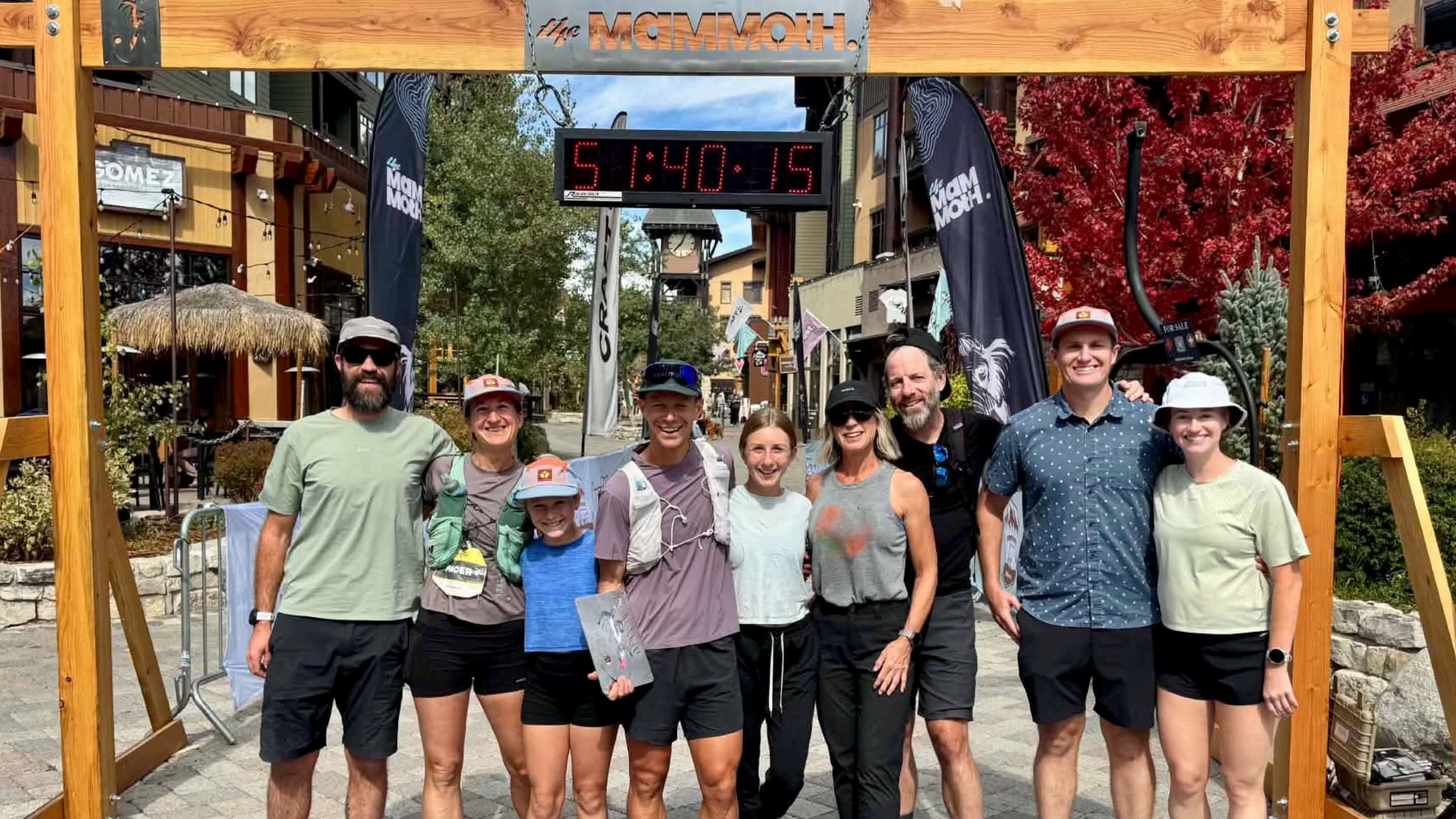
Joyes had a full support team assisting him. In addition to Fuller, Joyes’s wife and two daughters were there, along with a running couple from Hawaii and his personal coach.
“Gabe's a professional ultrarunner,” Fuller said. “This was work for him at the end of the day, but he was pretty clear that one of his main priorities for this race was that the crew and the pacers have fun.”
Though many people might see Joyes’ success as an individual achievement, both Fuller and Joyes described successful ultramarathons as “a team sport.”
“I had an amazing team helping me out,” Joyes said. “When I came into aid stations, they made sure that I was having enough fluids and electrolytes to keep my body working properly, and enough calories that were easy to digest and keep me energized.”
As Joyes ran through the mountains, his pacers kept him from getting lonely or going off track. When Fuller ran with Joyes, he did whatever was needed to keep his friend going.
“Trying to tackle one of these things alone is incredibly difficult from a logistics perspective,” Fuller said. “The emotional support and boost that you get when you're that deep, and being able to share the experience, is pretty powerful.”
One of Fuller’s tasks was keeping Joyes informed of his main “competitor.” Mika Thewes, the leader of the women’s race, was keeping up with the potential to overtake Joyes before the finish.
“This course had live tracking, so I was able to kind of keep track of her, and Gabe just kept putting in the work and grinding away,” he said.
Joyes kept himself going, but sometimes he “had to give (his) eyelids a bit of a break.” During the entire 51 hours, 35 minutes, and 11 seconds, he slept less than 15 minutes at a time.
“He lay down in total for 30 or 45 minutes, maybe,” he said. “I don't know if it even counted as sleep, but they came in 10- or 15-minute chunks.”
That’s what Fuller’s come to expect from his friend.
“Textbook race from Gabe,” he said.
Finished
Joyes finished at 1:35 p.m. Sunday. His wife, acting as his final pacer, crossed the finish line with him.
“There was a lot of relief to be done,” he said. “I love running, and I enjoyed the experience, but I was really happy to stop moving.”
Thewes finished second in 54 hours, 3 minutes, and 46 seconds.
The first-place finish got Joyes a $5,000 cash prize, but the real reward, he said, was celebrating with his support team – and getting a good meal.
“I ate a burger within 20 minutes of finishing,” he said. “I had a proper sit-down and spent a bit more time with my support crew. A literal and figurative change of pace was what I needed in that moment.”
Joyes heaped many praises on his support team, crediting them with his success as much as his determination.
“It may look like an individual sport, but it sure feels like a team sport when you have a support crew like that that plays such a pivotal role,” he said. “Their companionship and camaraderie really make the event so fun.”
What It Takes
Joyes also was eager to get home to recover and process everything that happened over the last week.
“I told myself that I'd give myself at least the rest of this week to think before I make any decisions or announcements about what’s next,” he said. “I need to soak this in a little bit and recover a little bit, at least, before I make any big decisions.”
Joyes believes he had an advantage in the Sierras because they reminded him of home. The terrain was similar to areas where he had been training in central Wyoming.
“The South Pass area reminded me a lot of the Mammoth Lakes area in terms of altitude, geography, landscape, and climate,” he said. “I purposely spent lots of time in the South Pass area, running lots and lots of miles and mimicking what I'd be experiencing at the Mammoth, so that way I was ready for what I encountered there.”
Training for an ultramarathon can be arduous, let alone a 200-mile continuous race through the complex terrain of the Sierras.
Fuller has been running for 20 years, with multiple 100-mile finishes and his first 200-mile race scheduled for next May. Even his pacing runs with Joyes made the Mammoth 200 a unique challenge.
“Just finishing these races takes a huge combination of talent and self-discipline,” he said. “This was my first experience at the multi-day distance, and it's a whole different ball game. The longer it goes, the more the brain and mental fortitude aspect comes to mind.”
For Joyes, the Mammoth 200 was also unlike any other experience in his long career, but he already knew that succeeding is as much mental as physical.
“For approaching an event this large, your motivation and your intentions need to be right,” he said. “This was an experiment in excessive running. I enjoyed the training process, and I enjoyed most of the race, but if this isn't something you truly love or are into, I just don't see how it could be done. You have to approach these things from a place of passion and joy.”
Wyoming Represent
Joyes didn’t just win the Mammoth 200. He won one of the world’s most visible 200-mile races as a Wyomingite.
The Mammoth 200 is unique in how it promotes itself. In addition to constant social media updates, it incorporates lots of technology to immerse viewers in the race.
“There were lots and lots of eyeballs on the Mammoth 200,” Fuller said. “This race was live-streamed by a company called Mountain Outpost, and they had live commentators, drone pilots, and a whole team covering the race in real time.”
People around the world watched Joyes cross the finish line Sunday. It’s a different way for people to appreciate the Herculean effort he and the other runners underwent.
Now that Joyes has finished his first 200-mile race, he’s not ready to commit to another one.
Not yet, anyway.
“Sometimes knowing is scarier than the mystery,” he said. “I certainly have the belief that I can do it, but I also know how kind of absurdly challenging it is. I would have to be really committed before setting up for another one in the future.”
One of Joyes' greatest rewards wasn’t just the validation of his training, but the validation of the training he’d given others preparing for 200-mile races.
“I often get just as much excitement for helping out other people as I do from my own races,” he said. “It's nice to know that I do understand the event properly now, and I can happily help people chase those big goals.”
Andrew Rossi can be reached at arossi@cowboystatedaily.com.


