

Authorities are warning of a growing danger from violent online criminal “gore” groups targeting kids and teens in Wyoming.
The international groups are run by predators who seek out vulnerable children on popular gaming and social media platforms, befriend them, and then pressure them into escalating acts of sexual and violent behavior both on and offline.
Those can include everything from sharing nude photos and sexual content to harming family pets and other animals, cutting themselves, and even livestreaming their own suicides.
They’re called “764” groups, named after a particularly notorious organization founded by a 15-year-old Texas teen during the pandemic, with the stated goal of tearing society down.
The FBI warns it’s a rising trend and has sent out multiple alerts to its field offices — including Wyoming and Colorado — as it attempts to get ahead the threat even as cases jumped from 250 in 2025 to 500 so far this year.
It’s difficult to gauge the extent to which these crimes may be happening in Wyoming because the numbers don’t necessarily tell the whole story, authorities say.
Some may be unreported or unknowingly linked to other cases already under investigation.
The FBI confirmed to Cowboy State Daily that it has investigations underway tied to Wyoming, though the federal agency declined to comment on the number or the nature of those investigations, citing its policy not to comment on open cases.
The Wyoming Division of Criminal Investigation (DCI) likewise said it is reviewing at least one tip that may be connected to the 764 online groups but declined to comment further.
So far, there have been no arrests linked to these groups Wyoming, the FBI reported, but that in no way mitigates the emerging threat that the agency is urging parents and guardians to take seriously.

It’s Coming
Terri Markham, co-founder and executive director of the Sheridan-based anti-trafficking group Uprising, said the particularly dangerous methods employed by these online groups are a real threat to Wyoming kids.
Markham’s work has involved years of training caregivers, law enforcement, medical professionals, and young people to identify and counter predatory behavior online — experience that makes her especially worried about what’s happening now.
“If it’s not here yet, it’s coming,” Markham said, “and we need to get in front of it.”
The group’s ideology is especially concerning, she said, and so is its timing — coming at a moment when AI is advancingrapidly, and children are getting online earlier than ever.
Some of those kids have unlimited and unsupervised access without fully understanding what they’re up against.
“These groups know what they’re doing and are very good at targeting victims,” she said.
They even have their own handbook on how to groom and exploit victims.
Bullied Kid Turned Predator
The 764 network was started in 2021 by then-15-year-old Bradley Cadenhead, of Stephenville, Texas, who named the group after the first three digits of his town’s ZIP code.
Cadenhead had been bullied as a child and developed an appetite for online “gore” — videos showing people gravely injured or killed in car wrecks, accidents, or fights, along with animal abuse, killings, self-harm, and torture.
He set up a group on Discord, a free social media platform where users communicate through private chats, text messages and shared media.
Using the screen name “Felix,” he coerced children into performing sex acts on camera, then leveraged the videos to blackmail the kids into doing all kinds of disturbing things.
In some cases, he coerced victims into carving his initials and name into their skin — a practice known as “cut signs” — and urged them to hurt their pets and other animals on camera, along with other obscene acts.
He was arrested at age 17 and is serving an 80-year sentence in a Texas prison after pleading guilty to nine felonies for producing and distributing child sexual abuse material (CSAM), among other offenses, according to court records.
‘Modern-Day Terrorism’
Cadenhead’s arrest, along with those of other key figures tied to 764, dismantled the original group, said Ash Thorne.
But the name has stuck and is now used as shorthand for the offshoots and splinter groups that carry on its practices and ideology, all of which fall under the Nihilistic Violent Extremism (NVE) category.
Thorne is a supervisory special agent in the FBI’s Denver field overseeing of Domestic Terrorism and Weapons of Mass Destruction (WMD) programs in Wyoming and Colorado.
The FBI is extremely concerned about the steep increase in activity as well as the nature of these groups and the age of victims, Thorne said, with FBI Director Kash Patel declaring the threat “modern-day terrorism.”
“The thing about these networks is that it’s a very hybrid, decentralized threat, meaning that there isn’t really one specific target,” Thorne said.
“While a victim could be located in Wyoming, the actual predator could be located in Warsaw, Poland,” Thorne added. “They don’t actually know or really care.”
Some groups, like 764, also embrace satanist or neo-Nazi beliefs. All operate toward the same broad objective: to perpetuate violence and glorify it.
Their motivations vary, Thorne noted, and some groups also embrace satanist or neo-Nazi beliefs.
But all have the same goal: targeting young and vulnerable victims with the goal of perpetuating and glorifying violence for the sake of their own notoriety and fame.
The more brutal the act, the higher their standing.
Beyond producing and circulating CSAM and mutilating animals, affiliated members have urged others to kill themselves and hurt people while livestreaming the acts, and at least one school shooting has been traced to the group.
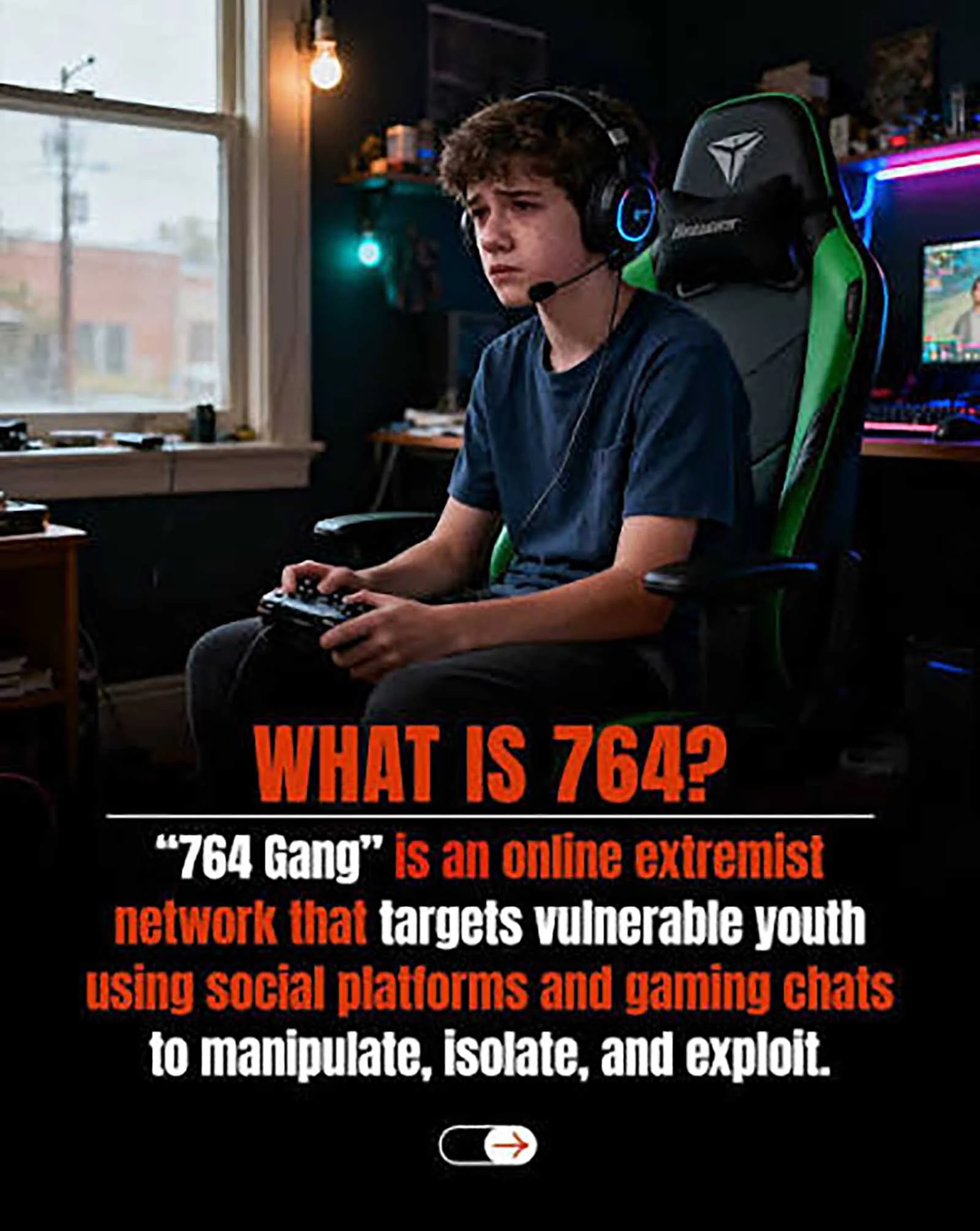
Grooming Into Violence
Their communication begins innocently enough, he said, with gang members reaching out to teens on popular social media platforms such as TikTok, Instagram, and Snapchat, and video game platforms like Roblox and Minecraft.
Once trust is established, the predators typically lure them into private chats under the guise of a romantic interest on in-game rewards through online platforms where the exchange becomes more personal and transactional.
Sometimes it’s one-on-one, Thorne said, and other times it’s a group ganging up on one victim.
Typically, intimate images and videos are exchanged, which are archived in “lorebooks”—digital troves held as collateral to threaten and control should a victim show hesitation or resistance.
The grooming process varies, Thorne explained.
It can be a slow erosion of boundaries over months, or a rapid acceleration over mere days.
Targets are systematically exposed to extreme content and coerced into participating, a strategy designed to dismantle their defenses through forced acclimation.
Anyone can be targeted, Thorne said, but typically it’s teen girls between the ages of 11 and 15.
They’re looking for vulnerabilities — a hunger to belong, a fragile self-image or eating disorders — which they exploit by pretending friendships or romantic interest as a way in.
The perpetrators keep them in line through a range of threats and intimidation, including releasing private details to the world, orchestrating “swatting” hoaxes that send armed police to a target’s home, or “bricking” that entails heaving a rock thrown through a window as proof the threat is local, personal, and real.
And worse, Thorne added, is that victims often end up becoming perpetrators themselves, which complicates prosecution.
“It’s dark stuff,” he said.
‘Perfect Storm’
Markham of Uprising pointed to a convergence of factors she termed a “perfect storm”: the rise of accessible AI tools, the relentless pursuit of the internet among youth, and the normalization of smartphones in the hands of increasingly younger children.
All of those amplify the threat posed by these digital predators, she said.
“What they're really doing is quite smart because every kid sort of has a goal and dream to become internet famous, whether that be to have a YouTube channel or be an influencer or vlogger or whatever,” she said.
They’re also validated by clicks and “likes” to the point where it can preclude their common sense and put them in danger.
In one instance, Markham recalled a case of an elementary-age boy in a local school district who had met with a bad actor online who prompted him to send nudes.
The images got flagged by law enforcement.
He became upset — not by the nude images being out there — but by the fact that his parents were planning to block his social media accounts because it would interfere with his goal of being a social media star.
“At this point in his little, underdeveloped brain, that’s what was most important to him,” she said.
Urge To Be Seen
Markham noted that for many young people, the digital world has become their primary reality.
It’s where they learn, whether it’s a new dance or how to put on eyeliner, and where they socialize, she said.
Platforms like TikTok don’t just encourage passive consumption; they create an intense desire to perform, to be noticed and talked about.
Increasingly, Markham said the goal isn’t just participation, it’s building a personal brand, turning online engagement into a full-time job and public identity.
“They don’t realize how rare it is that this actually happens,” she said.
She said that the effectiveness of these groups lies in their ability to exploit this mindset, enticing young people to record themselves doing hazardous or reckless things.
While it’s difficult to determine how many TikTok trends can be definitively traced back to such groups, the possibility has prompted her to reexamine earlier events, Markham added.
For instance, the widespread plumbing failure at a Wyoming high school two years ago, which rumors attributed to a TikTok challenge encouraging students to flush obstructive items.

Driven By Emotion
Manny Fardella, a school resource officer with the Cheyenne Police Department and president of the Wyoming School Resource Officers Association, said no 764-related incidents have been reported in his district or others so far to his knowledge.
He agrees with Markham’s assessment that teenagers’ deep reliance on their phones makes them vulnerable.
At Cheyenne South High School, where Fardella is stationed, phone use is restricted to before and after school, plus lunch, a policy increasingly adopted across Wyoming.
Fardella points to the still-developing prefrontal cortex in adolescent brains, which governs judgment and impulse control.
His chief worry is how readily teens engage online with strangers.
“This is their environment,” he said. “Their reality revolves around digital interaction.
“They’re driven by emotion and validation, so when they’re on social platforms, they chase that sense of connection and affirmation — often without knowing who’s on the other side.”
That openness, he added, mirrors the tactics of predatory groups operating online.
Even more concerning is how few boundaries many students maintain in digital spaces, navigating largely without safeguards, he said.
Parents First Line of Defense
This is where parents and guardians can make the biggest difference in keeping teens out of the reach of harmful NVE groups, Thorne said.
“The most dangerous thing we do is hand children unrestricted access to the internet without talking to them about it,” he said.
Friends and family are also critical in spotting early red flags, Thorne added, since abusers work to cut victims off from their support networks by posing as the only one who truly gets them.
That same language — “I’m the only one who cares” — is used to pressure teens into sending images and carrying out violent acts, a grooming process that builds over time.
“It’s horrifying, but parents have to know what normal looks like for their child in order to see when something’s off,” Thorne said.
Above all, he said, young people need to feel they can tell parents and other trusted adults about what happened without shame or fear of punishment.
That worry is shared by Markham, who asks how many children and vulnerable people have been exploited — or are being exploited now — because they were too afraid or embarrassed to speak up, or because they didn’t recognize what was being done to them.
Predators will always be out there, Markham said.
The answer is to teach young people to protect themselves by knowing their boundaries and listening to their own gut when something feels wrong.
Warning Signs
There are several warning signs parents should watch for, like abrupt changes in a young person’s behavior, especially withdrawal, moodiness, or irritability.
Teen victims also often show a clear shift in how they look, most commonly by letting hygiene and grooming slide, Thorne said.
Other signs include changes in eating or sleeping patterns, pulling away from friends and family, and quitting sports or other activities.
Teen victims may express a new, intense attachment to — or fear of — a new online “friend” or group.
In cases where teens are being romantically groomed, they might get packages delivered to the home, money, game currency, or other virtual items.
In terms of physical signs, be on the lookout for scarring on arms or other areas of the body, typically arranged in patterns, as well as recent cuts, scratches, bruises, bite marks, burns, or other injuries like words or symbols carved into the skin.
In some cases, victims will wear long sleeves and pants to hide the marks even in hot weather.
Other signs to look for include:
• Writing in blood or what looks like blood.
• Suicide threats and open talk of death, being unwanted, or not being around much longer.
• Expressing admiration for mass shootings or other mass casualty events.
• Family pets or other animals harmed or dying under suspicious circumstances.
• Pets that suddenly avoid or seem afraid of a child.
• Law enforcement showing up at the home based on a false report (swatting or doxxing) by an unknown person.
The FBI also encourages anyone who has been contacted by someone who may be affiliated with these groups or who has received images or videos with violent content to report it.
Tips and content can be shared online at the FBI’s Internet Crime Complaint Center or by contacting the FBI field office.
Anonymous tips can be reported online to DCI as well as local police and sheriff’s offices and school resource officers.
Tips can also be reported to the National Center for Missing and Exploited Children, which also provides a free service, Take It Down, which helps minor victims, even if they are now adults, remove or stop the online sharing of nude, or sexually explicit online content.
Jen Kocher can be reached at jen@cowboystatedaily.com.


