
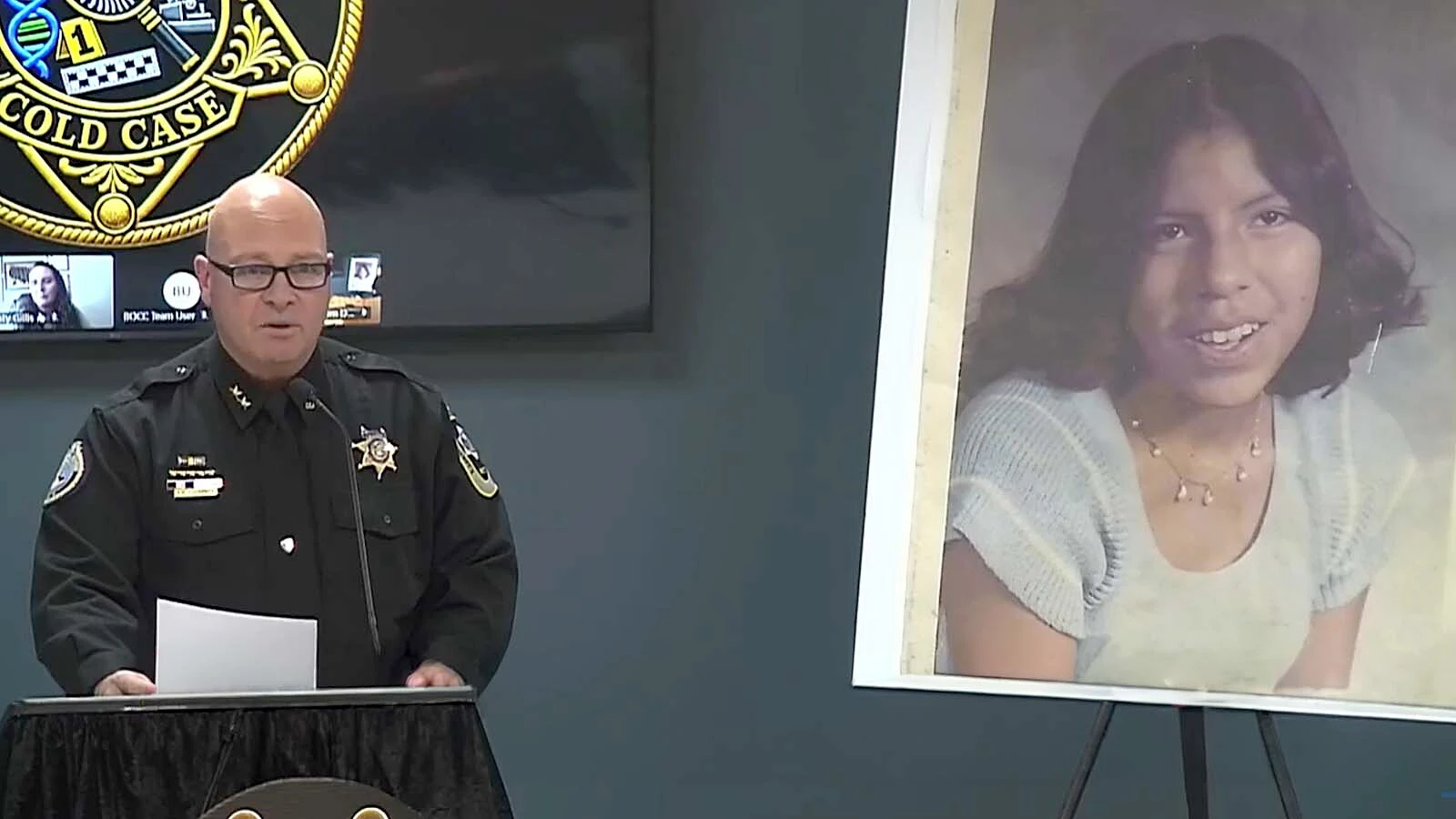
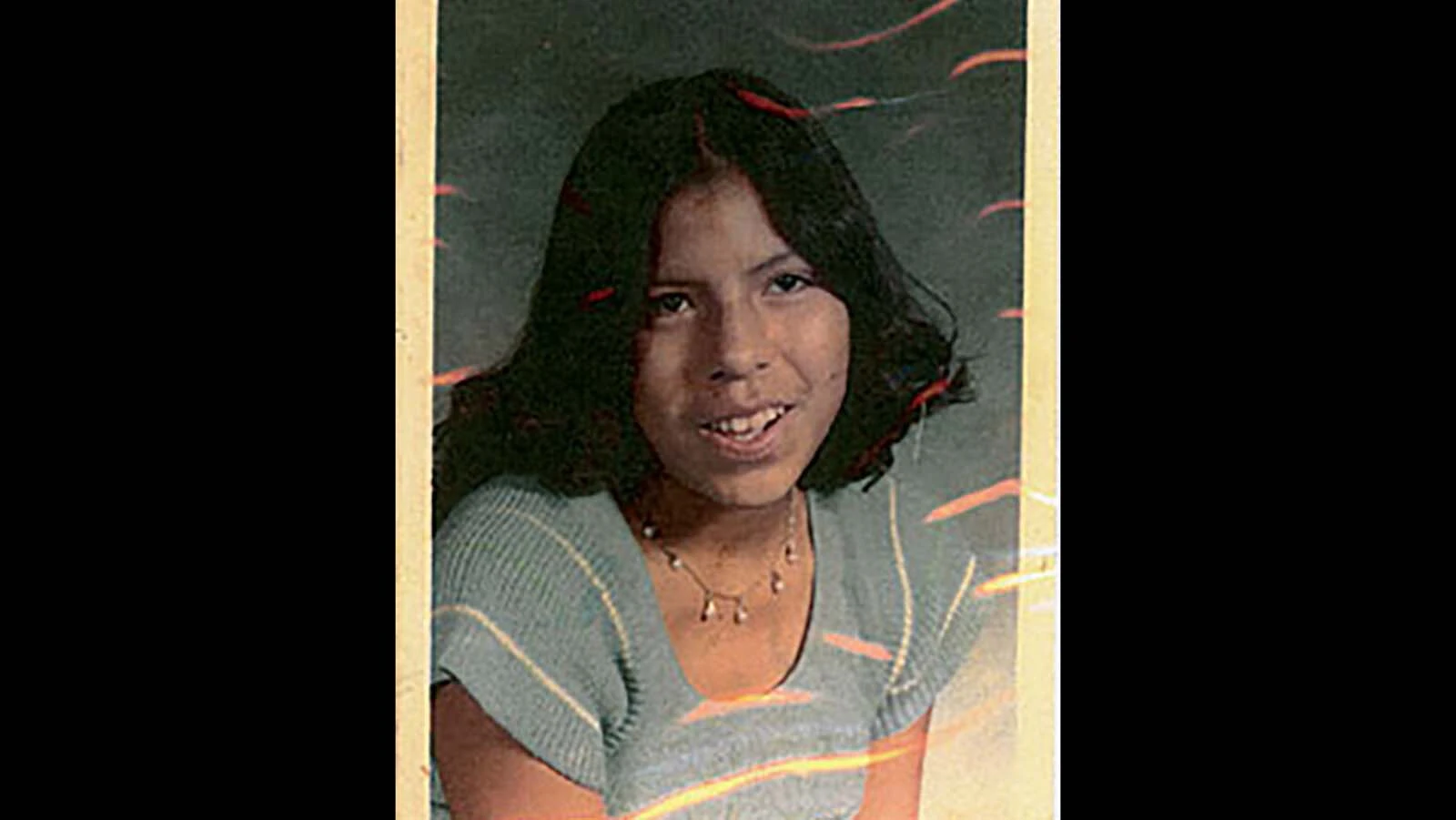
It was three days before Christmas in 1978 when 16-year-old Corina Contreraz’s body was discovered by a school bus driver 11 miles outside Billings, Montana, off Interstate 90.
She had been sexually assaulted and stabbed 18 times.
For nearly five decades, her family lived without answers.
Who had done this? And why?
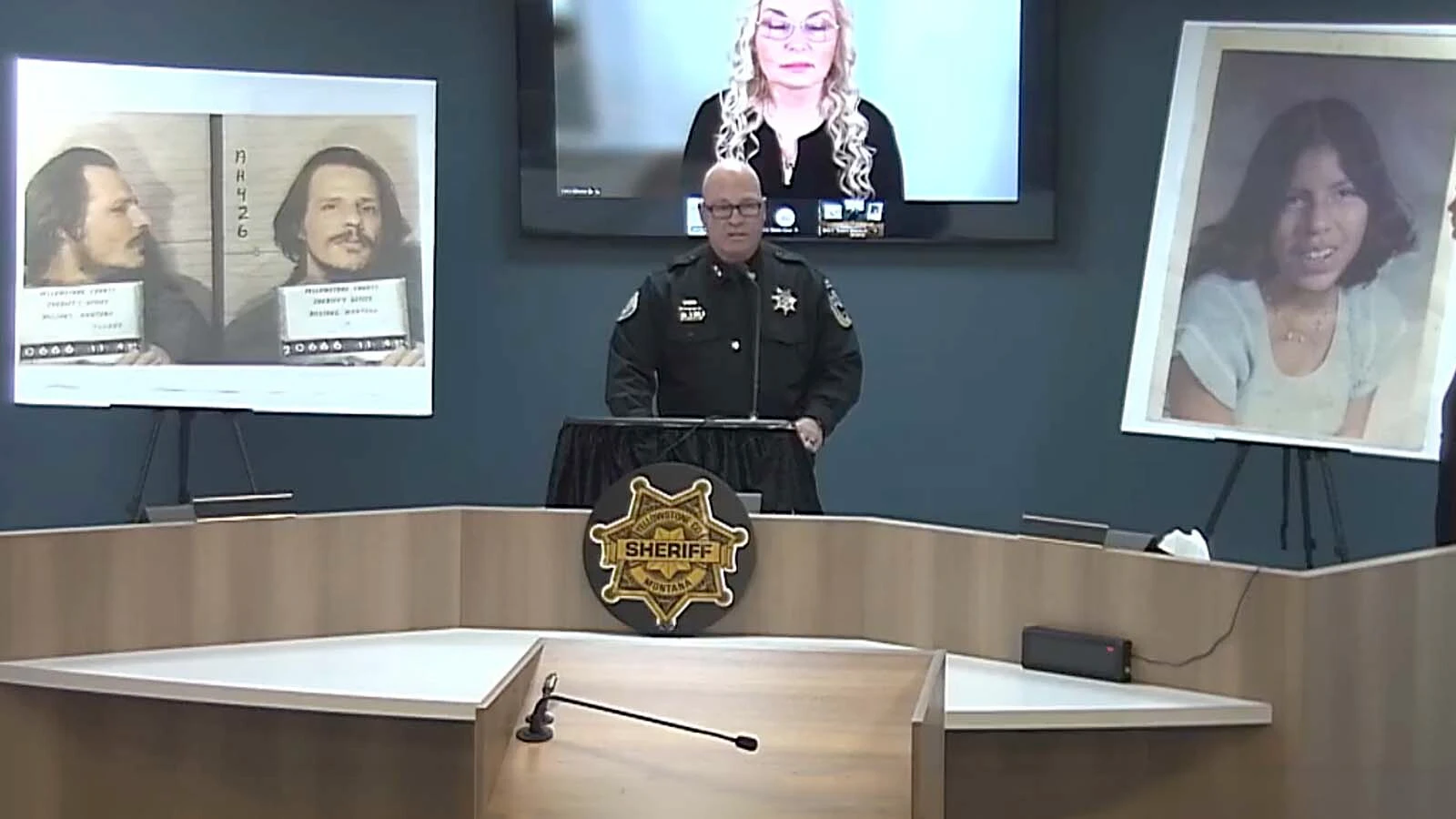
Now, after all that time, a cold case unit’s persistence and a DNA scientist’s breakthrough — extracting genetic material from an old booking card’s fingerprint — finally gave them a name.
The killer was Angelo James Stallsmith Sr., who died in 1990 in a Billings hospital.
His name meant nothing to Dotty Ramirez, who is Contreraz’s second cousin.
Like law enforcement, she believes it was a random murder by a stranger — a case of being in the wrong place at the wrong time. While knowing his identity doesn’t lessen her loss, it does close a painful chapter.
Now, in her 60s and living in Ohio, Ramirez flew out to Montana last month to attend the press conference held by the Yellowstone County Sheriff’s Office announcing the case was officially closed 47 years later.
Ramirez was still emotional when she discussed what it meant for her and her family to finally put that part of the mystery to rest.
“Her spirit is finally free, and we can breathe again,” she told Cowboy State Daily.
End of a Chapter
Over the years, her cousin’s spirit has remained with her, Ramirez said. Bits of memories come and go.
Sometimes, she’ll see a cardinal while sitting in her back yard and think it’s Contreraz coming to tell her to cheer up.
“You know, just little things,” she said. “I never forgot. I never forgot her.”
The two had been close as girls, living just houses apart from one another on South 34th Street in south Billings. They were part of a large extended family, and Contreraz was one of eight kids. As girls they were always together.
Though earlier news reports described Contreraz as “quiet,” Ramirez instead remembers her as a “happy and bubbly” girl. She can’t recall what Contreraz hoped to do with her life or whether she had big dreams.
“We were so young at the time,” Ramirez said. “We were just being kids.”
The months leading up to her murder were tough for Contreraz, she said. In September, her mother died, then two months later, her 24-year-old half-sister was hit and killed by a teenage driver when crossing a street on a Saturday afternoon.
‘Creeped Out’
Ramirez had turned 15 the day her cousin was killed. The girls had spent the day with friends, and later that night, around 11 p.m. or midnight, Contreraz stopped by her house to ask her to walk over to her boyfriend’s house with her.
“I told her I couldn’t go,” Ramirez said. “My family is here for Christmas. I told her I’d go with her tomorrow.”
Her cousin was discovered the next morning. Ramirez says the guilt of not accompanying her that night has never left her — a ghost she’s carried for decades.
If she had gone, she might have ended up dead, too. That knowledge has been a quiet, private burden, one she seldom shared.
After the murder, the world tilted on its axis. Fear and confusion took root in the absence of answers. Life fractured into a before and after.
Nothing was ever the same.
Nobody had any idea who had killed her, and everyone was suspicious.
“I wondered if it was this or that person,” she said. “I was always scared. I couldn’t even look at their house or walk by it. I would just avoid it, because I was so creeped out.”
Her death cast a pall over the community, and after that, the Contreraz family split apart, Ramirez said. Her own family moved away a couple years later.
But still, she never forgot. Over the years, watching true crime documentaries, she’d think of her cousin. As DNA and other techniques like forensic genetic genealogy advanced she hoped that one day there might be closure.
She’d nearly given up hope until “the glorious day when Monty called” in August and gave her the good news. They’d ID’d the guy, he’d told her, and now they just needed to conclusively prove it.
Cracking Cases
Monty Wallis came of age in Billings during a grim era he still recalls, the murders of women like Contreraz casting a long shadow.
That darkness also included the murders of Ruth Lori Ballew, 21, found near the city dump in February 1977, and Marsha Helgeson, 21, stabbed to death in north Billings in September 1978.
Wallis believes he, or the radio or TV station he was with at the time, likely reported on those deaths.
Torn between broadcast news and law enforcement, Wallis chose both — joining the Yellowstone County Sheriff’s Office in 1993 as a reserve deputy in patrol and investigations.
The murders continued piling up, and in 2012, former Sheriff Mike Linder got tired of the dozen or so cold cases sitting on the shelf – including Contreraz – and tasked the now-retired Wallis with designing and implementing a cold-case unit.
Wallis assembled a team of 14 retired agents from the U.S. Attorney’s Office, local police, sheriff’s department, and even a former Secret Service agent, and the group got to work.
Nearly 15 years later, his voice still smooth as a DJ’s despite his 80 years, Wallis still heads up the group — volunteers working without pay on a $5,000 annual budget bolstered by community support. They continue to slowly chip away at their caseload while notching victories, aided by advances in DNA technology.
They typically work about three days a week, Wallis said, which amps up to full-time as they close in on a suspect.
“We don't get a paycheck for doing this, but what we do get is an immense amount of pride and satisfaction of being able to have access to these cases and work them and be able to bring them to a successful conclusion,” he said.
Along with the Contreraz murder, the cold-case unit helped the sheriff’s office solve two other major cases for the sheriff’s office: The 1973 murders of Cliff and Linda Bernhardt in their Billings home — a case cracked in March 2019 using forensic genetic genealogy, among the earliest such successes nationally — and the 1998 homicide of Miranda Fenner.
Good Shot At Solving
The Contreraz case was also considered highly solvable, Wallis said, due to the pristine nature of the evidence and semen sample, so the team began diving in around five years ago.
In 2002, that evidence was submitted to the Montana State Crime Lab, where technicians successfully generated a DNA profile. Despite this breakthrough, the profile yielded no matches in CODIS or any other law-enforcement database at the time.
Meanwhile, the team re-interviewed and cleared previous persons of interest, cross-referencing their DNA profiles against the evidence.
In 2023, encouraged by their success with forensic genetic genealogy in the Bernhardt murders, the cold-case unit contacted Parabon Nanolabs again to use the same technique, hoping to identify a viable suspect through familial DNA matching.
Parabon was successful in helping trace the suspect’s lineage, and for the first time, provided the investigators with a list of potential suspects.
Dozens of interviews later, in December 2024, investigators were able to narrow the suspect list to the two Stallsmith brothers within the potential suspect family, both of whom had ties to Billings during the time the murder occurred.
A DNA sample from the son of one brother cleared his father, narrowing the focus to Angelo Stallsmith. The problem was Stallsmith’s 1990 death left no direct source for a genetic comparison.
Enter Suzanna Ryan, formerly of Pure Gold Forensics but who now oversees her own lab, Borealis Forensics.
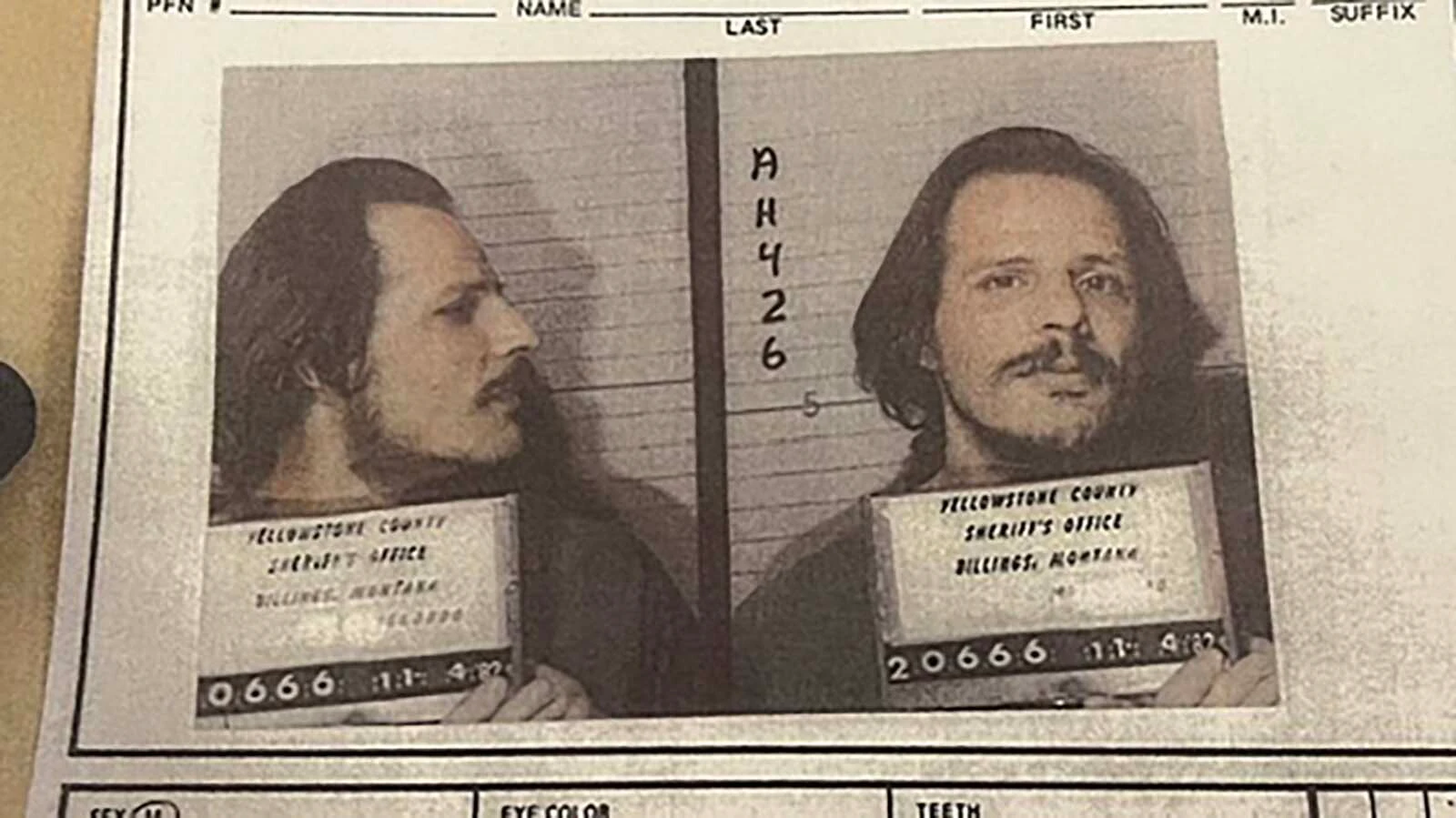
A novel use of DNA extraction from a 1982 booking fingerprint card on unrelated charges led investigators to Angelo James Stallsmith, a man with a long criminal history, who died in Billings in 1990. 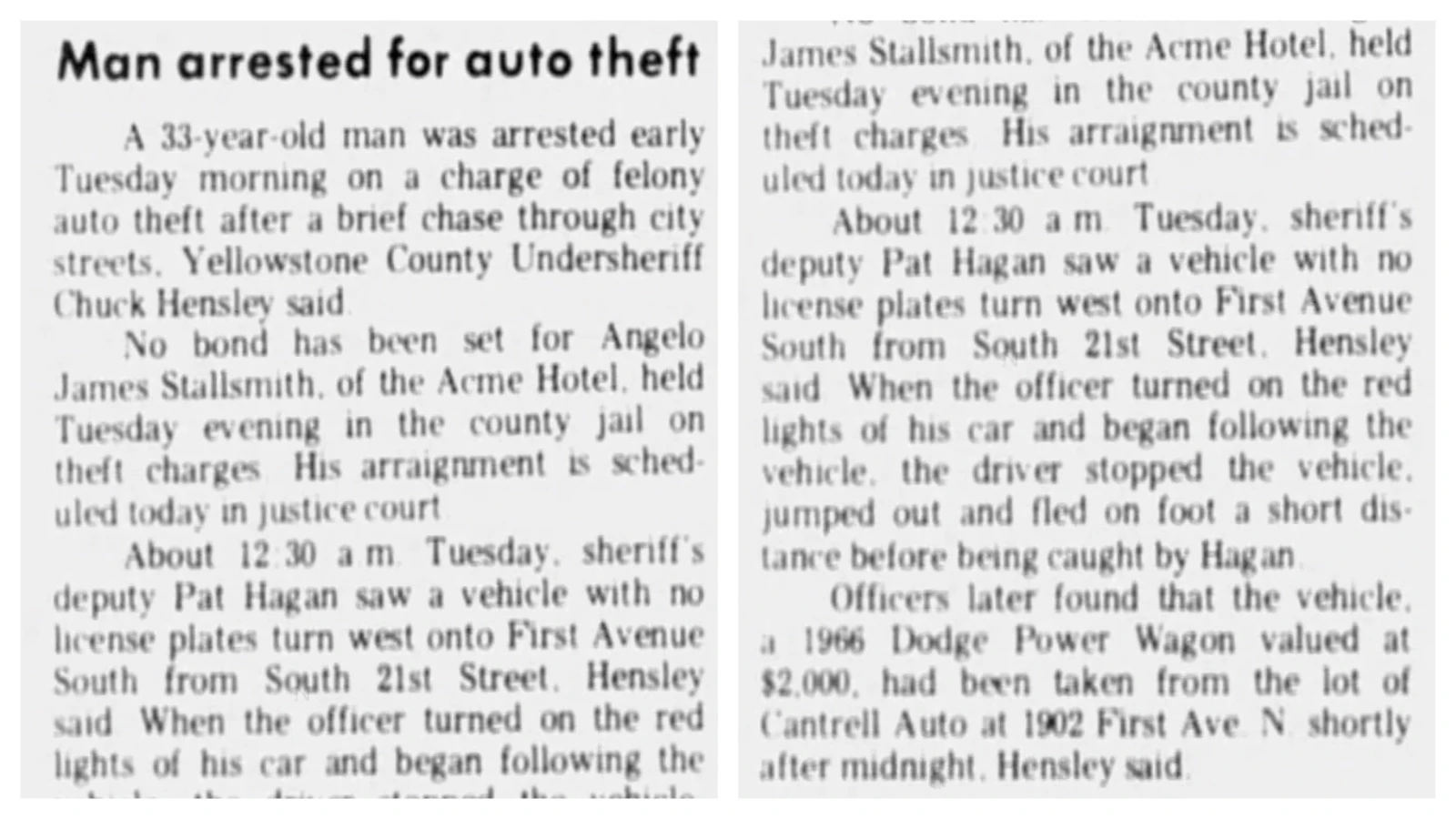
A novel use of DNA extraction from a 1982 booking fingerprint card on unrelated charges led investigators to Angelo James Stallsmith, a man with a long criminal history, who died in Billings in 1990.
Finding DNA From A Dead Man
Ryan loves a good mystery, she said, and this one presented a particularly stubborn set of obstacles.
How do you retrieve a viable DNA sample from a man who has been cremated?
Ryan gathered with Wallis and the team, turning over every possibility. Did the family keep any personal effects — hat, a pipe, an old shirt — anything that might yield a profile? Was there some archived tissue sample from a past medical exam?
Nothing. Nothing at all.
Then Ryan posed the question: Had Stallsmith ever been arrested?
Finally, a breakthrough.
It turned out that Stallsmith had a long and winding history with law enforcement, amassing 19 contacts across several states, including California, Oregon and Montana, between 1966 and 1989.
He also did time in San Quentin Prison in California, from which he escaped in 1972 only to be picked up days later in Salina, Kansas.
According to Wallis, most of his arrests were for robbery and auto theft, including an incident in 1982 where he led police on a high-speed pursuit through downtown Billings in a stolen car.
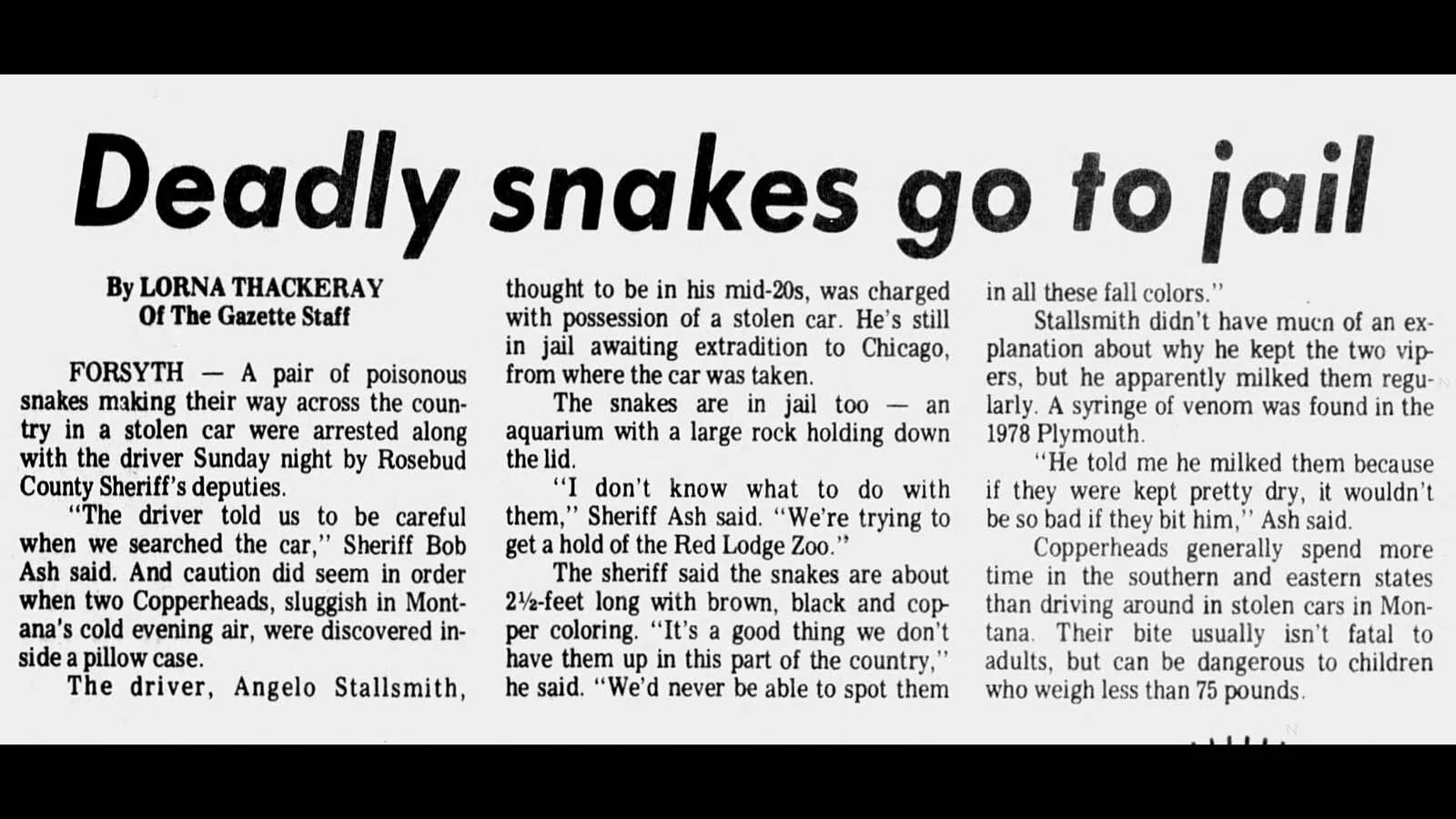
Just a month before that, he’d been pulled over outside of Forsyth behind the wheel of yet another stolen vehicle. Inside, officers discovered two copperhead snakes, sluggish from the cold, and hidden in a pillowcase, according to media reports from that time.
He couldn’t explain to the officers what he was doing with them other than to say he milked them regularly with a syringe of venom found in the 1978 Plymouth because if they were dry, it wouldn’t be so bad if they bit him.
Booking Card Breaks Open the Case
Given his multiple arrests, Ryan wondered if there were any old-school paper booking cards with his fingerprints.
“This was a long shot,” Wallis said, “and to the best of our knowledge there’s never been a case where a quality amount of DNA was obtained from a fingerprint card.
Wallis began making calls, starting with the Billings Police Department’s evidence division, which turned up a single booking card. Another call — this time to the state crime lab in Helena — produced four more.
“We sent those to Suzanna, and the rest is history,” Wallis said.
Ryan was less optimistic, but she did her research. Fresh latent prints came with up to a 90% success rate in pristine conditions; these were from 1982 and stored under who knows what conditions. She gave herself 25% odds, tops— but what was there to lose?
“I told them we’d try, but I wasn’t making any promises,” she told Cowboy State Daily.
She’d never tried this before, so she tried two methods. With a scalpel, she carefully sliced one thumbprint from its card, and then she swabbed the surface of multiple fingerprints using an organic, phenol-chloroform DNA extraction method.
The swabs yielded a usable profile from the mixed sample that she was then able to do a reverse comparison to match it back to the single-source unidentified DNA from the semen sample. All from a single card.
To her knowledge, no homicide had ever been closed using DNA lifted from a booking fingerprint card.
“We were pleasantly surprised,” Ryan said.
Finally Free
After 47 years of silence, Wallis was finally able to provide the family with a name. The investigation had turned up no other violent crimes attached to Stallsmith, no discernible link to Contreraz or the other murders from that era.
He was a ghost, unknown to the family, including Ramirez.
Yet, his identification — even posthumous — brought a palpable relief.
At the press conference, Ramirez was moved by the turnout. All the family and friends and detectives who’d carried the case for decades all gathered for the girl who never got a shot at life.
“Once it’s solved, everyone can take a small sigh, but the sadness is still there,” she said.
Contreraz is buried in the Holy Cross Cemetery in Billings. Ramirez would like to raise the money to give her cousin a proper headstone.
Right now, her grave is marked with a flat plaque that’s hard to see and typically hidden under grass.
“She deserves that,” Ramirez said.
She thinks her cousin knows that her murder has finally been solved and that allows her to finally be free.
“I wish I could tell her,” Ramirez said with a self-conscious laugh. “I wish I could speak to her one more time. But I know that she knows, and I know that she’s here and I know she’s happy.”
Contact Jen Kocher at jen@cowboystatedaily.com
Jen Kocher can be reached at jen@cowboystatedaily.com.


