
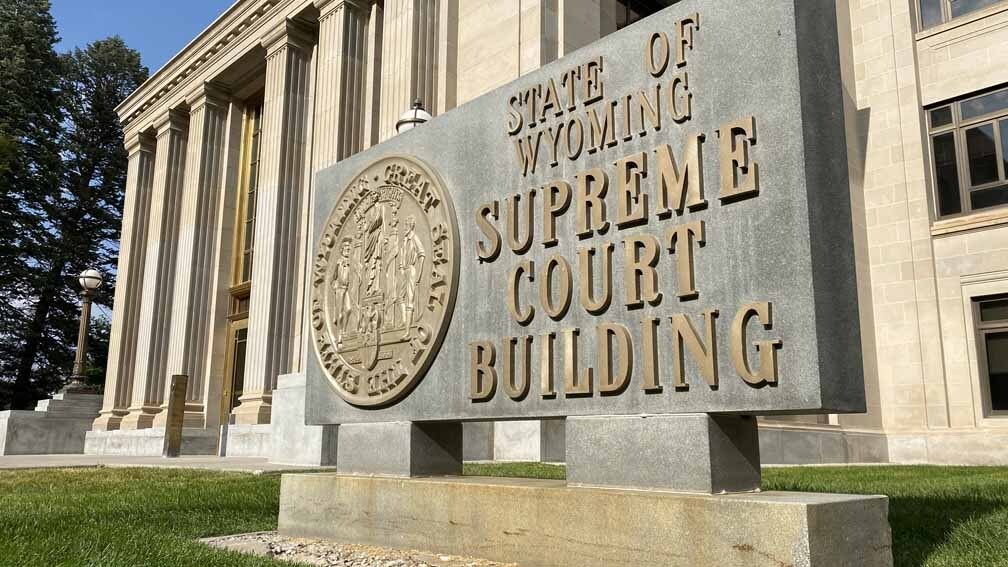
The Wyoming Supreme Court ruled Thursday that a law banning voters from switching parties once political candidates register to run for office is constitutional.
A group of Democrats, Republicans and voters who wanted to support some of those candidates in the primary election challenged the state’s crossover voting ban in court and lost. They argued the ban limits their access to candidates of their choice.
The plaintiffs also challenged Wyoming’s “sore-loser law,” which keeps primary election losers from running in the general election except as write-in candidates, and the closed primary system, which largely limits primary voting to people registered with major parties.
After the lower-court loss, the plaintiffs appealed only the ruling on the crossover voting ban, dropping the other two claims.
The Wyoming Supreme Court upheld the law in a unanimous opinion Thursday.
The law blocks voters from changing party affiliation once the candidate filing period opens. Voters must choose a major party before they know who is running if they want to vote in the primary.
Frustrated by what the court calls “party raiding,” or crossover voting, by people who are not Republicans, Wyoming’s Republican-supermajority Legislature passed the ban in 2023.
The year before, some Democratic voters organized to register as Republicans so they could vote for then-U.S. Rep. Liz Cheney over Harriet Hageman in the primary.
Hageman defeated Cheney and is now the Republican nominee for U.S. Senate.
“That deadline is a slight burden on the right to vote,” the opinion says. “It does not run afoul of Article 1, Section 3 (of the Wyoming Constitution).”
That section says equality in the enjoyment of natural and civil rights is made sure only through political equality, and that state laws affecting citizens’ political rights and privileges shall make no distinction based on “any circumstance or condition whatsoever other than individual incompetency, or unworthiness duly ascertained by a court of competent jurisdiction.”
In short, people have an equal right to access the ballot.
The opinion drew on the court’s earlier equal-protection case law. In 1992, the court said equal protection means treating similarly situated people equally.
Preventing a party change once candidates begin filing does not treat similarly situated people differently, the opinion says.
“Both groups have the opportunity to choose to affiliate with a political party,” it reads. “The fact that one group (unaffiliated voters) declines that opportunity does not create a separate class. There is no equal protection violation.”
The plaintiffs also challenged the ban under Article 1, Section 27 of the Wyoming Constitution.
That section promises “open, free and equal” elections and the “untrammeled exercise of the right of suffrage.”
The court drew in part on its Jan. 6 decision this year in State v. Johnson.
A four-justice majority in that case ruled that abortion is health care and that access to it is a fundamental right protected by strict scrutiny, the highest standard in constitutional review.
Justice Kari Gray dissented, pointing to constitutional language that lets the Legislature impose reasonable and necessary restrictions on abortion to protect health and general welfare.
That wording is not the same as the definition of strict scrutiny, Gray noted. Strict scrutiny asks whether a law serves a compelling government interest through narrowly tailored means.
That case surfaced briefly in the context of voting rights in Thursday’s opinion.
Voting rights are fundamental, the opinion says. But the state Constitution “separately charges the Legislature with securing the purity of elections.”
Therefore, the court said, “strict scrutiny does not automatically apply.”
Strict scrutiny would apply if the law imposed severe burdens on voting rights, the court added. It ruled that the crossover voting ban does not.
The court addressed the tension: Voting rights are fundamental, but courts cannot so tightly limit the Legislature that lawmakers cannot meet their constitutional duty to keep elections pure.
“The application of strict scrutiny to every election law would ‘paralyze the Legislature’s ability to perform its separate constitutional duty to administer elections,’” the ruling says.
In other words, if the court applied its highest test to every election law, the Legislature could not regulate elections.
After the law passed, Secretary of State Chuck Gray published an agency rule to close what some people called a loophole: he told county clerks to let people who weren't registered to vote to do so. That narrowed the ban to a ban on switching parties, not registering to vote altogether.
The high court's opinion references disputes about whether Gray's rule is legal, but since plaintiffs didn't raise those disputes to the high court, the opinion doesn't rule on that.
Secretary Gray Applauds
Secretary of State Chuck Gray dispatched a statement Thursday saying he applauds the ruling.
“Today’s Supreme Court ruling is a huge win for Wyoming elections, which we have consistently worked to defend,” Gray said. “This is a huge win. Banning crossover schemes and protecting Wyoming’s primaries have been cornerstones of our administration’s election integrity agenda since I took my oath of office in 2023. With this ruling from the Wyoming Supreme Court, the courts have time and again affirmed our work and our position. These common-sense laws are constitutional, and pivotal to ensuring election integrity in Wyoming.”
One of the plaintiffs' attorneys Bill Schwartz voiced disappointment in an email to Cowboy State Daily.
"We are of course disappointed the Court declined to give fundamental voting rights the preeminent weight we believe our founders intended," said Schwartz. "That said, we read the decision as the Court’s considered view under our system of checks and balances that the judiciary should defer to the legislature’s authority to regulate elections."
Leading up to this ruling, Schwartz has been outspoken on the need for upholding the judicial branch's role in the nation's governance, and has decried calls to move toward electing judges among other changes.
"We take some solace the Court rejected Secretary Gray’s radical notion that our state constitution provides no protection for the fundamental right to vote in state funded primaries," he wrote.
That reference points back to one of the state's arguments, that under the state Constitution, primary elections are not "elections" since those didn't exist in 1898 when the document was ratified. Primary elections are integral enough in the voter's choice, the high court countered, that they are true elections.
"Moving forward, our clients hope Wyoming voters will join them in their demand that our newly elected representatives reform the unnecessarily restrictive election laws implemented in recent years by the right wing of the Republican party—starting with abolishing the 97-day freeze period.," said Schwartz. The freeze period is what Schwartz calls the crossover voting ban, since it freezes voters out of changing parties from about mid-May to mid-August of each election year.
"Whatever the Legislature’s constitutional authority, we should insist that it never pass laws eroding our fundamental rights to participate fully and meaningfully in every part of the democratic process—including the right to make well informed party affiliation decisions after candidates are known and their positions are fully aired," said Schwartz.
Update: this story has been updated to include quotes from Secretary of State Chuck Gray and plaintiffs' attorney Bill Schwartz.
Clair McFarland can be reached at clair@cowboystatedaily.com.


