
A proposed bill that would require Wyoming governmental agencies to involve humans when letting artificial intelligence make consequential decisions fizzled Tuesday at a legislative meeting in Laramie.
Its prospects are now unclear. The Select Committee on Blockchain, Financial Technology and Digital Innovation Technology that considered it meets again Nov. 19, but some committee members criticized the bill as potentially unnecessary.
If it became law, the bill would require Wyoming governmental agencies at every level, from state to special district, to incorporate meaningful human oversight when using AI for key decisions on people’s lawful rights, benefits or obligations.
It would also impose a data-keeping requirement, making agencies keep records denoting which human performed the meaningful review.
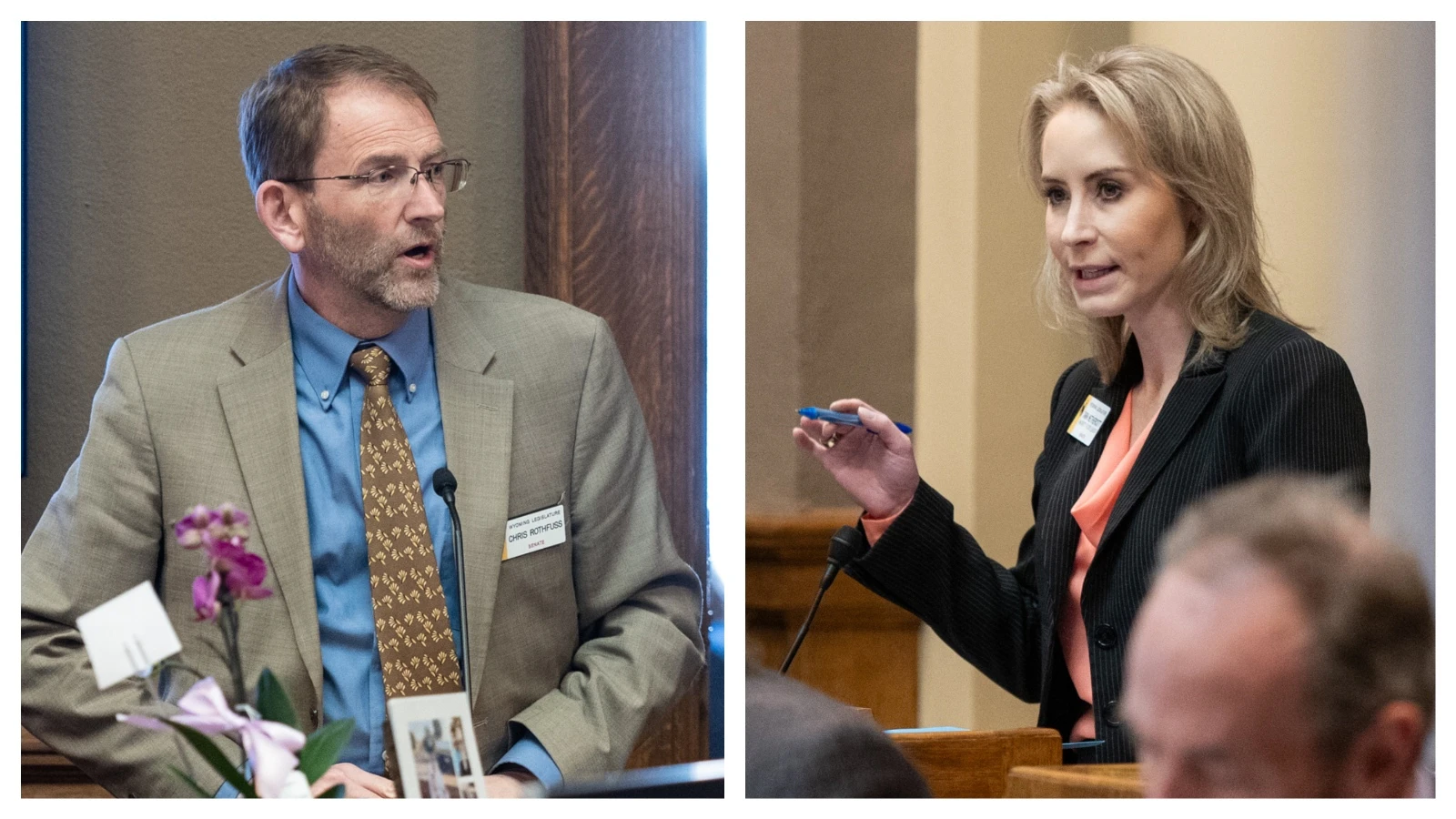
Sen. Chris Rothfuss, D-Laramie, advocated for the bill. He said rogue AI bots are no longer a futuristic concept; Wyomingites are skeptical of AI and this is one way the government can bridge trust with its people while preventing harm.
“How can we provide the public with comfort that utilizing AI in the government is going to be helpful to them?” asked Rothfuss. “I don’t know about everyone else, but when I talk to folks just out in the public right now, they’re not enthusiastic about AI.
“They’re expecting the robot overlords to come and get us. That’s pretty common right now.”
Don't Let It Take Over
Rothfuss framed the bill as a preventative measure that would preserve the government’s ability to benefit from some of AI’s positive aspects and still use it, amid growing public skepticism.
Critics, including former lawmaker Tyler Lindholm, pointed to regulatory burdens and broad definitions within the bill.
“Real unintended consequences … come with this legislation,” said Lindholm, who approached the committee during public comment.
Lindholm said his wife is a nurse practitioner working out of a rural Moorcroft clinic. She uses an AI device to review data from patient visits, and she reviews AI’s recommendations as the bill would require, said Lindholm.
But because she serves a public medical district she’d be a “mandatory reporter” under the bill’s data-keeping requirements, he added.
On the other hand, said Lindholm, AI stands to make government more efficient and effective for the people it serves. He said he’s excited about it, and it “is and can be as transformative as electricity for humankind.”
Sen. Tara Nethercott, R-Cheyenne, said she shares Lindholm’s concerns with the proposed law.
Rothfuss sparred with Lindholm.
He conceded that the bill’s definition of “consequential decision” is broad, but questioned how the medical decisions Lindholm’s wife makes could fall under those more government-oriented decisions.
Lindholm said people’s health benefits may intersect with the medical data gleaned about them.
Rothfuss said the legislation isn’t meant to target Lindholm’s wife, and lawmakers could still refine the bill to match its actual intent. But he advocated vocally for its overall mission.
“Do you really believe the general public wants government decisions made by artificial intelligence?” asked Rothfuss.
Lindholm said people want their government to be responsive, effective, and reactive.
People might be excited about that when the decisions break in their favor, said Rothfuss.
“But I guess I’ve never met a Wyomingite that would be comfortable with the idea that artificial intelligence made a negative-consequence decision for them, and there was no human in the loop,” he said. "I haven’t met that Wyomingite yet.”
Lindholm said he’s that Wyomingite.
Rothfuss challenged that, pointing to food freedom, a concept for which Lindholm lobbies ardently. He asked what Lindholm would think if the U.S. Department of Agriculture offloaded its statute interpretation about who can sell raw milk to an AI, and the AI told people they couldn’t sell raw milk “that just came directly from a cow they had out back.”
Lindholm said the USDA and Wyoming Department of Agriculture do a poor job reading statutes as it is, and he’d welcome fresh interpretation.
Tether It
Eric Alston, assistant professor at the University of Wyoming College of Law, said he agrees fundamentally with the principles of keeping a “human in the loop.” He urged lawmakers to reference clearly whether the bill was meant to pertain to autonomous AI agents acting within government systems.
Alston also “strongly” suggested a clear, legal identifier to tie AI actions to an individual government official’s identity.
Nethercott said accountability already exists, and she finds it “unwise” to delineate between types of technologies government agencies, “or anybody," may be using to make decisions.
“It doesn’t matter: You will use that technology at your own risk, and it will not absolve the individual or the entity from accountability,” said Nethercott, adding that the state should lean on directors of agencies and other officials to be accountable for their departments’ actions.
Nethercott pressed Alston on whether humans retain responsibility even when AI systems are helping them make decisions.
Alston pivoted, circling back to his point that lawmakers should tether the bots to the people using them.
Two of the committee’s three non-legislator commissioners, Joel Revill and Matthew Kaufman, asked lawmakers to focus instead on addressing what happens if a person is wronged by AI.
Rothfuss called that the wrong approach. He said the bill is a preventative solution, so that people don’t have to challenge agencies or go to court to remedy AI-induced government wrongs.
He also countered Nethercott by noting that, unlike spreadsheets and calculators, AI bots have a known bias.
The Impossible Divide
Sen. Jared Olsen, R-Cheyenne, said Nethercott and Rothfuss were trying to speak across a perception divide.
Nethercott believes a human will always be at the end of every AI decision chain, whereas Rothfuss believes an AI might act truly on its own, Olsen said.
“So help me understand an example where a person would use a government service but there’d be no human behind it,” said Olsen.
Rothfuss said AI can be programmed to do “all the decision-making” in a given task set, such as detecting Medicaid fraud.
“With agentic AI – that’s the point of agentic AI – I don’t need the human,” said Rothfuss.
He cited cases out of Michigan and other states.
But at some level, Olsen said, “there’s probably going to be an elected official who’s accountable.”
“My response to that,” said Rothfuss, “is, I’m an elected official and I’ve heard from the public, and this is what I think they want.”
Rothfuss said he could tell the committee wasn’t excited about the bill, and he asked his colleagues to venture alternate policy means that could achieve the same objective.
The committee broke early for lunch and took no action on the bill.
Clair McFarland can be reached at clair@cowboystatedaily.com.


