
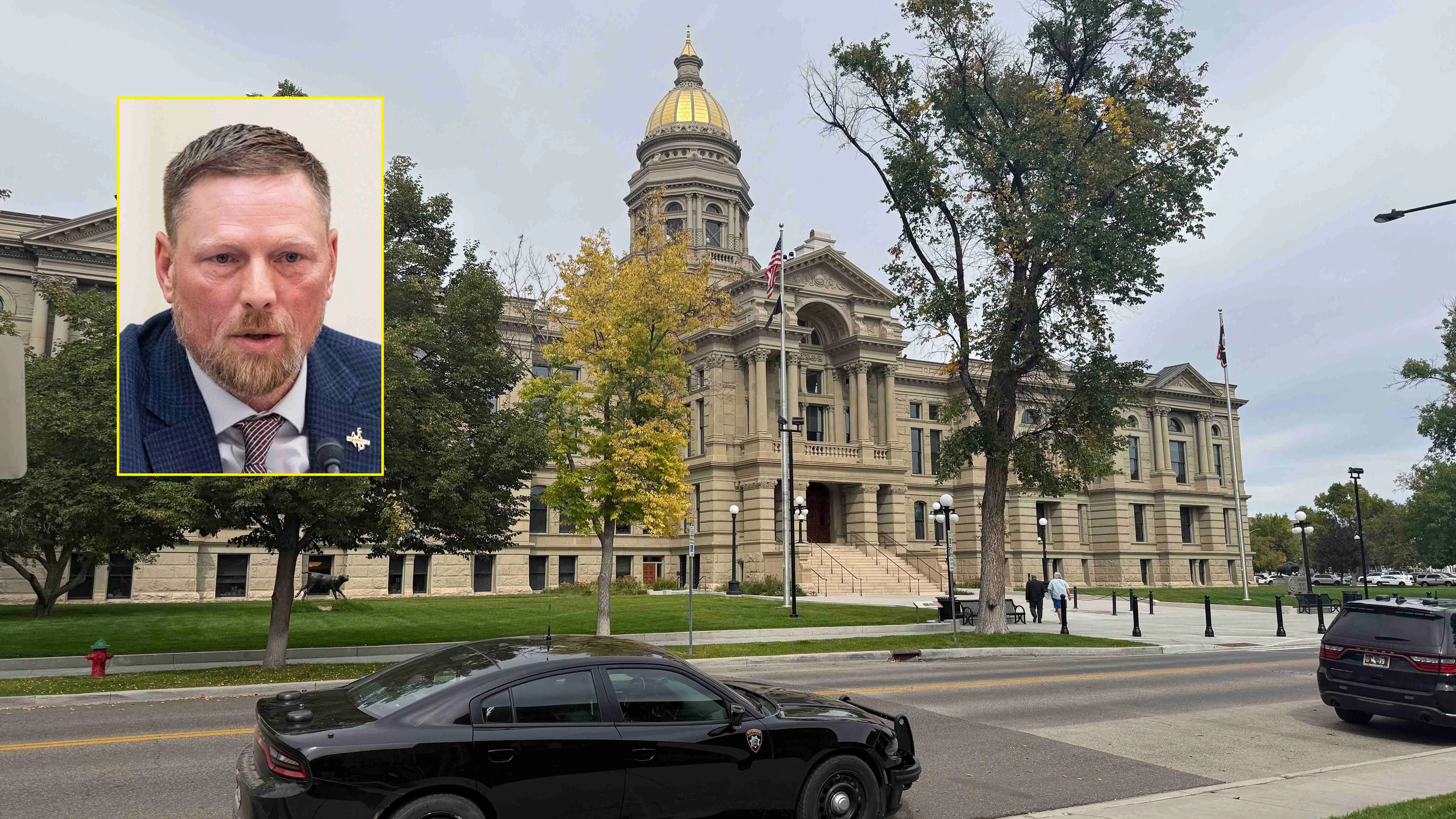
Electricity demands for large-scale industry projects have been dominating legislative meetings in recent weeks and stand to be a key issue going into the 2027 lawmaking session.
Three legislative committees have tackled this problem, each devoting hours to public comment.
The Joint Minerals, Business and Economic Development Committee narrowly killed a bill in August that would have let independent power suppliers sell electricity to any one customer using no less than 25 megawatts, or up to four customers using no less than 100 megawatts together.
That would introduce competition into the power-supply world, which now comprises tightly regulated monopolies.
On Tuesday, the Select Committee on Blockchain, Financial Technology and Digital Innovation Technology considered a more complex version of the bill – and heard nearly four hours of intense testimony.
The bill would give two options for independent power suppliers.
Under the first, they could sell “behind the meter,” or not using the grid, to any group of customers demanding no less than 10 megawatts. They’d have to establish contracts, and not offload costs onto the grid customers, the bill says.
For the second option, the power suppliers could pay a tariff to use a competitor’s transmission system and sell power through it, but only if the power company can’t promise to deliver a company’s needs itself within a year of the company’s request.
Opponents said letting big users unplug from the grid, or plug their own independent power suppliers into it, would have messy and likely negative consequences. Proponents said power companies are not keeping up with Wyoming's economic growth demands, which hinge on a huge power supply.
The data center company Prometheus Hyperscale spoke in favor of the bill. Companies and associations from the wind, oil and gas, trona and other blue-collar sectors lobbied hard for it as well.
Power utilities pushed, rather, for the chance to write their own version.
Either way, said Cheyenne-based Republican Rep. Lee Filer, some competitive change to the power supplier scene is coming – soon.
“It happens year after year. We hear about the same stories over and over again: ‘Well, they’re working on it,’” said Filer. “So, I think this is the year that we’re going to pass something.”
He added, “We’re better off working together and figuring that out without everybody writing their own bill – but at least working with the legislators to get the right bill passed through here to make sure everybody, especially the end users, are getting power.”
Filer’s determination comes as Republican voters largely routed Wyoming Freedom Caucus aligned legislators in the Aug. 18 primary election, but proponents of quicker economic development – such as Filer, Sen. Chris Rothfuss, D-Laramie, and Sen. Tara Nethercott, R-Cheyenne – remain.
At the end of the Blockchain committee’s discussion Tuesday, Rothfuss urged lawmakers and stakeholders to review the bill for potential improvements, and return to discuss it at the committee’s November meeting.
First Up, The Power Hungry
Members of the Minerals Committee and public speakers criticized Rocky Mountain Power, the local subsidiary of PacifiCorp, at length in an Aug. 27 meeting.
That criticism repeated Tuesday.
“The core issue,” said Thor Nelson, is that “it is becoming increasingly challenging in Wyoming to sustain energy intensive industry … to obtain the needed electricity, in particular from Rocky Mountain Power, and in particular in southwest Wyoming.”
Nelson, of the law firm Holland and Hart, spoke on behalf of Wyoming Industrial Energy Consumers, which represents large industries such as oil and gas, mining, manufacturing, chemical and cement companies.
The companies the association represents consume about half of the electricity sold by Rocky Mountain Power in Wyoming, Nelson said.
Carbon County Commission Chair Travis Moore echoed Nelson’s power concerns, saying his county needs more power to drive economic development.
“There are a lot of empty storefronts,” he said. “Any master electrician in Carbon County would tell you that the generator market for backup power is booming right now … I’m just gonna leave that out there.”
Moore said he has friends and neighbors who work for Rocky Mountain Power and doesn’t believe the “local folks” are the problem, but “shareholders outranking stakeholders.”
Nelson supplied a theory for the problem: The states on the eastern end of PacifiCorp’s territory, such as Wyoming, Idaho, and Utah, are feeding power to the western states such as Washington and Oregon – even as the western states choke off traditional power sources such as coal.
Oregon passed a law in 2016 saying it will wipe out coal-powered energy generation by 2030.
That means, said Nelson, PacifiCorp is going to launch a “very aggressive construction plan” to replace coal-fired generation serving Oregon with batteries and renewable energy, largely.
Nelson said that means PacifiCorp is planning programs to reduce consumption, not to build new generation, and not to boost substantial growth in Wyoming.
Rocky Mountain Power
Thom Carter, vice president of government affairs for Rocky Mountain Power, said the company agrees that Wyoming should compete aggressively for investment – but it’s already been involved in that.
RMP serves more than 145,000 customers in Wyoming and operates more than 3,200 miles of transmission facilities and 9,000 miles of distribution infrastructure in the state, Carter noted.
Since 2021, system reliability in Wyoming has improved by 26% and customer outages have decreased by an estimated 16 million minutes, he added.
Carter emphasized that Rocky Mountain Power has built its infrastructure, assumes the risk if certain projects don’t succeed and is responsible for protecting ratepayers when a large customer leaves the grid.
He warned against the “workaround strategies” that some lawmakers have been pushing.
“They create another path for obtaining power after infrastructure constraints have already emerged,” said Carter, meaning, the power utility is the one working to improve the grid, and the grid, not generation sources, is what’s lacking. “They do not address the underlying need for transmission, substations, distribution facilities, generation resources, and long-term reliability planning.”
Carter said RMP wants to help lawmakers to a solution, and doesn’t want to maintain the status quo.
He wasn’t alone in asking to lead the proposed law change.
Mike Nasi of Basin Electric Cooperative, Shawn Taylor of Wyoming Rural Electric Association, and Tom Lacock of Tri-State all said the Blockchain bill falls short of perfect and they want to help craft the solution.
That didn’t satisfy Filer.
“I’m gonna make this the easiest question,” he said. “You said that you guys cannot support this bill. But you haven’t given a reason why, except for the fact that you want to write your own. I’d like some reasons why this one doesn’t work, Mr. Lacock.”
Lacock said there are a few of those.
Taylor emphasized that co-ops are different from power utilities like Rocky Mountain Power.
The customers own the cooperatives, they’re not-for-profit entities, and rate changes generally go to the customers and through a board. Customers can appeal a rate change to the Wyoming Public Service Commission – which regulates the monopoly utilities – but Wyoming Rural Electric Association hasn’t had such an appeal in 20 years, said Taylor.
He rebutted language in the bill that he said would foist the cooperatives back under Public Service Commission oversight, despite their generally self-governing structure and success.
They’ve Made It A ‘Populist Chant’
Sen. Cale Case, R-Lander, has been working in the utility and power-grid policy area for three decades. The economics Ph.D. told Cowboy State Daily in a Wednesday phone interview that it is correct to call the wrestling match over power supply a dominant issue this interim, and a key issue going into January.
The Corporations, Elections & Political Subdivisions Committee that Case co-chairs is grappling with the same policy. It’s the only one of the three committees to which the Legislature’s leadership panel, the Management Council, directly assigned this topic.
Case questioned why the Blockchain and Minerals committees, which he said are more prone to industry advocacy, have taken on the topic also.
“It’s just not really that simple,” Case said. “I just think (proponents in the Legislature) have over simplified it and they’ve made it kind of a populist chant.”
He said the Legislature needs to find a solution, but said lawmakers haven’t produced one yet.
One underrated obstacle, said Case, is “sunk costs.”
That means, the power companies have already spent money building grid and transmission lines to existing consumers, such as big trona mines, and they now stand to lose justification for those investments if the trona patches or other industries can simply unplug.
But, saddled with the cost of those builds, the power companies might then have to offload their losses onto the grid’s remaining ratepayers, said Case.
He added that Wyoming’s grid has an immense ratio of industrial consumers: 56.8%, according to the U.S. Energy Information Administration.
Those industrial consumers might help rather than hurt residential and other small-scale ratepayers, said Case. But it depends on a variety of circumstances.
The Corporations Committee’s next meeting is set for Oct. 15 in Cheyenne.
Clair McFarland can be reached at clair@cowboystatedaily.com.


