
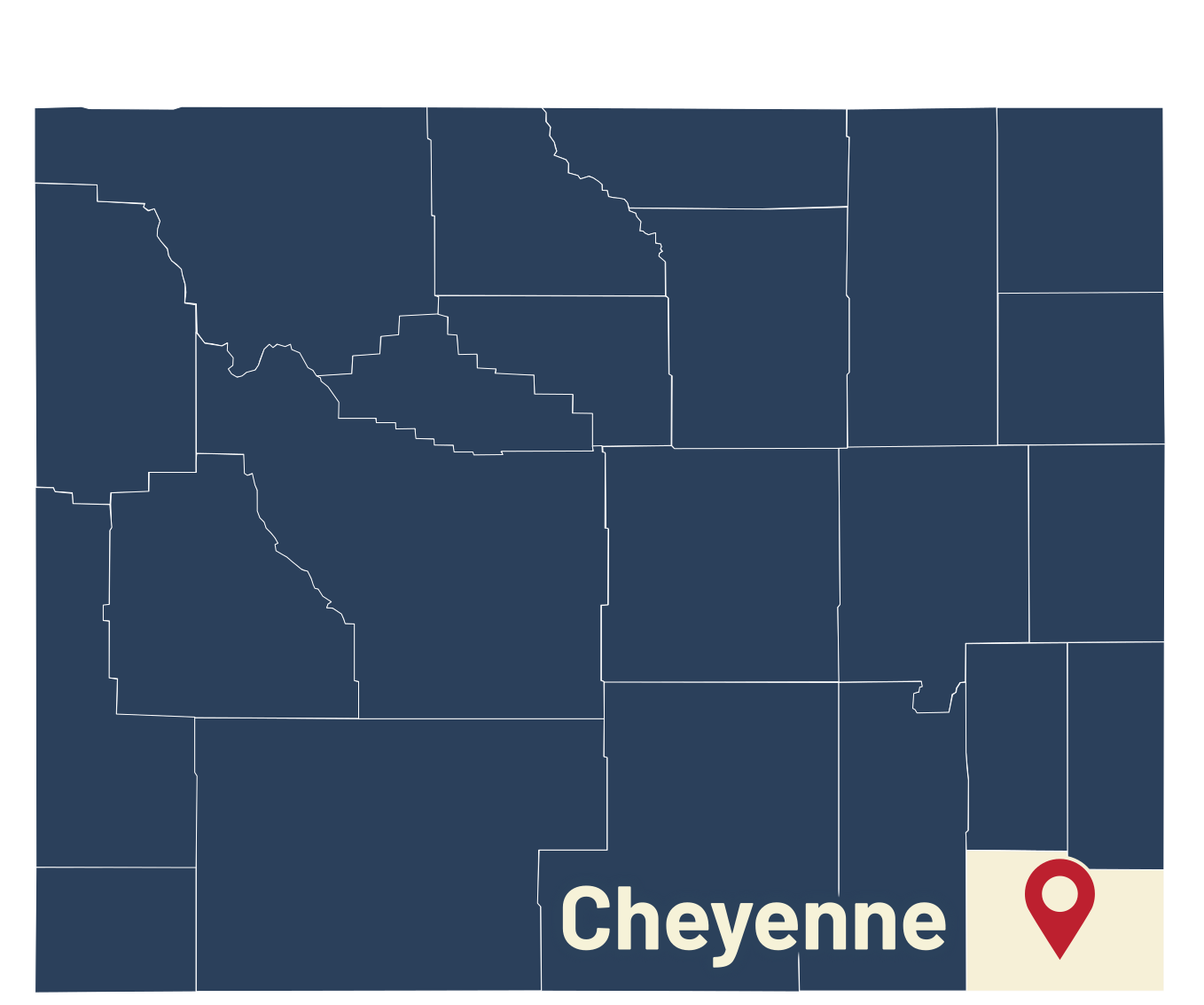
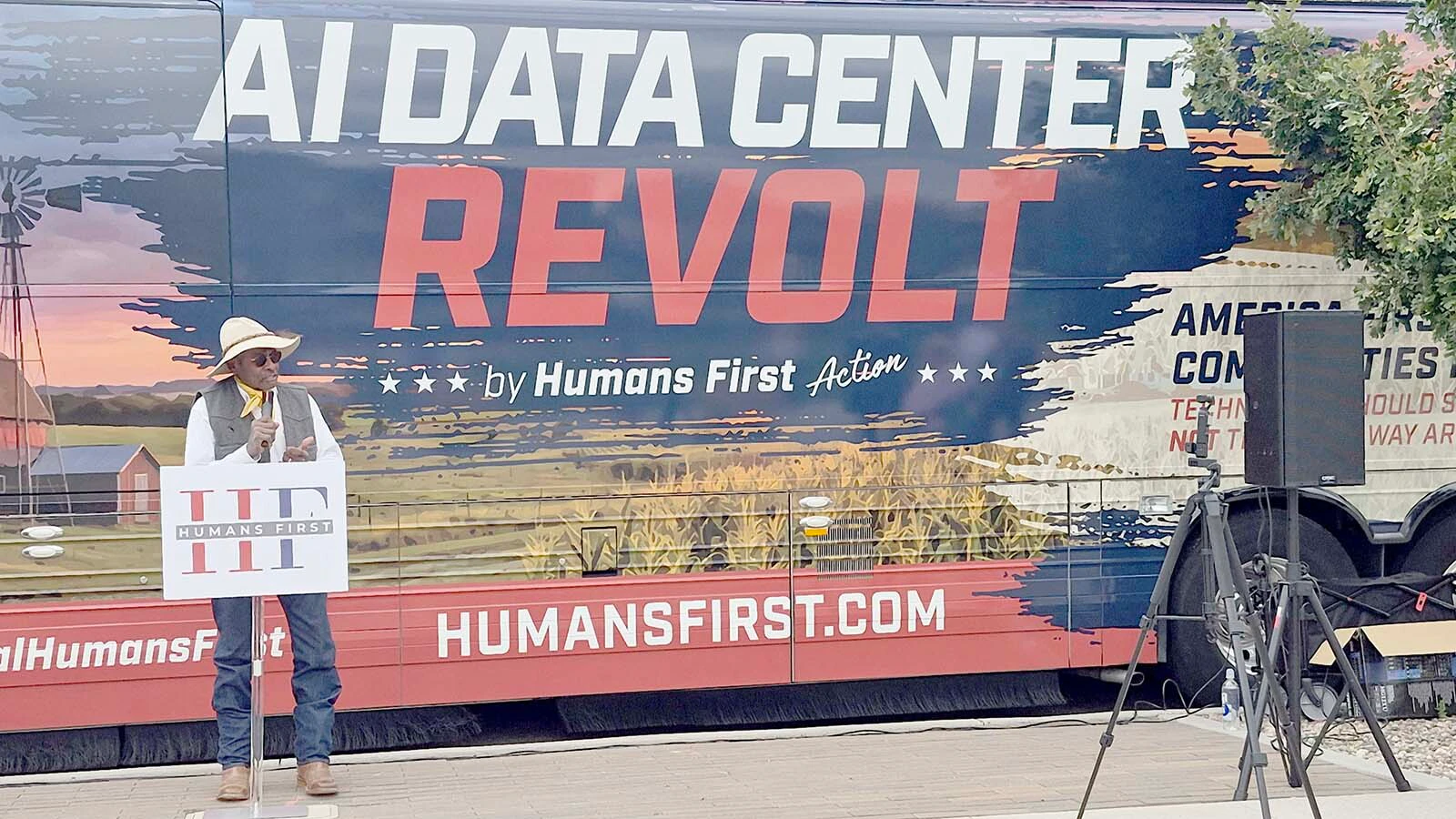
Humans First, a national grassroots group opposed to artificial intelligence, parked its rally bus in front of Cheyenne City Hall on Monday ahead of a council meeting where another annexation for a data center was approved.
The group brought its huge, colorful bus with “AI Data Center REVOLT” emblazoned on both sides.
“REVOLT” in all capital letters was in bright red.
The organization met about 30 Cheyenne residents, at least a few of whom seemed ready for revolution.
Several questioned why so many data centers want to be in Wyoming, a state that is experiencing a long-term drought.
A man shouted, “Because it’s cheap!” The line drew a few laughs and some nods.
Amy Kremer, Humans First chair, said the group is traveling about 8,000 miles on its 36-stop tour across 17 states.
The bus was in Laramie on Monday morning and made a special effort to be in Cheyenne to attend that evening’s City Council meeting, where a final vote was happening on a 1,260-acre annexation for a data center.
“Americans are not going to take these data centers being shoved down our throats,” Kremer said. “We’re going to fight.”
Why Cheyenne?
Wyoming’s capital city has been a magnet for some of the largest data projects in the nation, with heavyweights like Meta, Google, Microsoft and Related Digital all aggressively building out huge data center campuses.
Microsoft was the first to build a data center in Cheyenne more than a dozen years ago, and has since expanded its footprint of data centers across the city.
It’s poised for another large expansion after the annexation of about 3,500 acres into the city earlier this year. That annexation increased the total area of Cheyenne by about 20%.
Google was revealed in July as the mystery owner behind Wyoming’s largest data center development, Project Tembo (previously known as Project Jade).
That 2.7-gigawatt facility is under construction on 716 acres 8 miles south of Cheyenne in the Switchgrass Industrial Park, formerly used for cattle grazing.
Meta’s Cheyenne campus is right on the south edge of the city with construction moving quickly on the $800 million, 715,000-square-foot data center.
Related Digital is nearing completion of its first 184,000-square-foot phase of its $1.2 billion data center campus in east Cheyenne. It’s expected to be finished late this year.
Related’s Cheyenne facility will ultimately deliver up to 420 megawatts of computational capacity for its client, CoreWeave. The company also claims it will generate more than $250 million in tax revenue for Cheyenne over its first 15 years of operation.
Getting Run Over
“Many of my colleagues in ranching are taking just unimaginable amounts of money for data centers to be put on their ranch,” said local resident Dr. Taylor Haynes. “I can understand it, but I can’t go along with it.”
Haynes said he has not been offered money, but he wouldn’t take it under any circumstances.
Haynes said the United States has 46% of the data centers in the world, while China has 4.5%.
“If you’re telling me that we have to beat China, give me the metric by which they are ahead of us,” he said.
Haynes said he wants an explanation about why developers are in the desert with data centers that take a half-million gallons of water a day, and people talk about how it’s going to be recycled.
“I know what the hell recycled water is, and I know what a closed system is,” Haynes said. “It ain’t closed, OK? It starts out that way, but it never works.”
Haynes said he isn’t against progress, but he is “against being run over and taken advantage of. They think we’re a curiosity for even living here.”
Haynes said Crow Creek in Cheyenne isn’t even a creek right now, the Laramie River looks like a creek, and that "we want these things in our community?”
Humans First Texas State Director Cathy Latham said data center development is killing family ranches.
“We’re seeing ranches and generational farms disappearing because of data centers, and nobody is having a say,” Latham said.
Cheyenne City Councilman Mark Moody, who proposed a temporary moratorium on data centers that didn’t pass in May, said that “people aren’t looking at the consequences for agriculture. And the question is ‘how many can we actually handle?’”
Get Involved
Kremer encouraged people to attend Cheyenne City Council meetings because local residents have to be involved — and bring other people.
“When you show up, they listen,” she said.
One man in the audience clearly didn’t agree, and he raised his voice and said, “That’s bullshit!”
“We’ve seen it across this country,” Kremer countered.
She said the overriding goal of Humans First is to place guardrails on data center projects so people are in charge, not artificial intelligence.
She also said data centers should not be built near cities and towns that clearly don’t want them.
Bill Bryant, a candidate for a Ward 3 city council seat, said there is a definitive need for “all the technology, but my issue is, is there a need to put them all in the same place?”


