
Among the things that can make an adventure worthwhile are those unexpected moments when the world suddenly looks new.
Mine came on Antelope Flats, where I stood shivering beneath a moonless Grand Teton National Park sky while an astronomer explained that Earth is essentially a cosmic blueberry floating inside a giant pancake of light.
That was the after-dark half of Teton Science Schools’ new wildlife-and-stargazing safari, an evening that pairs two signature Jackson Hole experiences: an expert-guided search for wildlife, followed by dinner and then telescope time with a trained astronomer.
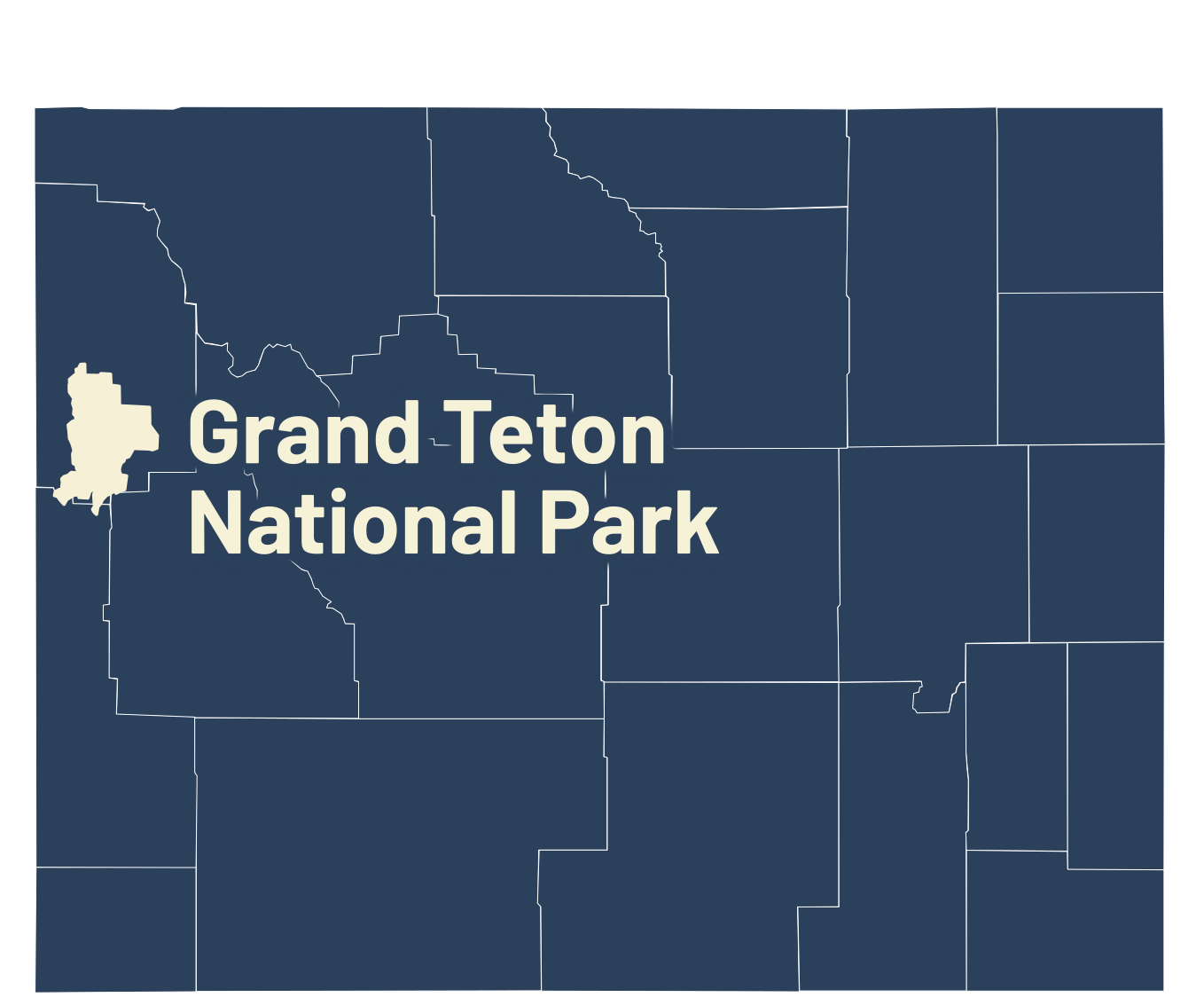
My tour began with wildlife at 4 p.m. at a little place called Blacktail Ponds Overlook, a wetland that does a great impression of a pretty postcard.
My guide was Tyler Griffin, a Connecticut transplant turned nature evangelist, who’s like a wizard when it comes to spotting wildlife.
When we showed up at Blacktail Ponds, for example, everyone was milling about, looking for wildlife in their binoculars and spotting scopes.
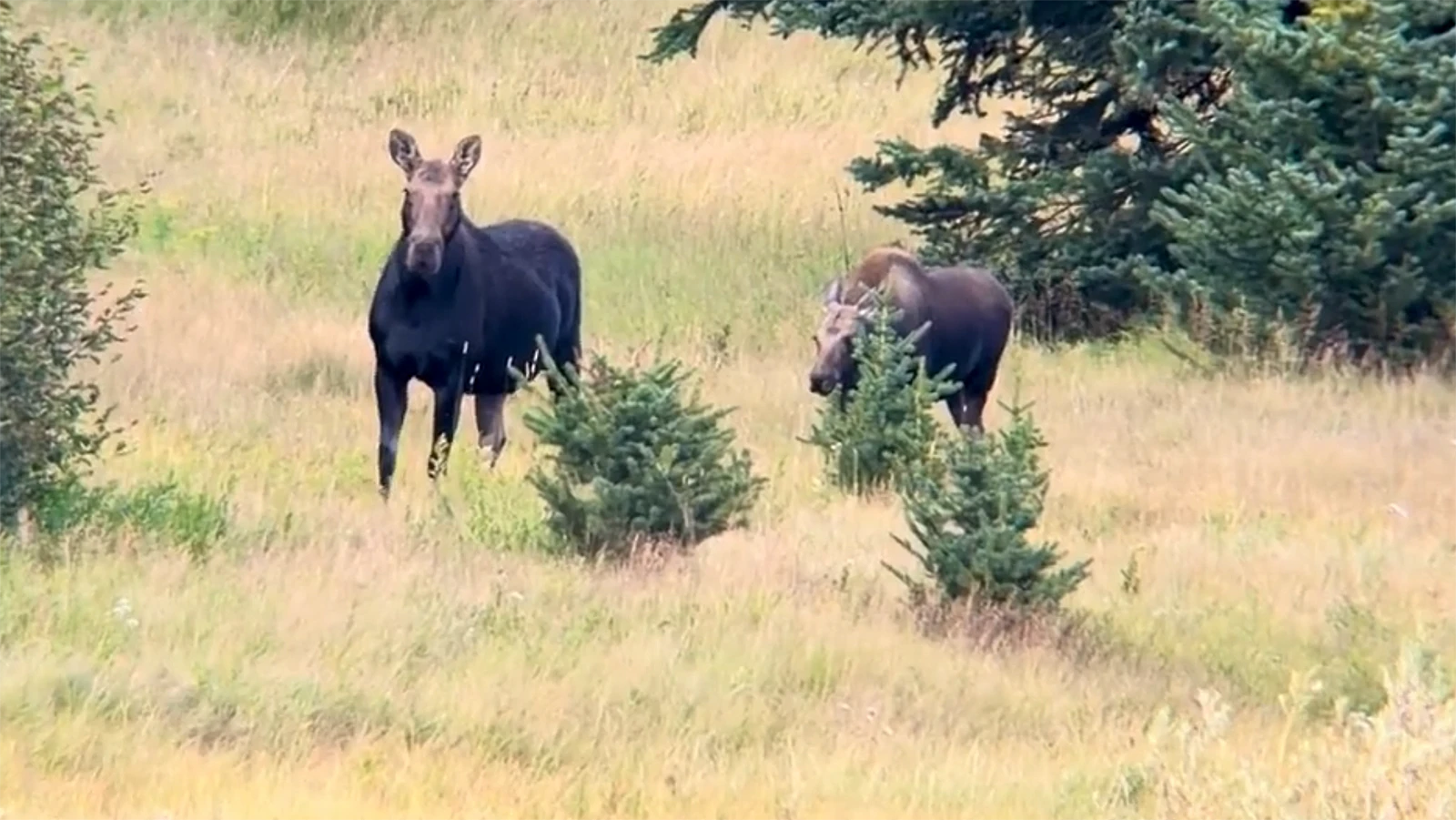
Tyler no sooner had his spotting scope up than he’d zeroed in on a mama moose, slurping aquatic plants in the wetlands while her baby hid behind a conifer.
People in the background started asking Griffin what he’d spotted — despite the fact they’d been there far longer. Griffin generously told them where to zero in, and pretty soon everyone was excited about the moose.
“They have this like bulbous nose that sticks down, which allows her to feed on aquatic plants really well while still seeing and keeping eyes on her calf and vigilant for predators,” Griffin said. “And she is getting a ton of nutrition and especially salts from these aquatic plants that she’s eating.”
Her legs are another secret weapon, Griffin added. They’re jointed so she can pick her legs up almost completely vertically.
“That allows them to travel through wetlands like this and really deep snow,” Griffin said. “They’re super good at traveling through deep snow. And they’re often seen in wetlands, so they’re nicknamed the swamp donkey.
"They just kind of resemble a donkey with the big ears.”
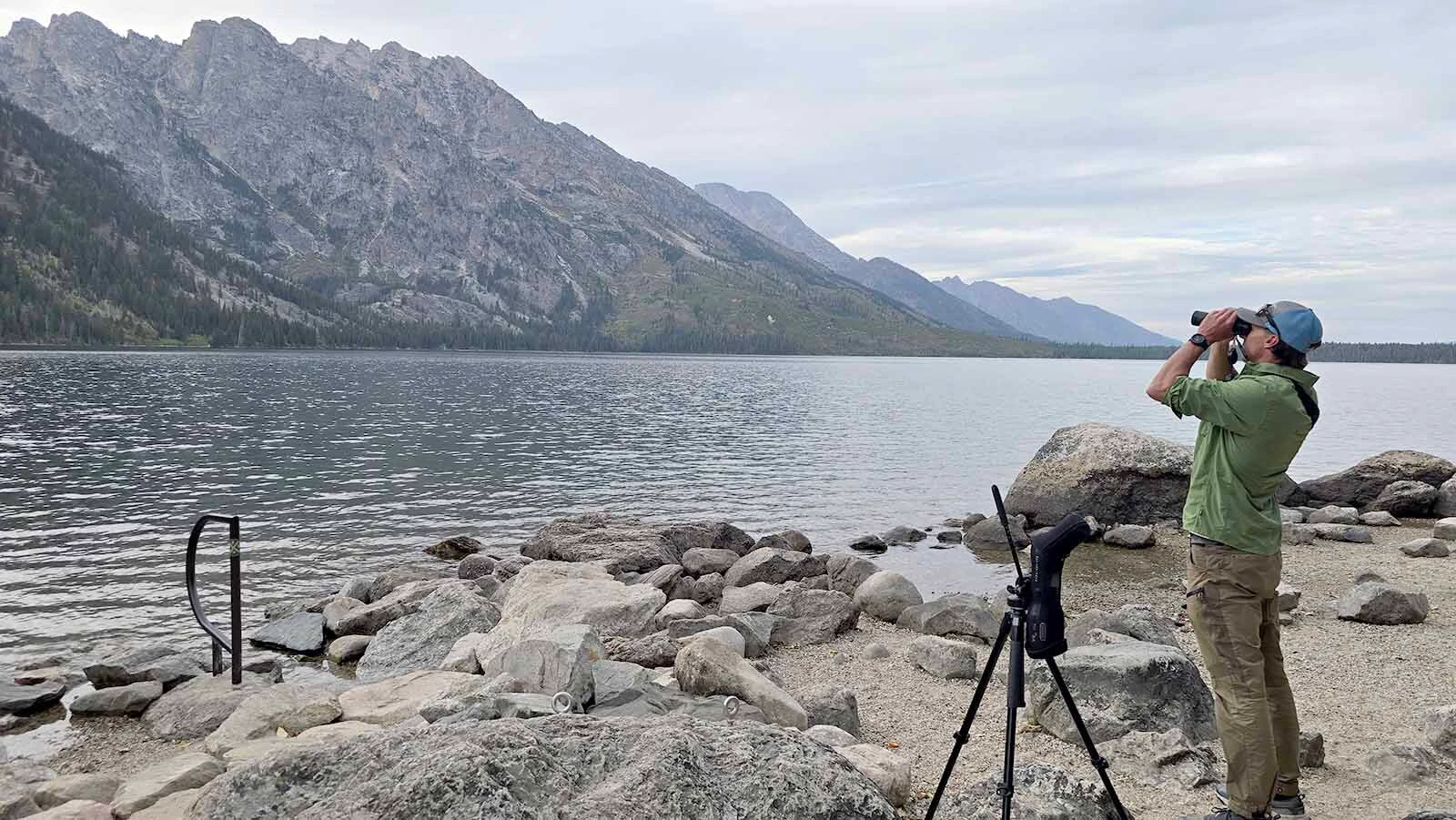
Tyler Griffin scans the far side of Jenny Lake for elk. (Renee Jean, Cowboy State Daily) 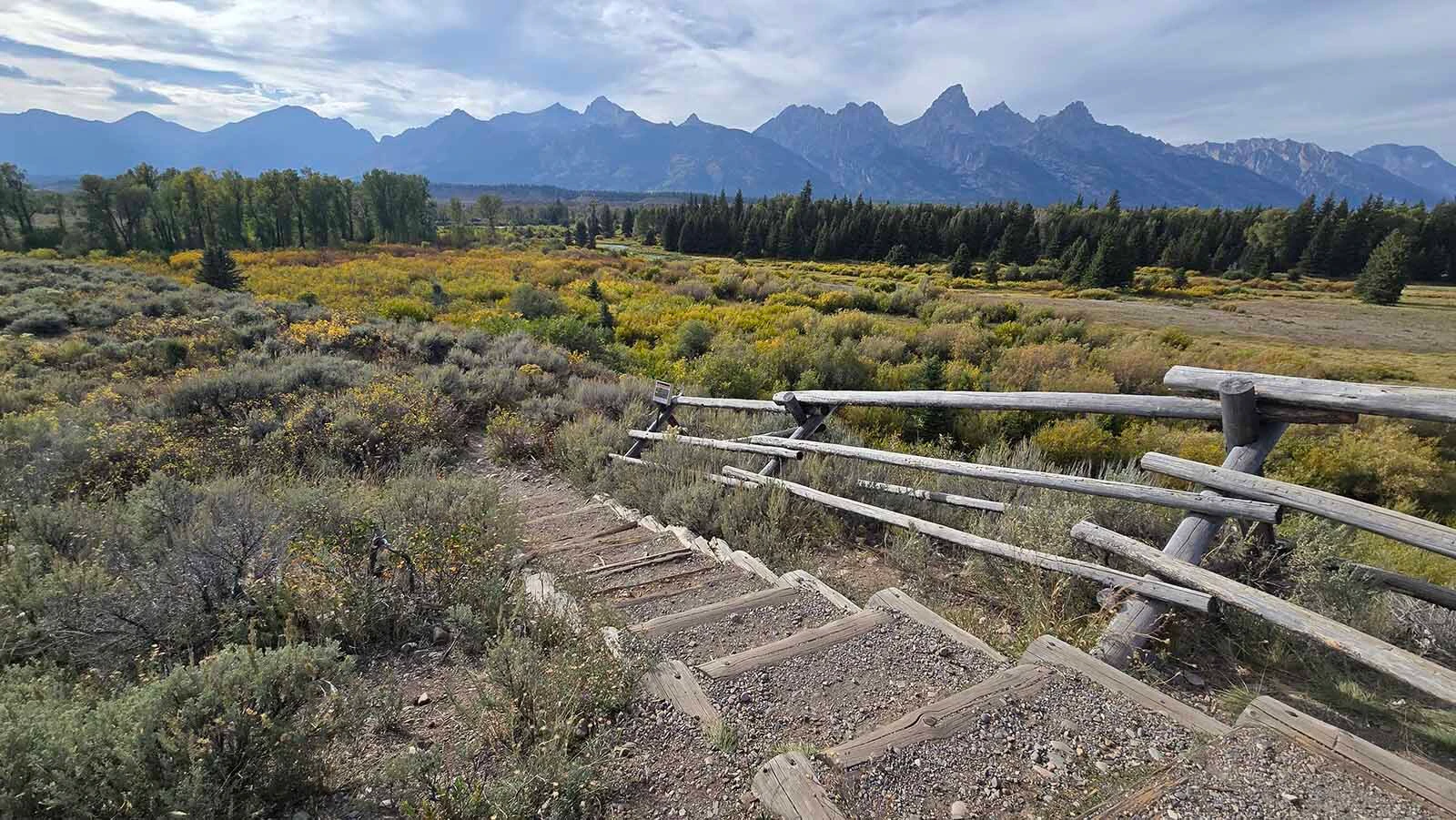
A walking trail leads down into Blacktaiil Ponds Overlook, for those who want to try fishing or hiking. (Renee Jean, Cowboy State Daily) 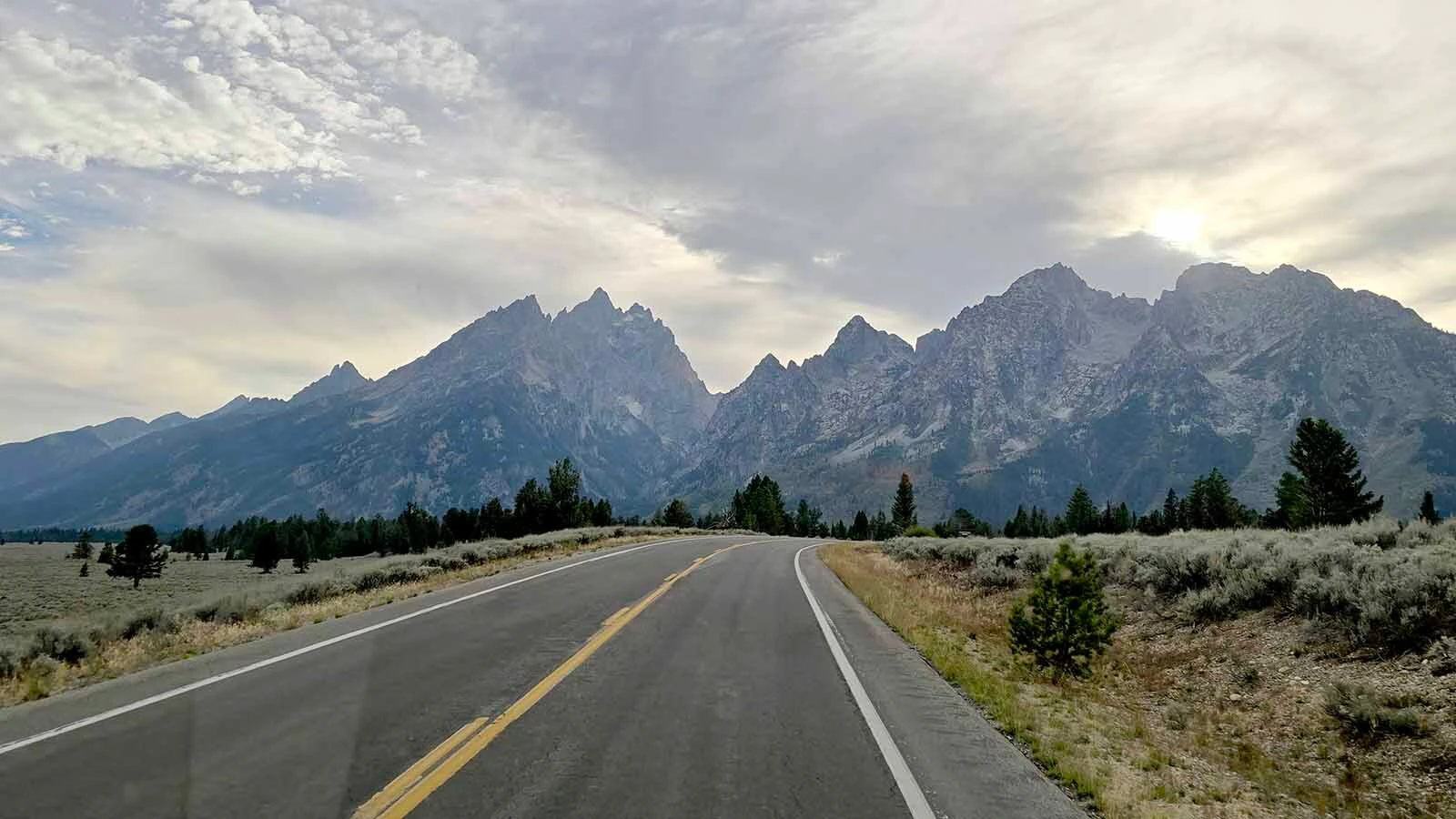
Majestic mountains in Grand Teton National Park. (Renee Jean, Cowboy State Daily) 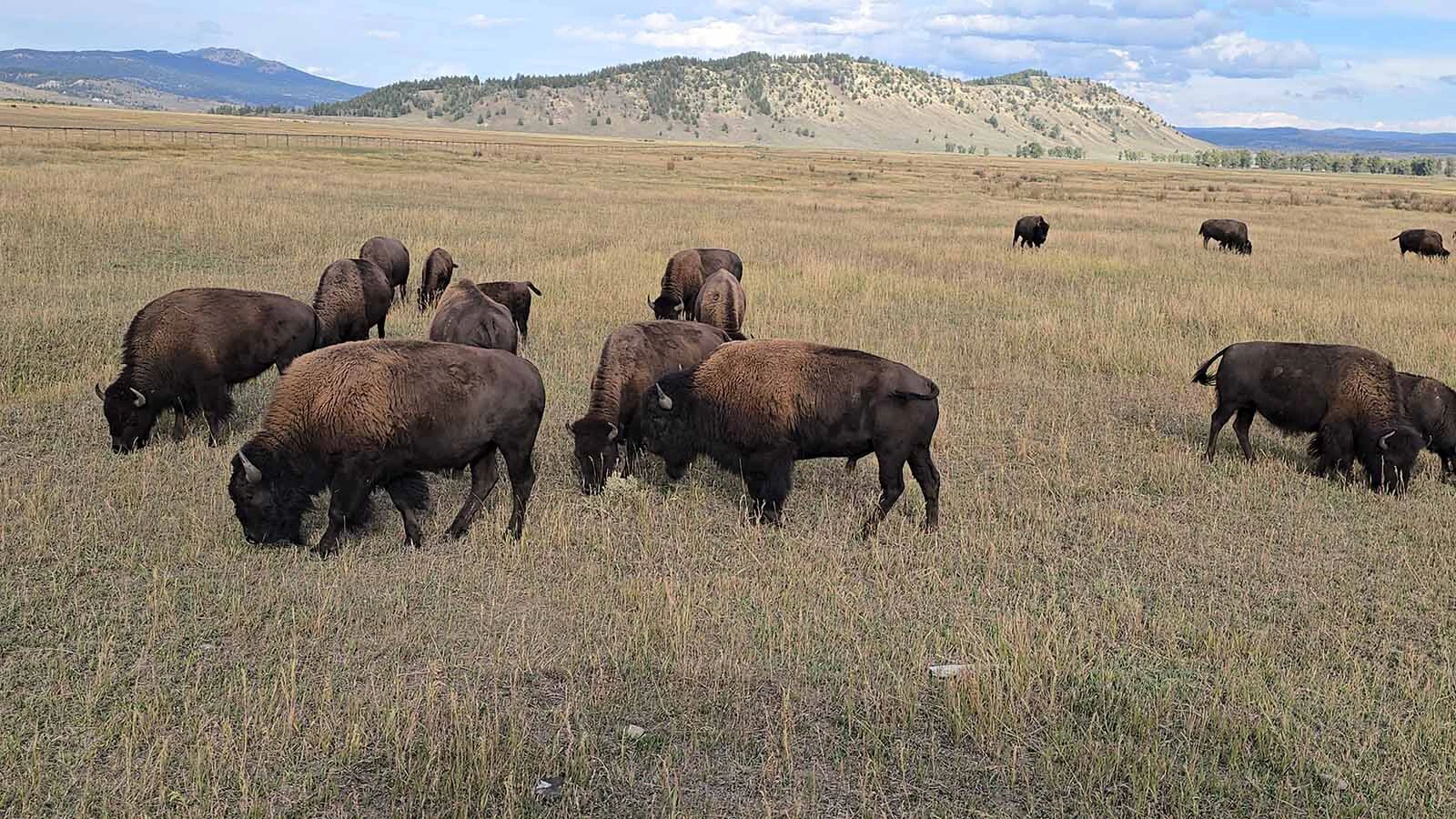
Bison graze on grasses in Grand Teton National Park. (Renee Jean, Cowboy State Daily) 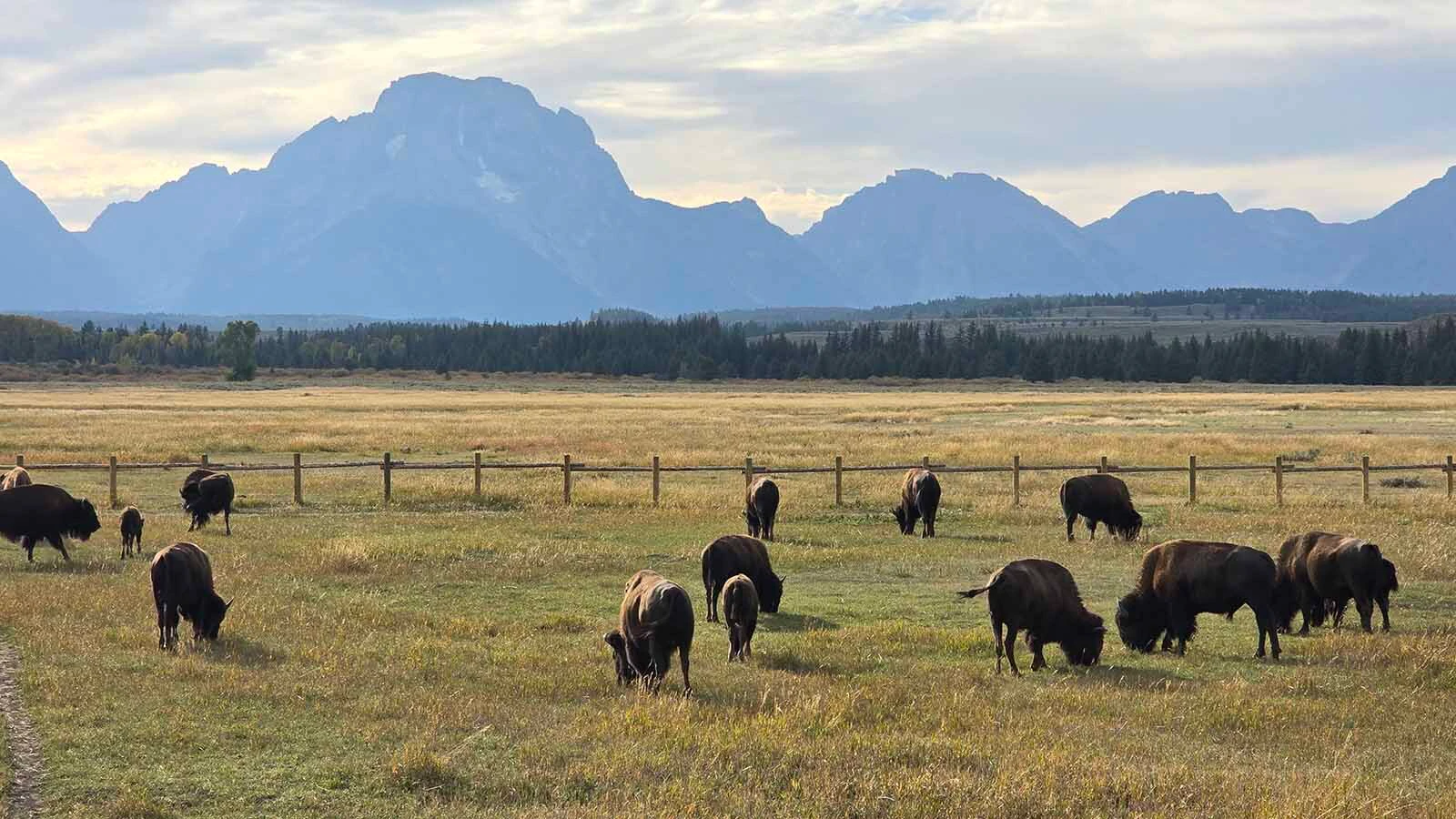
Bison graze on grasses in Grand Teton National Park. (Renee Jean, Cowboy State Daily)
Red Fur Cloak Of Invisibility
Although the baby calf was hiding behind a conifer, we could occasionally see a flash of red fur — the same color as a baby bison’s.
Deer and elk calves are born with spots to help break up their form, Griffin said. Moose and bison use a different strategy.
“It’s sort of weird because red stands out to us,” Griffin said. “It’s like, ‘Whoa, super obvious.’ But when you think about their predators, primarily wolves in this ecosystem and grizzly bears, too … dogs can’t see the red spectrum very well.”
That makes red something of an invisibility cloak.
Moose, Griffin added, are not herd animals like elk and bison. They’re solitary until winter, when groups of males gather in bachelor groups, primarily in open, sagebrush fields, where they’ll eat bitterbrush.
“Bitterbrush holds onto its leaves a lot longer than the willow bushes and aspen trees and cottonwood trees,” Griffin said. “Moose are what we call a browser. They eat buds, leaves, and twigs, versus a grazer who eats grass.”
That strategy means moose don’t need to migrate as far. There’s plenty of buds, leaves, twigs sitting above the snowpack.
Elk Ranch Flats And Grumpy Bison
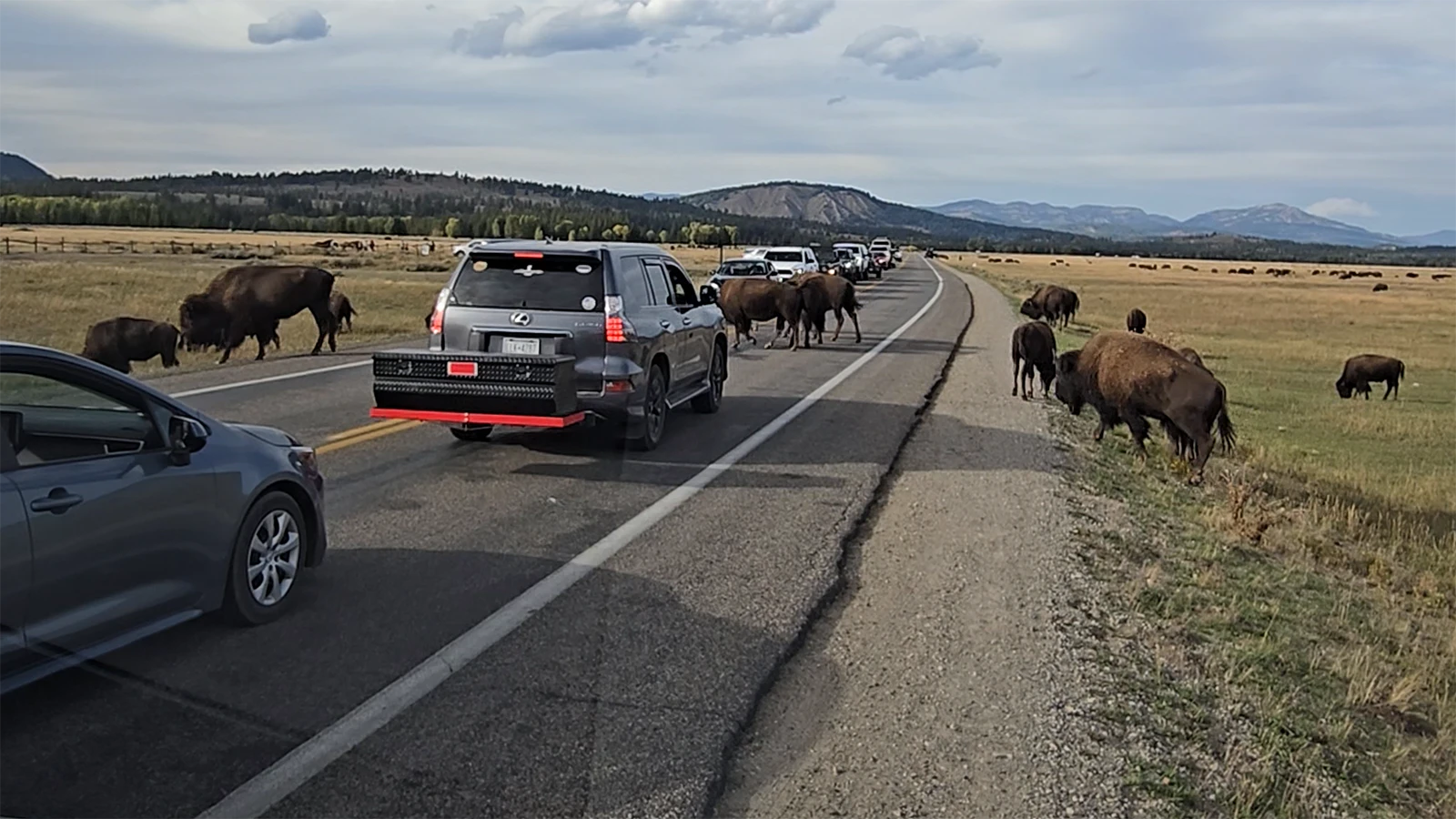
No spotting scope was required at Elk Ranch Flats, a favorite bison gathering place. When we arrived, bison were spread across the valley floor as if they owned the place, which they kind of do.
This is where a lot of viral videos of bison tossing and charging at so-called “tourons” get made, Griffin confirmed. Touron is a mashup of tourist and moron.
In fact, while we were there, a man was taking photos just 3 or 4 feet from a young bull, while a group of larger bulls was nearby, locking horns.
Griffin visibly tensed up seeing how close the man was to the sparring bison. He was about to drive over to warn him when the man either got the photograph he wanted or realized he should move away.
“People underestimate bison so often,” Griffin said as he watched the man leave. “Especially when it’s not super obvious that we’re in a national park because we haven’t gone through a booth.
“People will see the fence and say, ‘Oh, they must be domesticated,’” Griffin continued. “So, they’ll go right up to the fence, 5 feet away, and little do they know those bison can actually jump that fence. They’re not safe behind that fence.”
The fence, in fact, is designed to fail if a bison runs into it. The top bar is only held by a couple of nails. That way, a jumping bison will pop it loose instead of breaking its leg.
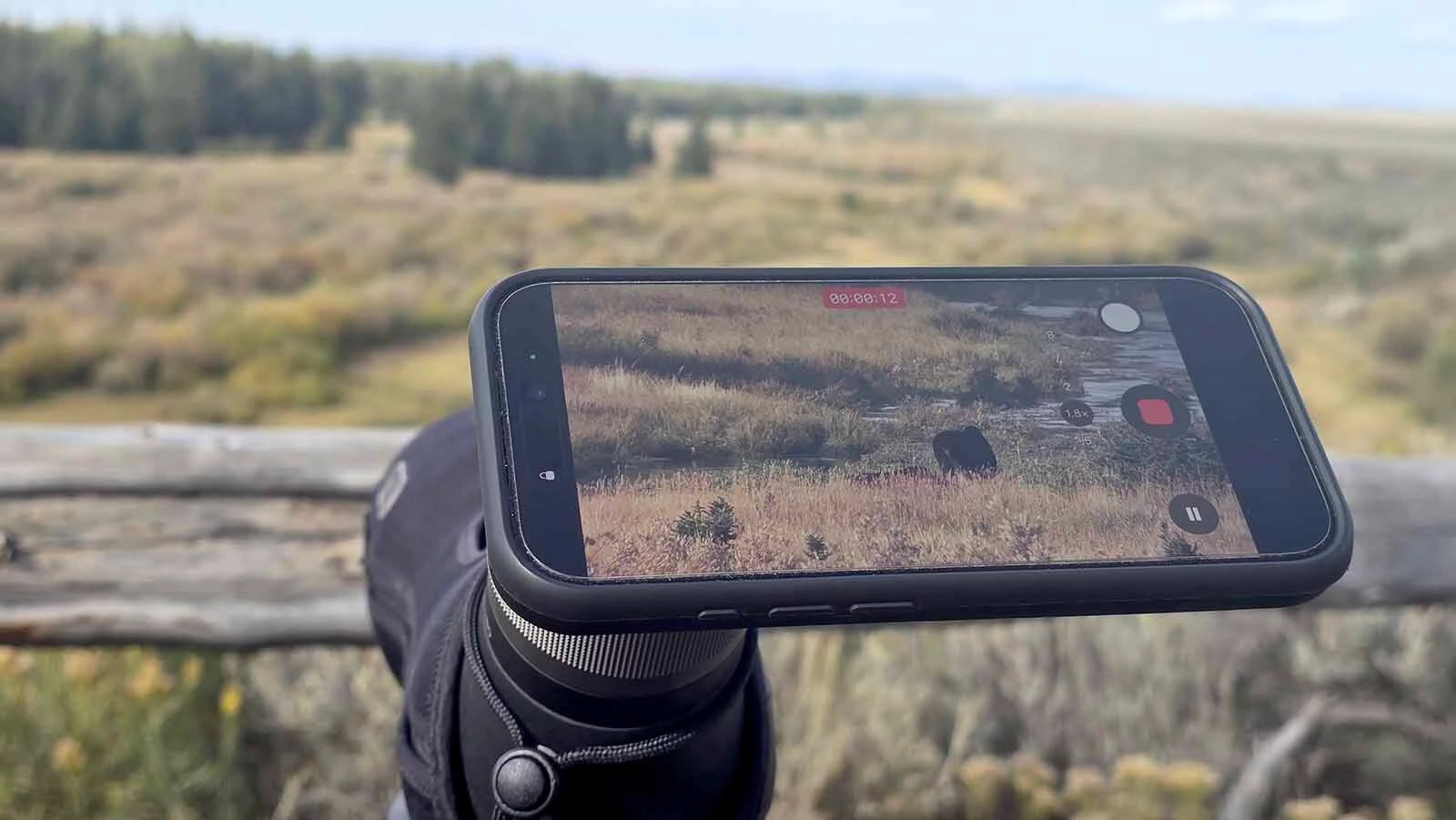
The moose in this spotting scope is far away, but can be seen with binoculars or a spotting scope. (Renee Jean, Cowboy State Daily) 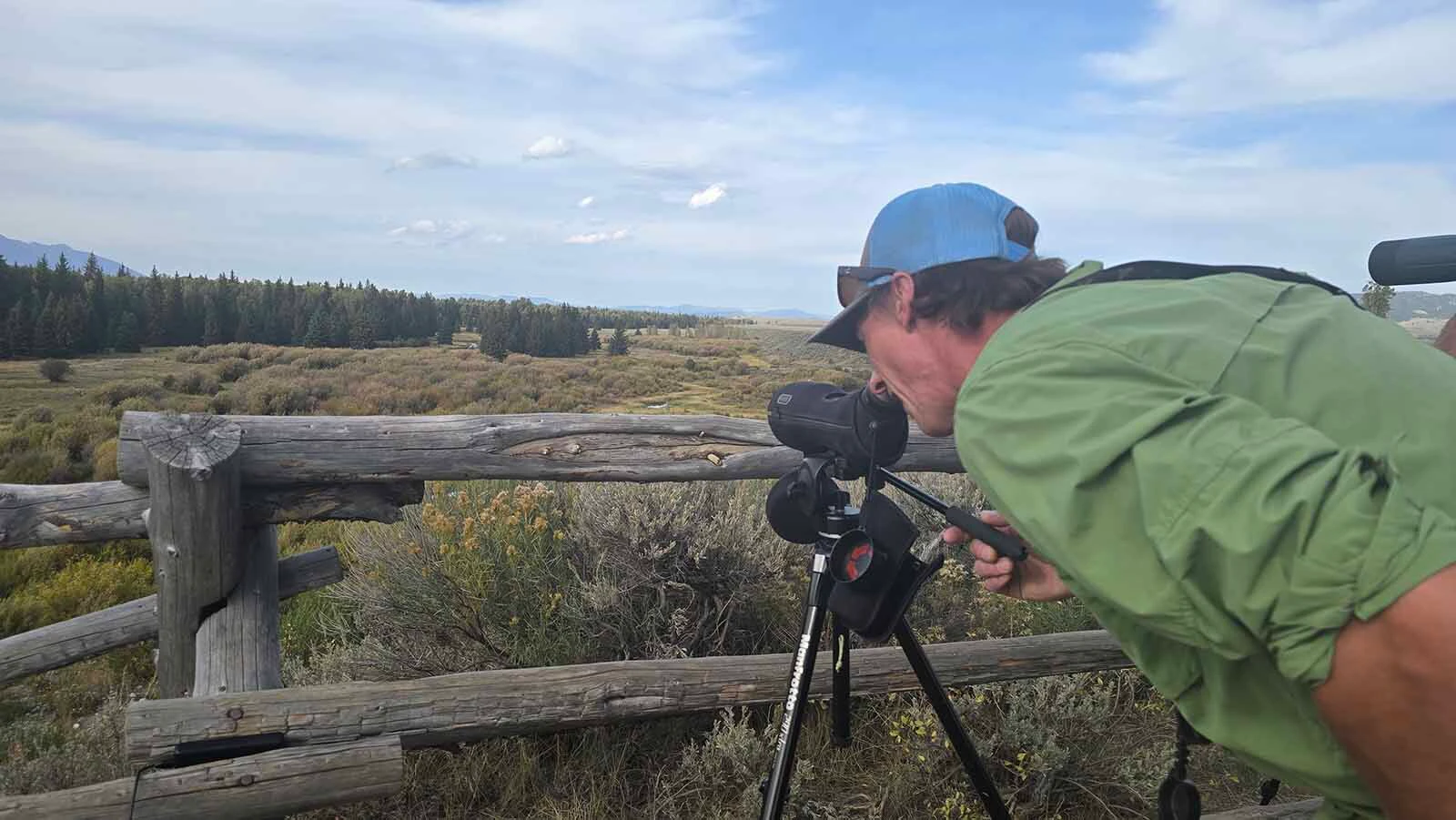
Wildlife expert Tyler Griffin peers through a spotting scope. Moments later he'd zeroed in on a mama moose. (Renee Jean, Cowboy State Daily) 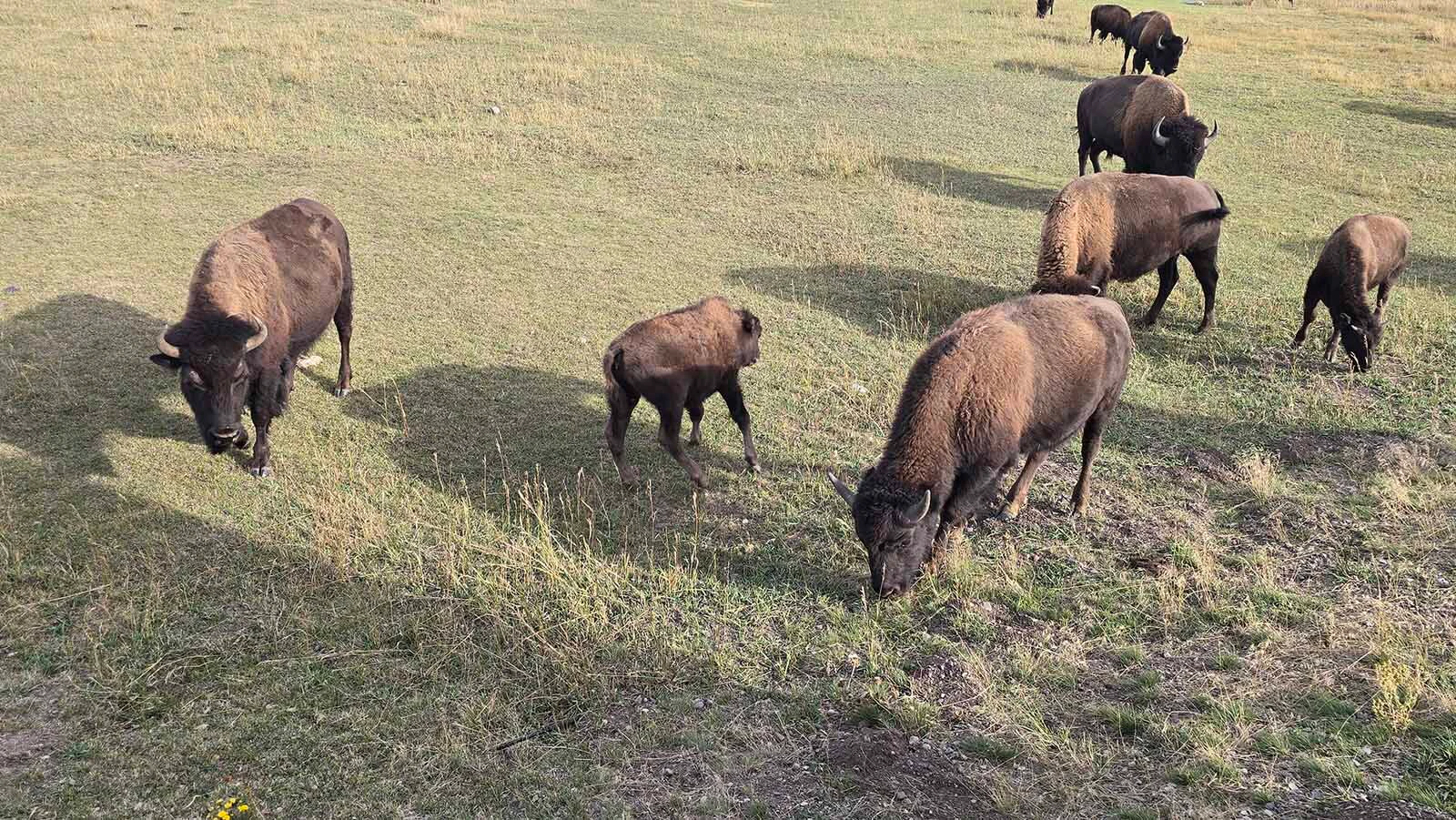
Bison graze on grasses in Grand Teton National Park. (Renee Jean, Cowboy State Daily) 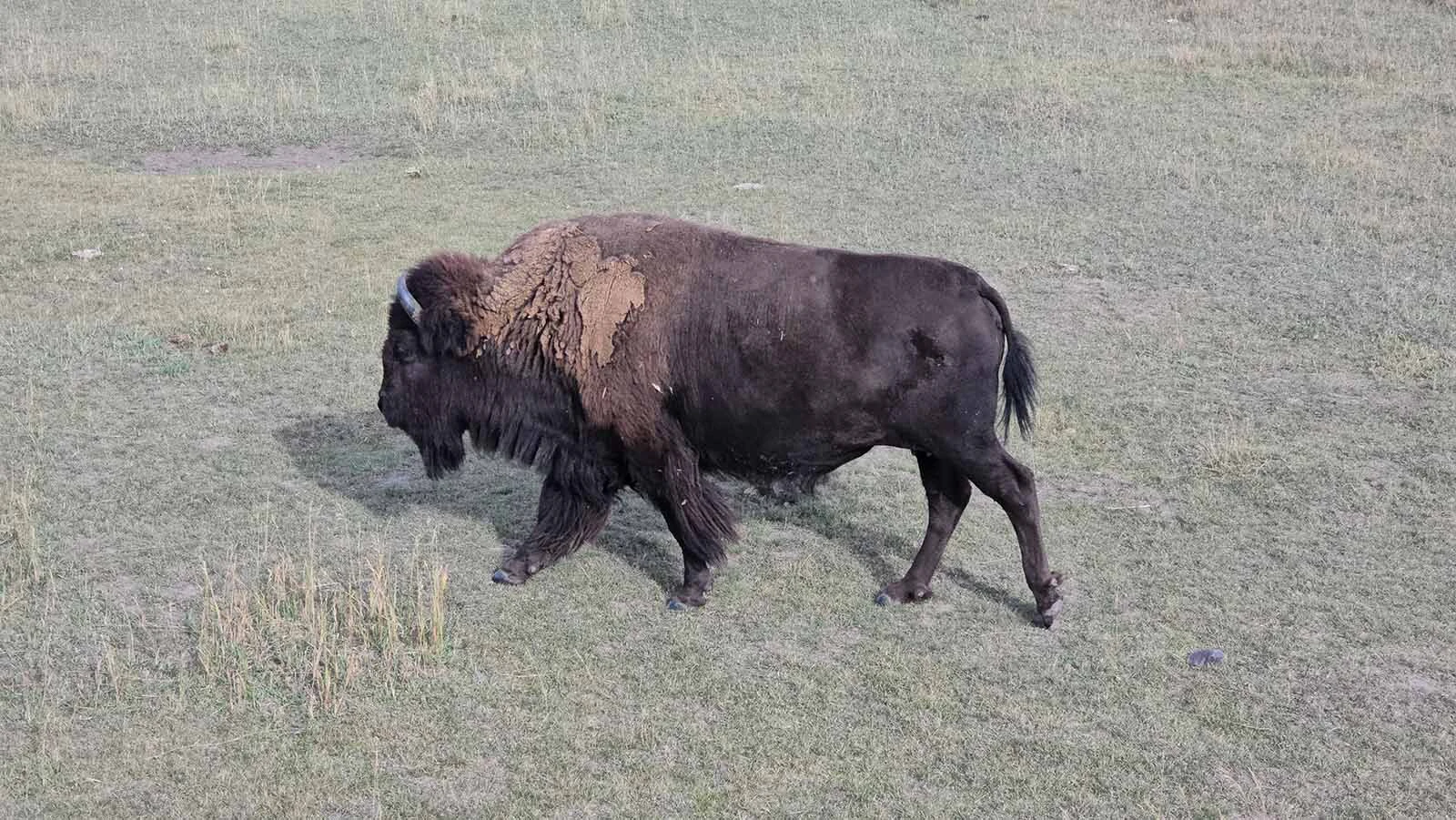
A bison with mud on its shoulder in Grand Teton National Park. (Renee Jean, Cowboy State Daily)
Antsy Pronghorn
Pronghorns are not an uncommon sight for Wyoming motorists. But Griffin brings important context to the visual.
“That’s a nice buck out there, off to the right,” he said, gesturing toward it.
Spreading out behind that buck was a cloud of females, at least 45 — all part of his harem.
“Their mating season is typically in August to the beginning of September,” Griffin said. “So this time of year, you will still see the male chasing around those females.”
Both male and female pronghorn have horns, but females' typically are smaller.
“The one way to tell a male apart is the black mark on his cheek, the side of his face,” Griffin said. “His head is down right now, but once he picks his head up and gives us a side profile, you might see this black mark on his cheek.”
It’s an oil gland that males rub on bushes and trees and fence posts to mark their territory.
“The older the buck is, the bigger that black patch will be, too, because it’s staining its fur over the years,” Griffin said.
Pronghorn are North America’s fastest land animal, Griffin added, and their migration from Grand Teton National Park to the Red Desert is 150 to 200 miles, matching a recently discovered mule-deer trek along a similar path for the longest ungulate migration in the lower 48.
Only caribou in Alaska migrate farther in North America.
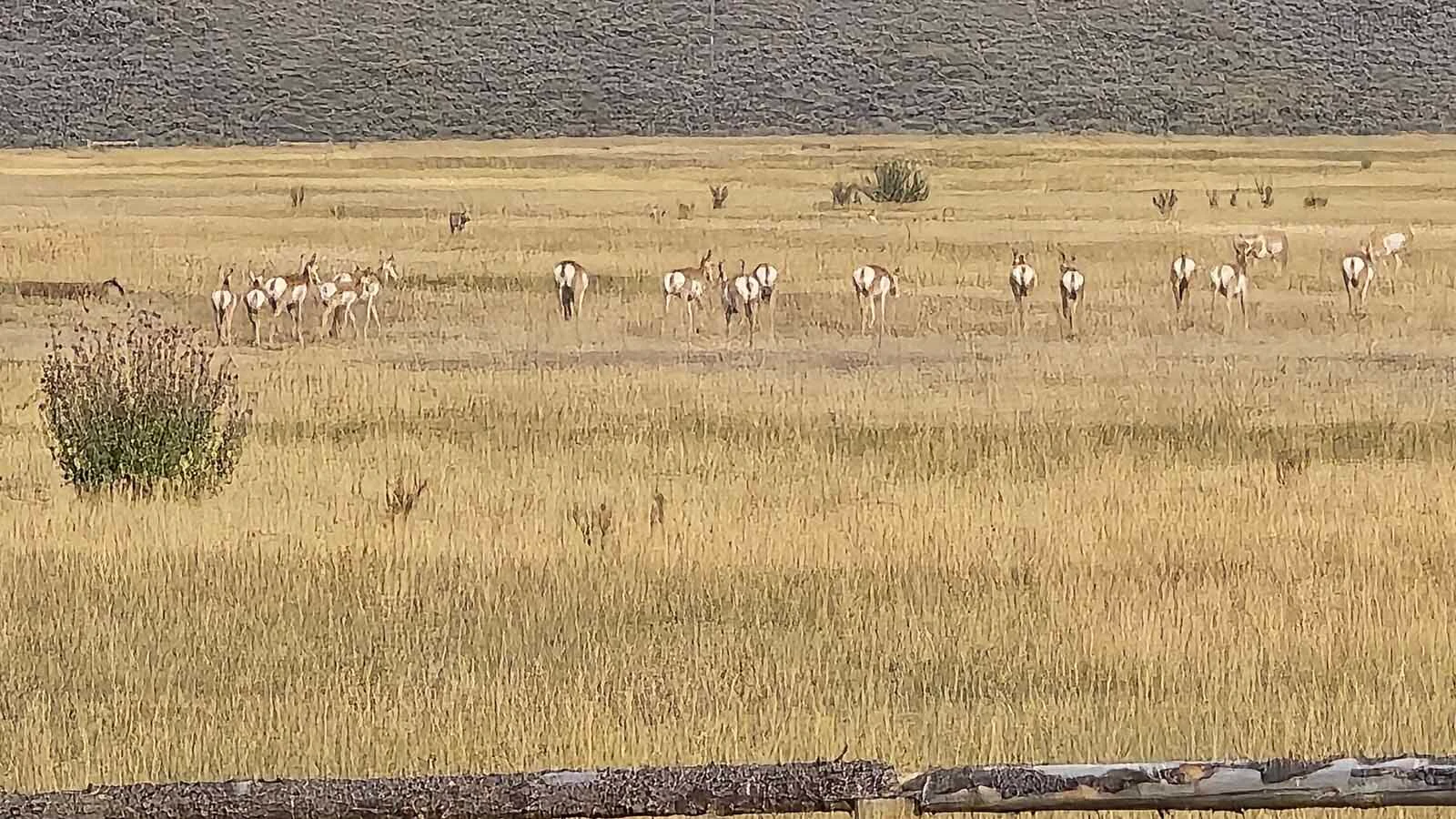
Part of a massive herd of pronghorn in Grand Teton National Park. (Renee Jean, Cowboy State Daily) 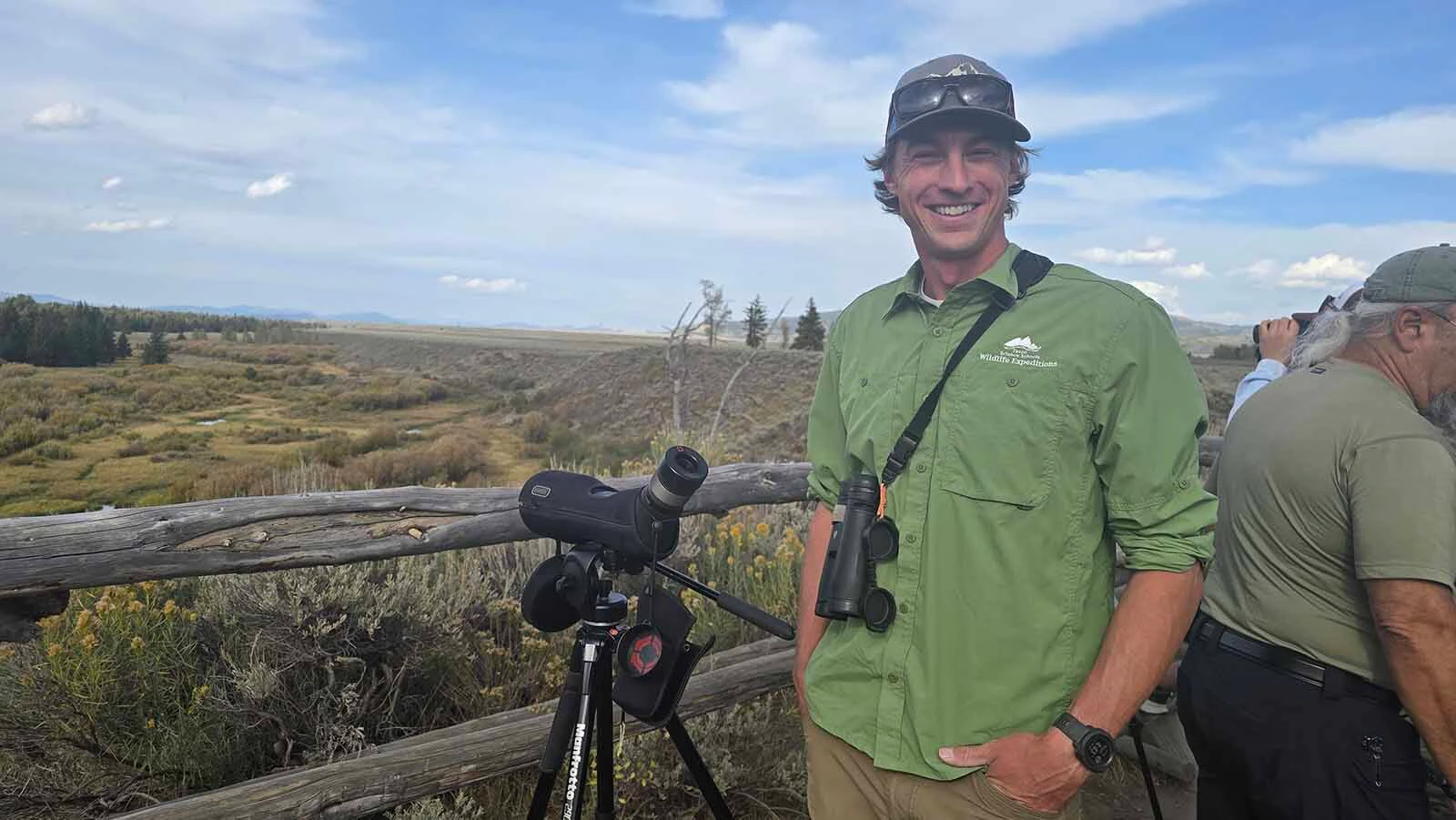
Wildlife expert Tyler Griffin leads wildlife safaris for Teton Science Schools in Jackson Hole. Teton Science has recently added an eight-hour wildlife safari and stargazing combo. (Renee Jean, Cowboy State Daily) 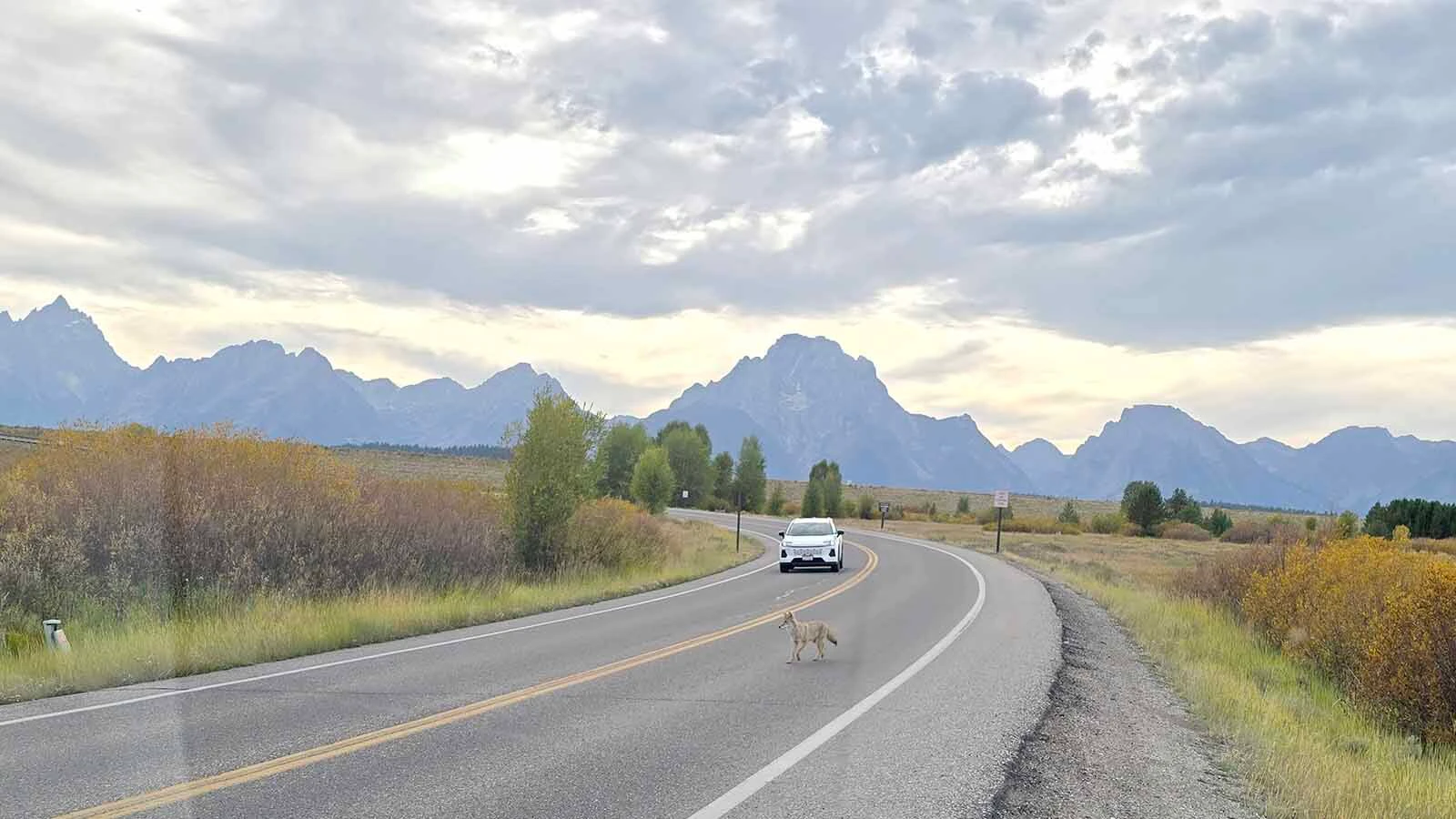
A coyote runs out into the road, then around the back of the vehicle Cowboy State Daily was in, before disappearing into the tall grass for good. (Renee Jean, Cowboy State Daily) 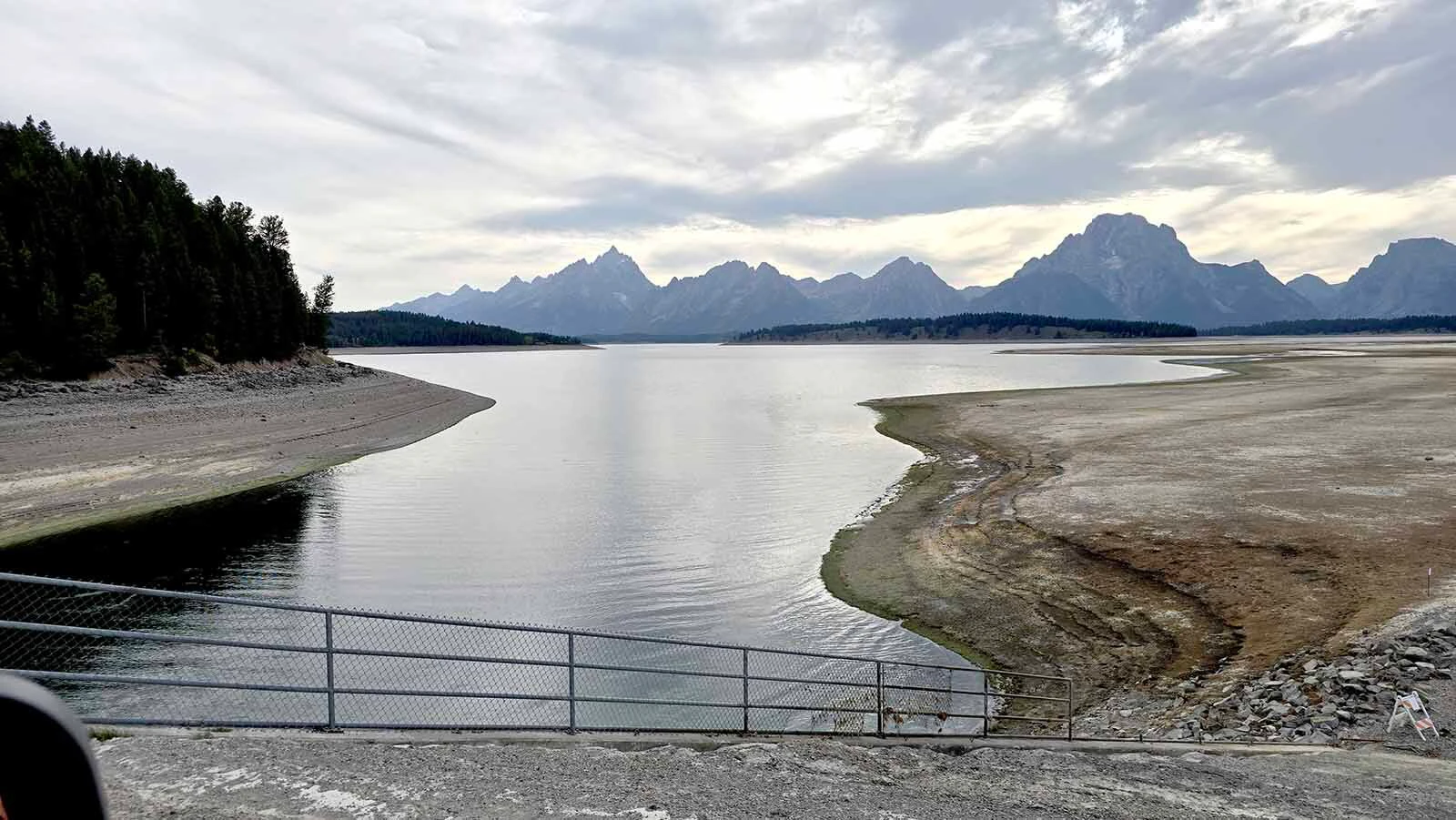
Jackson Lake does its best imitation of a post card. (Renee Jean, Cowboy State Daily)
Black Bears Elusive This Year
This year, black bears have been especially elusive, and we didn’t find one.
“We got some really cold temperatures in June, freezing temperatures actually,” Griffin said. “That has affected our berry crop this year.”
Because of that, black bears aren’t showing up in their usual spots. Bears are omnivores, so they’re filling their bellies with other things, like insects.
“You’ll see black bears breaking apart logs and eating ants a lot of times,” Griffin said. “So they’re pretty good at finding other food sources, but it definitely affects their behavior. And it could affect how much nutrition and fat they’re able to store up before hibernation.”
Bears need up to 20,000 calories a day to get ready for hibernation, Griffin said. That’s equal to eating 37 Big Macs. Though we didn’t see a black bear, we were gifted with something else on our way to Dornan’s Pizza.
We heard it first, before seeing anything at all.
Griffin immediately pulled over to wait. Moments later, a coyote poked his golden head out from 6-foot-tall emerald green grass to peer at us. Almost as quickly, he spun around, diving into the grass. We heard him yip a few times, as if searching for something.
Then he dashed across the highway, circled our truck, and disappeared again — this time for good.
Where Elk Sometimes Sing
Before Dornan’s, we detoured to Jenny Lake, among the most popular places for humans in Grand Teton National Park.
Elk, as it happens, love Jenny Lake, too. And the acoustics at the lake are perfect to hear them bugle, capturing the sound and bouncing it from great distances away.
“This time of year is ramping up into the elk mating season in September,” he said. “The bulls do a beautiful bugle call.”
Griffin hoped we’d hear an elk bugle, a mating call he described as a high-pitched scream mixed with a whistle. It’s supposed to be an attractant.
“It says, ‘Look at me, I’m impressive. I’m a big bull,’” Griffin said. “That’s the primary reason they grow antlers too, is to impress the female. It displays their genetics, essentially, and says, ‘Hey mate, with me because I’ve got impressive genetics. I can grow this big antler rack.’”
Griffin quickly found a herd on the faraway hills — much farther away than the mama moose. They were teeny-tiny in his spotting scope. And, unfortunately, silent.
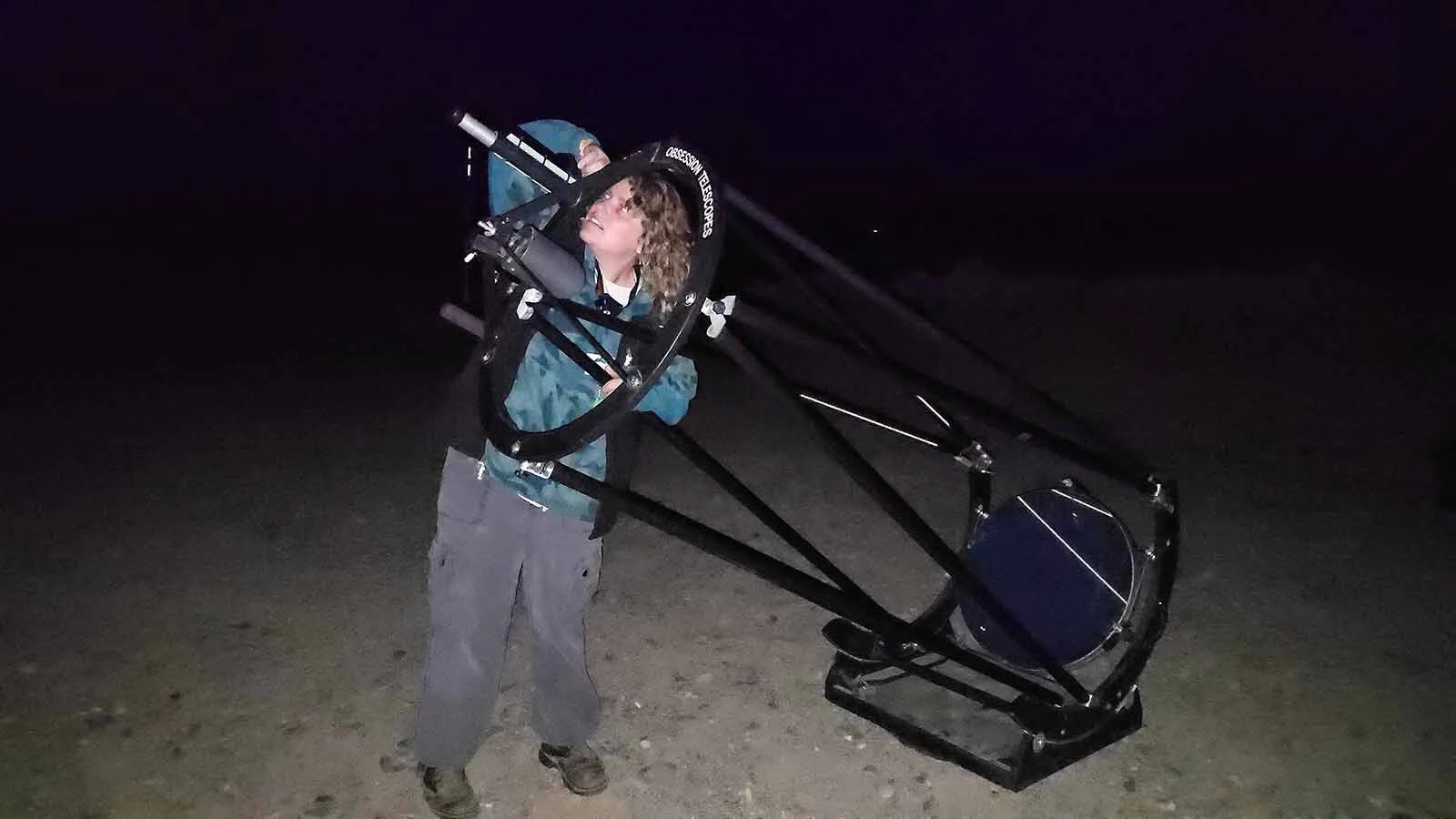
Sara Eberlin zeroes in on a galaxy 30 million miiles away. (Renee Jean, Cowboy State Daily) 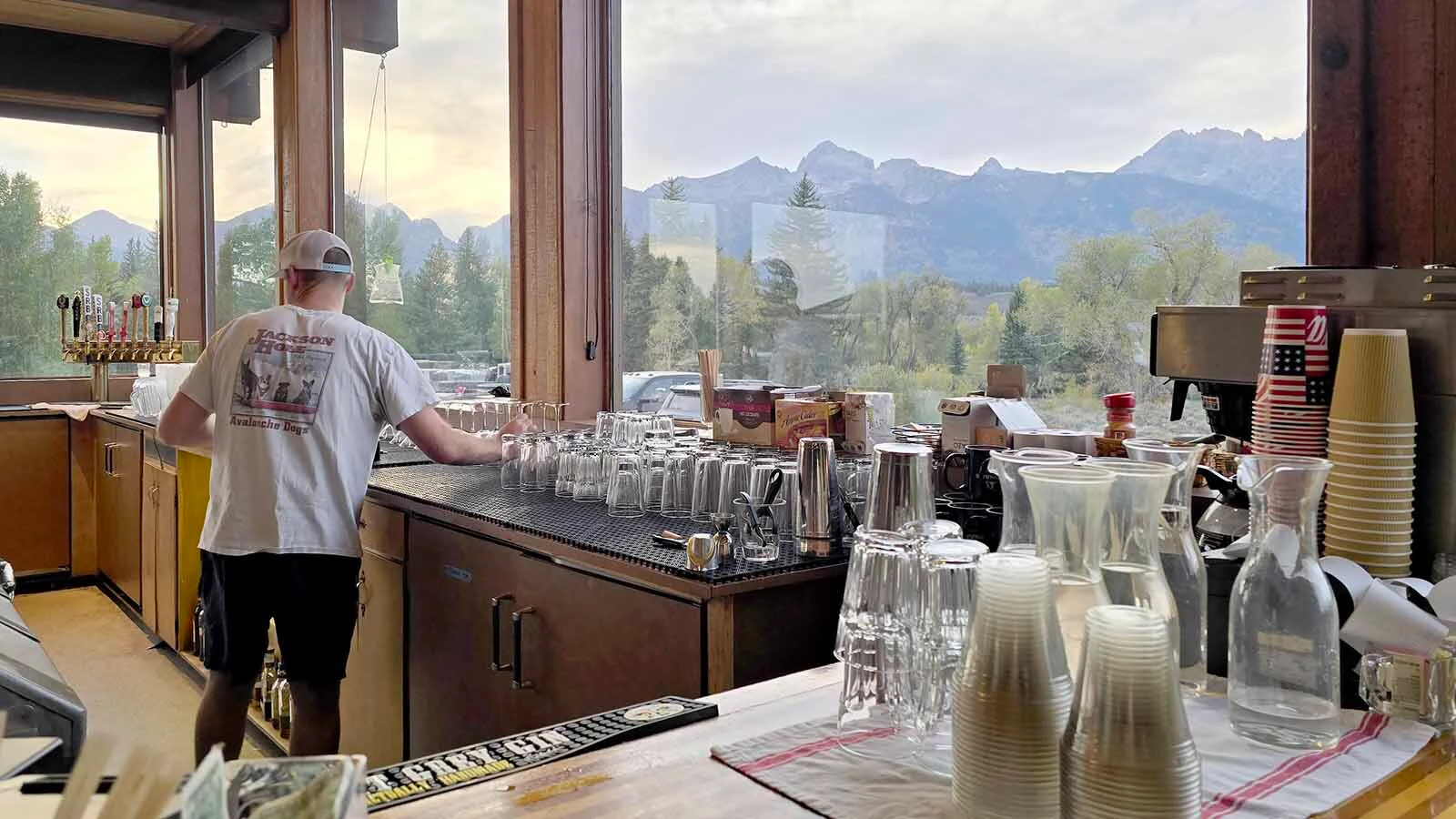
The view adds a lot to the ambiance at Dornan's Pizza, which has wide picture windows, to make the most of it. The food was delicious. (Renee Jean, Cowboy State Daily) 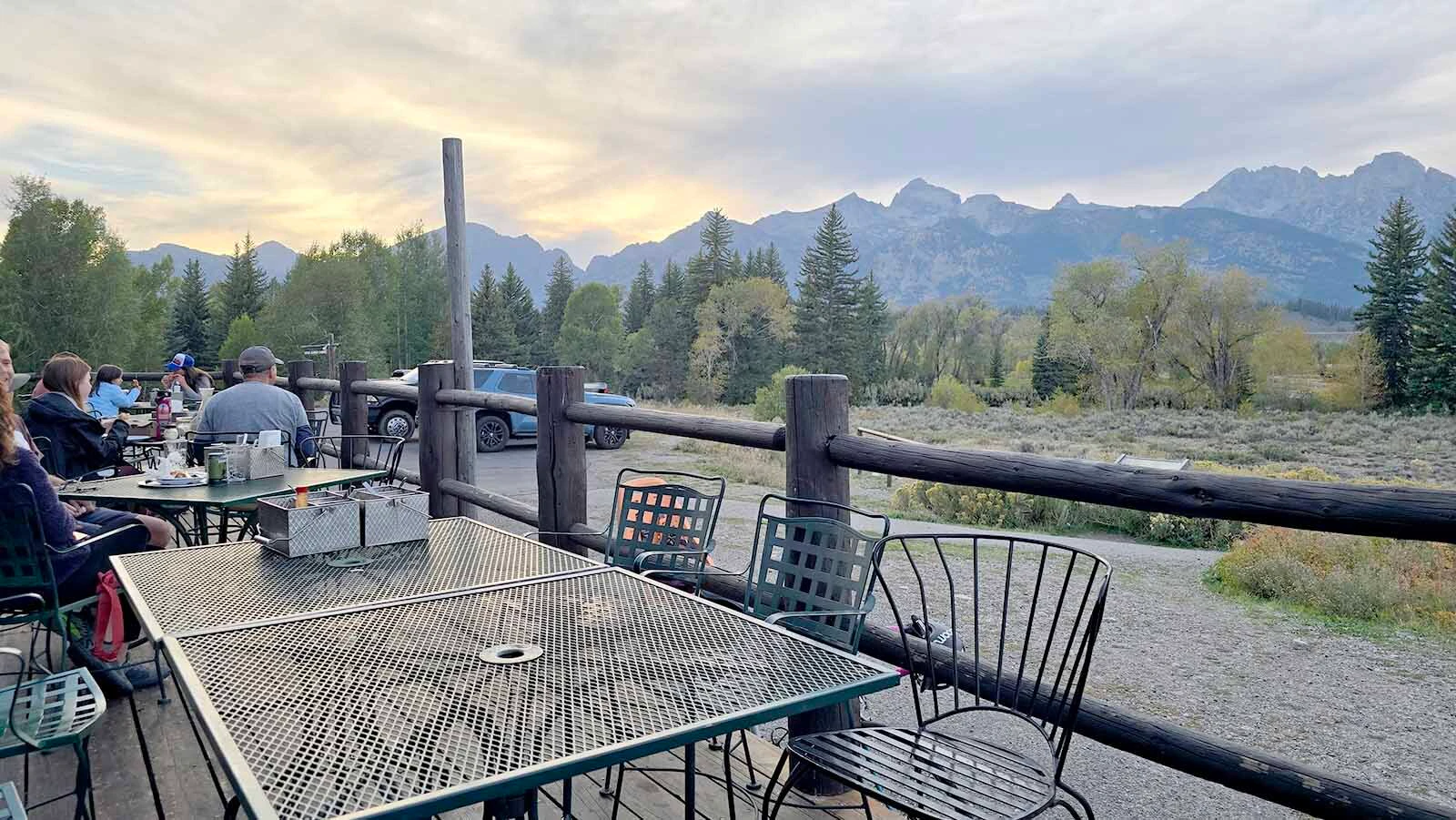
The view at Dornan's Pizza makes the food taste that much better. (Renee Jean, Cowboy State Daily) 
Pesto sauced gnocchi and pizza from Dornan's Pizza. (Renee Jean, Cowboy State Daily)
Bring On The Stars
Griffin makes up for the silent elk with pizza and pasta at Dornan’s in Moose, which is included in the tour. Dornan’s is a private inholding inside the park where the Tetons do their own thing over the top of every bite of pizza or pasta.
Griffin ordered a large pizza, while I tried the caprese gnocchi. They proved to be light and airy pillows sauced with pesto — to die for.
As the light sank over the horizon, Griffin checked in with the next tour guide, astronomer Sara Eberlin. She gave him a “go” for the second half of the experience.
Eberlin studied astronomy in Africa and spent two years under New Zealand skies before landing in Jackson, where she leads tours for Wyoming Stargazing, which has become part of the nonprofit Teton Science Schools.
Our spotting scope for the stars was a large-aperture Newtonian reflector telescope called a Dobsonian. It sat on a mount easily turned in any direction.
Our quarry with the Dobsonian was different from Griffin’s. Rather than massive moose or bear, we were after the tiniest pinpoints of light in our night sky.
Our conditions for this star quest were nothing short of a gift. There was no moon, and Teton County is dark-sky country. Jackson’s airport, Eberlin noted, is the only dark-sky airport in the world, turning its lights off every night after the last planes arrive and depart.
“With no moon in the sky we can see around 4,000 to 5,000 stars,” Eberlin said. “But with a full moon that goes down to about 200. So it makes a big difference.”
Just 20% of the world’s population can see the Milky Way because of light pollution, she added. This night, we were in that lucky 20%.
Navigating The Sky Like A Pro
Eberlin started with basic orientation. Two stars on the outer edge of the Big Dipper’s cup form a line that points at the North Star.
“If you’re lost in the woods, you can draw a line straight down toward the horizon, and that’s true north,” she said. “Here in Jackson, the angle between the North Star and the horizon is about 43 degrees.”
That’s also Jackson’s latitude — and that’s how ancient sailors navigated the open ocean. They used the North Star to find their latitude.
The Big Dipper’s handle arcs right over to the fourth brightest star in the night sky, an aging red giant called Arcturus.
“There’s a nice little mnemonic to remember it,” Eberlin said. “Arc to Arcturus.”
Arcturus is about 40 light years from Earth, Eberlin said, and it’s 10 billion years old.
Arcturus is a bright thing, easily seen without a telescope. The Dobsonian let us look at much fainter stars, including a cluster of 300 stars that looked like a kaleidoscope.
“They’re teenager stars,” Eberlin said. “They’re very young. They’re around 14 million years old, which is pretty young for a star.”
As the cluster ages, these teenager stars will begin to scatter.
“Our sun was once in a star cluster like that one,” Eberlin said. “And so is Arcturus and most of the other stars in the night sky. They have just drifted away from their stellar circles.”
Enter The Milky Way Stage Left
Andromeda is 2 million light-years out, and looks like a fuzzy grey thumbprint in the Dobsonian telescope.
“You’re seeing in that just fuzzy smudge the combined light of a trillion stars,” Eberlin said. “And there could be plenty of planets in that galaxy too. As far as we know, there’s aliens over there stargazing back at the Milky Way right now. We would never know.”
I wondered what they would be saying over in that other galaxy.
Eberlin moved on to the Cigar and Bode’s galaxies — two spirals about 14 million light-years off, drifting toward eventual merger.
“That means if there were aliens there somehow zooming into the Earth, they wouldn’t see any Tetons here, because the Tetons are only around 10 million years old,” Eberlin said. “Which is pretty fun to think about.”
As the last residual sunlight faded from the sky, the Milky Way finally began to appear.
“We see a lot of faraway stars in the Milky Way, and that’s simply because of the shape of our galaxy,” she said. “So, you might remember, the Milky Way is shaped like a big disk. Since we’re inside of that disk, we see it from the inside out, sort of like if you imagine yourself as a blueberry floating in the middle of a blueberry pancake.”
As we look into the night sky, there’s pancake in every direction.
From this perspective, I suddenly realized I’d been seeing the Milky Way the same way I’d look at a bison, from the outside in. But here, there’s no outside. I’m in the middle of the very thing I’m looking at. I’m part of it.
Why September Works So Well
Griffin and Eberlin agree on one thing: For travelers who want to pair wildlife viewing with stargazing, autumn is hard to beat.
Summer crowds are thinning, elk are entering the rut, astronomical darkness comes earlier, and moonless evenings make the Milky Way easier to see.
That doesn’t guarantee a bear, a bugling elk, or a cloudless sky. Wildlife remains wildlife, and weather still calls the shots. But with fewer tourists traveling about, there’s also less interference.
Each half of the tour offered fresh appreciation of the cosmos, from a golden coyote peeking shyly from emerald grass to the dark sweep of sky where galaxies whirl and Earth is just a cosmic blueberry floating in a giant pancake of light.
Renée Jean can be reached at renee@cowboystatedaily.com.


