
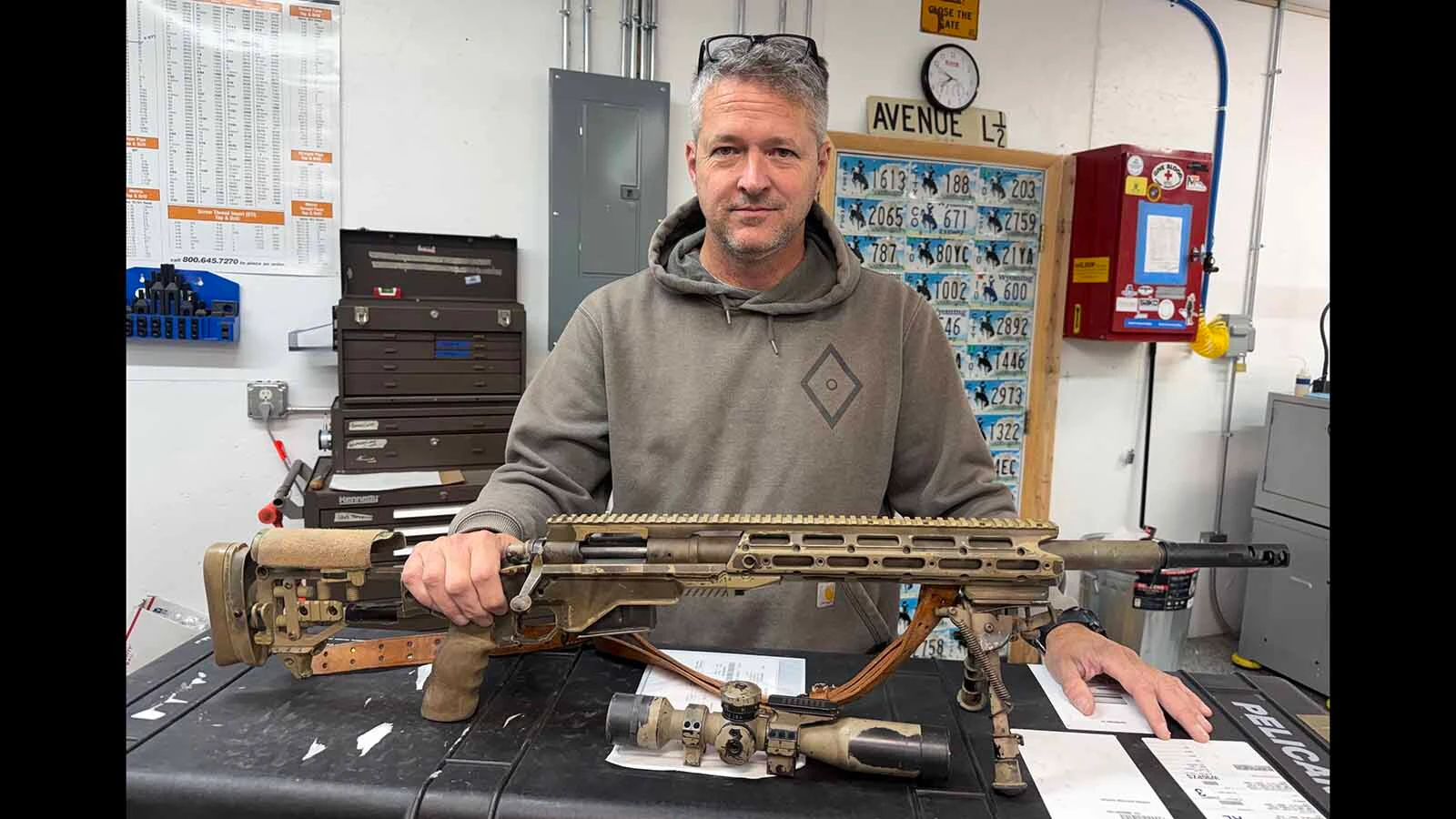
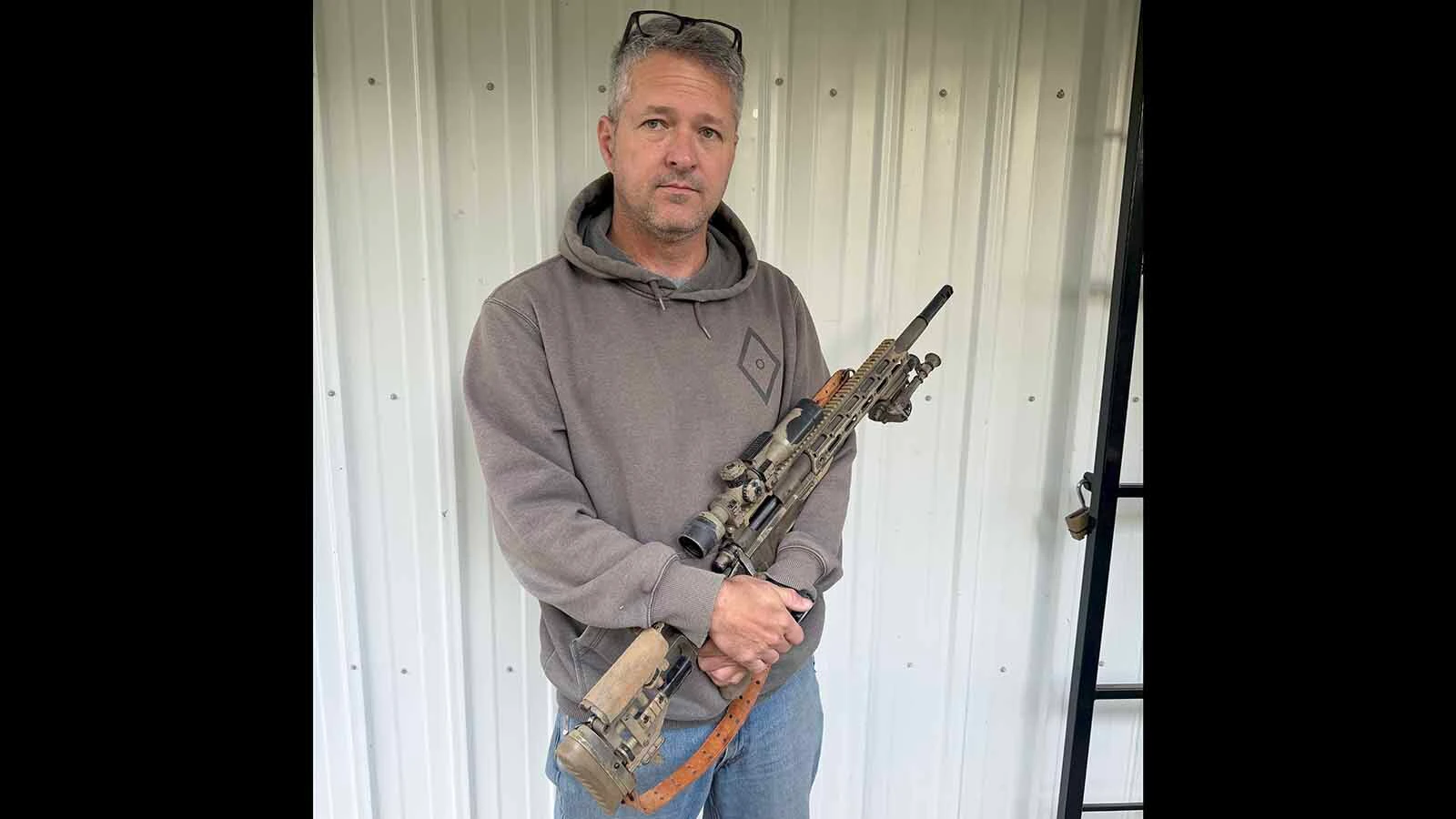
More than two decades after a barrage of mortars in Fallujah, Iraq, separated Chad Cassady from his U.S. Marine sniper rifle, he can hold it again.
That barrage left the Lander, Wyoming, man in a life-and-death struggle with a 10-millimeter piece of shrapnel that ripped into his kidney, liver and lungs. It also left him without his M40A3 bolt-action weapon, which was also damaged in the attack.
In the intervening 22 years, Cassady transitioned to an infantry officer and spent 16 more years traveling the world on assignments. His sniper rifle also traveled the globe in the hands of various Marines.
Cassady, now a 52-year-old gunsmith and Lander city councilman, characterizes the chain of events that brought the weapon — with the serial number that begins with “E676” followed by four more numbers — back to him as “surreal.”
“I cannot understand why this has happened,” Cassady said. “This whole bizarre story and circumstances hinge on this memory of this serial number that I never forgot.
"Once in a while I would be like, ‘I wonder where that rifle is.’ And then I would carry on with my day.”
But he is thankful to be able to once more hold the weapon that takes him back to a terrible time that included the loss of friends and the intensity and carnage of street fighting.
Yet on the flip side, he said it includes the selfless courage of comrades trying to save one another.
“There’s a lot of story behind it,” he said.
Cassady's Story
That story for Cassady began with his enlistment in the U.S. Marines in February 2001 after receiving a bachelor’s degree in political science from Sam Houston State University in Huntsville, Texas, and pursuing his master’s at Southwest Texas State University.
He said the Marines were never on his radar for a career. But “circumstances” directed him to enlist, and he had no interest in Officer Candidates School, despite urging from his recruiter to take that route.
Basic training at Camp Pendleton, California, was followed by infantry training, where he felt in his element.
On Sept. 11, 2001, while serving in the 3rd Battalion, 1st Marine Regiment at Camp Pendleton practicing squad-level attacks, he and other Marines learned the nation was at war. In June 2002, he was among Marines deployed on ships to the Middle East and other Pacific destinations.
After that deployment in December 2002, he was on leave in the states and was called to return to base due to the invasion of Iraq. He participated in the invasion as a corporal and fire team leader.
His unit was among the troops that took and held Baghdad.
Sent back to the states, Cassady pursued sniper and other training in preparation for a third Middle East deployment.
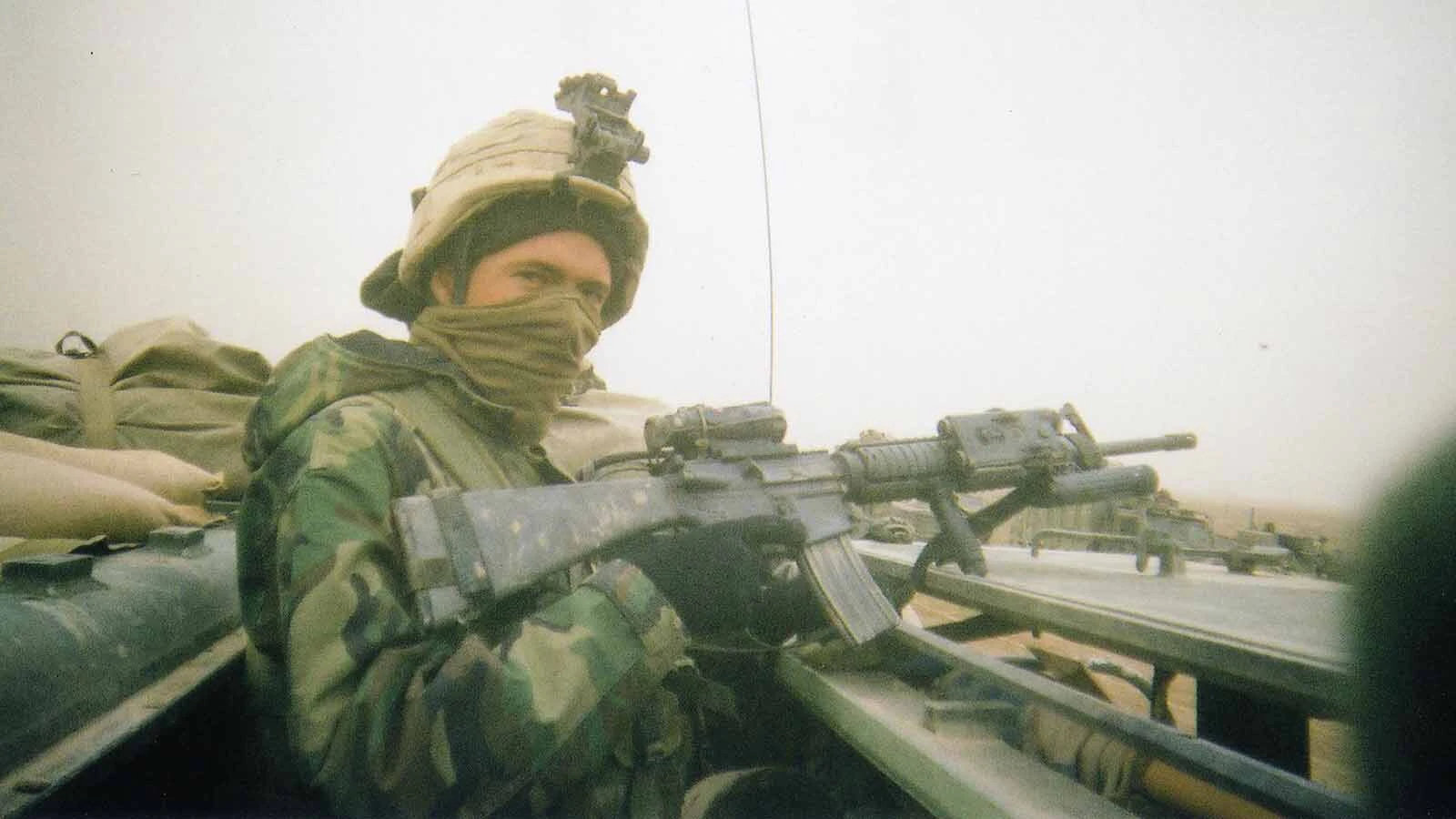
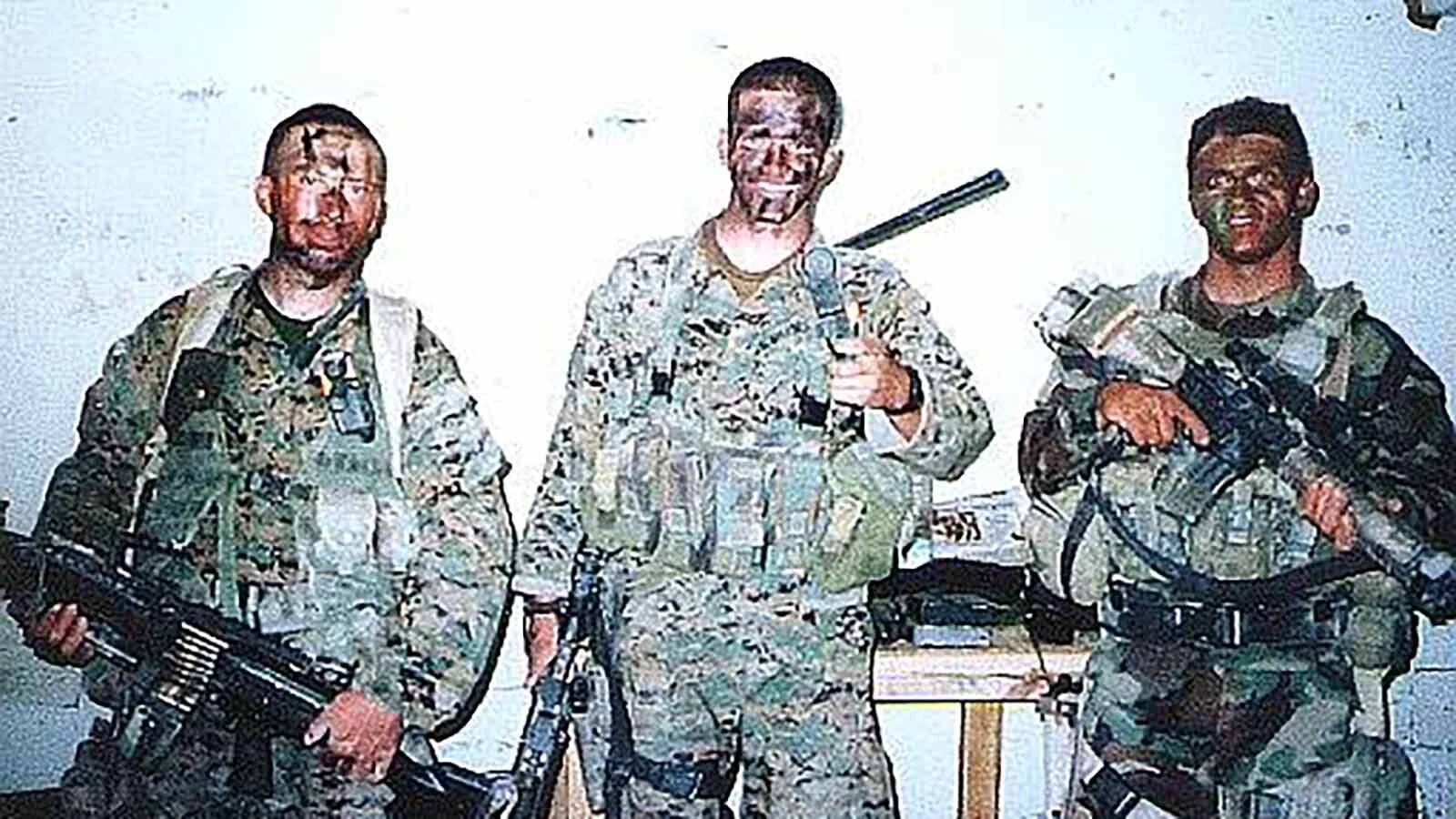
In the summer of 2004, as a sergeant and scout sniper team leader, he was assigned to Iraq’s Anbar Province to support infantry companies in counter-insurgency efforts.
“We worked in small villages and towns all around Fallujah,” he said. “We were in Abu Ghraib prison for a long time, working out of the prison doing sniper patrols.”
In November 2004, his unit was ordered to prepare for the Second Battle of Fallujah. The operation launched on Nov. 7.
Cassady remembers that on Nov. 9 his four-member team was split into pairs, and he and Cpl. Russell Scott had just finished helping clear a building.
Part of their role was targeting enemy 82-millimeter mortar positions.
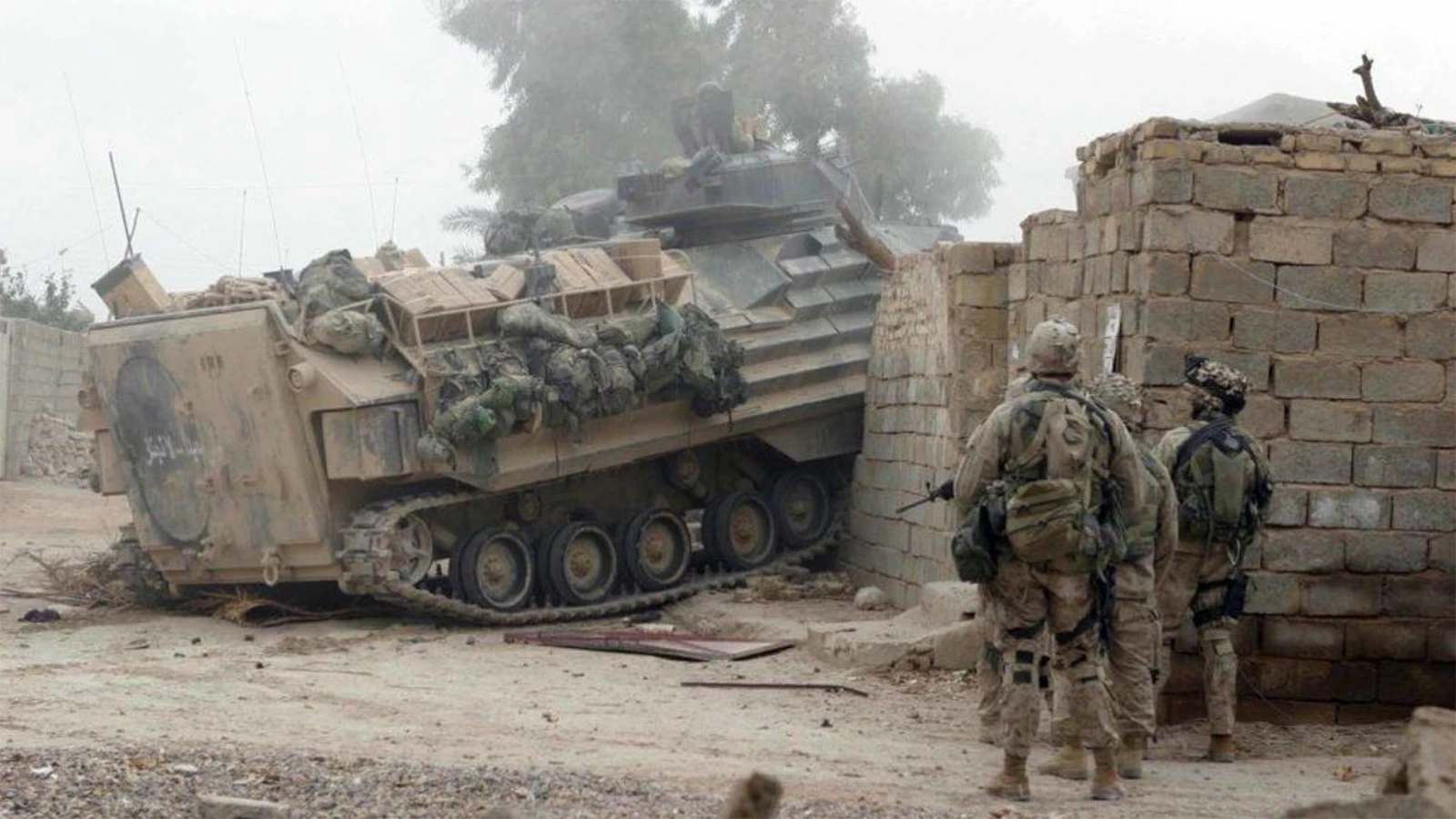
He and Scott were in the street with two members of a tracked armored-vehicle crew as Marines conducted operations.
Mortars Launched
Cassady remembers hearing the thunks of mortar rounds being launched a block away and instinctively running away from the vehicle.
The pair had been headed back into the courtyard and house they had just cleared of the insurgents.
Scott was behind him as the first of several rounds landed and the vehicle was bracketed.
“The round hit behind us,” Cassady said. “It blew Scotty to the ground. It blew me up into the air and then I hit the ground.”
Cassady said he got off the ground, ran into the house and kitchen, put down his helmet and weapon, and ran back out to pull Scott into the house.
He returned to the vehicle and pulled Scott, who was bleeding from the neck, into the house. On his final run to get the last comrade, he discovered the mortar rounds had killed him.
Having done an initial assessment on himself in the kitchen, Cassady found blood on the back of his leg. He assumed he wasn’t badly injured.
But after seeing the last Marine was gone, he looked back down the street, locked eyes with another Marine, and went into the courtyard.
He immediately understood his first self-assessment was not accurate.
“Very soon after, I realized I was very severely injured, because my blood pressure started to drop,” he said.
Cassady recalls sitting down against the courtyard wall, pulling out his pistol for safety, looking at Scott inside the house, then lying down.
Within minutes, a Navy medical corpsman ran into the courtyard and started to work on him. The medic rolled Cassady over and found the entry wounds.
A chunk of mortar had sliced through his back metal plate armor and into his body.
The corpsman tried to stop the bleeding when another mortar attack started. Cassady remembers machine-gun fire, and the medic lying on top of him trying to protect him but making the pain worse.
A Humvee was summoned. Cassady, Scott, and the other Marine were taken to the battalion aid station to be stabilized and then sent to a helicopter landing zone with others to be evacuated.
The landing zone was under fire.
They were flown to a nearby Marine base, where he and Scott held hands, not knowing whether death would come or not.
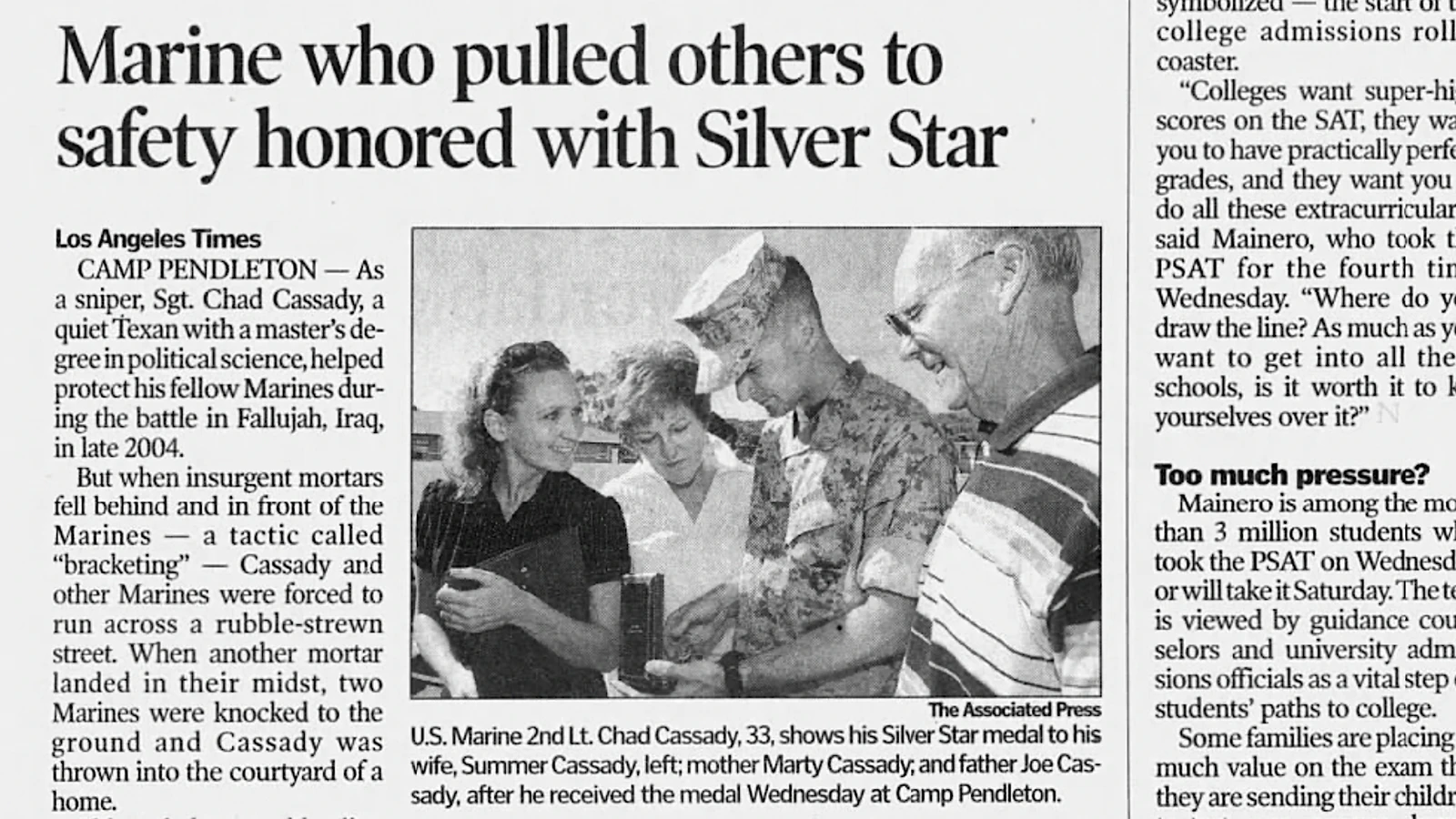
The Los Angeles Times published a story about Chad Cassady receiving a Silver Star for his efforts to save other Marines during combat in the Second Battle of Fallujah in November 2004. (Newspapers.com) 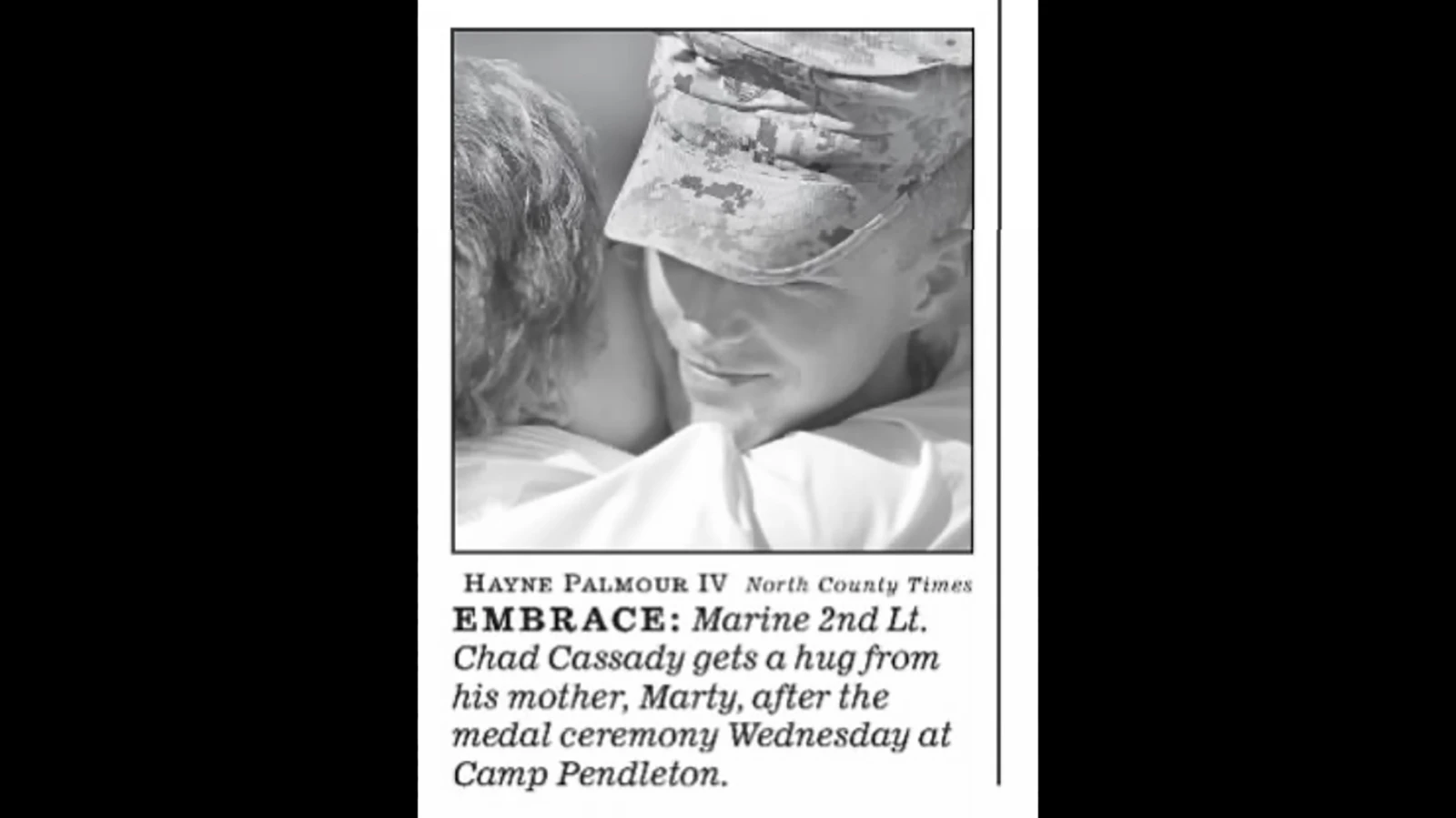
Chad Cassady hugs his mother in a photo taken when he was awarded the Silver Star. (Newspapers.com)
Internal Wounds
A quick assessment of Scott and Cassady led to Cassady being taken into treatment first.
Cassady said Scott didn’t want to let go of his hand because Marines in body bags were being brought out of the same doors they came in.
Scott thought that would be Cassady’s fate.
Cassady remembers waking up in the middle of surgery because they hadn’t given him enough anesthesia.
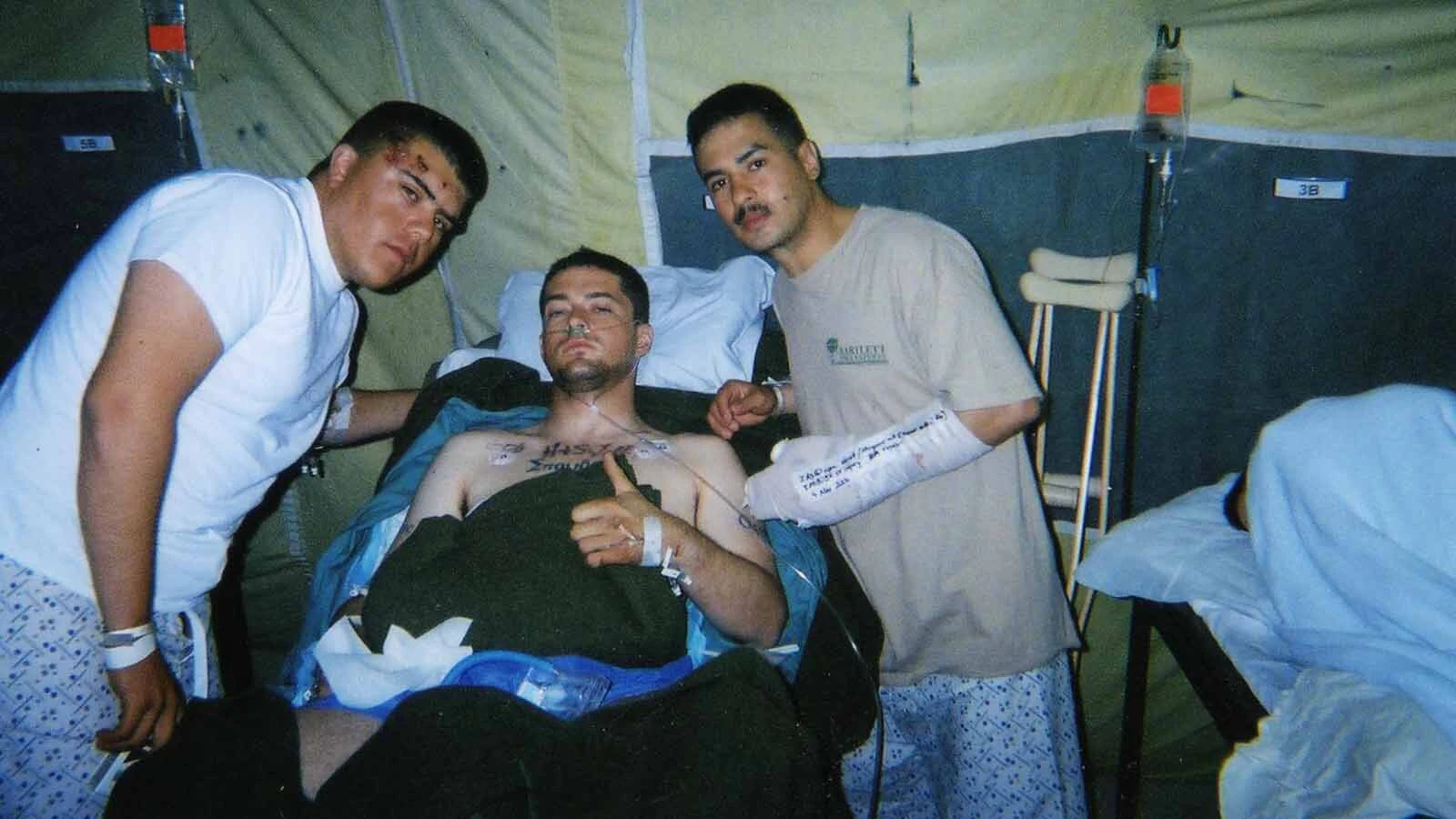
From that base, he was transferred to a hospital in Baghdad, where he woke up in a lot of pain.
It was Nov. 10 — the birthday of the Marine Corps.
He learned he had a collapsed bladder, a right lung with a chest tube pumping blood, and a damaged kidney and liver. Metal had sliced him internally.
He was told he was given last rites three times during the ordeal.
In Baghdad, Marine officers as well as civilian contractors who were former Marines came to the hospital to encourage the troops and share a “Semper Fi” for another year of Marine Corps history.
Cassady said he asked one of the contractors if he had a cell phone. He did. He tried to call his wife, Summer. She didn’t answer.
He remembered his best friend’s number in Texas, called him, and was assured that the friend would call his wife.
Cassady was flown to Germany and then to Bethesda, Maryland. His wife joined him.
After initial care and assessment there, and due to more casualties arriving from Iraq, he was sent on to San Antonio, Texas, while he still had the collapsed lung. The flight made things worse.
“My lung filled back up with fluid and I was suffocating,” he said. “I was in the emergency room and bounced all around these medical facilities in central Texas because no one knew what to do with me.”
Cassady said he finally started to heal, and as his first four-year enlistment in the Corps came to a close he was released back to his unit but still recovering.
His commander encouraged him to do all he could to pass the physical test so that he could re-enlist.
There were conversations and encouragement for him to consider Officer Candidates School.
Silver Star, Re-Enlistment
Cassady never considered not re-upping even though his third deployment and service in Iraq nearly ended his life. He characterizes the Second Battle of Fallujah as one that resulted in an “immense amount of casualties.”
“My generation of Marines were the small-unit leaders in that fight. A lot of us were wounded and a lot of us were killed,” he said. “My commitment was to the Marines and I knew then that the war was not close to over, and that there were young Marines … that really deserved and desperately needed the leadership that we could provide as combat veterans.”
With staples holding his abdomen together just removed, Cassady took the Marine Corps physical test to re-enlist. He remembers it being “brutal” to do the crunches and other exercises, but he passed.
He was selected for Officer Candidates School in Quantico, Virginia, and then to The Basic School for officers, followed by an infantry officers course.
Cassady was assigned to the Marines’ 2nd Battalion, 5th Regiment as an officer and, following a tour in Iraq in 2007 where he was involved in the surge in Ramadi, he received the Silver Star for his actions in Fallujah that November day in 2004.
The Los Angeles Times published a story in its Oct. 18, 2007, edition about his award, delayed because of his deployment. The newspaper quoted fellow Marines who described Cassady as “quiet” but “tactical.”
“He’s definitely a lead-from-the-front type,” Sgt. Aaron Beckett told the newspaper.
In addition to the Silver Star, Cassady received two Purple Hearts, Navy and Marine Corps commendation medals for valor, and other awards.
Varied Career
Cassady said his career involved more ship deployments, a stint in Afghanistan, and a few years as an exchange officer with the Royal Marine Commandos in England while a captain.
He also served as a company commander back in Iraq protecting the U.S. Embassy in Baghdad from ISIS.
After becoming a major, Cassady was sent to Australia to attend the Command and Staff College with the Australian military. His final years were spent working at the Mountain Warfare Training Center in northern California.
Military friends from Wyoming and a Vietnam vet who became his neighbor (who was also from Wyoming) suggested he consider moving his family to a small community in the state after his retirement. He said he retired at 20 years in 2021 to spend more time with his family, which includes three sons.
Cassady said he didn’t want to go into law enforcement and sought to try something different, so he went to a gunsmithing school in Colorado. The family moved to Lander and he opened his gunsmithing business in 2023.
Meanwhile, in a conversation with a former Marine buddy about five years ago, Cassady casually mentioned how he never forgot the serial number of the sniper rifle he carried in Fallujah in 2004.
“You get issued a lot of weapons in the military and you are required to memorize the serial numbers,” he said. “I memorized many serial numbers over the years and they just got jettisoned out of my memory, except for one, and that was my sniper rifle.”
Unknown to Cassady, his friend wrote the serial number down when Cassady recited it to him. Then the friend began a search for the weapon and a way to reunite it with Cassady.
FOIA Request
His friend did a Freedom of Information Act request on the weapon using the serial number and learned it was in “cold storage” at a Marine Corps base in Georgia.
“He is heavily involved in Marine Corps history, firearms, and knows a lot of people in those spaces,” Cassady said. “And they very slowly, within the bounds of the law, started to try and figure out if there was a way they could reunite that rifle with me legally.”
His friend found there was a method where if the rifle was transferred to the Civilian Marksmanship Program in Anniston, Alabama, there was a possibility that the organization could help get it back to Cassady.
Over three to four years, delayed by the COVID pandemic, people Cassady “never met” helped his friend get the weapon transferred to the civilian program.
Once they received it, officials in Alabama at the program could decide whether to sell it, hold it, or whatever they wanted to do.
They chose to give it back to Cassady.
So in June, Cassady flew back to Georgia and then went to Anniston, for a ceremony where the weapon he carried through sniper school and onto the streets of Fallujah was reunited with him.
Cassady said the M40A3 had been upgraded to an M40A6 at that point. The scope on the rifle had been damaged and the receiver gouged by mortar fragments when he carried it on Nov. 9, 2004.
It now has an updated barrel and different stock, but “continued to serve the country just like I did,” he said. The serial number was the same.
While in Anniston, he fired some rounds. Memories of his sniper school and those two days in Fallujah came flooding back.
“It’s a very intense connection it brings back,” Cassady said. “When I carried that rifle in defense of the nation I saw and was exposed to the worst of humanity. And at the same time, in the same day, within minutes of each other, I saw the most selfless behavior that a human could exhibit.”
Now the rifle is in his gun safe and he feels “blessed” to be in a place where his friend and others whom he has since met “cared for me and wanted me to find peace” and reunited him with the weapon whose serial number he never forgot.
Cassady understands that combat service members rarely, if ever, get the weapon they carried into battle back into their lives. He said as a gunsmith he knows weapons, and none of the rifles he’s worked on feel the same as that sniper rifle.
He said he would love to meet other Marines who carried his sniper rifle serving the country after he did.
“It’s surreal,” he repeated. “I am so grateful.”
Dale Killingbeck can be reached at dale@cowboystatedaily.com.


