
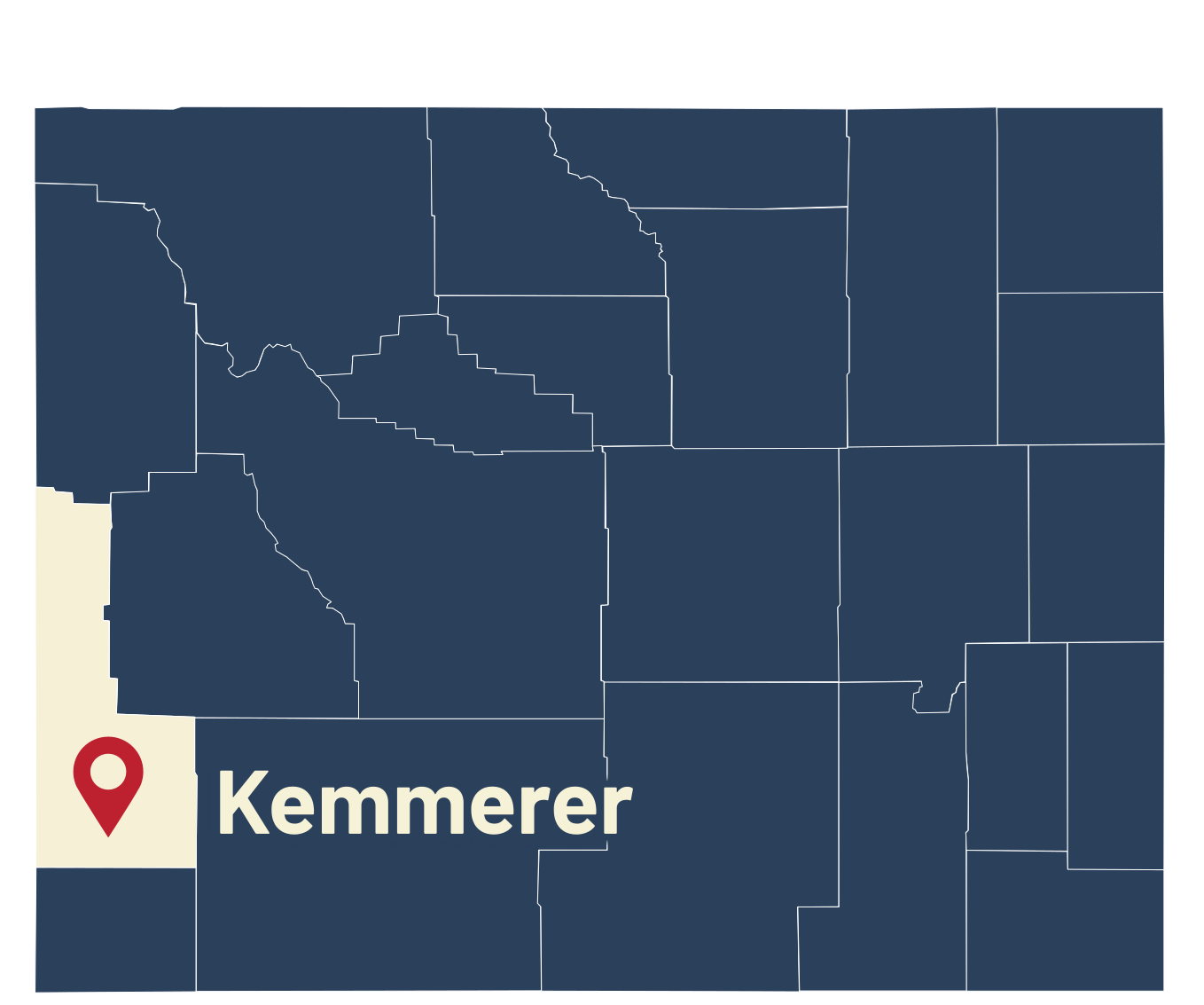
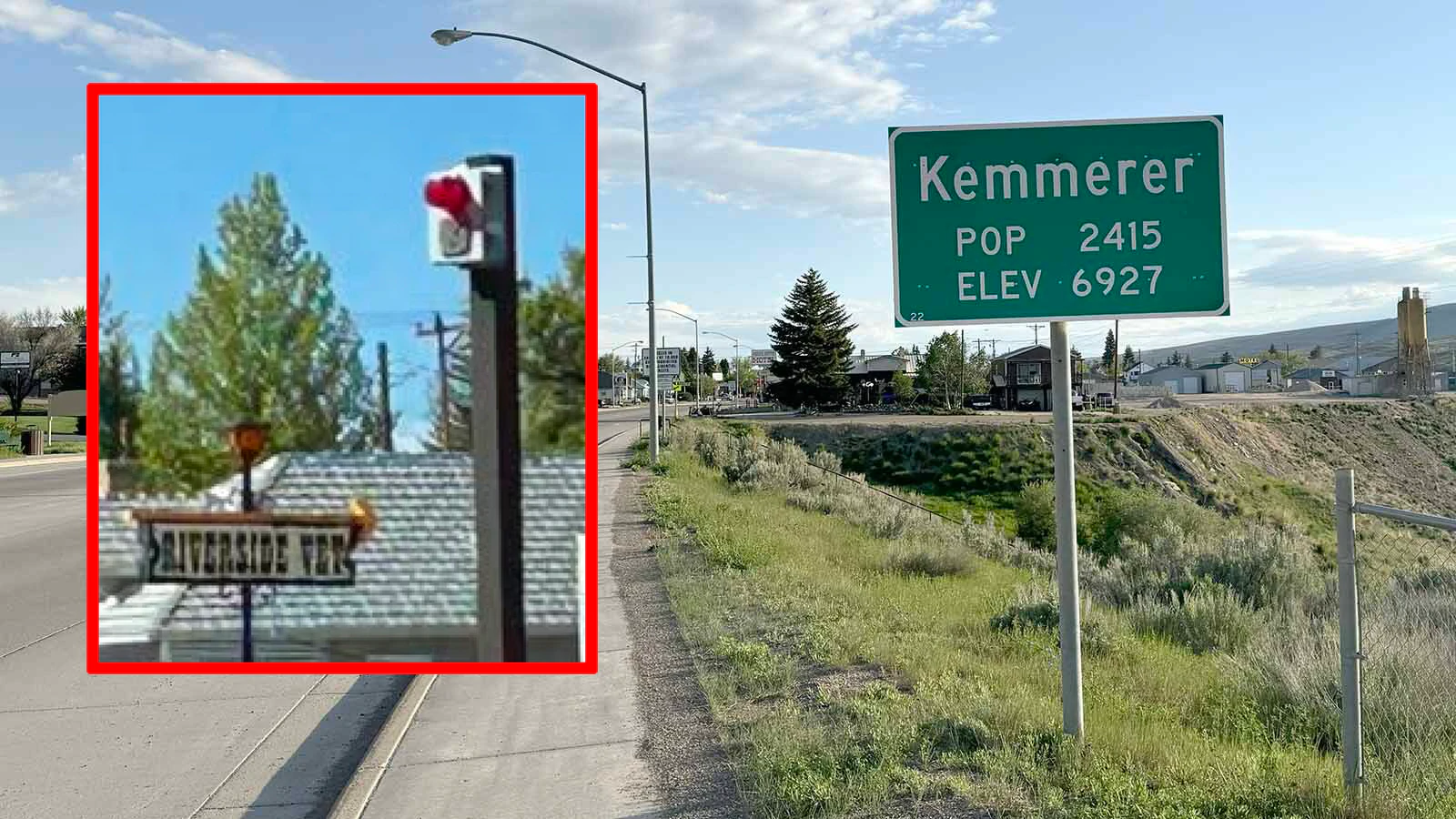
A social media post mistakenly identifying new surveillance equipment in Kemmerer as Flock cameras has sparked a broader debate over privacy, police surveillance and what the cameras actually do.
The controversy came before the Kemmerer City Council on Monday, when the city’s police chief presented information about the cameras at the request of Mayor Robert Bowen.
No action was taken or needed, Bowen told Cowboy State Daily, adding, “We’ve already purchased the cameras.”
Bowen said he asked Police Chief Michael Kahre and members of the police department to prepare the presentation to address what he described as misinformation about surveillance cameras and personal property rights circulating on social media.
Town Attorney Jason Petri also was asked to give the council a legal opinion about whether the cameras violate residents’ privacy rights.
“They pretty clearly do not,” Petri told Cowboy State Daily.
The issue, Bowen said, largely stems from one person’s interpretation of the cameras and applicable privacy law.
That person is Marshal Corwin, who attended the council meeting Monday. He has said on social media that the surveillance cameras are constantly searching people regardless of wrongdoing.
Bowen said Corwin was “quoting a lot of case law that is not applicable.”
Chief’s FB Response Starts Firestorm
The controversy came to light Sept. 1, when an anonymous person posted photographs of the new cameras on social media.
“Anyone else seen the Flock cameras in Kemmerer? One in front of BMO and one in front of Riverside Vet and one on the Vidock by the museum on the light poles,” the post said.
Kahre was the first to respond, saying, “Rather than posting without knowledge of the cameras and jumping to conclusions one should ask!”
He then clarified that the cameras are not Flock and are not part of the Flock Safety system.
Instead, they are standard surveillance cameras, he said, similar to security cameras used by businesses, schools and other public facilities.
“They are there to assist our officers with public safety, investigating incidents, and protecting our community,” Kahre said.
Kahre said he is aware of the conversations and concerns surrounding Flock cameras and automated license-plate reader technology.
“I believe our citizens deserve accurate information about the equipment their police department is using,” he said.
The exchange quickly grew into a much larger discussion, generating more than 100 responses. Some commenters expressed anger, while others posed questions.
The discussion ranged from comparisons between the surveillance cameras and Ring doorbell cameras to questions about the number of police officers in Kemmerer and broader concerns about privacy and government surveillance.
Corwin told Cowboy State Daily in a Facebook message that he disputes the police department’s position that the cameras do not violate privacy because there is no expectation of privacy in a public place.
“If there’s no right to privacy then stalking is legal, photographing and filming children playing at school is legal,” he said.
Cameras Are Not Flock
Bowen said he asked for the presentation at Monday’s council meeting to educate both the council and the public.
The Kemmerer Police Department has operated one surveillance camera for several years, Bowen said. The department purchased three others this year. The cameras are mobile, which allows police to move them around town.
Kahre said the cameras do not collect data and are not routinely monitored in real time. Bowen added that there is no artificial intelligence software or facial recognition.
“It’s just a regular camera,” he said.
The cameras were purchased using impact funds — industrial assistance payments intended to help local governments offset the public costs and infrastructure demands associated with large-scale energy and industrial development.
In Kemmerer’s case, the money came from the TerraPower project, the nuclear power plant backed by Bill Gates.
Bowen said the town did not purchase the cameras because it expects crime to increase as the TerraPower project brings more people to the area.
Instead, he said, the cameras are intended as another public-safety tool.
Bowen acknowledged the area is experiencing population growth and that more people in town means more traffic and potentially more incidents.
“But we didn’t buy them because we’re worried about an increase in crime. We bought them for safety,” he said. “We understand they’re good people coming in."
What About Privacy?
Petri’s role Monday was to explain what the law permits, rather than advise the council on whether it should operate the cameras.
His legal analysis relied heavily on a series of U.S. Supreme Court decisions addressing people’s expectation of privacy in public places.
“If you’re walking down the street, a police officer could be standing on a corner writing down license plate numbers of cars that pass by,” Petri told Cowboy State Daily. “You might not like it, but it’s not against the law.”
A police officer would not need a search warrant simply to observe and record information visible from a public place, Petri said.
The situation is different when officers seek to search private property or areas where a person has a legally protected expectation of privacy.
“It’s different if you’re in your house or driving your car and police want to search your car,” he said.
For Kemmerer officials, Monday’s discussion was less about changing the city’s camera policy than making sure residents understand what equipment the police department is using.
And while the cameras might look similar to equipment used in other communities, officials emphasized they are not Flock cameras, are not part of the Flock Safety system and do not use the automated license-plate reader technology.
Around Wyoming
The distinction is significant in Wyoming, where Flock cameras have become the subject of controversy in several communities.
Glenrock is under a 30-day extension to decide if it will continue the use of its four Flock cameras – plus one in Rolling Hills – at a $15,000-per-year price tag. Residents have pressed town officials and Police Chief Colter Felton for more information about the cameras on the town’s perimeter and in nearby Rolling Hills, raising questions about transparency, cost and privacy.
In Jackson, where 28 Flock cameras are in operation, residents and privacy advocates have also questioned the scope and regulation of the technology.
"Everybody knows that when you're in public, you don't have any expectation of privacy in the sense that you can see people and people can see you,” Jay Stanley, senior policy analyst for the ACLU, previously told Cowboy State Daily.
In July, Green River residents shut down the city council’s consideration of whether to approve a nearly $112,000 grant it had been awarded to install license-plate readers around the city. The council and mayor voted 6-1 against approving the grant.
In Kemmerer, however, town officials say the cameras are a much simpler tool – and that much of the controversy stems from mistaking them for something they are not.
Kate Meadows can be reached at kate@cowboystatedaily.com.


