
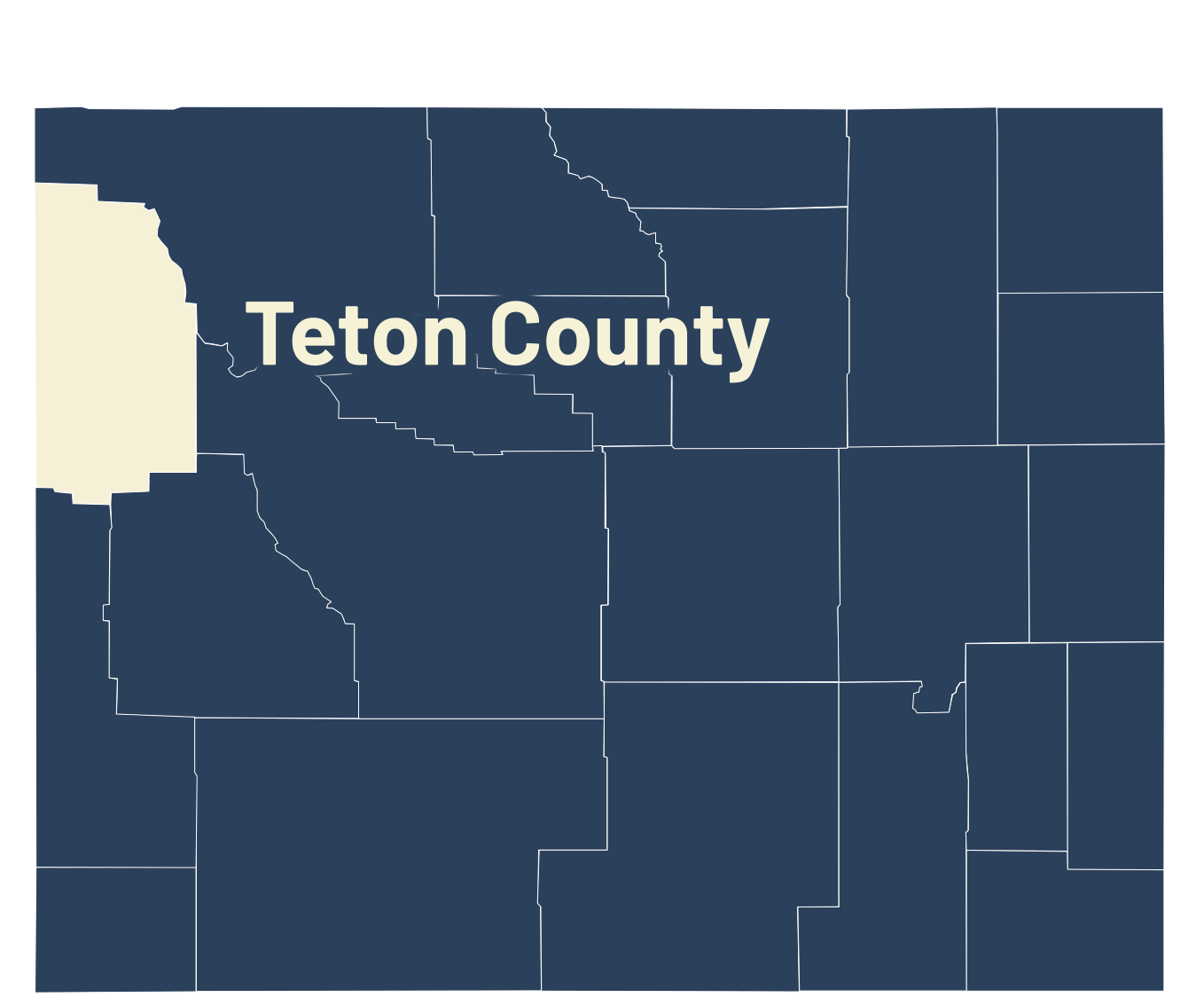

Teton is the only county in Wyoming with its own registered lobbyist.
That’s because the state’s only blue county is a unique place, where the local governments charge fees of home builders so they can subsidize price-capped and affordable housing for daily-grind workers living among the ultra-rich.
The Teton County Commission voted Tuesday in favor of renewing the lobbying contract of Nick Agopian, but with a price upgrade from the prior rate of $9,000 to $10,000 a month. Agopian has represented the county before the Wyoming Legislature since 2024.
“Well, Teton County has our own mix of challenges, and framed in our own way,” Commission Chair Mark Newcomb told Cowboy State Daily in a Thursday phone interview. “I think housing is probably no. 1 on the list. We want to make sure we are always poised to meet that with all of our local programs.”
Wyoming lawmakers from other communities have opposed those “local programs” for years.
In 2021, Sen. Bo Biteman, R-Ranchester, successfully championed a bill that barred cities from conditioning sewer access on the homeowner’s contributions to the supply of price-capped and affordable housing.
Around that time, developers in Jackson were clashing with local government over whether the town could use sewer access as a bargaining chip.
Housing mitigation fees and programs are just “one leg of the stool” that supports affordable housing, Newcomb said Thursday, “but still part of that stool, and we want to protect it.”
Speaking personally, Newcomb said he feels $10,000 a month for the lobbyist is steep.
“But (Agopian) is good at his job, and in the long run, paying him to preserve what, over the years, can amount to a couple million dollars in mitigation fees makes it worth it for the workers of our county,” he said.
Agopian declined to comment.
Economic
The debate over mitigation fees is economic.
State Rep. Steve Johnson, R-Cheyenne, supported the latest unsuccessful effort this year to ban housing mitigation fees altogether, and he suggested that capitalism could correct the region’s woes.
“I feel sorry for these rich people. Maybe if they’d pay a living wage,” he said in a sarcastic tone during floor debate on the bill.
Johnson said people might have to pay $500 an hour for Teton County’s economy to self-correct, but that’s not the public’s job.
Other lawmakers agreed.
On the other hand, proponents of the mitigation system say workforce housing depends on it.
House Appropriations Chair John Bear, R-Gillette, brought an amendment in 2025 and a bill in 2026 to ban housing mitigation fees, which he’s called a violation of the Fifth Amendment’s provision against the government “taking” property without paying a fair price for it.
At least one family agrees with that assessment: Trey and Shelby Scharp sued the county in 2025 over what they called government “extortion” leveraged from a common-sense upgrade to their family home. The lawsuit ended early when the county said it had “miscalculated” the fee that sparked it.
The Scharps lamented not being able to take the issue to trial.
Meanwhile, both of Bear’s attempts failed.
Some Senate lawmakers said they rejected the 2026 version because it was steeped in the CheckGate controversy. Its chief proponent handed out checks on the House floor two days before its introduction.
But housing mitigation fee proponents have had another Wyoming philosophy on their side: Local control. The notion is that smaller iterations of government should control the problems closest to them, instead of the Legislature.
“We like to keep our local control,” said Newcomb.
He’s eyeing the newest iteration of the Legislature with caution.
“We’ll see what happens this year. I know it’ll probably come back,” he said of the legislation.
Bear, Johnson, and many other housing mitigation critics are not returning after losing their primary election challenges. Novice lawmakers with little or no known record on the issue will take their place in January.
Why Not Use Everyone Else’s Lobbyist?
County governments pay dues to the Wyoming County Commission Association, whose lobbyist Jerimiah Rieman represents their general interests before the Legislature.
Rieman pushes for greater local funding and autonomy.
That’s not enough to account for Teton County’s interests, he conceded in a Thursday email. He said he suggested Teton should consider hiring its own lobbyist.
“So, you know, a few years ago as we were working through some of those issues, and as they became more of a time demand for me, I actually approached the county and said, ‘I think it would be worth having a conversation about having some additional support that is specific to your county,’” Rieman recalled.
Teton is also represented by the WCCA, and one of its commissioners, Natalia Macker, serves as the advocacy group’s president.
“It’s something that I think ultimately is a partnership,” said Rieman.
He noted that while Teton is the only county commission with a registered lobbyist on the books, other counties – particularly the mineral-rich in northern Wyoming – send paid representatives to communicate with federal agencies.
“Those same folks work very closely with my team, which is dedicated to natural resource issues,” said Rieman.
Like Newcomb, Rieman remembered Teton’s workforce housing systems triggering tension in the Legislature.
Jackson Did, Too
Teton’s county seat, Jackson, just concluded its own lobbyist contract, with former Democratic lawmaker Andy Schwartz.
Schwartz said he ended that relationship because his other lobbying work is “concentrated in one area” of social services, such as developmental preschools, youth services, and senior centers.
Schwartz said he started serving the town around early 2023 and lobbied for it for three legislative sessions.
Housing was the key reason.
“It’s all about the exactions and housing funding. That was what prompted them to do it, because there’s been this repeated effort going back – I don’t know – to when I was in the Legislature,” said Schwartz.
Schwartz’s tenure ended in 2022.
Schwartz said he’s “had a couple conversations from people in other parts of Wyoming asking about methods to fund housing programs.”
That “used to be just a Jackson issue,” but it’s spreading, said Schwartz, adding he’s heard of interest from people in Cheyenne and Laramie.
Jackson Mayor Arne Jorgensen told Cowboy State Daily the Wyoming Association of Municipalities, which represents towns and cities, has progressed to a point at which it can represent the town’s interests.
Clair McFarland can be reached at clair@cowboystatedaily.com.


