

Editor's note: This story has been updated to include a response from Odyssey, the online platform the state uses to administer its Education Savings Account program.
For Wyoming parents trying to use the state’s new Education Savings Account program, getting approved for funding has not necessarily meant having money they can actually spend.
Some families have logged into the state’s online ESA platform and seen thousands of dollars appear in their accounts, only to find the money later frozen or removed.
Others are still waiting for final approval while trying to make decisions about curriculum, school enrollment and the coming academic year.
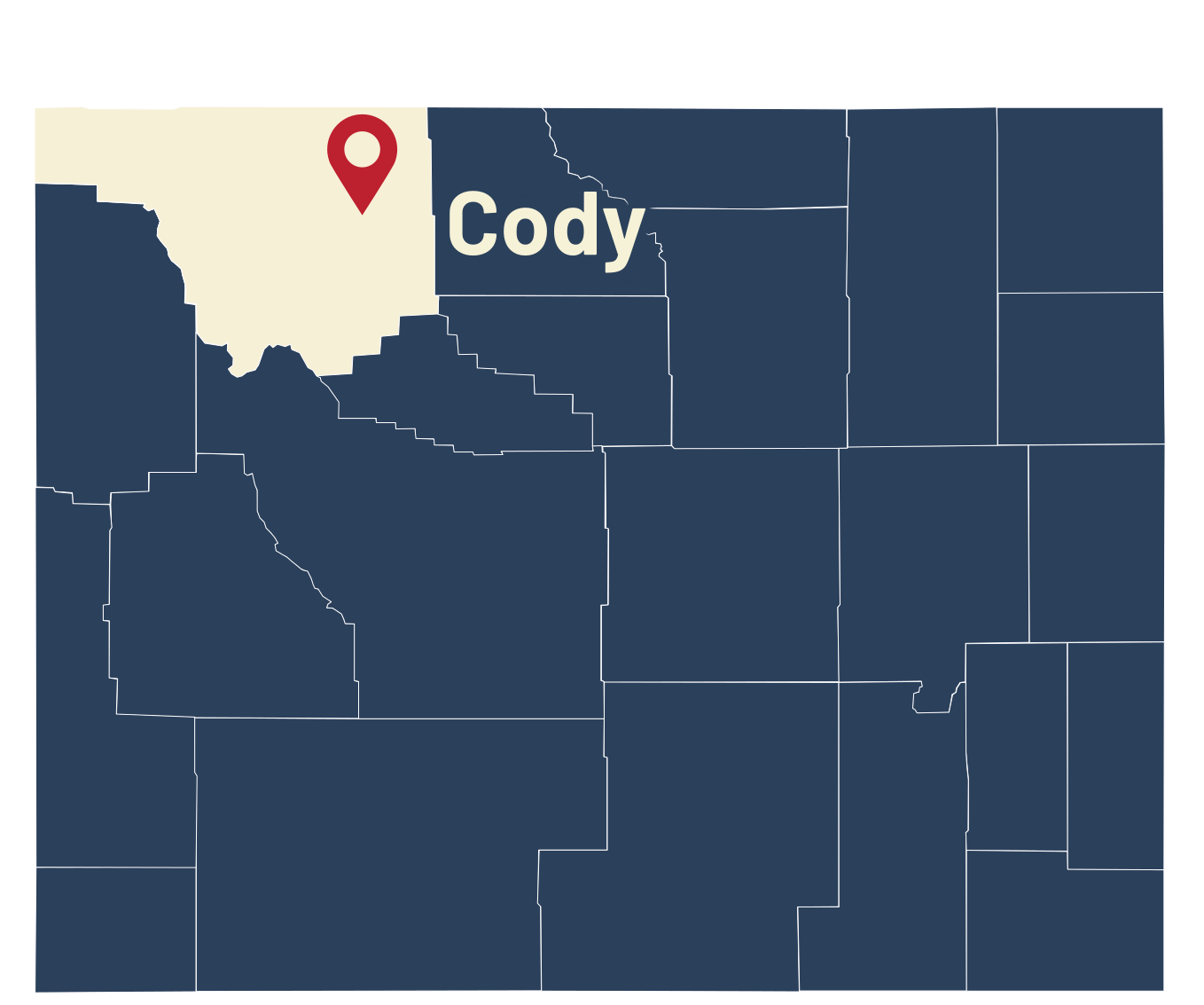
For Ann Pavlak, a Cody mother of two homeschooled children, the uncertainty has been especially frustrating.
“I feel like they took on this massive thing and they didn’t do a lot of groundwork up front,” Pavlak told Cowboy State Daily. “They really didn’t do the research to make sure it got implemented smoothly.”
The Wyoming Education Savings Account program was approved by the Legislature in 2024 and is intended to give families public funds they can use for a variety of educational expenses outside the traditional public school system.
The program provides up to $7,000 annually, or $1,750 per quarter, for each eligible student.
But the rollout has been complicated by a pending constitutional lawsuit and by what the Wyoming Department of Education describes as the challenges of launching a “historic program.”
The result, some parents say, has been a frustrating cycle of applying, waiting, receiving approval, making plans and then finding out they still cannot access the money.
Dicky Shanor, chief of staff for the Department of Education, said the state understands families are eager to receive and use their ESA funds.
“As with any historic program rollout, we've received questions and concerns,” Shanor told Cowboy State Daily via email. “We understand that families and providers are eager to receive funds, and we are working to do so as quickly as possible while still ensuring the program is implemented responsibly.”
Funds appear, then vanish
Pavlak applied for ESA funding last year, but the program was temporarily halted after the Wyoming Education Association and nine parents filed a lawsuit challenging its constitutionality.
About 4,000 families applied and were approved to receive funds when the freeze took effect, leaving those disbursements unavailable for the 2025–26 school year.
“By the time school was supposed to start, they said it wasn’t going to get resolved,” Pavlak said. “I thought it wasn’t ever going to get off the ground.”
In May 2026, the Wyoming Supreme Court lifted an injunction imposed by Laramie County District Court, allowing the state to move forward with the program while the lawsuit continues.
This year, Pavlak applied again.
She then found herself facing a different kind of uncertainty: Whether her children would actually receive the money she was told they were eligible to receive.
Emails reviewed by Cowboy State Daily illustrate the confusion.
In one message sent through Odyssey, the online platform the state uses to administer the program, families were told their accounts incorrectly reflected a “funded” status before the funding process was complete.
“As a result, the funds previously reflected in your account are not available at this time,” the email said.
Families whose accounts were changed back to “Eligible” were told their children were on a waitlist for funding and could receive money if additional funding became available.
The email also said purchases made while the funds were showing as available had been canceled.
“We apologize for any confusion this may have caused,” the message concluded.
Consequences Of Confusion
For families trying to plan a school year, Pavlak said, the confusion has real consequences.
This year, she said she weighed whether to enroll her children in Brain Tree, the tuition-free virtual K-8 school she ultimately signed up her children for last year, or try again to obtain ESA funding.
Enrolling her children in the virtual school would make them ineligible for the ESA program because students cannot simultaneously be enrolled in a public school and receive ESA funds.
Pavlak said she was reluctant to make either decision without knowing whether the ESA money would actually be available.
Then, Thursday, she received an email saying one of her two children had been approved for funding.
But the enrollment remains pending. Her other child was listed as approved but “on hold.”
Odyssey later said in an email to Cowboy State Daily the second student's appeal “remains under review and is expected to proceed to approval and funding upon completion of that review.”
Pavlak said the differing statuses left her unsure what they meant or when she would actually be able to use the money.
She said she knows another family that received ESA approval, only to see its funds frozen.
According to Pavlak, her friend logged into Odyssey after receiving notification that her two sons had been funded and used the available money to purchase curriculum and supplies.
The next day, she said, the funds were frozen.
“It is a mess,” Pavlak said. “From all sides, it’s been a weird experience.”
Parents Not Alone
Pavlak has also experienced the program from the provider side.
She said she applied to become an ESA vendor so she could provide reading-specialist services through Odyssey.
Although she said she has been approved by the state to provide those services, she has been waiting more than a month for Odyssey to approve her vendor profile.
Odyssey disputed that, telling Cowboy State Daily that Pavlak applied as a vendor on behalf of Gravel Road Reading and that Gravel Road Reading’s application was approved on July 6.
Meanwhile, Pavlak works with two homeschooled students whose families have applied for ESA funding.
She said one family has received ESA funds but cannot use them to pay Pavlak because Pavlak is not yet approved as a vendor on Odyssey.
Again, Odyssey disputed that claim, saying Pavlak’s “readily verifiable factual claims is directly contradicted by contemporaneous records.”
Gravel Road Reading has been an approved Odyssey vendor for more than two months, the company said in its email and has had active offerings available in the marketplace.
Meanwhile, she works with two homeschooled students whose families have applied for ESA funding.
One family has received ESA funds but cannot use them to pay Pavlak because she is not yet approved as a vendor on Odyssey, she said.
The other family, she said, was told it had received ESA funding, but those funds have since been frozen.
The situation has left Pavlak caught between families trying to spend their educational dollars and a state system that is still working through the details of getting those dollars where they are supposed to go.
Still Working Through Rollout
Shanor said the department and Odyssey have assisted hundreds of families with questions and problems.
For the 2026-27 school year, the department has received 4,915 ESA applications. Of those, 4,461 have been approved or determined eligible, Shanor said.
The program has funding available for 4,200 spots, which are allocated on a first-come, first-served basis as required by state law.
Last year, the department received 4,012 applications, but eligibility verification was not completed because the program was paused.
Shanor said Odyssey is expected to complete final document verification by Tuesday, after which families that applied for ESA funds will be placed in the appropriate status.
Lawsuit In The Background
The uncertainty surrounding the ESA program comes as the state continues to defend it in court.
The Wyoming Education Association, which represents more than 6,000 public-school employees, filed the lawsuit in June 2025 along with nine parents of school-aged children.
The lawsuit challenges the constitutionality of the ESA program on two grounds.
It argues that directing public money toward private educational enterprises violates the Wyoming Constitution. It also argues that the program conflicts with the constitutional requirement that Wyoming provide a “complete and uniform system of education.”
A Laramie County District Court judge issued an injunction blocking the program last year, but the Wyoming Supreme Court later lifted that injunction, allowing the state to distribute ESA funds while the broader case continues in district court.
The litigation therefore remains an important backdrop to the program, but for parents like Pavlak, the immediate concern is more practical.
They need to know whether the money they have been told they qualify for will actually be there when they need to spend it.
The ESA program was created to give parents greater control over their children's education.
Shanor said flexibility is central to the program.
“The program exists because learning is not one-size-fits-all,” he said. “It lets parents choose the best learning environment for their child while maintaining academic accountability through core curriculum requirements and annual progress evaluations.”
For families trying to make those choices now, however, the question is whether the promised flexibility will be accompanied by a system they can count on.
Pavlak said the uncertainty has made an already complicated decision even harder.
Families are not simply waiting for money, she said. They are making decisions about where their children will go to school, what curriculum they will use and what educational services they can afford based on whether those funds will actually materialize/
Kate Meadows can be reached at kate@cowboystatedaily.com.


