
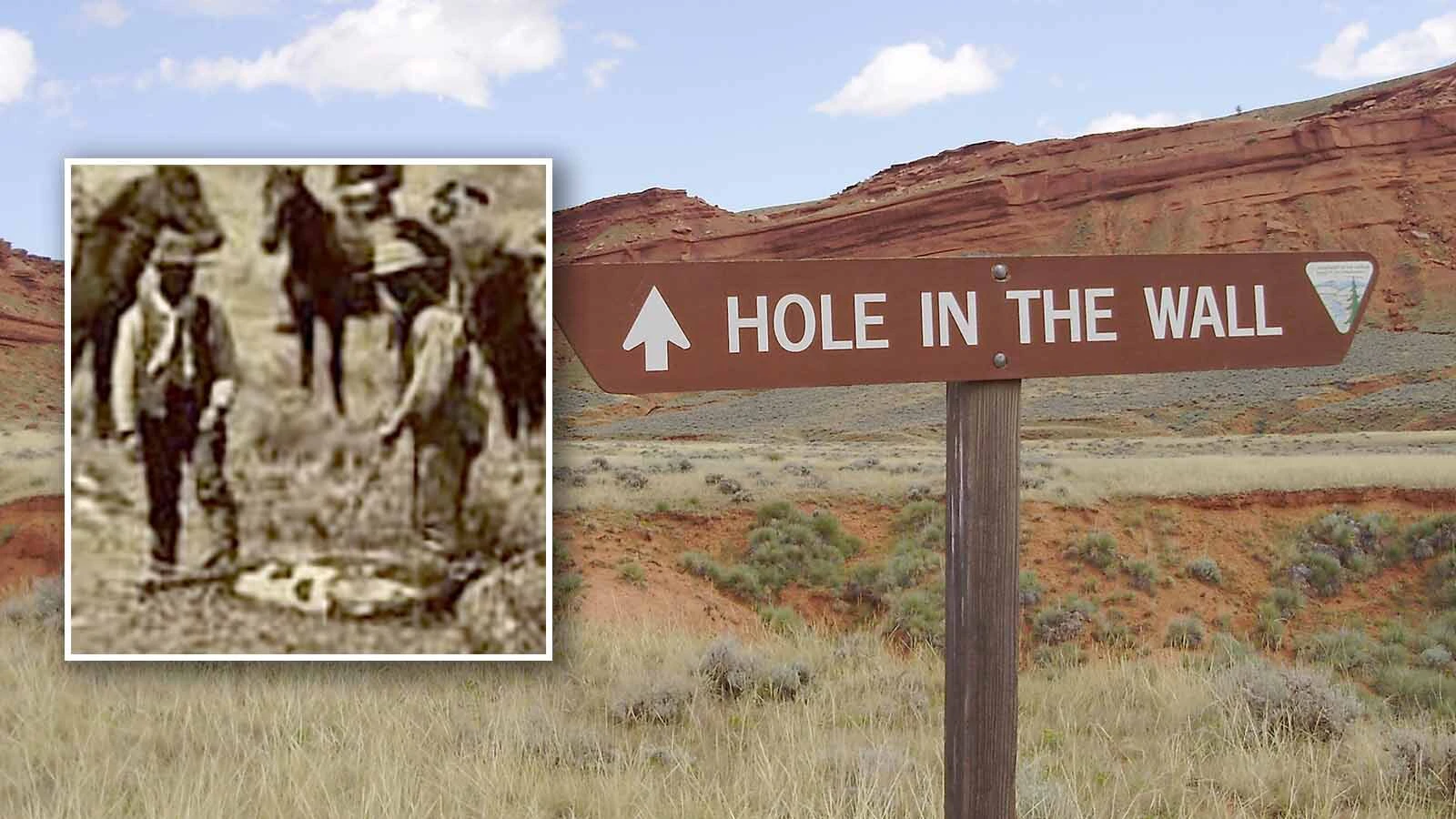
A photo of the elusive Hole-in-the-Wall outlaw Harve Ray has just been officially verified by historian Michael Bell after more than a year of research.
Ray was known to be a cattle rustler and was involved in at least two major heists – the Belle Fouche Bank robbery and the Wilcox train robbery.
“For the first time ever, we have a photograph of this Wyoming outlaw,” Bell told Cowboy State Daily. “Harve Ray, had he lived longer, would have been as famous as Flat-nosed George Curry, Butch Cassidy, and Harvey Logan.”
Instead, Ray disappeared and, more than a century after his mysterious disappearance, has all but faded from public memory.
“Maybe he got the memo that said outlawry is not a good thing to do, and he just dropped out completely, like a smart man,” Bell said. “We know that Al Hainer, Butch Cassidy's partner, disappeared in 1903. There's quite a few folks in the Wyoming Outlaw circles who just vanished.”
The 1887 photograph is in the Wyoming State Archives and most of the men were identified by their full name when the photo was taken. Bell spent over a year researching each person in the photograph and proved their identities conclusively.
“My theory went that if the majority of these people are identified as named individuals whose history we can trace,” Bell said. “Then the logic is that the man identified as Harve Ray really is Harve Ray.”
Bell said the man labeled “5” and holding the branding iron is Ray during his years as a law-abiding cowboy working on Kirby Creek.
“I don't know how this photograph got into the Wyoming State Archives so we don’t have providence,” Bell said. “It's not perfect but my argument is based on resilience. Every other character named in this photograph can be identified and can be placed in that area at the time.”
Bell said he believes that the photograph was taken by Capt. Edward Cooksley, who owned the ranch where the branding took place.
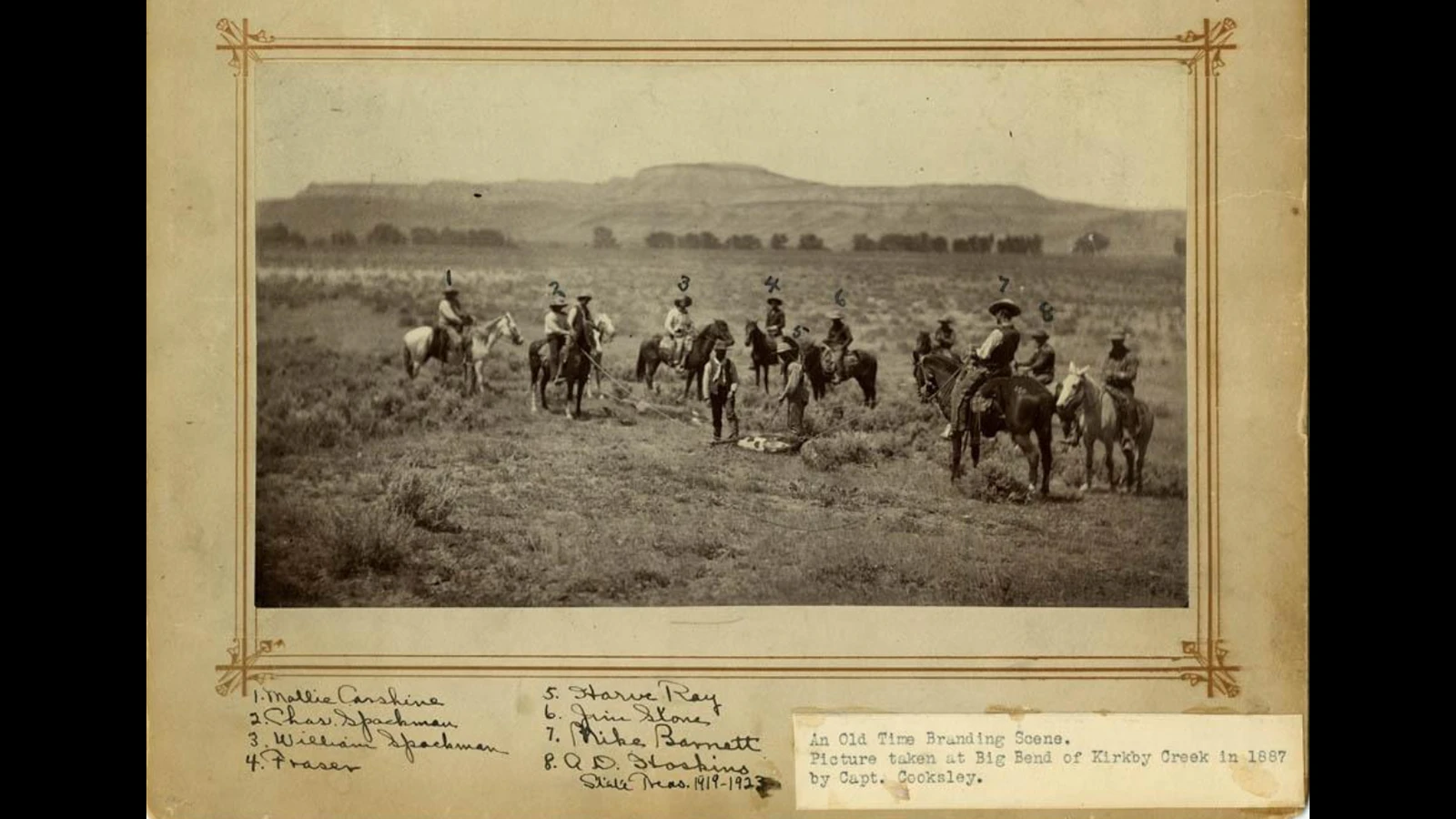
Historian Mike Bell said that after over a year of research, he has verified that two of the cowboys pictured in this 1867 branding photo on Kirby Creek are identified correctly as two notorious outlaws. No. 5 is Harve Ray, who went on to become involved in the Belle Fouche robbery and the Wilcox train robbery and Mike Barnett who was killed in a shootout at the Cunningham Cabin in Jackson. It is the only known photo of Ray, who was more notorious and well-known in his time than Butch Cassidy and the Sundance Kid. (Claire Nicholson Taylor, BLM Intern) 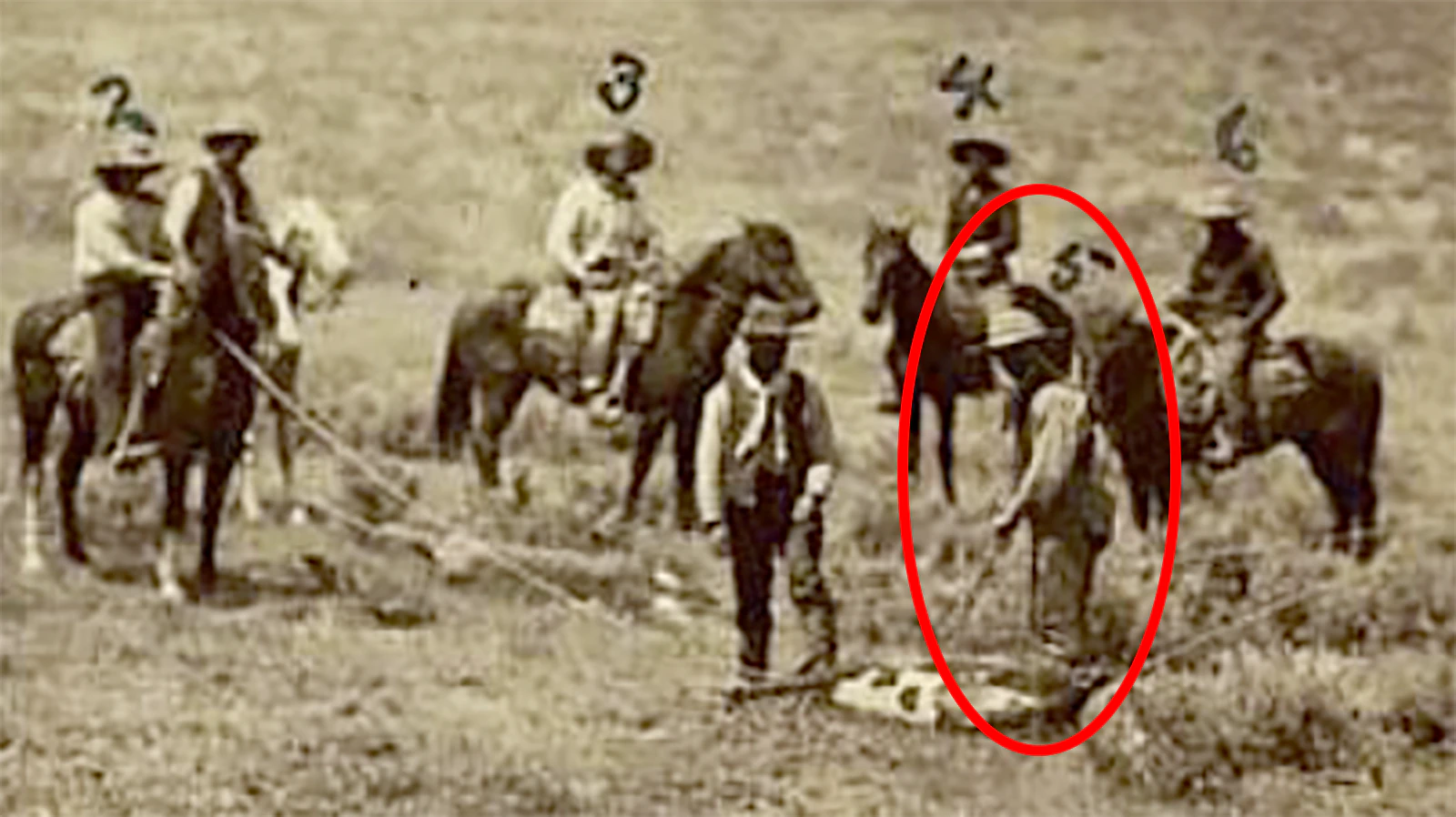
Historian Mike Bell said that after over a year of research, he has verified that two of the cowboys pictured in this 1867 branding photo on Kirby Creek are identified correctly as two notorious outlaws. No. 5 is Harve Ray, who went on to become involved in the Belle Fouche robbery and the Wilcox train robbery and Mike Barnett who was killed in a shootout at the Cunningham Cabin in Jackson. It is the only known photo of Ray, who was more notorious and well-known in his time than Butch Cassidy and the Sundance Kid. (Claire Nicholson Taylor, BLM Intern)
The Outlaw Harve Ray
By piecing together saloon receipts and tax records, Bell was able to prove that Ray lived in the Owl Creek region at the time the photo was taken.
Bell said tax records show Ray was ranching in Red Bank for about six years before he turned outlaw.
“He told the tax assessor that he was born in Tennessee, was aged 29 and was living in Red Bank. He owned eight horses and 30 head of cattle, and gave his occupation as a cowboy,” Bell said. “He went on to reveal that he had been in Wyoming Territory for six years and in Johnson County for three years.”
This information is consistent with Ray’s appearance in the Cookesley photograph.
Ray began his criminal career with cattle rustling after the photo was taken and soon was robbing post offices across northern Wyoming and southern Montana.
“He'd gone from being small-time outlaw to mid-time outlaw,” Bell said. “Once he goes into bank robbery, then he's way up there. He clearly followed the full trajectory from small-time rancher to full-blown outlaw.”
Bell found a record from Henry Sherrod's Saloon in Anderson from 1893 showing Ray was drinking with Butch Cassidy and Tom O'Day.
“He then had a claim right in the heart of the Hole in the Wall in 1894,” Bell said. “At some point, that got confused with Butch Cassidy having a claim, but I just suspect Cassidy was in the area, and he and Harve Ray are all part of the same little network of outlaws.”
The land claim was canceled on Nov. 15, 1895, by which time Ray returned to Owl Creek and was soaking himself in the hot waters of the natural springs at the mouth of the creek on the Wind River Reservation.
Ray and his partner Lewis R. “Lew” Henderson arrived on Owl Creek sometime in April 1894. Ray told a reporter from the Big Horn River Pilot that when he had arrived at the springs three weeks earlier his rheumatism was so bad that he had to be helped from his horse. Now he believed he was cured.
Shortly after, Ray was caught with a herd of stolen cattle from an Owl Creek rancher. The cows were returned and Ray planned his next move.
Belle Fouche Robbery
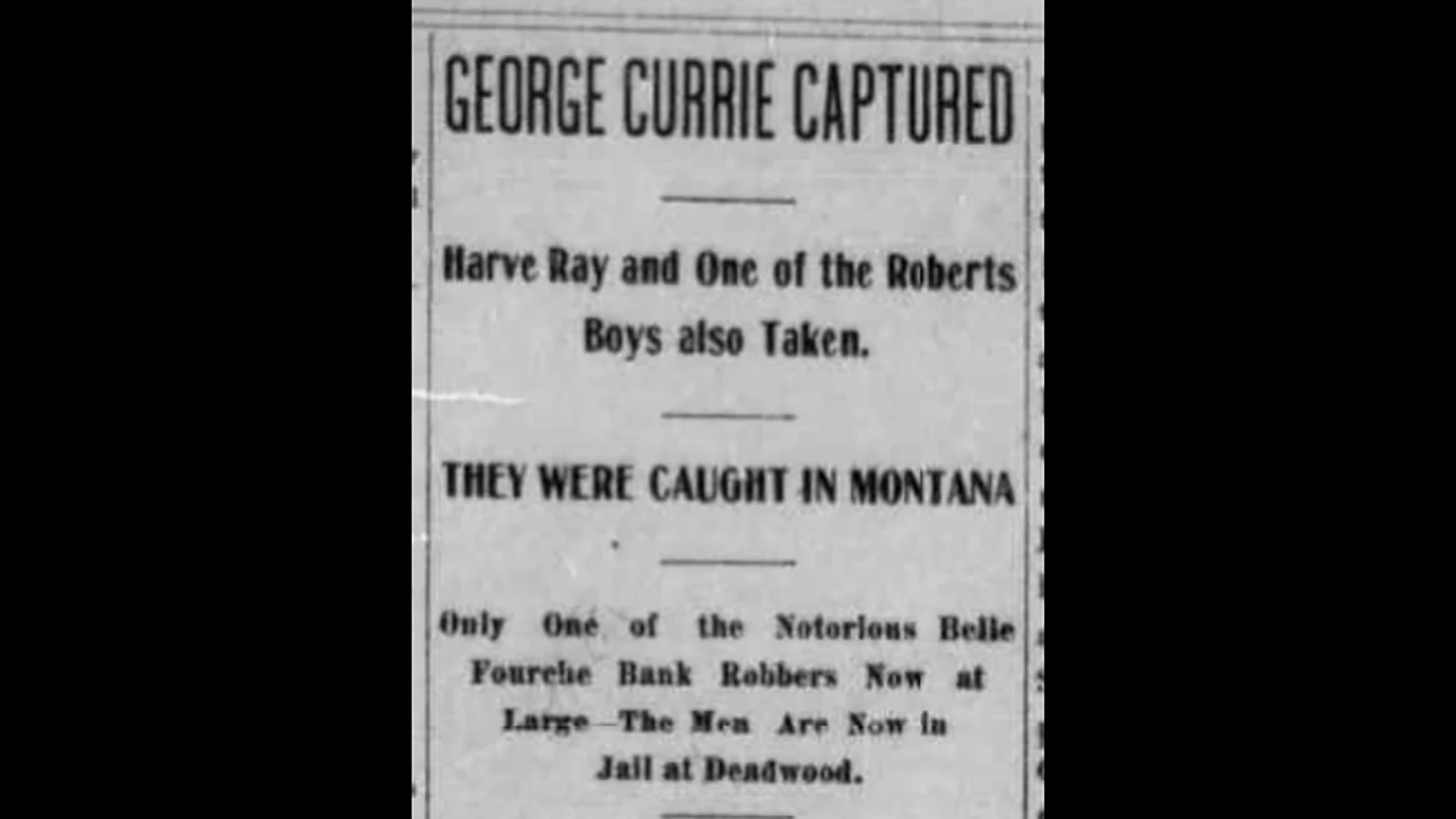
Once more, Ray appeared in the news and this time becams one of the most wanted men in the Rocky Mountains. On July 1, 1897, five men of the Hole-in-the-Wall gang held up the bank in Belle Fourche, South Dakota. Ray was believed to have been one of those outlaws.
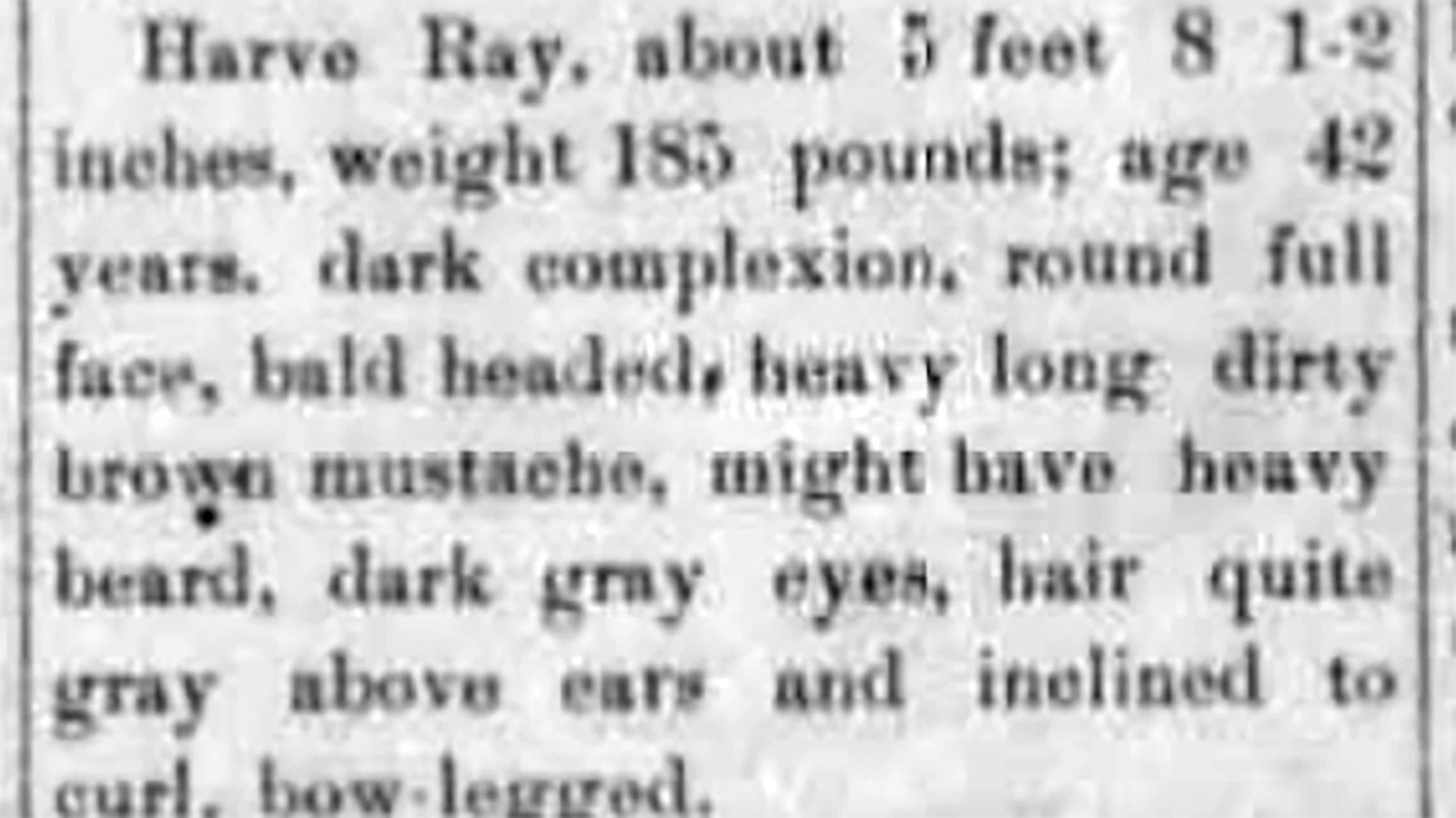
Authorities described Ray in the Aug. 5, 1897, Natrona County Tribune to help in the massive man hunt for him and the others involved in the robbery.
Ray was described as being 5 feet 8 1/2 inches, weighed 185 pounds and was 42 years old. He had a “dark complexion, round full face, bald headed; heavy long dirty brown mustache, might have heavy beard, dark gray eyes, hair quite gray above ears and inclined to curl, bow-legged.”
The headlines from the Natrona County Tribune on Sept. 30, 1897, announced his capture in Montana along with his friend George Curry.
Outlaw Ride Continues
Ray was back to cattle rustling later that fall according to the Crook County Monitor, Nov. 17, 1897.
“Only a week ago it was currently reported that Harve Ray and Geo. Currie had gone to Alaska, but the news has come to Casper that they were both seen up in the vicinity of the Bar C ranch a few days ago,” the Monitor reported. “It seems they are being harbored there and some fine night they will be swooped down upon and taken to prison just as their friends and companions have been before them.”
The Wyoming Derrick, Feb. 24, 1898, reported that Ray was involved in one of the biggest illegal cattle drives in the state.
“The Harve Ray party have come in a body down into the head waters of Salt creek, within twenty miles of Casper and driven all the cattle before them toward the broken country of the Hole-in-the-Wall,” the Derrick reported. “There was said to be upwards of twenty men making the drive, and they were not going on the run, but just drifting the herds along so as not to attract notice.”
Believed Dead
In June 1899, the Wilcox train was robbed and Harve Ray identified by authorities as one of the outlaws involved. A warrant was signed for his arrest and he fled Wyoming by the next spring.
According to Bell, when the Hole in the Wall was invaded by Bob Devine and his cowboys from the Oglala Cattle Company and others, the outlaws in that area headed south. They went down to Powder River on the Colorado-Wyoming line, where they joined up with Butch Cassidy.
George Curry, who went with Ray, was shot dead by a posse on the Green River in Utah on April 17, 1900. The lawmen who shot Curry pursued Ray north, and Bell said he was last seen heading back to Wyoming across the Red Desert.
The July 16, 1903, Wyoming Derrick stated the case against Ray in the Wilcox robbery was dismissed by the Supreme Court because Ray was believed dead.
“Ray literally rides out into the sunset, last seen going north towards the Wyoming line,” Bell said. “He's abandoned the horses they've stolen, because they can't move that fast and Ray just disappears over a rise into the Red Desert in southern Wyoming, never to be seen again.”
The Photo
Bell said it is because of the mystery that still surrounds Ray that the photographic find is so important to Wyoming’s historic record.
In his search to prove the photo was of Ray, Bell saidhe also learned more about the men associated with the outlaw.
“This is a split second in the lives of these men, and I've been able to trace the history of almost all of them, from cradle to grave,” Bell said. “Of the eight people in the photograph who are named, six of those eight can be verified. We can fill in their backgrounds in detail.”
Bell was especially excited about uncovering the story of Cookesley, who owned the ranch where Ray was working in 1887.
“I'd never heard of Cooksley and discovered he was one of these English guys who left the UK having been in the Army,” Bell said. “He wasn't a very successful businessman, including the ranch, which went bankrupt in the early 1890s.”
Cooksley is not in the photograph because Bell believes he was the photographer and most likely the one who identified each man in the photo.
“Having this photo has just helped fill in part of the story of Harve Ray,” Bell said. “But the mystery remains about what just happened to him.”
Jackie Dorothy can be reached at jackie@cowboystatedaily.com.


