Nature can be brutal. It’s also heartwarming at times.
A pair of sandhill cranes demonstrated that recently in Grand Teton National Park.
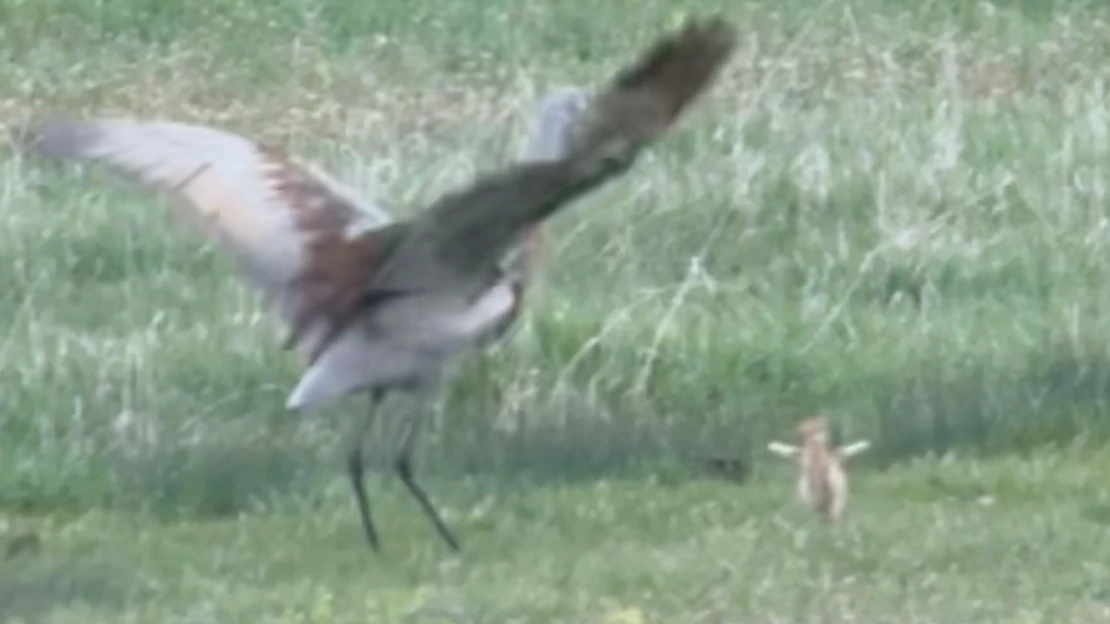
Sandhill parents delighted onlookers by hopping and spreading their wings for their offspring, called a colt.
For its part, the colt, probably about only a month old, did its best to mimic its parents’ moves, breaking into a stumbling run and spreading its tiny wings.
“That was incredible for me to see in real time,” Alexis Cariddi, a naturalist and guide with Jackson Hole Ecotours, said.
Everything a colt must know to survive “is entirely taught by the parents. Sandhill cranes mate for life, and they raise their colts together for about a year,” she said.
Ahead of Schedule
Sandhill crane colts usually hatch in April, said Cariddi, who captured video of the crane parents giving lessons to their offspring at the end of May.
That means the colt was probably entering its second month, when cranes start to get serious about training their young.
“By the second month, once they have some muscle development in their wings, that’s when they start to get flight training,” she said.
It might seem a bit early to start flight training when the colt is still hardly more than a downy puffball, with only the stubby beginnings of wings.
But it’s also none too soon. It can take colts about two months to learn to fly.
Cranes start migrating out of Grand Teton as soon as mid-September. And it’s a long flight to wintering grounds in New Mexico, Texas, Arizona, or Mexico.
And because of an unusually warm and dry winter and spring, cranes in Grand Teton might be following the same pattern as other wildlife there and doing things early.
“Most of the patterns we were seeing in wildlife this year have been about a month early,” Cariddi said.
Young cranes usually get “kicked out on their own” after their first migration, so the parents can start nesting a new offspring, she said.
More Than Just Flight Training
Retired game and fish bird biologist Andrea Orabona of Lander told Cowboy State Daily the cranes’ behavior in the video demonstrates more than just early flight training for the colt.
Cranes teach their colts how to hop and jump as part of their natural “dancing” and motor development, Orabona said. “This early hopping helps colts build muscle coordination and wing strength needed for flight, serves as a defense mechanism to ward off predators, and passes down complex social rituals essential for future mating.”
When it comes to defense against predators, cranes don’t mess around.
In June, a sandhill crane drove off a grizzly that got too close to its nest in Yellowstone National Park.
Why Are They Called Colts?
So, why is a young bird called a colt?
The traditional term "chick" is also acceptable for sandhill crane offspring.
But the term "colt" is popular because they can walk, run, and swim within 24 hours of hatching.
That mirrors the abilities of newborn horses.
Young cranes are also called colts because they hatch with long, knobby legs, not unlike those of a young horse.
Mark Heinz can be reached at mark@cowboystatedaily.com.