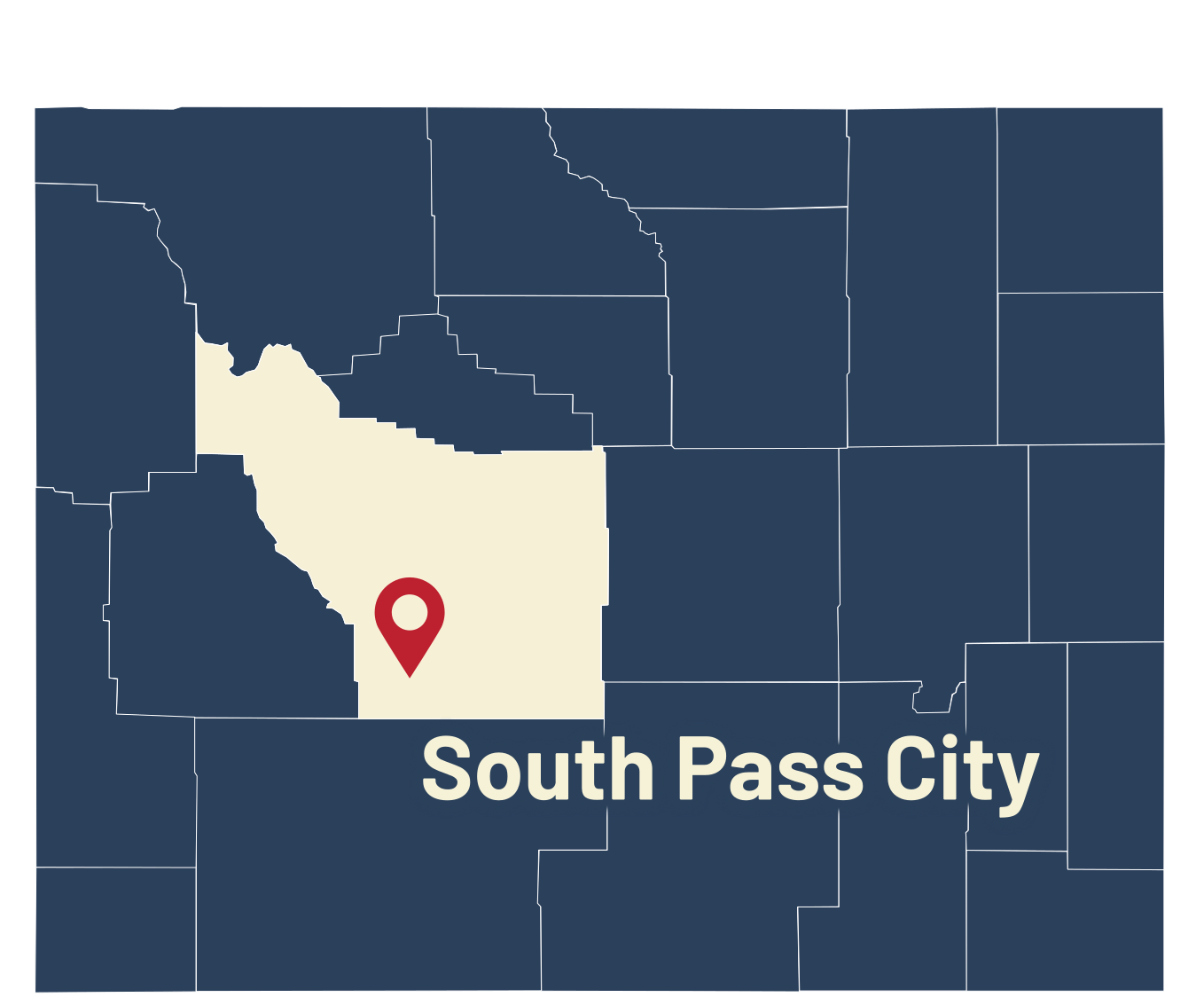
John Mionczynski has been part of the living history that has brought Gold Rush Days and South Pass City to life for more than 50 years.
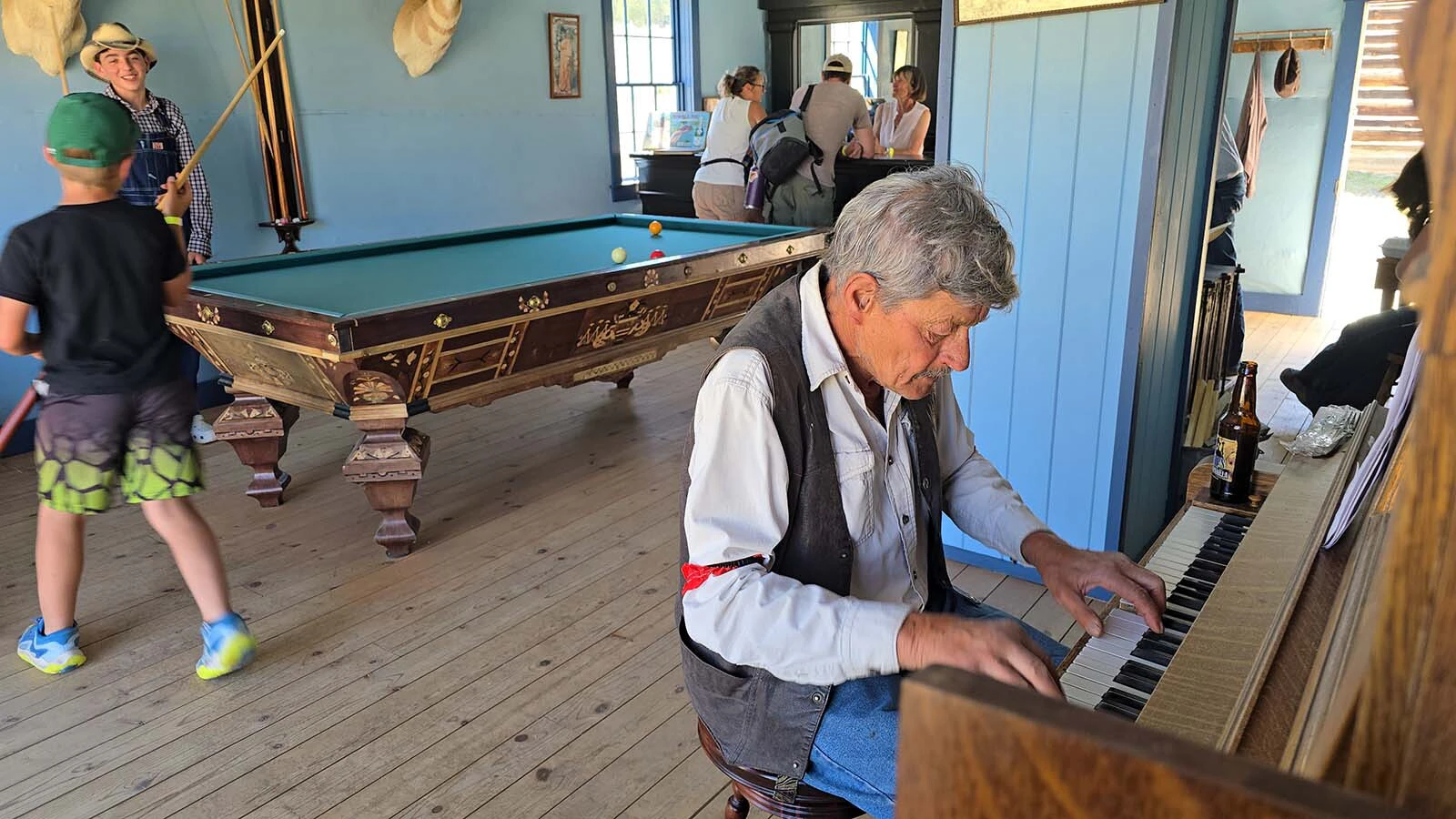
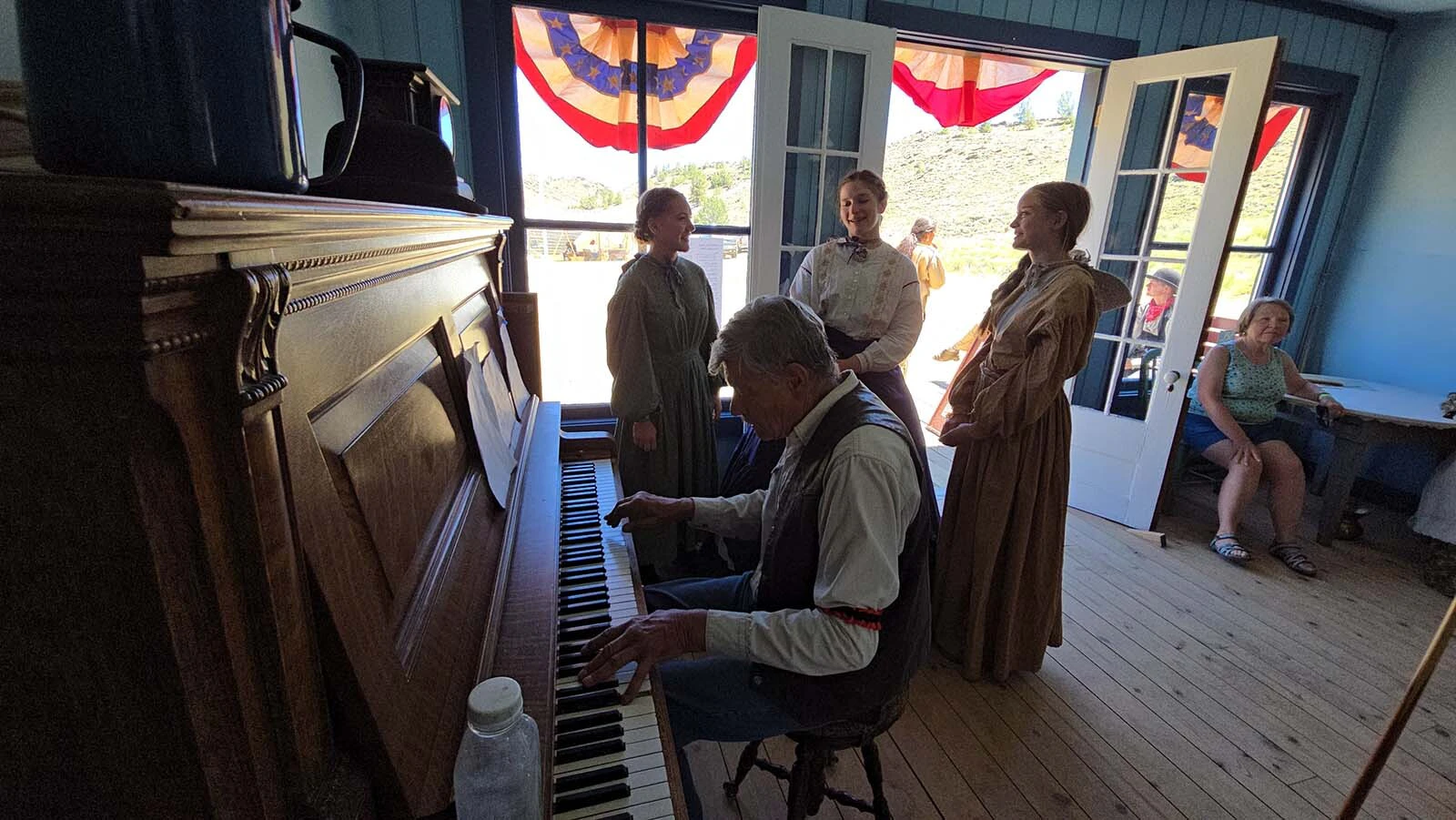
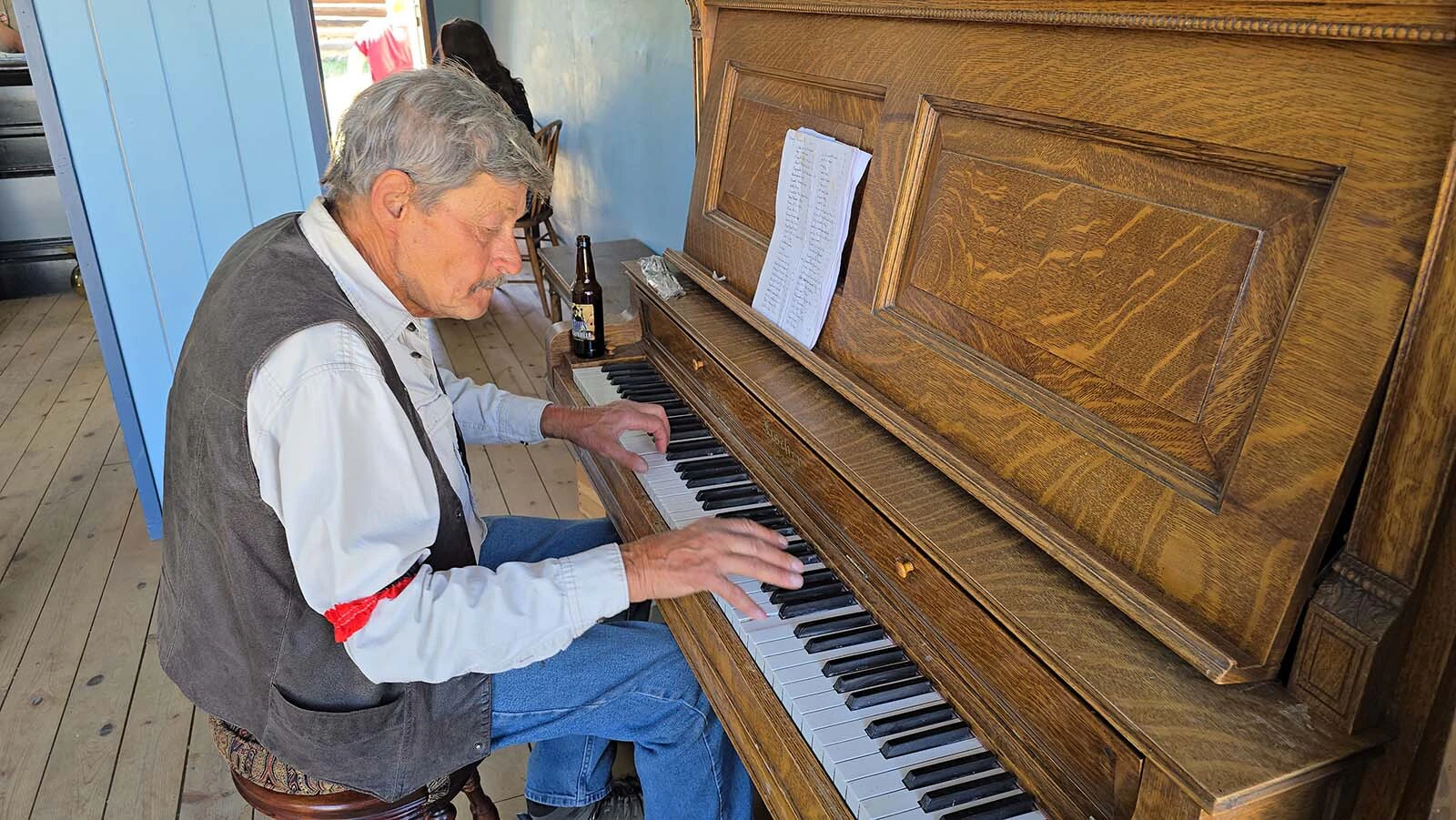
Watching him play a flawless rendition of “The Entertainer” in the 1870s gold rush town’s saloon, one would never guess that South Pass City’s beloved piano man once couldn’t use his fingers at all.
When he was 8, Mionczynski fell from a high-backed lawn chair and shattered his elbow.
“It was in a cast for six months, I think, because the bones had really gotten mangled in the elbow,” Mionczynski recalled. “The surgeon took out the elbow, so it was a stiff arm. So they asked my parents if I wanted the arm to be like this …”
Mionczynski bent his arm horizontal.
“Or like this,” he said, unbending the arm so it was vertical.
Those were his two choices, because the doctor couldn’t see any way to put back his elbow.
Neither choice was appealing to his parents. So the surgeon tried something radical.
“He carved a joint in there,” Mionczynski said. “He said, ‘I don’t know if it’ll work, but it could allow him to move his elbow like a normal elbow.”
It wasn’t a real elbow. By carving the bone ends into a functional shape, the surgeon created a false joint in hopes that scar tissue would fill the gap, acting as a makeshift cushion that could allow for a surprising amount of mobility.
An Accordion Saves The Day
It wasn’t an immediate success.
At first, the joint wouldn’t move at all. It took weeks of concerted effort to budge the tiniest fraction.
Mionczynski had to work at moving it a little more every day. In the meantime, his fingers had begun to atrophy.
So his mom bought him a small accordion, knowing he loved music. She hoped it would motivate him to work harder at regaining use of his arm and his fingers.
Mionczynski’s dad had been teaching him how to play instruments like the harmonica and the violin before the accident.
“I couldn’t play any of those instruments after the accident,” he said. “But with an accordion, you have to use your left arm to pull the bellows in and out. And then there’s buttons there, too. You have to move it up and down. So it was a brilliant idea.”
It took two years to fully regain the function in his arm and fingers. But his mother had picked the right motivation.
“The problem was, at first I was not interested in exercises,” Mionczynski said. “But with accordion ballads, I was interested. It was fun. I enjoyed it.”
Piano Therapy In A 150-Year-Old Saloon
Decades later, that once-shattered arm is what powers the music that gives South Pass City’s saloon its heart.
On Gold Rush Days, tourists crowd inside to hear the piano music and to buy ice-cold sarsaparilla.
Mionczynski is in his element in these moments. To him, it’s not a performance at all. It’s more like therapy.
He’ll spend most of his summers running pack trips, plant classes and history tours back to back for a couple of months. It’s a season of logistics and long miles in the high country of Wyoming.
But in South Pass, all of that’s far away. He’s playing the tunes of a forgotten era in a 150-year-old saloon.
It’s a reset button tapped out in ragtime and waltzes alongside re-enactors in dusters and satin dresses.
“I just face the wall,” he said with a chuckle. “I don’t have to talk to people until I stop playing. For me, it takes my mind completely off any scheduling problems I have, or vehicle problems that have to get fixed before the next trip, or any of the other usual problems people have.”
South Pass Gets A Piano Man
Mionczynski has been South Pass City’s piano man since 1974, when the state resurrected the gold-rush town.
“The governor came down,” he recalled. “And at that time, there were some people still living here. Most of these buildings were leaning with the wind.”
Poles had been used to prop up some of them, Mionczynski recalls.
“They finally got the main hotel here and the Smith-Sherlock store rebuilt, resurrected,” he said. “And the interiors were done and the windows that were broken replaced. They were starting to make it look like a real town, without buildings that looked like they were about to fall over.”
For the occasion, there was a band wagon in front of what’s called The Exchange today. But at the time, it was named the Grecian Bend Saloon.
“The state’s trying to rebuild this place the way it was around 1870,” Mionczynski said. “So they’re going with what the buildings were at that time.”
Mionczynski had already made something of a name for himself playing with his band, The Buffalo Chips, at Atlantic City’s Mercantile.
“We had more fun than we should have,” he said, his eyes filling up with the memories. “It was a great band. We all liked each other like a family. We played old-time music of different sorts, and we had people who would dress up in the 1890s Western clothing.”
The band wasn’t interested in the typical venue, either.
“What our band liked to do was play for the smallest towns in Wyoming,” Mionczynski said. “We’d go there and we’d visit and get to know a person or two. And some of these towns only had two.”
Eventually, they’d suggest the idea of coming to play for the town for free.
“We played for a lot of small towns,” Mionczynski said. “We just had a lot of fun playing old-time music.”
From Long Island To Wyoming
Mionczynski was born in 1947, thousands of miles away from Wyoming, on the east end of Long Island, New York — closer to the Atlantic Ocean than to Atlantic City, where he makes his home.
Mionczynski had a high school pal named Dennis. The two did basically everything together, including graduate from high school in 1964. Where Mionczynski was shy, Dennis was outgoing. They complemented each other in that way.
“We were adventurous kids,” Mionczynski recalled. “We liked to go camping while we were in high school, and we camped all over.”
The Vietnam War was going on at the time, and their teachers had been encouraging them to enlist in the Army right out of high school.
“We all took it to heart,” Mionczynski said. “I was very patriotic. I wanted to go in the Army and Dennis and I were going to go in together. But I was too young and my brother was already in the Navy, so my parents wouldn’t sign me up.”
The two young men decided they would take a year off to travel the country, and then sign up to serve.
“I could afford to have a car because I played in this band, and we made money in high school,” Mionczynski said. “So my dad found a ’58 Ford coupe that I could afford to buy for $300, and he helped me purchase it.”
Mionczynski and Dennis had no idea, however, where to go in this brand-new car.
“So what we did was, we took an atlas of the United States and I think we blindfolded Dennis first,” Mionczynski said. “After he had his blindfold on, I took the map of the United States and just spun it around on the table.”
Dennis put his finger down on the map, right smack in the middle of the Pacific Ocean.
Mionczynski took a turn next but his finger also landed somewhere ridiculous — southern Mexico.
The third time was the charm.
“Dennis was blindfolded, and he put his finger down on Boyd, Montana, which is right near Red Lodge,” Mionczynski said. “So that’s where we were going.”
Four Flat Tires And Fate
The boys loved Boyd and thought they’d found the place they wanted to live someday.
But fate was about to take another turn.
“We didn’t want to go to Yellowstone Park because it was too big and full of people,” Mionczynski said. “So we went down what is the Chief Joseph Highway now. It was a dirt road, and we went to Cody and then we went to the Bighorn Mountains.”
The two camped in a Forest Service campground, which was a rustic affair quite unlike what’s there today.
“There was an outhouse there, and a place to park your car, and that was about it,” Mionczynski said with a chuckle. “And the first night it rained really heavily.”
That forced the boys to sleep in the car, one boy to each of the bench seats.
“When we woke the next day, we had three flat tires that night,” Mionczynski said. “What are the chances of having three tires go flat on the same night when you’re not driving?”
The flat tires didn’t upset them though.
“We took it as kind of some sort of sign and didn’t bother to fix them,” Mionczynski said. “We just took off, into the mountains. We hunted with our throwing knives and found squirrels and fish. We had a wonderful time and decided we were going to live in Wyoming.”
Enter The Red Desert
That’s how Mionczynski fell in love with Wyoming, ultimately becoming a prospector for gold and jade.
“I was looking for a place to be alone more than prospecting,” he said. “I liked traveling alone. I liked living off the land. Both Dennis and I used to like to do that.”
Because he liked to be alone, he gravitated to the biggest “white spot” on the map — the Red Desert.
“I went there in ’67 just to see it,” Mionczynski said. “By then, I had the prospecting bug, so I was there with the intent of finding something that I could prospect for to pay off my college debts.”
Mionczynski and a college friend worked on gold claims near the Sweetwater River. It was backbreaking work with a gold pan, a sluice box, shovels and picks.
Dennis was drafted that year and went into the Army.
“He went to Vietnam and he was sending me postcards that said, ‘Doesn’t matter what you do or how you do it, but whatever it takes, don’t come to this place,’” Mionczynski said. “These were very serious, very ominous postcards. He was getting shot up and losing all of his friends to the battle. He was my best friend, so I believed him.”
The Red Desert became a meditation for Mionczynski as he thought about the war and the postcards.
“The question I nailed it down to was, ‘Is it OK to kill somebody when you don’t know exactly why you’re doing it?'” Mionczynski said. “That’s what Vietnam was for a lot of young people. You’re following orders, but you’re basically — if you fired the bullet — killing somebody. If you don’t know why you’re doing it, I didn’t think it was right.”
The Best Job Ever
Eventually, the lonely desert wanderings pulled Mionczynski into wildlife biology and one of his “best jobs ever,” living with bands of bighorn sheep, migrating with them, and recording everything about their lives for Wyoming Game and Fish, the U.S. Forest Service and the Bureau of Land Management.
That’s when he became the goat outfitter.
“They were my pack animals,” Mionczynski said. “I was carrying a 110-pound pack with this new radio equipment I had to carry. And that was the first time anybody had tried to study bighorn sheep with radio telemetry.”
To entertain himself, Mionczynski brought his accordion along. And discovered that goats don’t just like music. They love it.
“They would gather around every time I got the accordion out,” Mionczynski said. “I would start playing and they would close their eyes, rest their heads back on their shoulders, and their eyes would be closed until I finished the song.”
The instant the music stopped, they would all wake up, eyeing Mionczynski as if waiting for the next tune.
“It had to be some kind of meditative thing for the goats,” Mionczynski said with a chuckle.
The bighorn sheep, on the other hand, had little interest in the music. They tolerated the goats, and tolerated Mionczynski, but didn’t gather round for concerts in the wild.
Home At Last
Mionczynski ended up in Atlantic City when his Jeep broke down, leaving him stuck with no transportation and no money.
He wandered into the Atlantic City Mercantile, which, at the time, was a bar.
“I didn’t drink in those days, so I sat at the end of the bar just because it was cooler in there than outside,” he said. “And I heard these old-timers talking about Butch Cassidy.”
Mionczynski was interested in the conversation because he’d seen the movie “Butch Cassidy and the Sundance Kid,” which had just come out.
He was surprised, though, to hear the men say that Butch Cassidy had visited the area in either 1938 or 1939.
“That was the first time I interrupted them after about an hour of listening,” Mionczynski said. “I said, ‘Well, I thought he died in Bolivia. The movie showed him dying in Bolivia.’”
Mionczynski hung out for a long time at the bar, listening to the stories. Eventually, though, his eye was caught by the piano in the corner.
At first, the owner, Lyle Moore, told him the piano was broken. But he and Mionczynski got to talking about jade and gold and struck up a friendship.
Finally, it was revealed that the piano was not broken at all. The owners of the bar just didn’t like people making noise if they couldn’t play.
“So, I went over and played the rest of the night,” Mionczynski said. “And oh the bar was crowded. It was all old-timers. And they kept coming up and asking me for songs. I knew a lot of the old songs because I had played old-time music to work my way through college.”
That’s how Mionczynski found a place in Atlantic City, becoming a partner on jade and gold claims with Moore, as well as playing piano every night at the Mercantile. It didn’t take long for other musicians to find him and start playing with him, eventually forming the Buffalo Chip band.
Keeping The Dream Alive
These days Mionczynski lives just 5 miles from South Pass City in what he jokingly calls the “suburbs” of Atlantic City.
He still lives off the grid and prefers his solitude, though he’s a man with lots of stories.
Every Gold Rush Days, he’ll come back for the crowds that visit South Pass City, taking his usual place at the saloon piano.
For all the winding paths that brought him to Wyoming — shattered elbow, desert wanderings, bighorn sheep, goat packs, broken down cars and barroom pianos — it’s South Pass city’s little saloon that seems to match his inner tempo best.
On Gold Rush Days, the room hums with visitors and re-enactors. Sarsaparilla bottles clink as people toast the history they’re reliving. The man at the upright piano keeps his back to the crowd, facing the wall as his fingers fly.
He doesn’t need to see the people at all. He can feel them in the room with him, tapping and humming along to the tunes he’s playing.
For a moment, he can imagine that he’s back there in South Pass City in 1870 with all the other prospectors who came to Wyoming with a dream.
For a boy who once had to choose between a permanently bent arm or straight one, it’s hard to imagine a more unlikely — or more perfect — piano man.
Renée Jean can be reached at renee@cowboystatedaily.com.