The founders of a Colorado company said they’ve found a way to boost rainfall by at least 10% in certain locations, using technology that could help mitigate the persistent Colorado River water crisis.
However, an abiding distaste for “cloud seeding” in Wyoming has hampered efforts here so far, representatives of Rain Enhancement Technologies say.
Randy Seidl, the company’s CEO, and chief meteorologist Jeff Chagnon told Cowboy State Daily their system relies solely on solar-generated electricity, not cloud-seeding chemicals.
They’ve built rain-making facilities in Utah and Colorado, but when they’ve approached Wyoming officials their message has been conflated with the “cloud-seeding umbrella,” Seidl said.
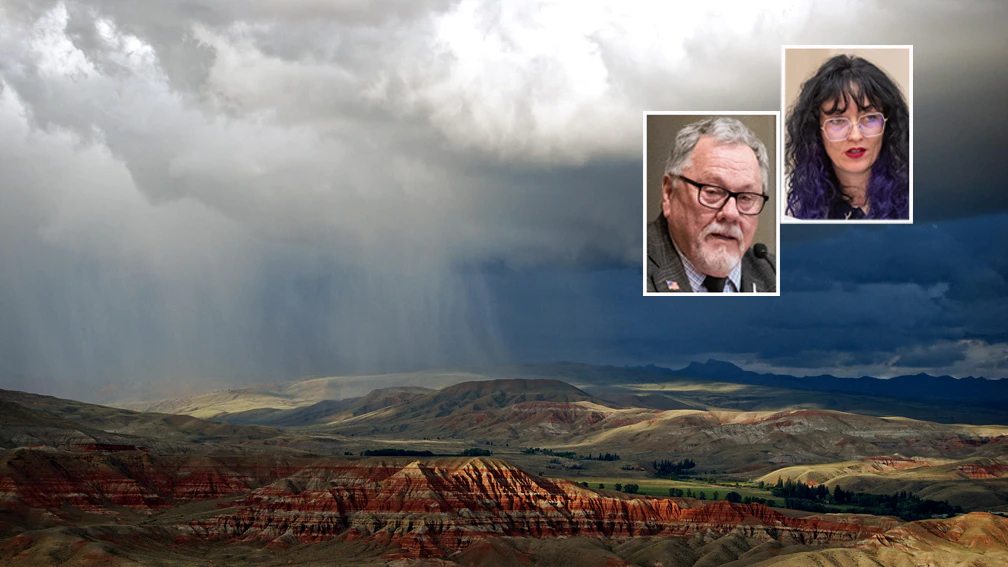
Legislative Rep. Karlee Provenza, D-Laramie and former Rep. Mike Schmid, R-La Barge, were involved in pitched debates over cloud seeding during the 2025 session.
The state seeded clouds in the Wind River Range, Sierra Madres and Medicine Bow Range for almost two decades before the House of Representatives ended funding for plane-based seeding last year, though ground-based efforts continue.
Provenza and Schmid told Cowboy State Daily they’d be open to considering Rain Enhancement Technology’s method if they can be shown proof that it works.
An Abiding Water Crisis
A shortage of Colorado River water is alarming officials in Wyoming and other western states.
In the simplest terms, it’s feared there won’t be enough water to meet to allotments established for seven states, Indian tribes and Mexico under the 1922 Colorado River Compact.
And there’s been growing tension between the Upper Basin states of Wyoming, Colorado, Utah and New Mexico, and the Lower Basin states of Arizona, Nevada and California.
The Upper Basin states claim the Lower Basin keeps demanding more water amid a dwindling supply.
This year, that’s included a drawdown of 1 million acre-feet at Flaming Gorge Reservoir, on the Wyoming-Utah state line, to make up for a shortage at Lake Powell, on the Utah-Arizona line.
Seidl said he doesn’t think his company could supply the entire estimated 2 to 4-million-acre-foot shortfall on the Colorado.
But they could certainly help, he said.
At one of the company’s sites serving 64,000 acres of land an additional 8,750 acre-feet of water was generated over one winter, Seidl said.
‘Goal Post-Looking Thing’
Using ground-based electricity to generate more precipitation isn’t a new idea, Seidl said, but his company is a pioneer in attempting to deploy it on large scale.
Rain Enhancement Technologies emerged “as a real company and a public company” on Jan. 1, 2025.
Chagnon said the heart of the system is a “football goal-post looking thing” with antenna that carry 100,000 volts of electricity generated by on-site solar panels.
An electrical charge can prompt tiny water droplets to converge into drops heavy enough to fall as precipitation, he said.
“We’re not adding anything to the cloud," Chagnon said. "We are adding a charge to those seeds (aerosol droplets) as air passes by our unit. They become ionized and ingested into the clouds. If you take two droplets and they’re charged, there will be an attractive force. It helps them get bigger, faster.”
Test sites in Oman, as well as facilities in Utah and Colorado, have demonstrated the capacity to boost natural precipitation by up 15% or more, Seidl said.
“We guarantee 10%,” he said.
The company is trying to sell its units to private parties, and to municipal, county and state agencies, he said.
It costs $150,000 a year to lease a unit, against a total purchase price of $750,000, and units have an estimated 15-year lifespan, he said.
Willing To Check It Out
Provenza said she thinks the largest barrier to precipitation enhancement in Wyoming is politics.
She said the conservative Freedom Caucus was to blame for blocking efforts to continue cloud seeding because of baseless fears over the chemicals.
And so, she wonders if “this new form” used by Rain Enhancement Technologies would face similar pushback.
The problem of water shortages isn’t going away, she said, adding that, “The Legislature is going to have to grapple with the idea that were going to have to do more if we want to keep more of our water. As a lawmaker, I’m going to have to see proof of the concept. We’re talking about taxpayer dollars.
“I’m certainly open to hearing about it. I hope my colleagues have the same mindset of curiosity about it.”
Better Than Cloud Seeding?
Schmid said the fears he and others had over cloud seeding weren’t baseless.
He said he was never shown proof seeding made a difference over the long run. And there was evidence the silver iodide used was harmful to aquatic plants and wildlife, he added.
Schmid said he found evidence that silver iodide contamination contributed to the health problems and low birth rates of the legendary Whiskey Mountain bighorn sheep herd in the Dubois area.
That herd once numbered around 2,500 sheep but shrank to fewer than 500 because of chronic pneumonia outbreaks and low reproduction, he said.
“Silver iodide can cause lung problems in wild sheep,” Schmid said.
He said Rain Enhancement Technologies’ idea sounds encouraging, but he has questions.
“If they ionize clouds here in the Green River Basin, would that steal water from somebody else down range?” he asked.
“Prove to me that it’s working, that it’s not hurting our plant life and our wildlife, and that it does not steal water from our neighbors, and I’m all for it.”
Mark Heinz can be reached at mark@cowboystatedaily.com.