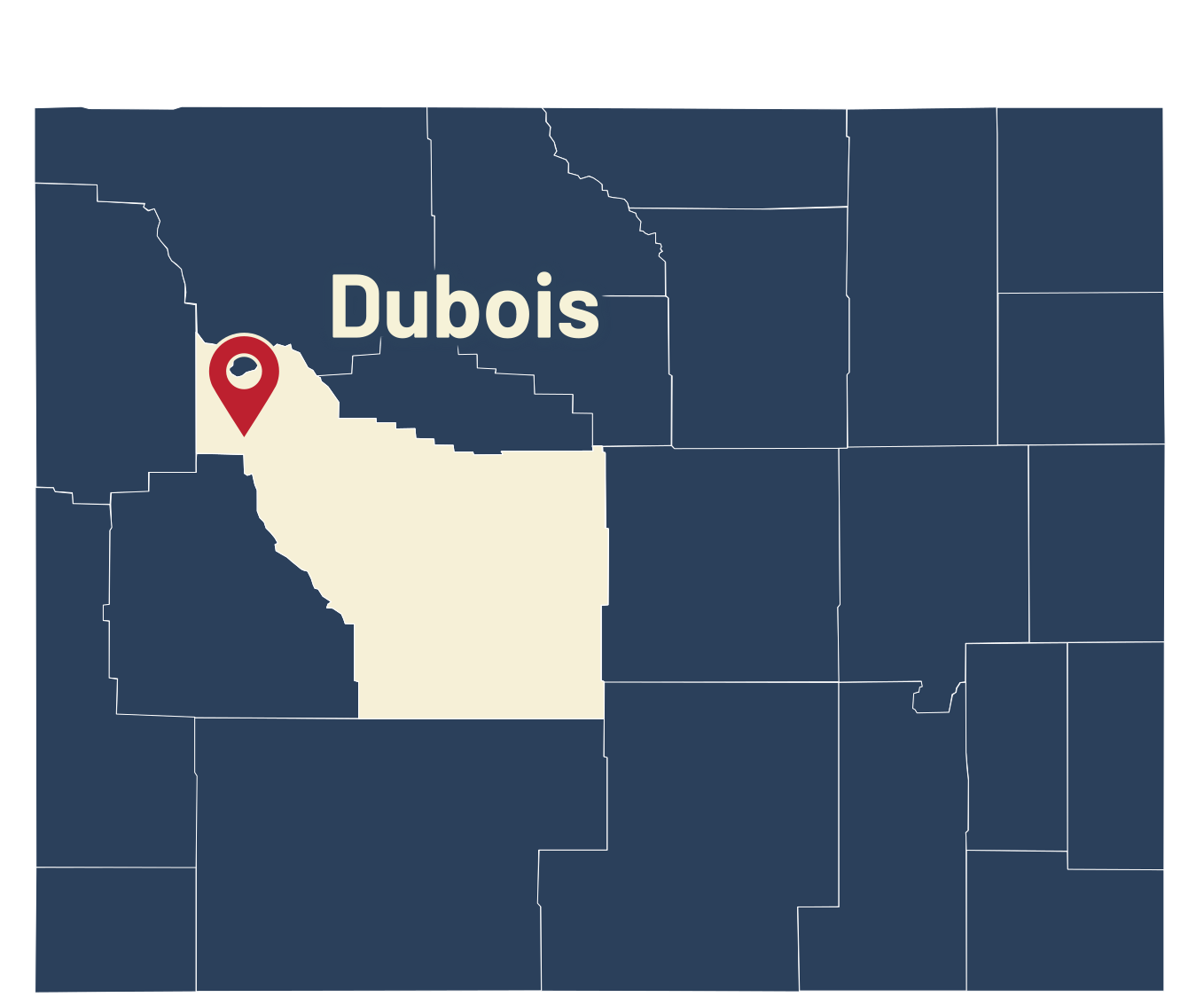
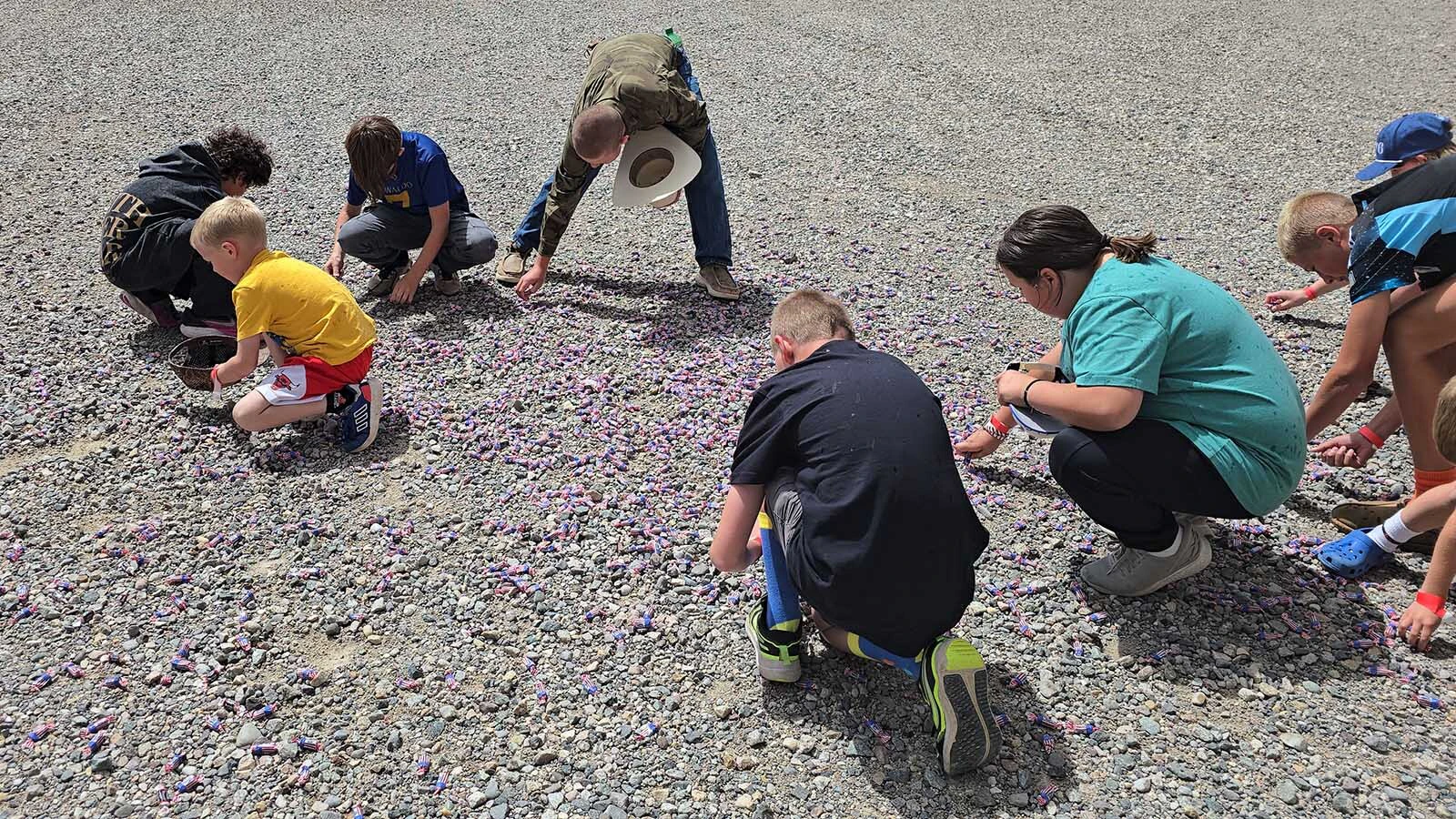
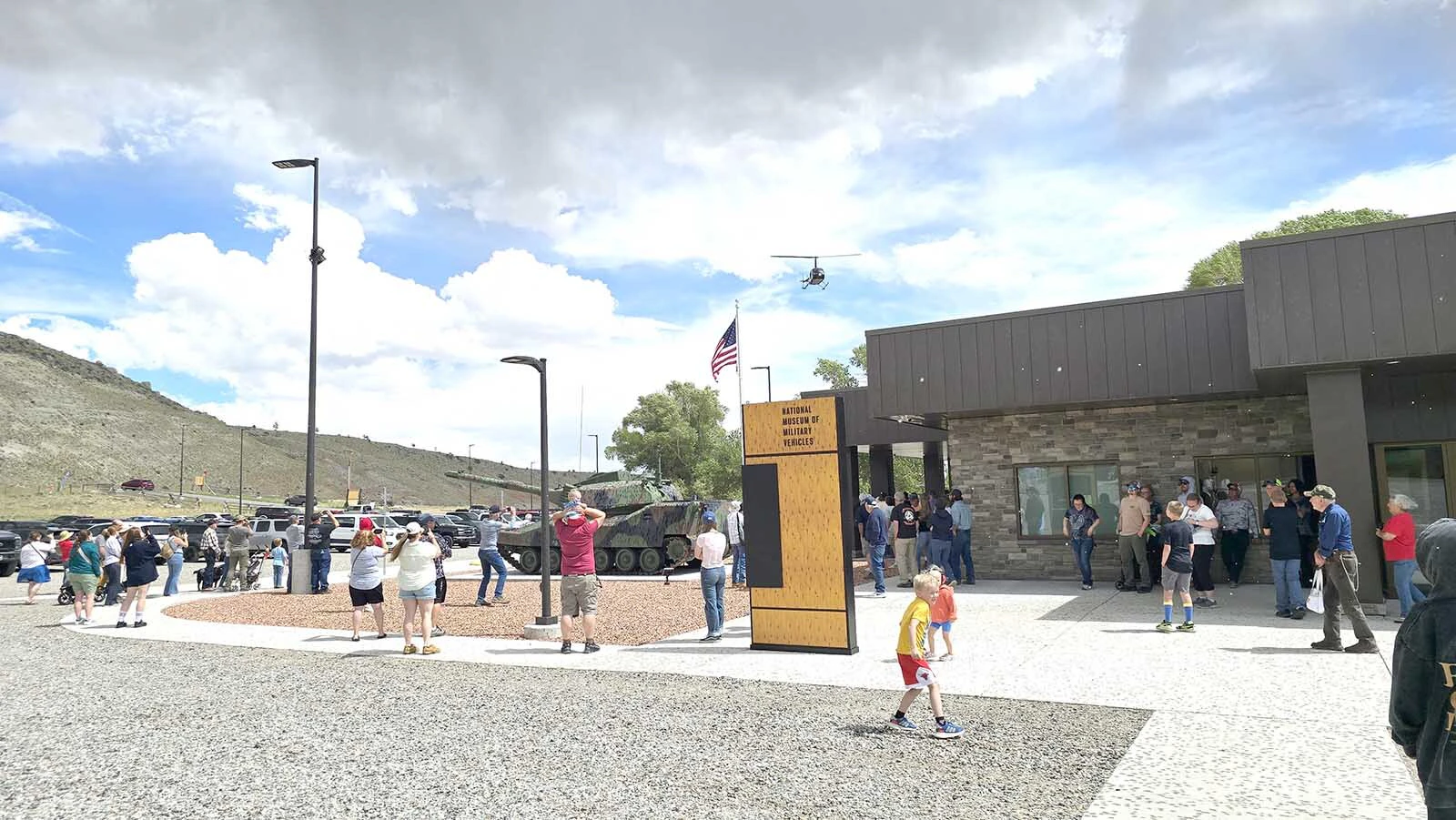
Mortar rounds were once code-named “Tootsie Rolls” during the Korean War. But no one was diving for cover at the National Museum of Military Vehicles when the Tootsie Rolls started falling in Dubois alongside big, fat raindrops.
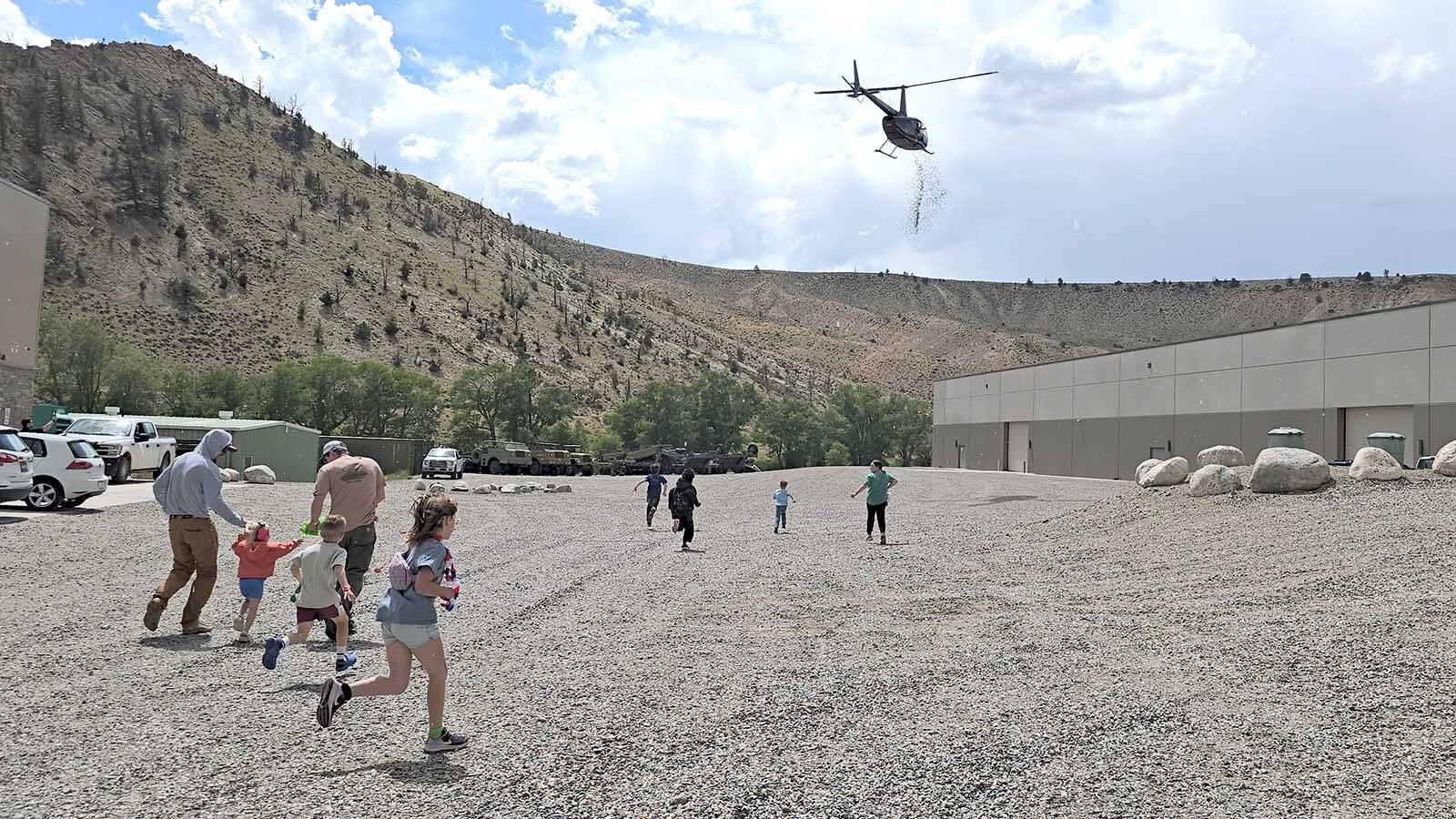
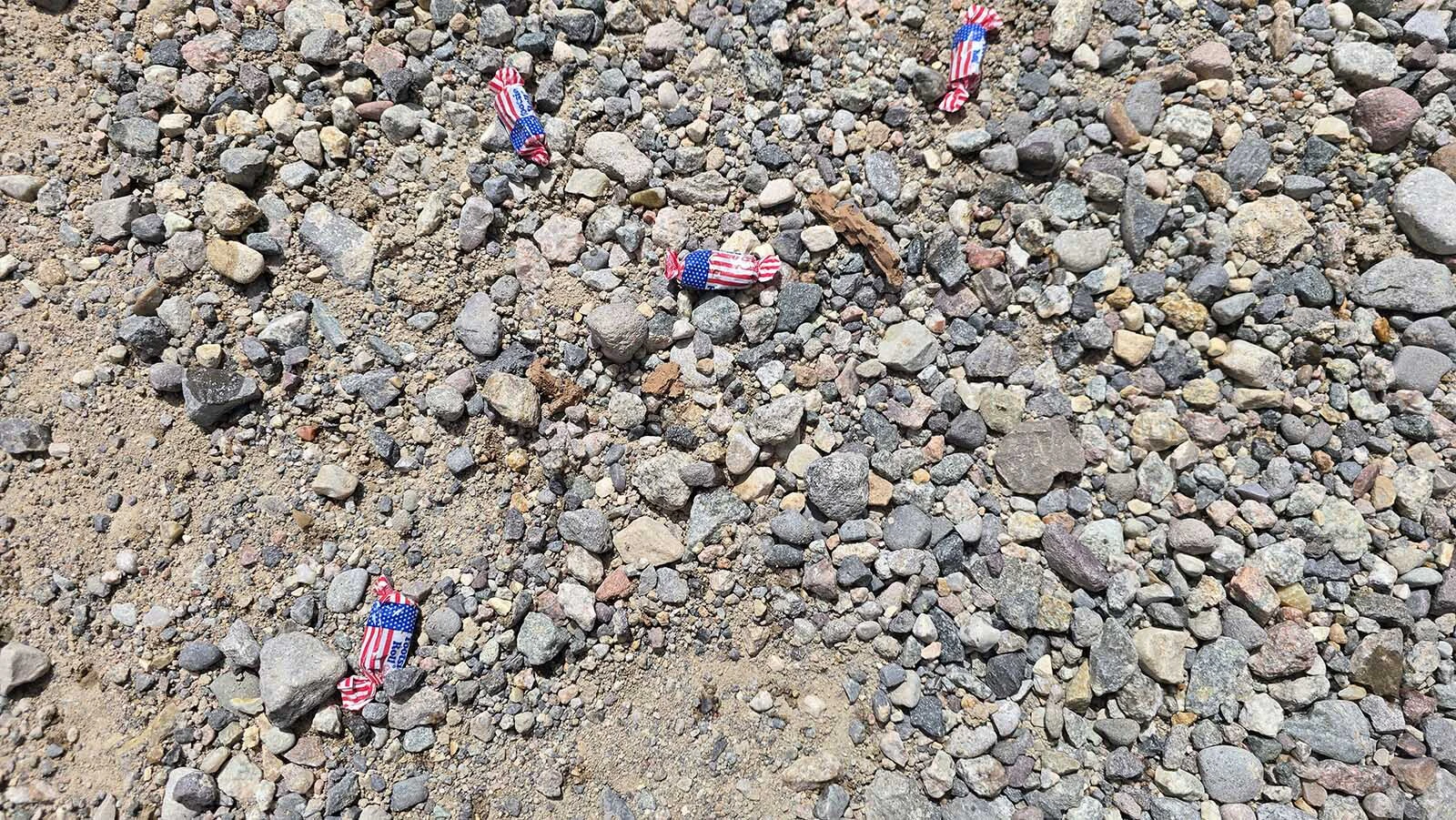
Instead, there were children clapping hands and laughing, just before a squealing sprint for a spot under the black helicopter hovering just above one of the museum’s side parking lots, letting fall what looked a bit like rain itself.
The helicopter drop was arranged by U.S. Army veteran Gene Humphrey, who was born and raised in Burns. Humphrey worked with museum staff and a friend, helicopter owner Steve Funk, to pull it off.
Marines of a certain age were smiling in spite of themselves as the children scrambled after the candies wrapped in special red-white-and-blue paper. They remembered a time and a frozen place when those gooey caramels meant the difference between life and death.
Code Word: Tootsie Roll
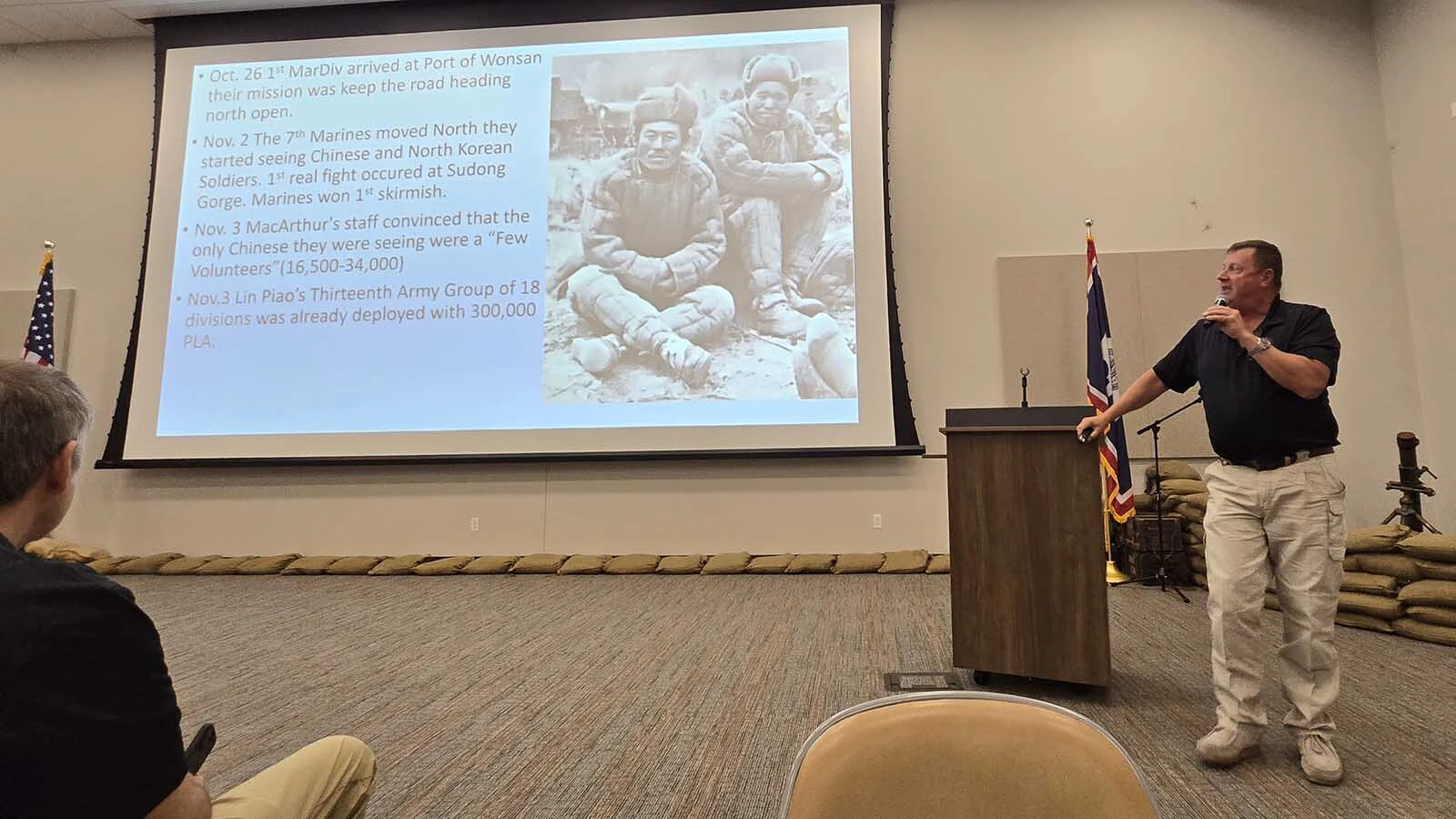
The year was 1950 and the location was the Chosin Reservoir, American History Project Founder and The Chosin Few President Shayne Jarosz recalled during a recent lecture series at Dubois’ National Museum of Military Vehicles. The lecture is part of ongoing activities this year that celebrate America’s 250th.
“The men were surrounded by roughly 300,000 Chinese troops,” Jarosz said. “It is minus-40 degrees. They do not have the cold-weather gear that they need, and they are being attacked in force.”
To maintain a level of secrecy about their needs, the Marines had code words for everything important.
“If you needed something, you didn’t want to say, ‘Hey, we’re almost out of bullets, send them',” Jarosz said. “Because the Chinese were listening. So the code word for mortar rounds was Tootsie Rolls.”
One day, the radio chatter suddenly became all about Tootsie Rolls, but not all the pilots were aware of all the code words.
“We are running low on Tootsie Rolls and we need them right now,’” Jarosz said the men were screaming. “And these great pilots who are flying all these sorties have no idea what in the world is going on. But they know that these men are in a desperate fight for their life and if it’s Tootsie Rolls they want, then it’s Tootsie Rolls they’ll get.”
This version of the story has been disputed by some historians, Jarosz acknowledged. But enough veterans have told him personally about this tale that he feels comfortable repeating it.
“So, along the entire evacuation route, they dropped Tootsie Rolls, and it ended up saving the lives of these men,” Jarosz said. “They had not eaten in days.”
The sudden arrival of the candy was like manna from heaven to these men, providing something simple but vital — sugar and calories in a package small enough to slip into frozen hands and pockets.
More Than Just Food
The Tootsie Rolls did more than just feed starving Marines.
“Their fuel tanks had been shot and would not hold any fuel,” Jarosz said. “They could chew on that Tootsie Roll and melt it. Then they could put it in a bullet hole and, at 40 degrees below zero, it would expand and seal that gas tank.”
That allowed them to fuel enough trucks to evacuate their wounded. History records 18,000 casualties during the Chosin Reservoir battle, as well as thousands more who suffered frostbite. Those numbers could have been significantly higher but for the improvised repairs the candy made possible.
Word of the Tootsie Roll story eventually made its way back to the candy makers. Since the 1950s, the Tootsie Roll Corporation has chosen to quietly honor the Marines of Chosin, sending them more than 150 pounds of their candy to all of their annual reunions.
“You want to see a bunch of 90-year-old men acting like they’re 5 years old,” Jarosz said with a chuckle. “It’s really wonderful. And what’s even more wonderful about this is, Tootsie Roll is a family organization, and they never forget these guys.”
The candy company still ships the treats to reunions of men sometimes called The Frozen Chosin or The Chosin Few, so named because so few survived. They are a dwindling brotherhood of men who survived a freezing gantlet.
A Freak Cold Snap
For the men caught up in the Chosin Reservoir Campaign, the battle quickly became less about human enemies and more a fight against the Korean winter itself.
The weather, according to veteran accounts, had been relatively mild when Americans first landed in North Korea.
Marines and soldiers who reached the Chosin area in early November 1950 were writing family members back home, saying the weather wasn’t “too bad.”
However, a Siberian cold front swept in, precipitously changing all that. Temperatures plunged to around 40 below, with wind chills far colder. Some estimates say it was down to minus-70 — among the harshest conditions ever recorded in that part of North Korea.
The freak cold snap caught the troops without proper cold-weather gear or equipment. Many of the Marines were still dressed for the mild coastal climate they’d left behind when they received their marching orders to head to the Chosin Reservoir.
A 1 a.m. Battle Changes Everything
When the Chinese launched their massive night assault at about 1 a.m., only half the Marines were on alert. The rest had their boots off, socks draped around their necks, in an attempt to dry them before the next day.
They had no time to put their boots back on. They dove into foxholes shoeless, and sometimes sockless, too.
Enemy fire came in human waves of roughly a thousand men at a time moving in V-shaped, three-man formations to help minimize casualties from machine guns and artillery. The successive waves felt relentless and endless, and were a strategy Jarosz said was aimed at trying to melt down machine gun barrels through sheer numbers.
But there was also a psychological aspect, too. Every wave, the Chinese were crashing cymbals and blowing horns as they charged to unnerve the Marines.
“The Marines are like, ‘Oh, what in the world is going on?’ ” Jarosz said. “You talk to the veterans today about this stuff, and they said it was the biggest nightmare they ever had.”
Frostbite, meanwhile, ravaged the ranks, and many men later required amputations.
More than 8,000 Americans suffered frostbite at Chosin.
Chinese Ill-Prepared For Cold, Too
It wasn’t just Americans suffering from the cold, Jarosz said.
The Chinese soldiers, too, had come dressed in lighter clothing than the moment required. They were wearing thin, cotton-quilted uniforms and shoes Jarosz likened to old “Chuck Taylor” Converse sneakers.
“Their feet would swell so much that their shoelaces would literally pop,” he said. “And at first the Marines didn’t know what in the world that noise was. It was the Chinese shoelaces exploding. So I mean, these guys were really, really miserable, because they had been out there much longer than the Marines had been out there.”
Among the Chinese, Jarosz said 30,000 men are estimated to have died from cold alone, while 40,000 died in combat.
The Chinese army had been moving toward Chosin Reservoir in stealth mode, tying themselves to trees by day to sleep, and traveling at night so their movements would not be noticed.
“A man who is out during the day would be seen by any kind of spot or airplane and would be shot on sight,” Jarosz said. “So this was a very, very well-disciplined military.”
The Battle For Fox Hill
Among the most desperate of the Chosin Reservoir fights unfolded on Fox Hill, a rocky ridgeline commanding the Toktong Pass. The narrow mountain defile controlled the way to Yudam-ni and Hagaru-ri and was the 1st Marine Division’s only escape route.
There, about 220 Marines of Fox Company were giving their all to hold the 2- to 3-mile-long mountain pass against an assault by 1,400 Chinese troops.
In places, it was a line stretched so thin as to be more gap than men. Still, the men held their own, thanks to Marines like Hector Cafferata, who fought barefoot for three days, batting grenades back at the enemy with his rifle and shooting so many dead that the men who wrote his application for a Congressional Medal of Honor feared to list the true number, lest commanders think they had lied.
“When they wrote his citation up for his Medal of Honor, they purposely said that when the fighting had stopped on Fox Hill, they found more than 15 dead Chinese bodies around Hector’s fighting position,” Jarosz said. “There’s an annotation on that citation that says, ‘We actually counted 100 bodies that he had single-handedly killed, but we knew that nobody back at Headquarters would believe it'.”
Many of those Chinese soldiers were killed in hand-to-hand combat, Jarosz said.
Shot In Head, Sent Back To Work
On the eastern side of the reservoir, things weren’t going quite as well. Soldiers with the Regimental Combat Team 31 — roughly 4,500 undertrained GIs — had been overwhelmed. As their column tried to withdraw under heavy attack, wounded men loaded in the backs of trucks were slaughtered when Chinese forces overran the convoy.
Survivors, many badly wounded and half frozen, wriggled out from under wrecked vehicles. Too weak to walk, they were forced to crawl across the surface of the frozen Chosin Reservoir.
Jeeps from the Marine base camp at Hagaru-ri, which sits at the southern tip of the Chosin Reservoir, were sent to pick up the stragglers. It was a grim, slow rescue that took place under the cover of subzero darkness.
Jarosz recalls the story of Col. Warren Wiedhahn. The young Marine machine gunner, a private at the time, was shot across the forehead in the battlefield chaos.
He was mistakenly tossed into a pile of bodies when his blood froze over his face and medics thought his skull was gone.
Thirty minutes later, he woke up and stumbled into a warming tent, shocking everyone.
“With the limited medical care they could give him, they stitched his forehead back together,” Jarosz said. “They bandaged his forehead and gave him four aspirin. Then they said, ‘Get back on the line'.”
Years later, every time schools in his home state of Virginia would call school off for a snow day, he would call Jarosz to marvel — half joking, half bitter — that kids stayed home for a dusting of snow when he’d once been “shot in the head and had to go back to work.”
A Ghost In Fluorescent Aviation Tape
Many of the men who fought so valiantly at Chosin Reservoir did so despite knowing their families already believed them dead.
Early media reports, even in newspapers back home, were reporting that the First Marine Division had been lost.
But the Marines did what Marines are trained to do. They started fighting back in reverse, step by bloody step, evacuating their wounded as they went.
Leaders such as Major General Oliver P. Smith, the legendary Col. Lewis “Chesty” Puller, and First Lieutenant Kurt Chew-Een Lee, the first Asian-American officer in the Marine Corps, kept pushing their men forward, doing everything they could to evacuate as many as possible.
Chew-Een Lee had been shot in November, a bullet shattering the bone in his arm. It was still in a sling at the time. But he didn’t let that stop him.
To make sure his men could see him on this fighting rescue mission despite the blinding snow, he wrapped himself in fluorescent aviation tape.
He was a glowing silhouette on a land where everything else was white drifts and black sky. Men trudged behind him in snow up to their knees, following him toward the embattled company on the Fox Hill ridge.
Blowing The Bridge
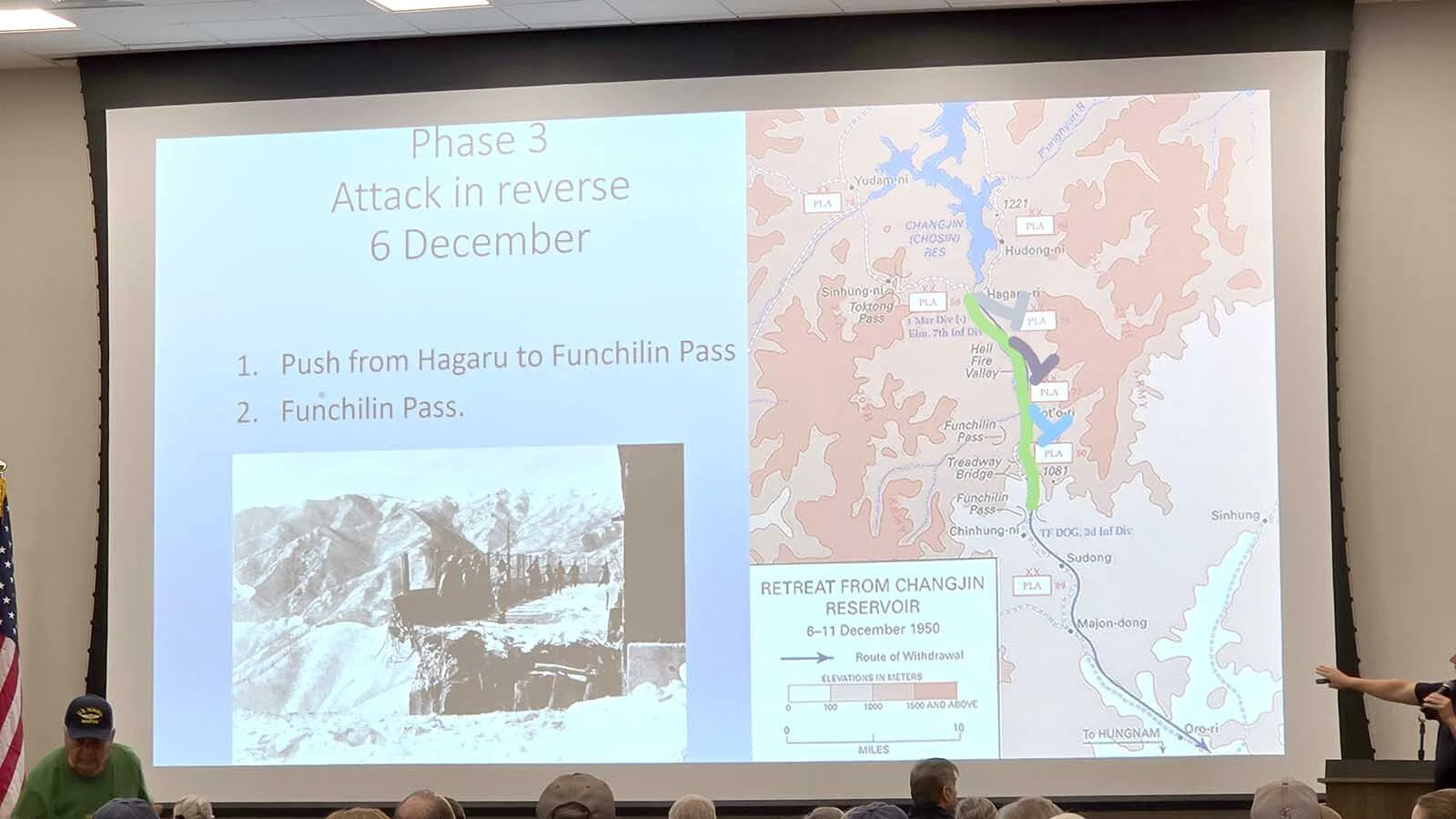
Step by step, the men fought their way off Fox Hill and back onto the narrow road that snaked south toward the sea, no longer trying to win ground. They were just trying to stay alive long enough to get out of the mountains.
The road funneled everything — wounded men, frozen trucks, tanks held together thanks to Tootsie Rolls and hope — toward Funchilin Pass.
The Chinese had already blown up the concrete bridge that had been there, leaving a toothless chasm with no way to cross.
It was a problem others were working on, with a crazy-sounding plan like some writer would dream up for a movie.
But this was real life.
Air Force C-119 “Flying Boxcars” would each carry a single steel bridge section — a chunk of portable treadway about the size and weight of a small railcar and push it out the back, over the mountain.
Each section would float down under giant cargo chutes onto a flat patch of ground near the blown span at Funchilin Pass. The Marines would then bolt the pieces in place to hold them.
On paper, the plan sounded simple enough. Bridge sections would drop from the sky, Marine engineers would stretch them across the gap and bolt them into place, and then everybody would quickly get across. Once everyone was across, the span would be blown up, keeping the Chinese from following.
Two bridge sections dropped too fast and were too badly mangled to use.
“They … were able to jerry-rig this thing to where they were able to get these men out of there,” Jarosz said.
How Legends Are Made
All along that frozen gantlet — from Chosin Reservoir to Funchilin Pass — the soldiers found Tootsie Rolls that helped sustain them as well as to plug bullet holes to keep trucks fueled up and running.
Regardless of which legend one believes, Jarosz said, there’s no disputing that the Tootsie Rolls were in the nick of time to save them all at a critical moment.
They have become part of an enduring legend of American courage and ingenuity.
It didn’t take long for the children to scoop up every last Tootsie Roll from the gravel at the National Museum of Military Vehicles after Jarosz’s lecture. They were excited about their sugary haul, even as they were largely unaware of the larger significance behind the moment.
But there were those in the crowd who understood.
For them, it was enough to see Tootsie Rolls falling from the sky in honor of all the sacrifices made. This time, it was in a country that is at peace, in a Wyoming town a world away from the Frozen Chosin.
And they wouldn’t have it any other way.
Renée Jean can be reached at renee@cowboystatedaily.com.