
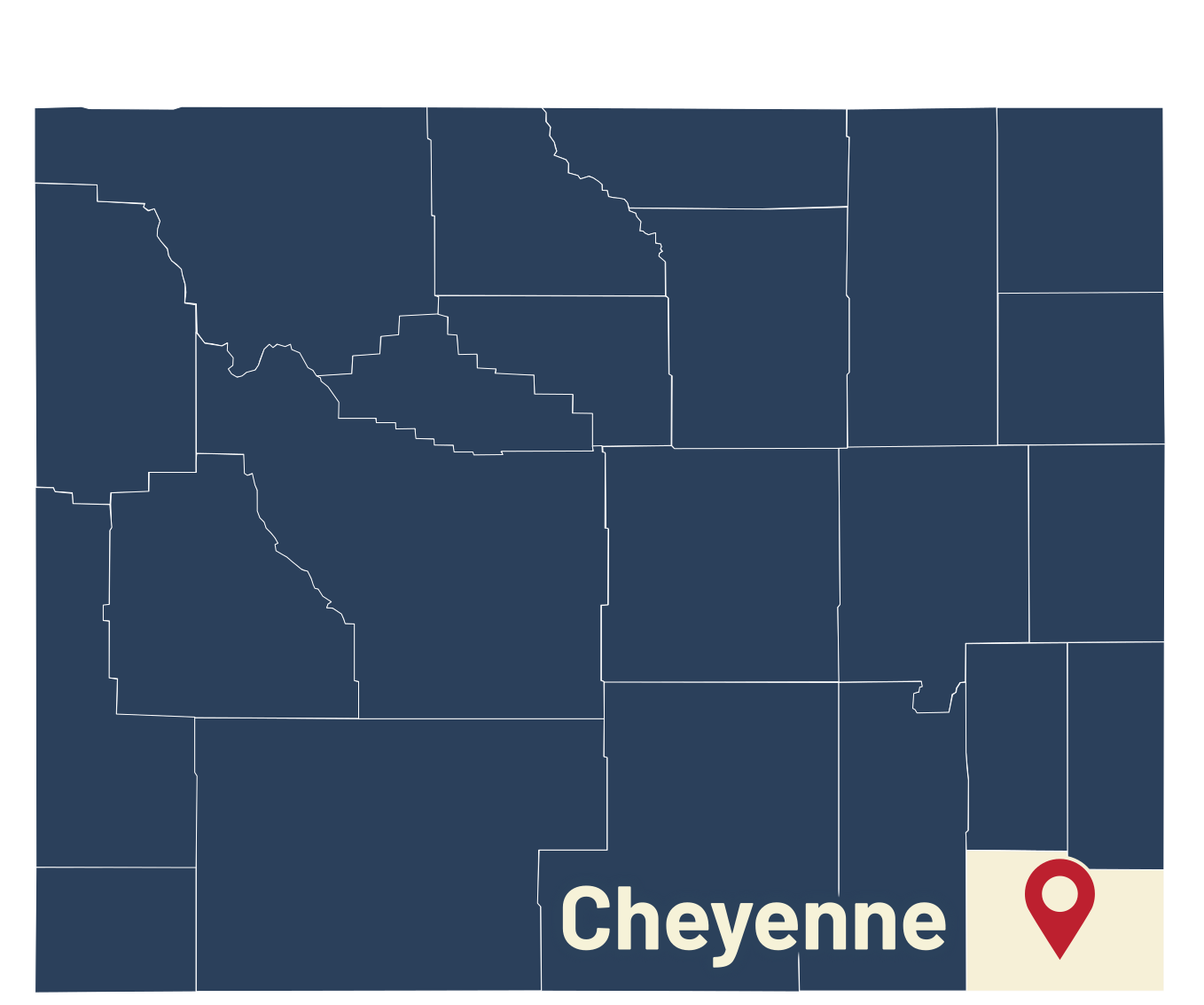
CHEYENNE — In 2022, Jessica Boyd put in an offer for an older home right on the edge of what she could afford on her hospital job’s salary.
The mother of four had second thoughts over the home’s ancient heating unit. It looked Jurassic — like something that could go extinct at any moment, leaving her holding an expensive bag.
With four children to feed and care for, how could she possibly afford to replace the furnace if it finally croaked?
“I told them, I don’t want to move in with that in there,” she said. “I wanted them to go ahead and just replace it. They wouldn’t, so I decided not to purchase it.”
Homes in Boyd’s range — around $200,000 at current interest rates — haven’t gotten any better since then.
“The homes in that range are trailers in trailer parks,” she said. “They’re not even on a foundation or anything.”
Or they are “massive” fixer uppers, like the $180,000 home she went to see that turned out to be a burned-out shell.
“I went to see it and when I looked inside, the whole inside was burned down,” she said. “I was like, ‘You’re selling this for that much money? You can’t even live in this'. It’s just crazy. Just insane.”
Boyd’s experience reflects a broader trend. Wyoming needs 20,000 to 38,000 more homes by 2030 to keep up with demand, according to a statewide housing study commissioned by Wyoming Community Development Authority.
That gap is continuing to widen, as housing costs continue to rise faster than median incomes.
Boyd was never supposed to be shopping for a home as a single parent. She and her children’s father had been looking at houses together, but he died a couple years ago.
Her hospital job as a team leader in the payments division pays well, she said, but she still can’t afford anything on the market in Cheyenne.
“Prices just keep getting higher and higher,” she said. “Really, without two incomes, without two people having a decent job, you’ll just be renting the rest of your life.”
Townhomes For Working Families
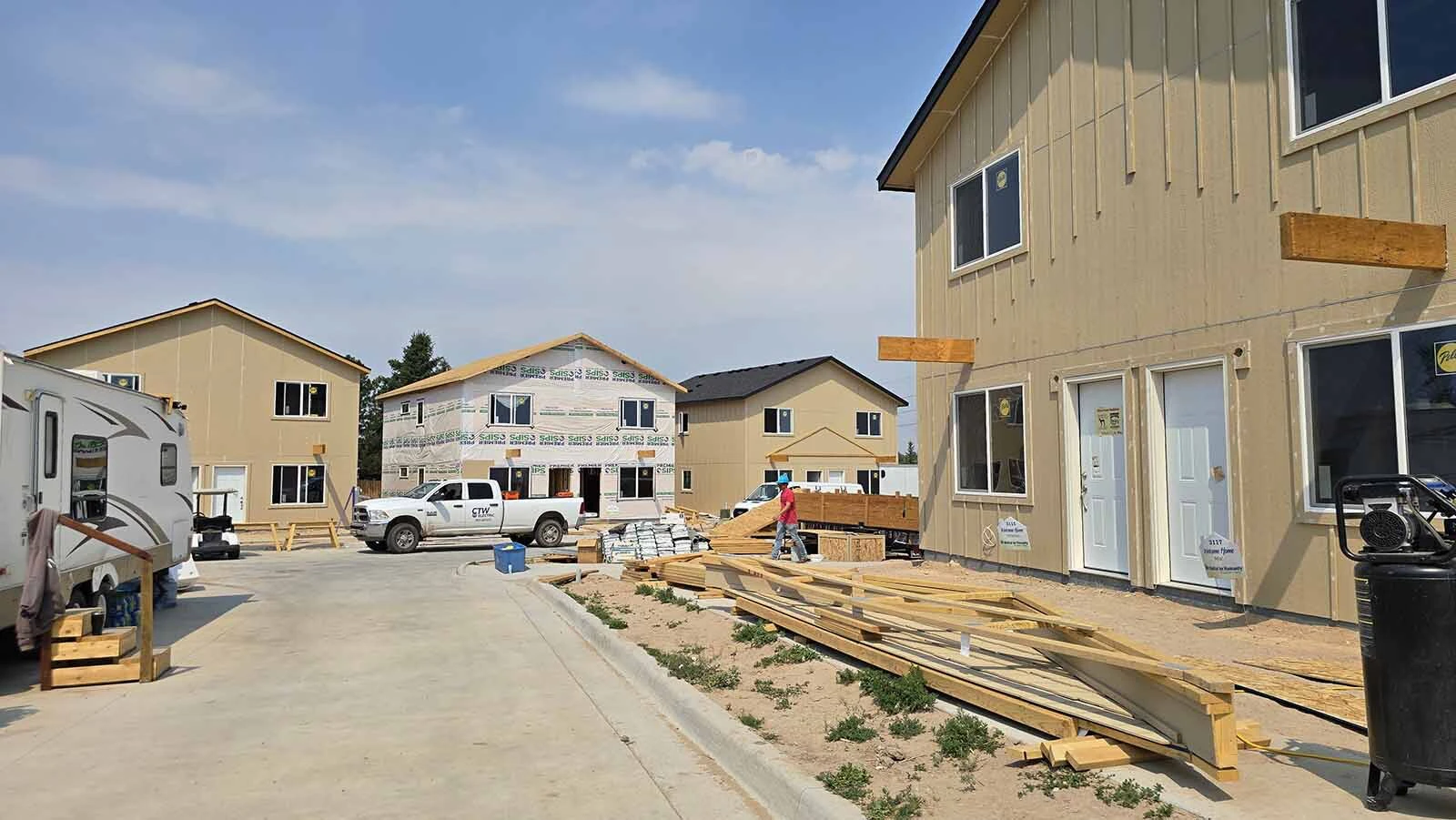
Buyers like Boyd — working families shut out of conventional starter homes even with decent, full-time paychecks — are exactly who Habitat for Humanity is working to reach with its new Pronghorn Crossing neighborhood in Cheyenne, a 12-home development reserved for buyers who make 80% or less of median incomes.
The development on the city’s eastern edge is the largest, most ambitious project to date for Habitat for Humanity of Laramie County.
It will ultimately have six attached twin homes, for a total of 12 in all, ranging from three to four bedrooms, with two baths.
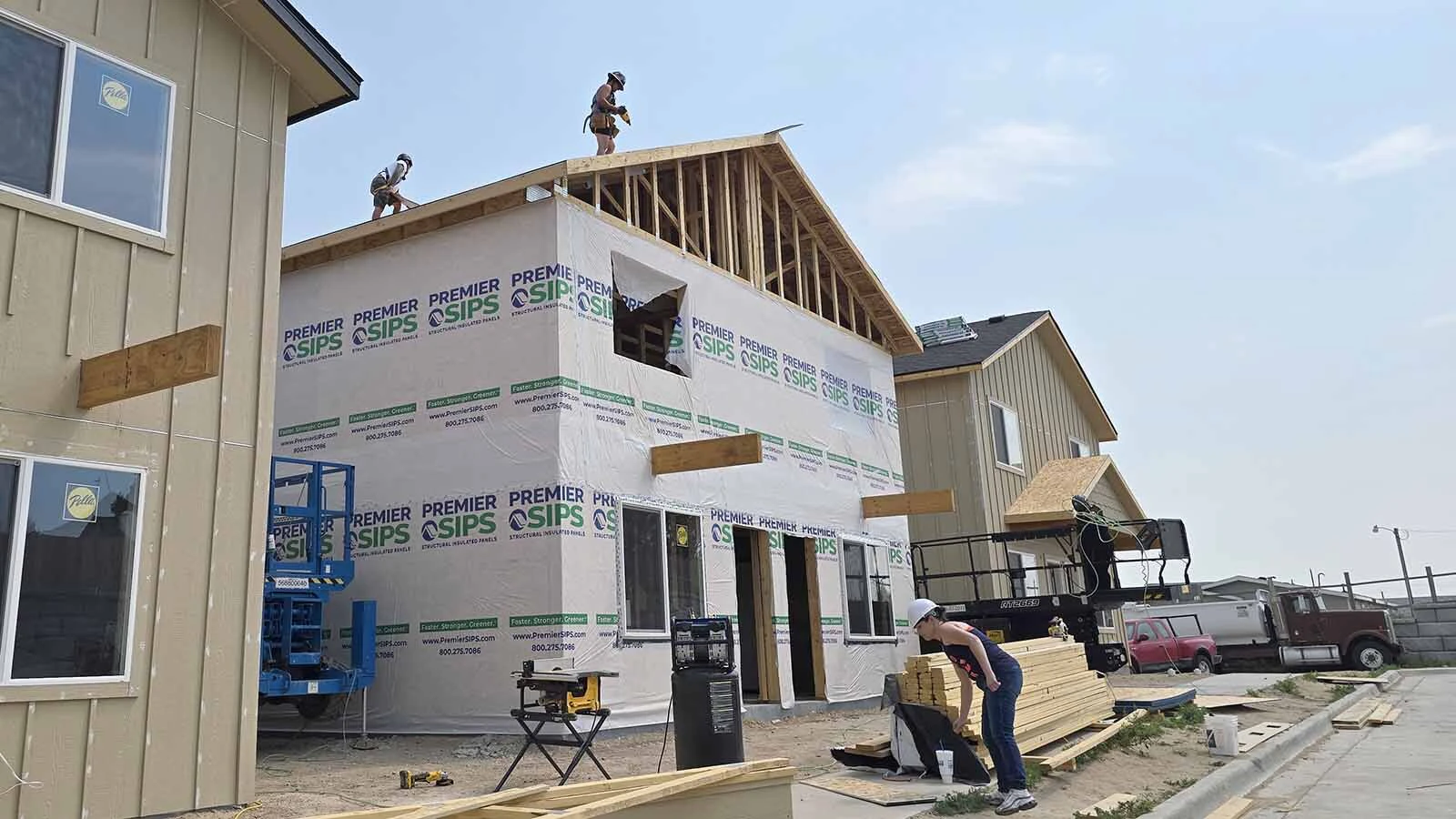
The homes are being built with structurally insulated panels, high-efficiency mini-split heating and cooling, tankless water heaters and solar panels, all aimed at keeping utility bills low once families move in.
There are no garages and the yards are tiny, but for working-class families trying to find that first stepping stone to financial stability, it’s a lifesaver, Boyd said.
“I lived in a townhome before and I always said, like, ‘I will never live back in a townhome style house',” Boyd said. “And when these came up, I was like, you know what, I’m not going to argue. I’m not going to be picking about it. This is a blessing, and I’m so grateful, so happy for this.”
Not A Free Home
Boyd isn’t the only Pronghorn Crossing buyer who has been shut out of Cheyenne’s starter home market. Victoria Hunt is also in line for one of the twin homes.
The mother of three is a recovering addict, working hard for a second chance at life.
“I met someone and just kind of got into like opiates and pills and things, and it just became worse and worse,” she said. “I went through a pretty rough divorce and I was separated, living with my family.”
During that time, she learned about drugs and street life.
“That totally changed everything for me,” she said. “And then it went downhill really, really fast.”
After an arrest, she was offered the chance to try a treatment program in Rock Springs.
“I spent five months there, and then literally came out with just the clothes on my back,” she said.
She’s employed full-time now, but starting from scratch with three children is not an easy road.
The day she learned she had been selected to become one of the 12 Habitat for Humanity home owners was one of the best of her life.
“I’ve already saved and have my down payment,” she said. “And now I just have to put in the hours.”
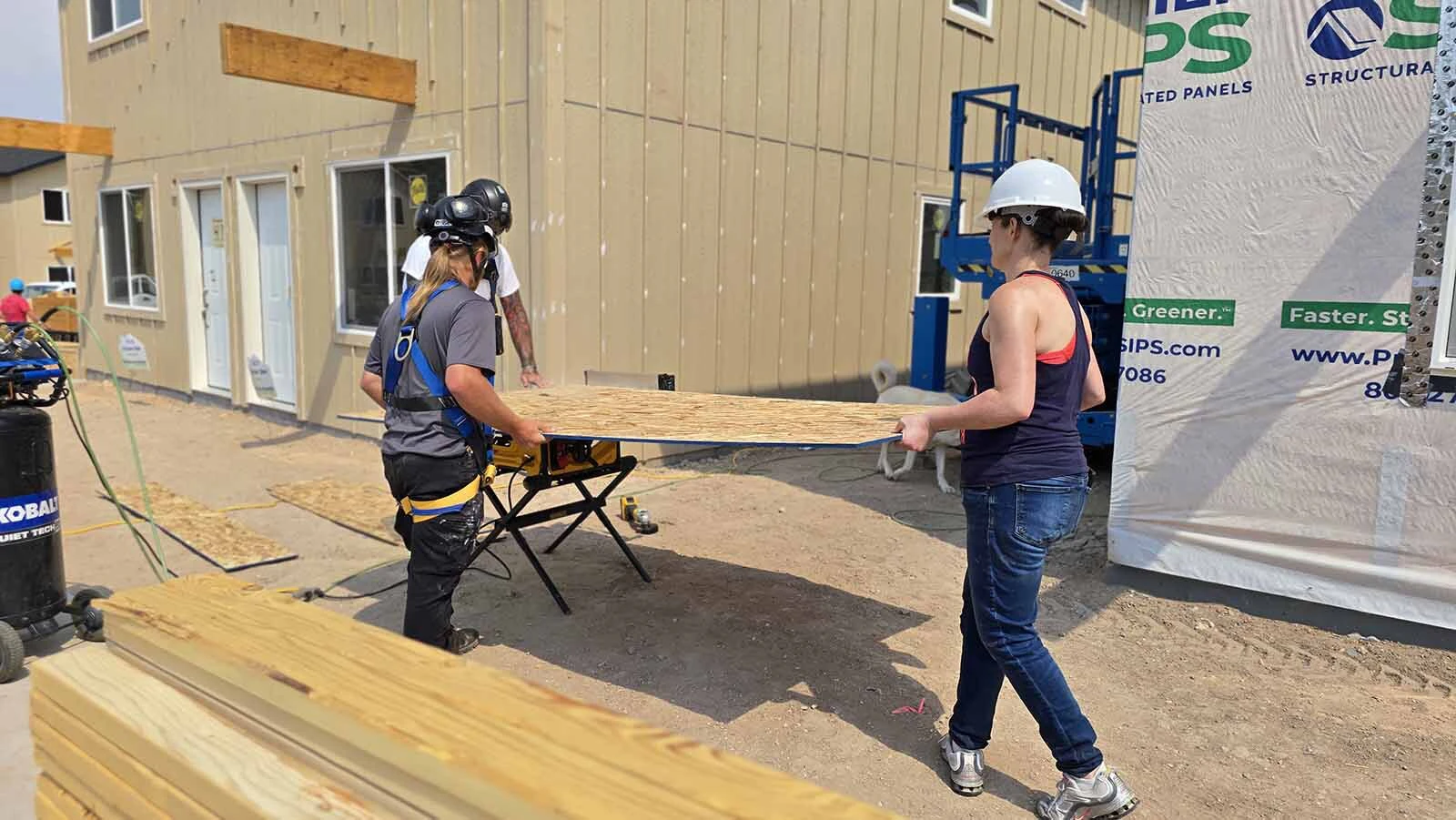
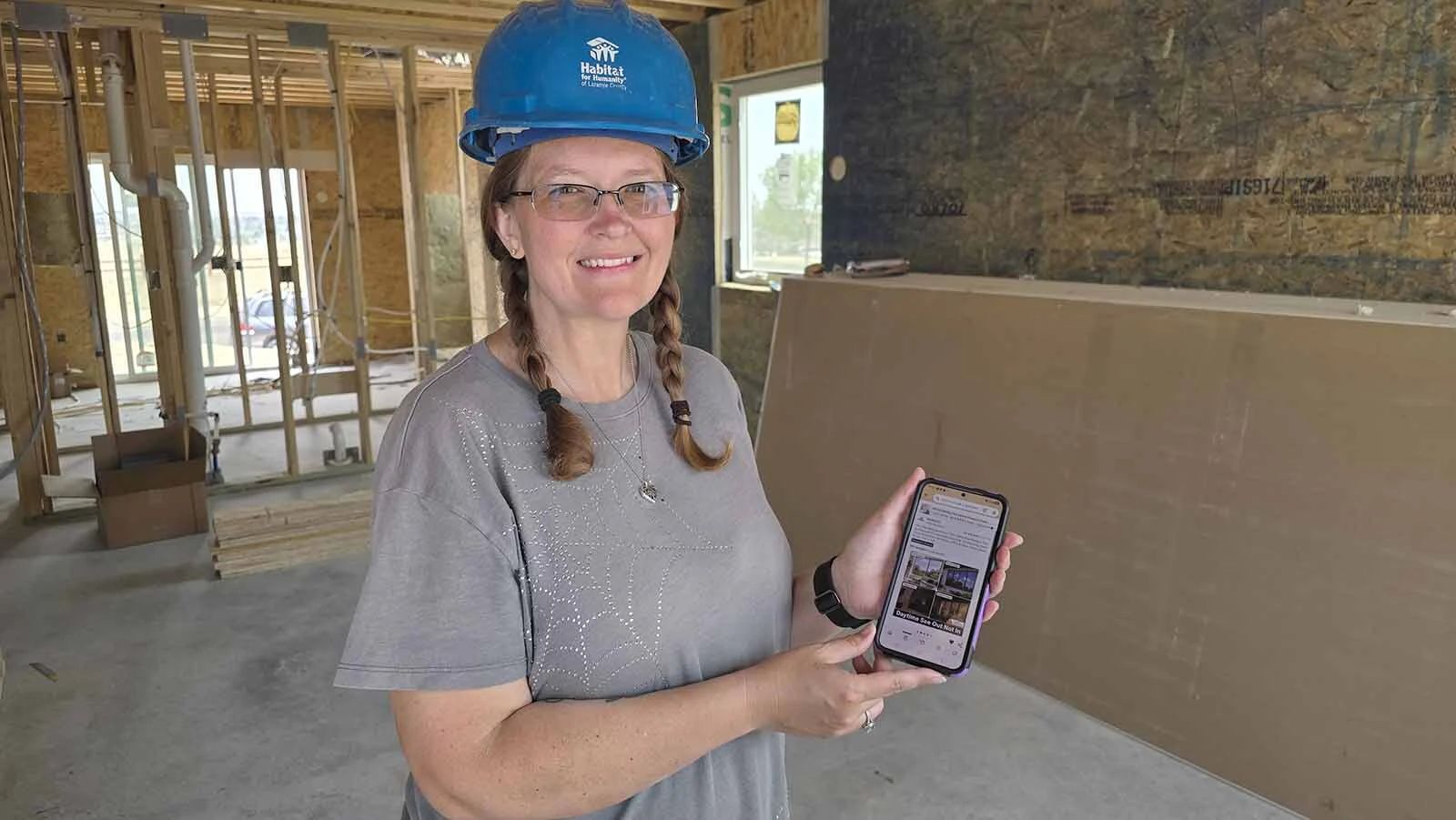
Habitat homes are not free. Buyers like Hunt and Boyd must get mortgages and pay closing costs. They also put in hundreds of hours of “sweat equity” working on their and their neighbors’ homes, which further helps lower the costs of building the homes.
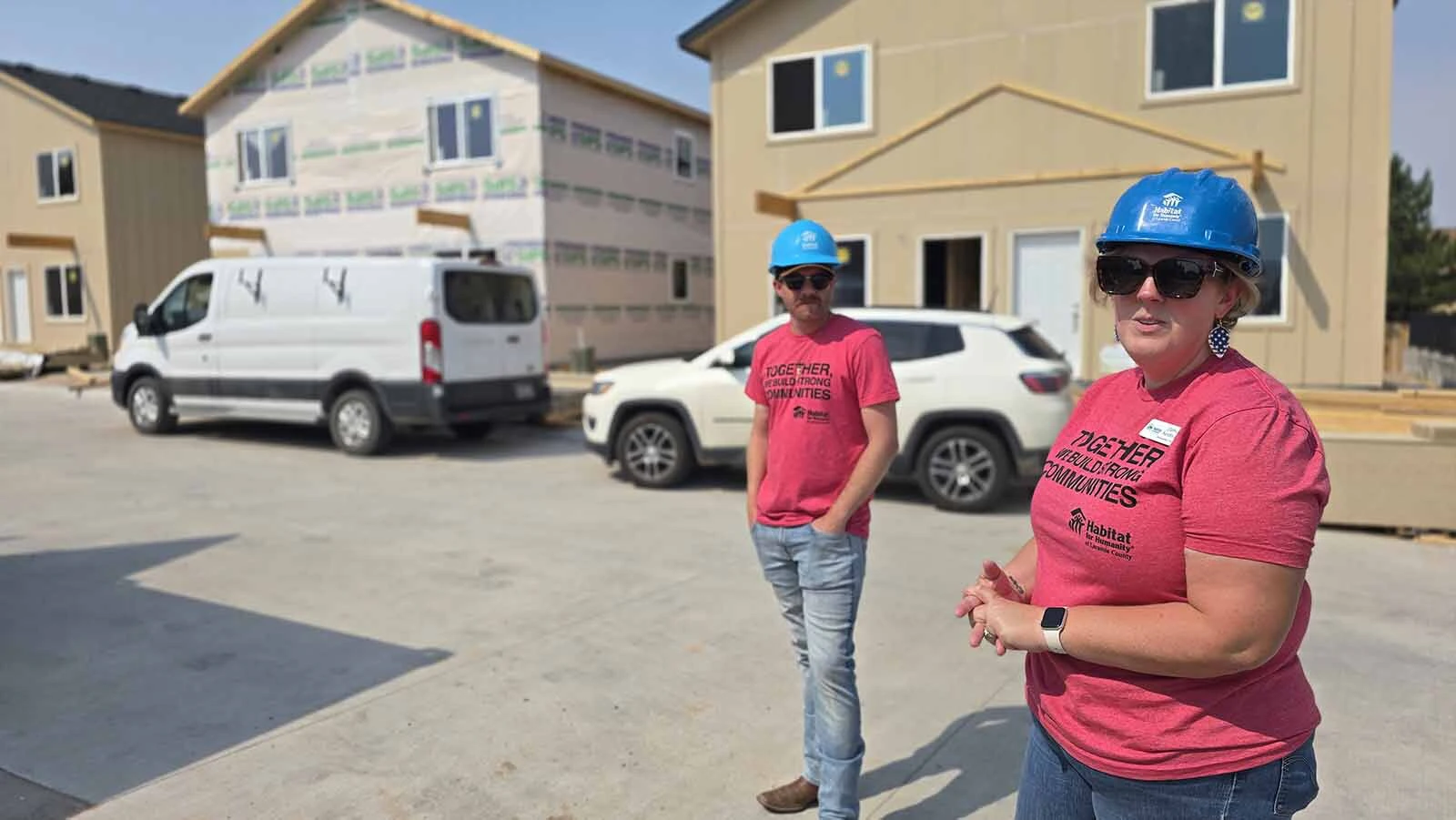
Daphney Sandoval talks about Habitat for Humanity of Laramie County's latest project, Pronghorn Crossing, which has six twin homes for 12 families while a colleague looks on. (Renee Jean, Cowboy State Daily) 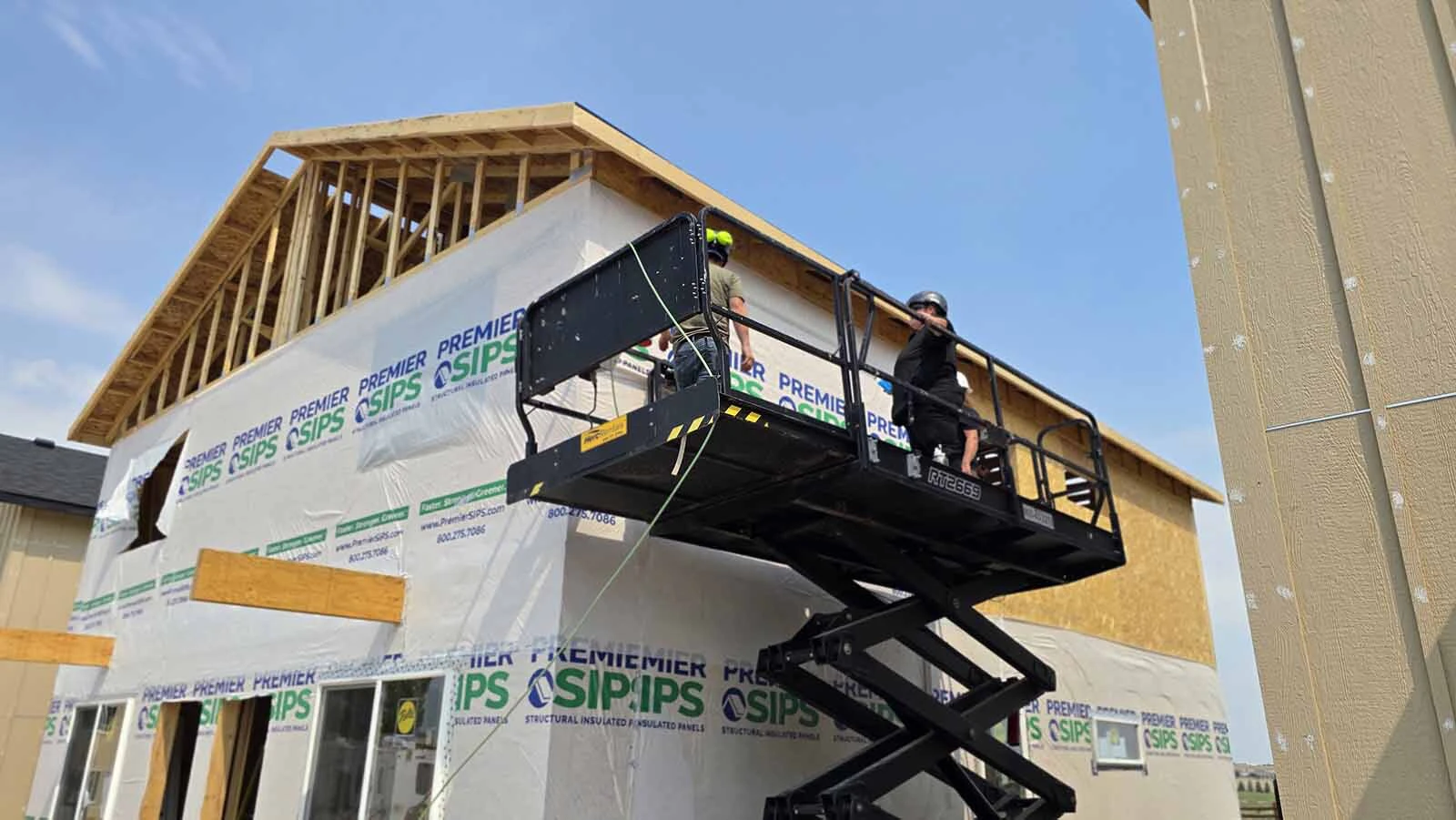
This home is being wrapped with a plastic covering that allows the final outdoor panels to seal better. (Renee Jean, Cowboy State Daily) 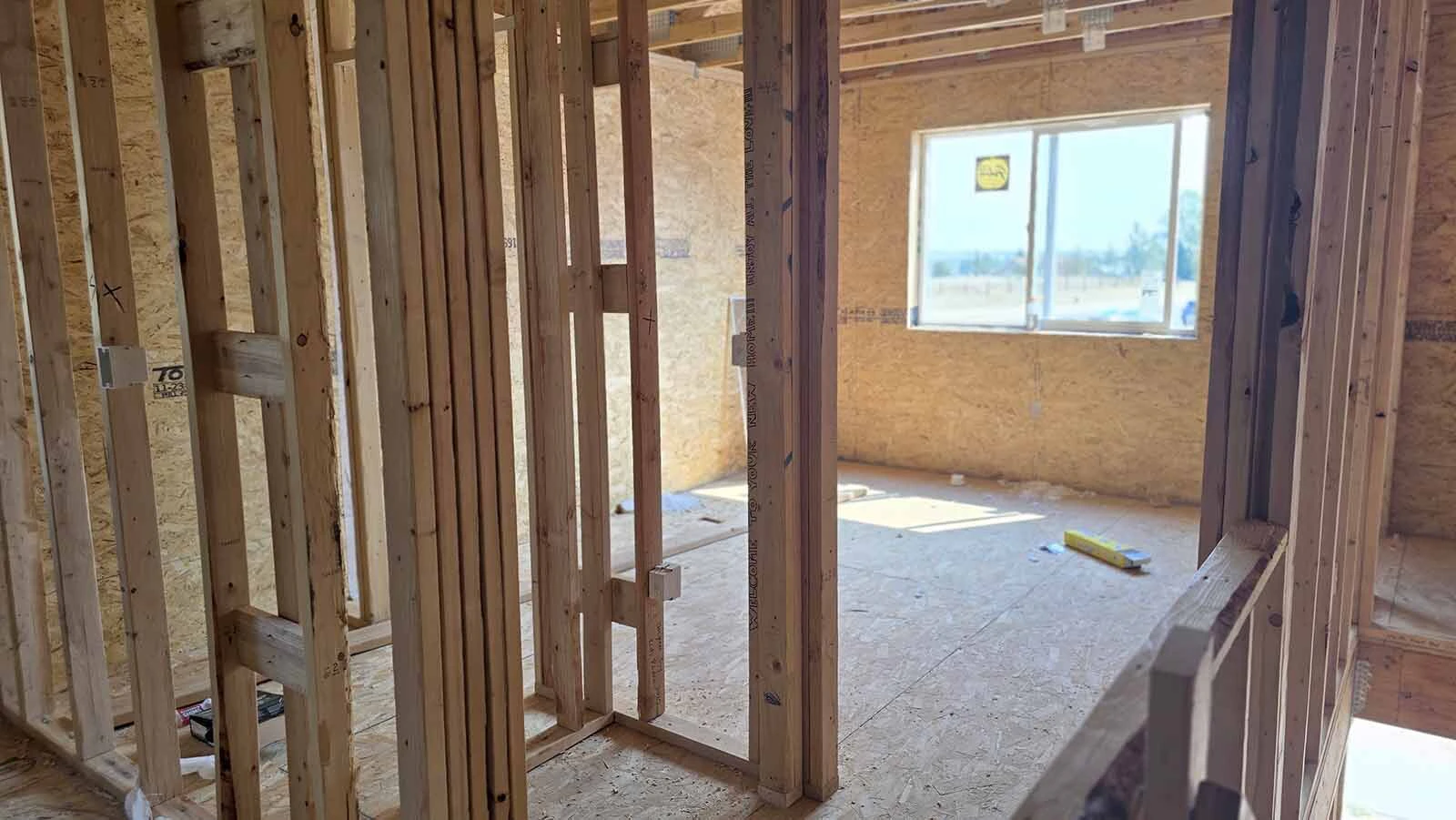
All the units have at least one nice view outside the window. This particular home is overlooking a park across the street. (Renee Jean, Cowboy State Daily) 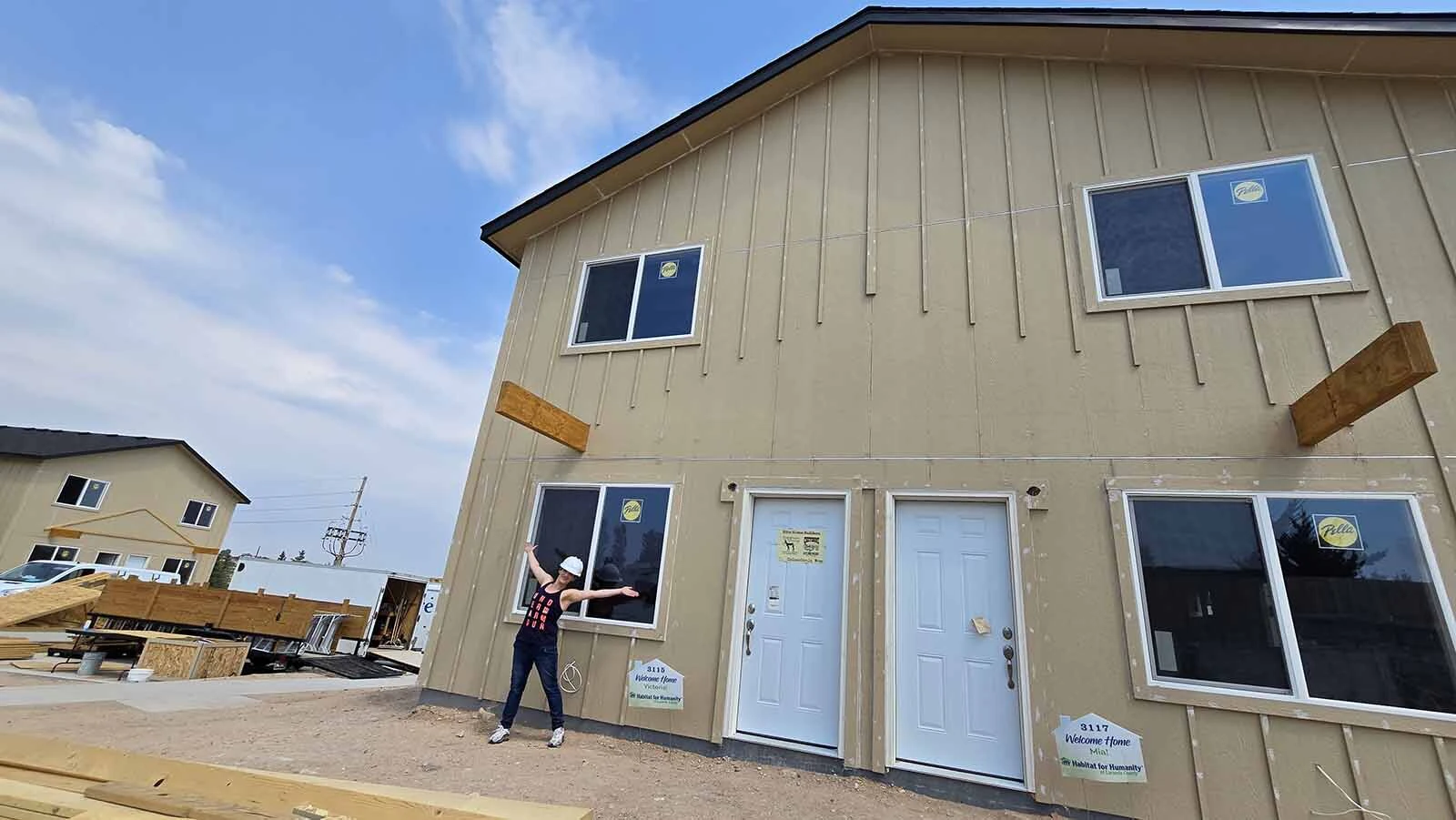
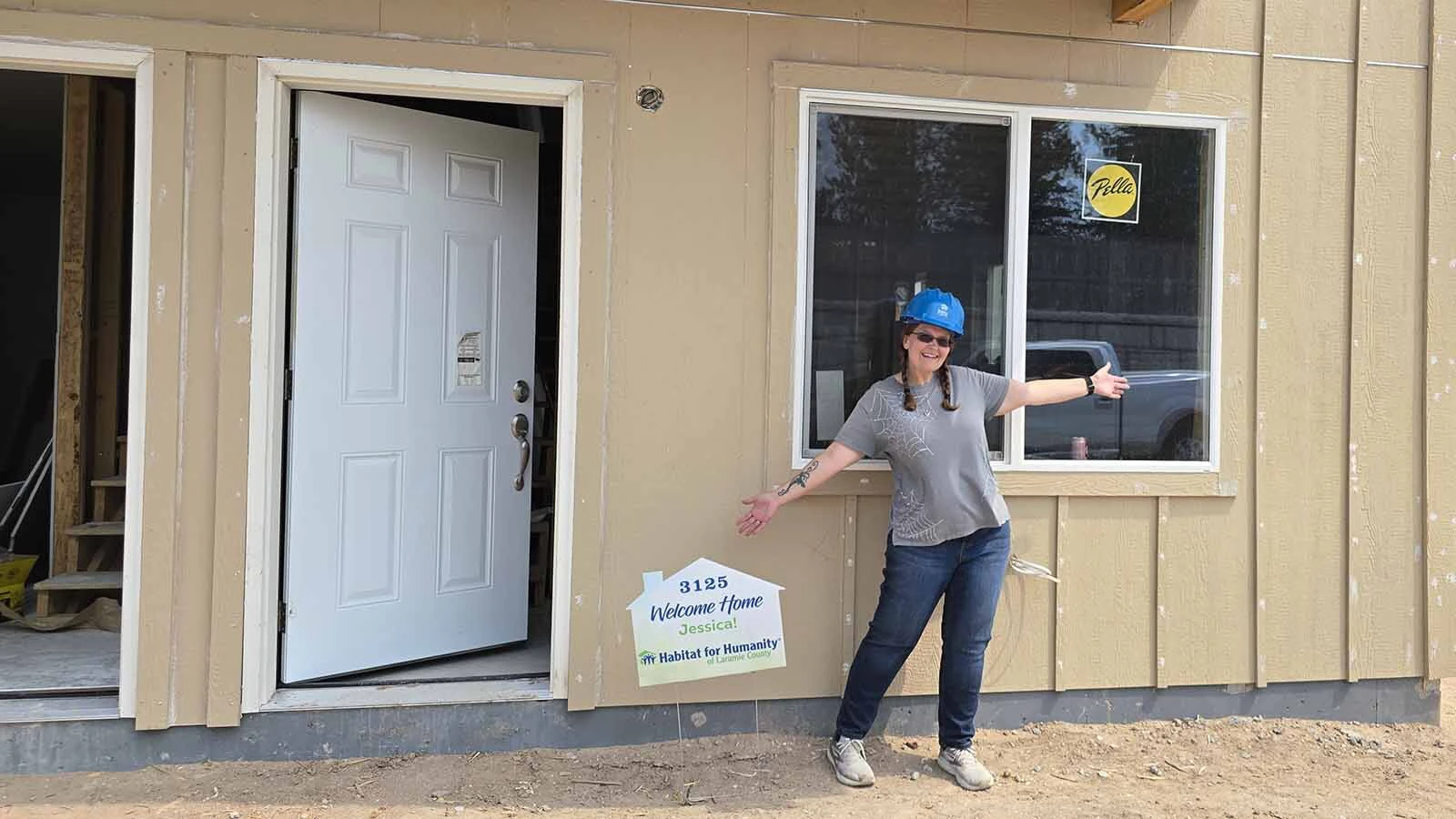
Victoria Hunt poses in front of the home that will be hers once she has put in all her required labor hours. (Renee Jean, Cowboy State Daily)
Jigsaw Puzzle On Donated Dirt
Creating this development for second chances and first-time homebuyers wasn’t an easy task. It was a jigsaw puzzle from the start, one missing a few key pieces.
Habitat for Humanity’s Daffney Sandoval told Cowboy State Daily the .93-acre lot for the project was donated to Habitat for Humanity of Laramie County six years ago by Leaning Tree Homes.
But a bare piece of land is just one piece of the puzzle. There were no streets, no sidewalks, no sewer or water lines — none of the basic infrastructure a nice neighborhood requires before even one house can go up.
“We kind of sat on it for a while because the cost of the infrastructure was going to cost over $1.8 million,” Sandoval said. “And that’s just the road, gutters, sewer, sidewalk, water stuff, the retaining walls and this detention pond.”
The math was tough for Habitat.
Its participants do obtain loans that help cover, on a sliding-fee scale basis, at least some of their home’s true costs.
Each participant’s home cost is set based on their annual incomes, but if the actual cost lies too far outside what their incomes can cover, then the projects become too difficult for the nonprofit to pull off.
So, in 2023, Habitat for Humanity decided to help advocate for a statewide Unmet Housing Needs fund in Wyoming.
“They passed it with $10 million — $5 million from ARPA and $5 million in state funds,” Sandoval said. “And the city actually applied on our behalf to the Unmet Housing Needs fund to get the infrastructure completed here.”
That allowed the project to break ground in November 2024 to get the basic infrastructure in place.
With that in place, the homes work out to around $315,000 each, which is workable.
Without it, the homes are closer to $375,000 — a price point that would push the homes out of reach for the very families the project is meant to serve.
How To Turn Eight Into 12
Policy changes at the local level also helped stretch the project further.
Originally, there was only room for eight single-family dwellings on the property due to Cheyenne’s zoning and lot-size rules.
But the city has since rethought many of its ordinances around home-building, hoping to spur new construction.
It has scrapped minimum lot sizes for residential properties, removed density caps for multi-family units, changed setbacks, and removed minimum parking requirements.
They’ve removed luxury material requirements from multi-family building facades and display-window requirements for multi-family dwelling units.
They’ve also added cottage lots, for multiple, small, clustered houses designed to face a shared common open space. Sharing infrastructure that way helped further lower construction costs for the Habitat project, Sandoval added.
“We’ll have plenty of parking,” she said. “And we’ll do a privacy fence in the back, and we used the cottage law amendment with the city, so we have kind of shared yard spaces.”
The cottage lot option also allowed Habitat to build six twin homes for 12 units in all, instead of just eight.
Each of the homes will carry a small, forgivable second mortgage and a shared-equity clause — along with Habitat’s right of first refusal if owners ever decide to sell. That prevents quick flips, and helps ensure the units remain affordable for future working families, Sandoval said.
Big Picture Changes Still Needed
As big a lifesaver as the Unmet Housing Needs fund was for the Pronghorn Crossing project, the $10 million fund is barely scratching the itch that is Wyoming’s housing problem.
When the state opened applications for grants from the Unmet Housing Needs fund, communities responded with 21 separate proposals totaling roughly $51 million in requested help — more than five times what the fund could provide.
The projects included many aimed at workforce housing, as well as senior housing, and other developments similar to Pronghorn Crossing in towns all over Wyoming.
That has Habitat pushing for other big-picture changes at the state level — fixes that don’t necessarily require a big new pot of money but that would change how existing tools can be used.
One example Executive Director Dan Dorsch cited is the TIF district, a special taxing district that works by borrowing from future tax revenue generated by property improvements.
Typically used for blighted or vacant properties, the structure is intended to answer the chicken-and-egg proposition for a tract of land that’s not going anywhere because the costs of cleaning it up or building infrastructure mean developments don’t pencil out.
Dorsch said he believes the same dynamic could be used for affordable-housing projects, instead of just blighted or vacant lots, to help get them off the ground.
“Affordable housing improves property taxes as well,” he said. “So the same principle would work.”
Pronghorn, for example, will generate new property tax increases totaling up to $48,000 annually.
“Nobody can build affordable housing,” he said. “So why not have that incentive there to build it?”
Renée Jean can be reached at renee@cowboystatedaily.com.


