
Dietz was once a busy and bustling community made up of a collection of mining camps scattered along the Tongue River Valley.
Barefoot children were full of mischief, baseball games were played between rival camps, and then the explosions would come.
Families would rush to the mines to discover if the men who were working that shift had survived.
Stanley A. Kuzara of Sheridan was born on Oct. 15, 1906, into this dangerous and poor — but lively — life. Along with many others, found that growing up in a dangerous coal town, the first life lesson was survival.
His parents were Polish immigrants and his father was working in Mine No. 5, so the family lived at the coal mining camp of Dietz No. 5 at the time of Kuzara's birth.
The Kuzara family, which eventually grew to seven boys and five girls, lived in a converted barn that was formerly a camp grocery store and post office, Kuzara wrote in his book “Black Diamonds of Sheridan.”
Later, their camp would be renamed Dietz No. 8 when Mine No. 5 closed and a new mine established in the same area.
By the early 1900s, Dietz was among the largest coal-producing communities in northern Wyoming with 800 men working the mines in the winter and 400 in the summer.
Unlike a single town, Dietz was a collection of mining camps.
G.B Dobson of Wyoming Tales and Trails wrote that each town bore the number of its corresponding mine, thus when Mine No. 5 was closed and replaced by Mine No. 8, the camp was renamed Dietz No. 8.
Other mines in the region included the Hotchkiss, Acme, Model, Carneyville (later Kleenburn), Monarch, and Kooi.
Nearly every European country was represented in the camps which Kuzara listed as Polish, Hungarians, Welsh, Scotch, English, Italians, Czechoslovakians, Bulgarians, Austrians, Germans, Serbians, Montenegrans, Irish, Slovaks, Japanese, and French.
Life was precarious in the camp.
When Kuzara was a year old, his parents had to live in a tent with the family while they waited for their new house to become available. That would be the John Hecht Place located about midway between the Dietz No. 7 and the Dietz No. 5 camps.
It was while in this tent that Kuzara said his mother had him in a high chair placed near the coal range to keep him warm.
One of the other small boys began to climb on the high chair and, when it became unbalanced, Kuzara fell on top of the hot range.
He severely burned his right cheek and carried the scar for the rest of his life.
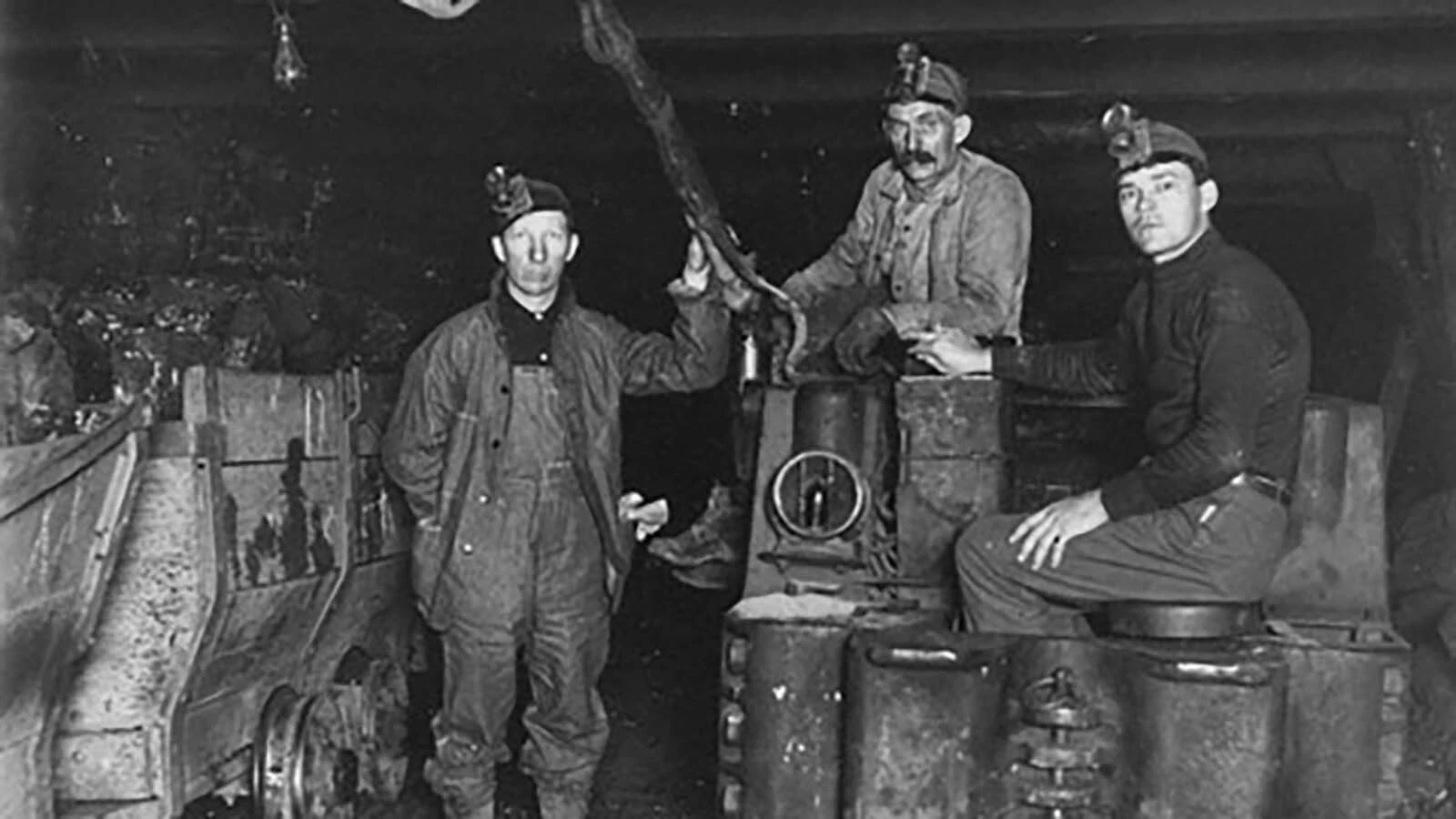
Miners with an electric engine in Dietz No. 8 mine. (Kuzara collection, Sheridan County Fulmer Public Library) 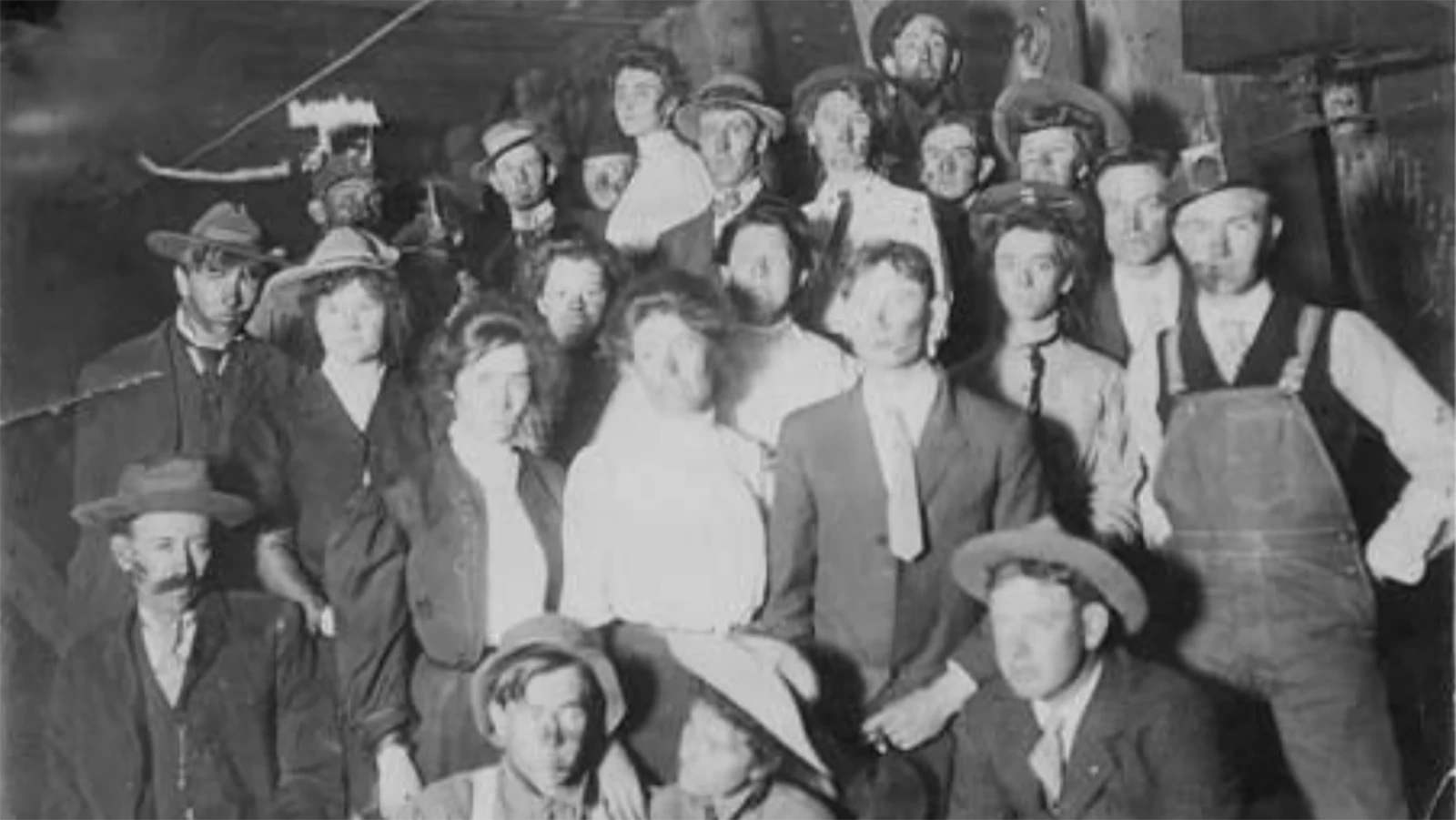
A tour of the mine in Dietz by local community members. Dietz is now a ghost town and the coal mines abandoned but in the early 1900s, up to 10,000 people lived in the coal mining district which included several mines and camps. (Wyoming State Archives) 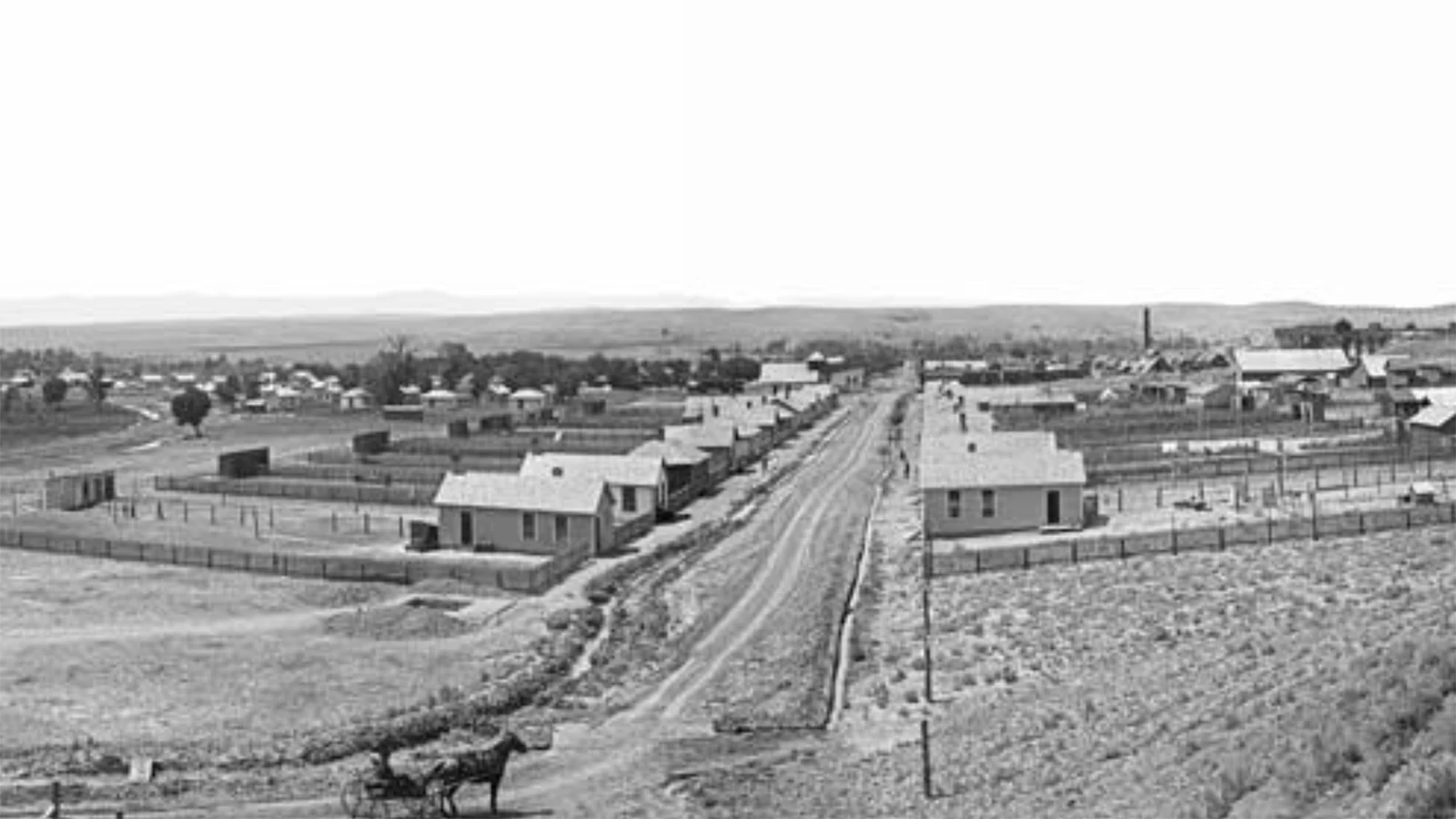
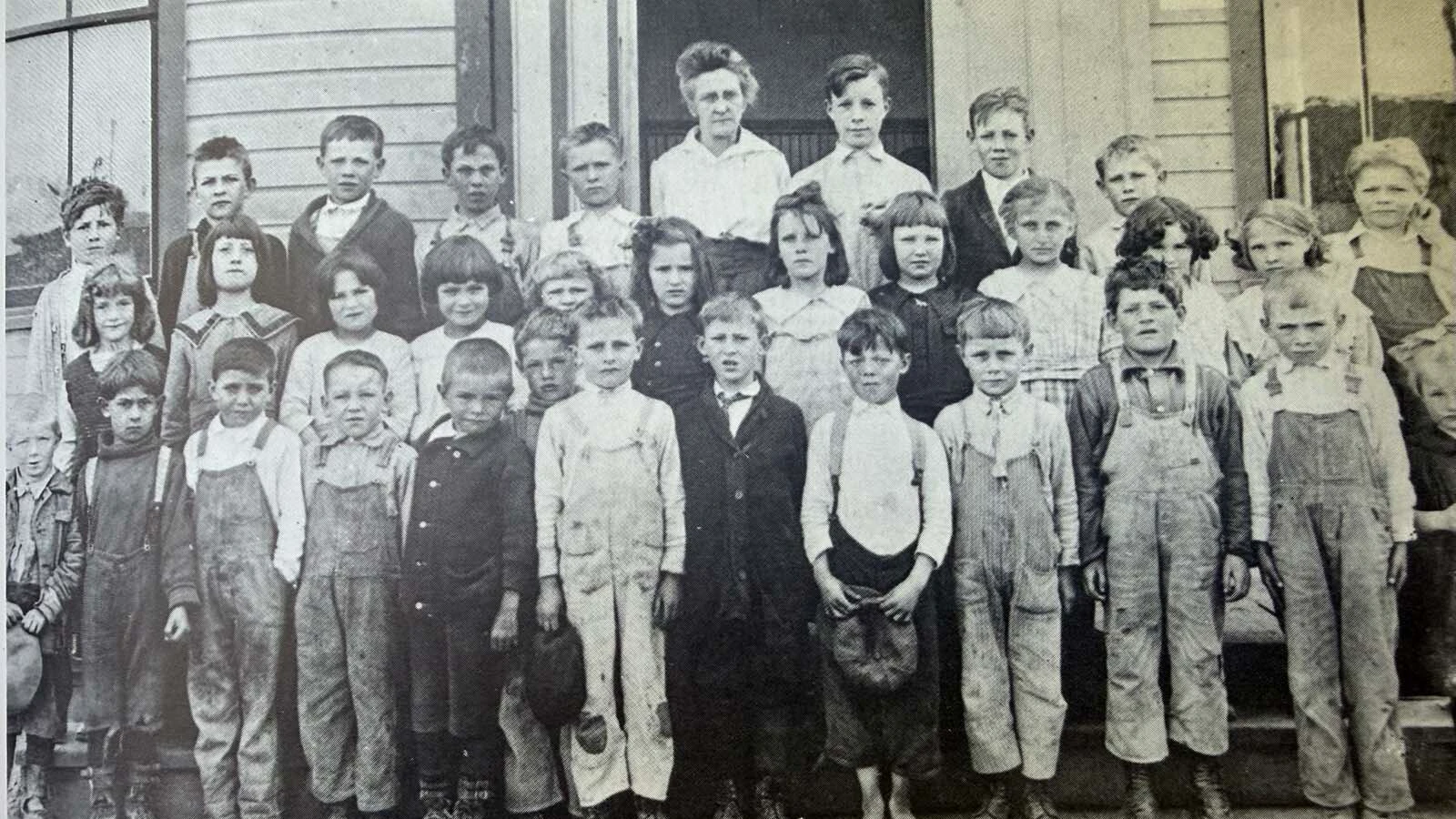
Dietz, Wyoming, is a ghost town today but it was once a thriving community and collection of coal mining camps. While the men worked long hours underground, their families carried on life above ground and it sometimes could be just as dangerous according to Stanely Kuzara. He grew up in Deitz and says it is a wonder that he survived his childhood and the mischief he pulled with the other boys. (Joseph Elam Stimson, photographer, Wyoming State Archives)
Dangerous Games
Kuzara said that the kids in the coal mining camp would have to get inventive in their games.
He remembered how at times, they would “borrow” a handcar from the CB&Q railroad.
These carts would be left on the siding of the tracks by a maintenance crew and proved too tempting to the boys who found it.
Some of the older boys would carry them to the interurban tracks whose bed was not level as the railroad tracks.
“We would all push the hand-car up to the top of an incline just to experience the sensation of coasting down at quite a speed,” Kuzara said. “It was a wonder that we survived as the handles of the hand-car would be pumping up and down of their own accord.”
Another favorite pastime in the winter was to slide down the hills on homemade sleds, bobsled and toboggans.
The children would also ice skate on the sloughs and river, the latter which was kept clean of snow by flooding.
“Of course, skating on the river was sometimes very dangerous since the ice was either very thin where the water was naturally swift or was even non-existent,” Kuzara said. “We had to remain constantly on guard and did have some narrow escapes.”
A game unique to the coal mining camps was playing with carbide, a compound of carbon and a metal.
Kuzara explained that it was the habit of the miners to clean out their carbide lamps of the residue of carbide.
He said that near the exit of the mine, one miner after another would unscrew the base of his lamp, knock it against the post and deposit the residue until there was quite a pile of spent carbide powder.
“As the men would empty their cans, we children would finger through the carbide dust, picking out all granules of unused carbide,” Kuzara said. “Sometimes we would merely pile it, drop water on it and light it; other times, place a supply of carbide in a bottle and after watering it, quickly cap the bottle and get quite a charge out of the resulting explosion.”
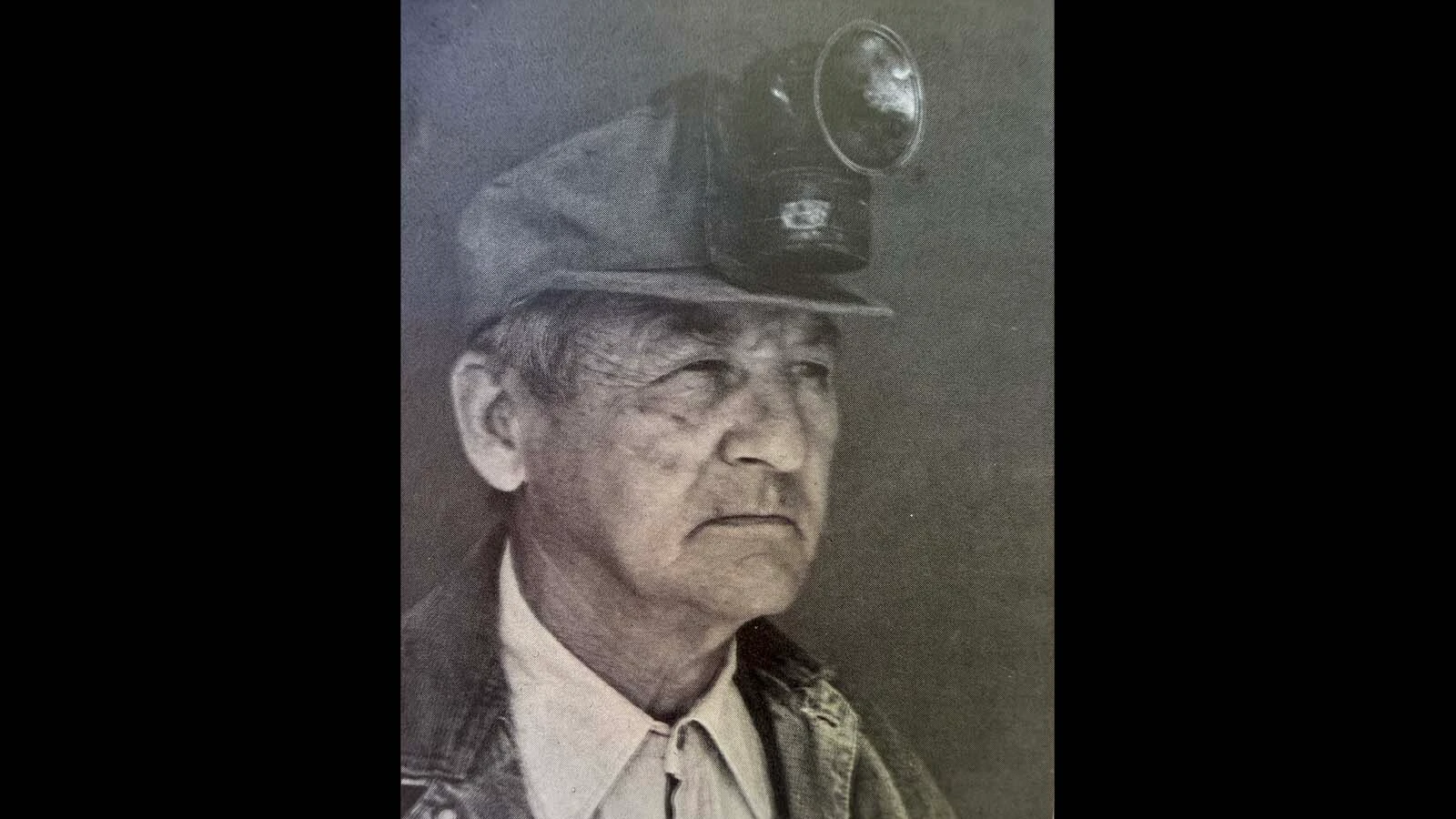
Stanely Kuzara (pictured) grew up in the coal mining community of Dietz, Wyoming, near Sheridan. As a kid, he used to take the discarded carbide, a compound of carbon and a metal, from their head lamps and make miniature explosions with them. (Kuzara Collection) 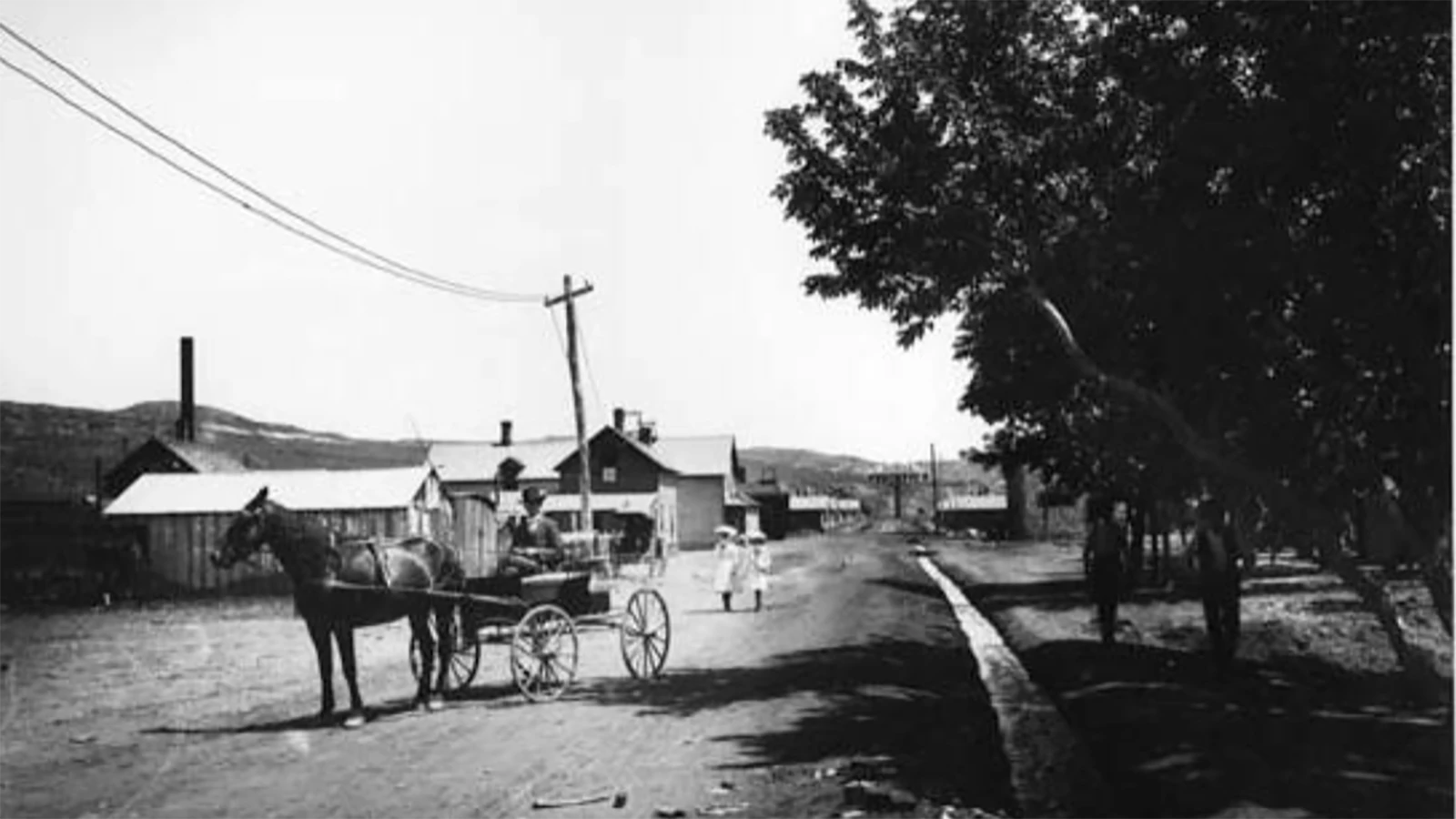
Dietz, Wyoming, was a coal mining camp near Sheridan. 800 to 400 men worked in the mines and their families lived in the camps that were scattered along the Tongue River. Stanely Kuzara grew up in the camp, one of twelve children, and remembers a childhood of belonging to a loving community and plenty of mischief. (Wyoming State Archives) 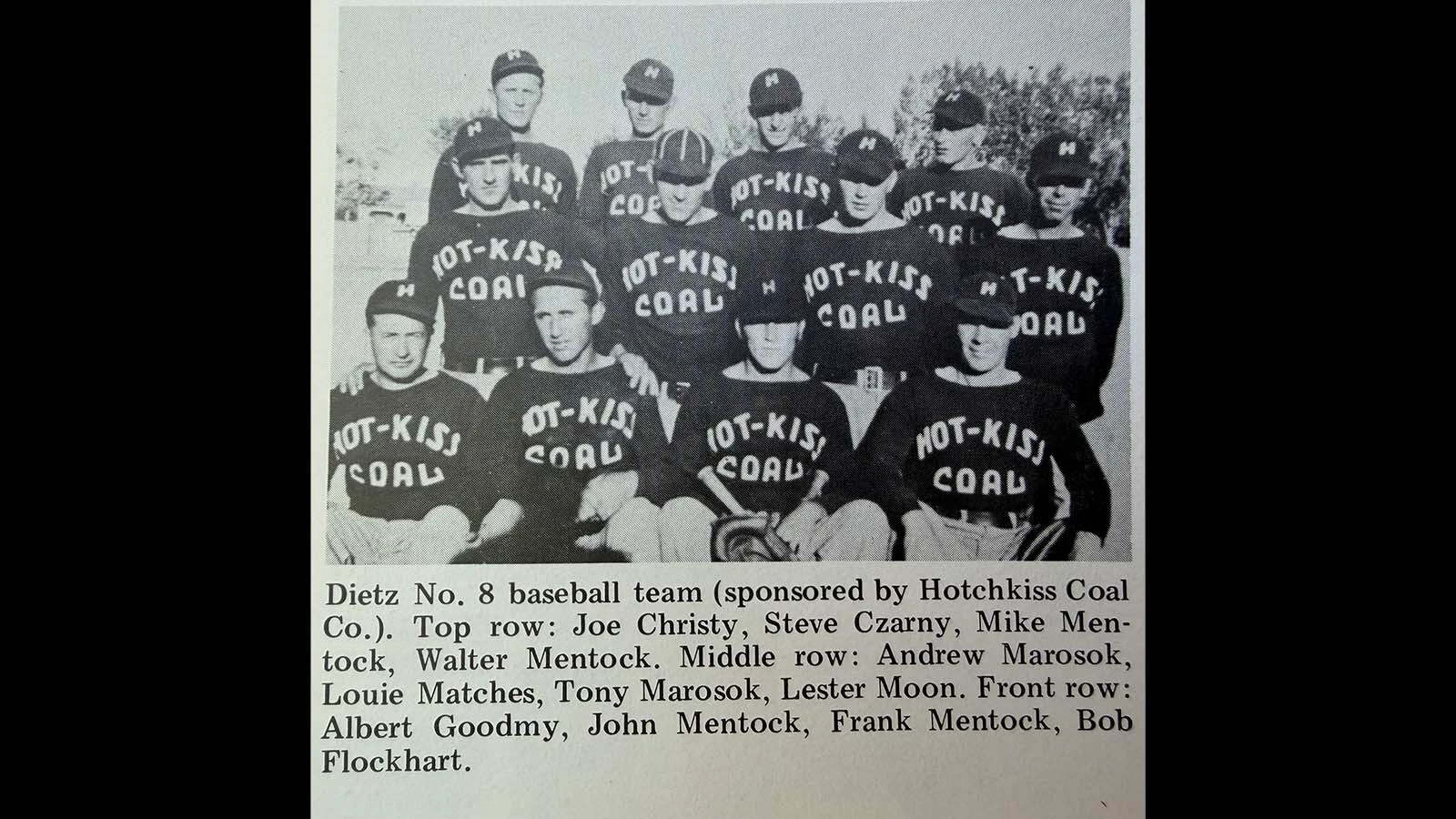
Baseball was a favorite pastime in the coal mining camps near Sheridan, Wyoming. In Dietz, Stanely Kuzara said that all ages played the game and that the men had an especially good team and were very competitive. (Kuzara Collection)
Different Rules
Kuzara recalled that even the men had their games that were usually of various contests of strength such as boxing, wrestling, weightlifting, and throwing horseshoes.
“My father once bet one of the more husky miners, Joe Stucca, that he could not lift a certain water-soaked oak railroad tie about 20 feet long,” Kuzara said. “The bet was $5.”
Stucca not only lifted one end of the tie on his shoulder, but gradually worked to its center until he had it balanced. Then the miner walked off with it.
It was estimated that the tie weighed about 800 pounds.
Kuzara said that all ages played baseball. Each camp had its own team and there was real rivalry among the various camps as well as with teams from Sheridan and the surrounding area.
“Even with us younger boys, baseball was one of our principal activities,” Kuzara said. “However, instead of competing teams, we used to play work-up.”
A player would begin at left field position and as a batter was struck out, the players would gradually move up a position until finally, the boy would arrive at the batter’s box where he remained until he was put out.
This made it so that the younger boys became very adept in each position, and they became particularly good batters.
The end results were that when they were older and joined the men on the baseball teams, they were already very good at the game.
Even in the wintertime, Kuzara said the men were able to keep involved in physical activities when not working their long hours in the mine
“Frequently with a keg of beer nearby, the frozen river became the scene of a game called Pravo, sometimes referred to as curling,” Kuzara said. “In this game of competition, one would run to a foul line and slide a disk or quoit along the ice, as in bowling, to an objective spot or line, frequently glancing off another’s quoit to gain advantage.”
Kuzara said that as a young boy, he also played on the frozen river in the wintertime. One of the games was called Shinny, which resembles hockey today.
“Instead of owning any manufactured hockey stick and puck, we used to find a willow or some other tree which had a crook in it shaped like a hockey stick, and for a puck we used to use a bung from a barrel,” Kuzara said.
In the summertime as they tramped around in the trees, he said they were always on the lookout for a better “shinny stick.”
Another game Kuzara said was played by the men on the ice was called Bolina.
He described this as similar to curling except that balls were used. A smaller target ball was rolled a distance, then the larger ball rolled, or lagged, to see how near one could get to the target ball.
In all of these games, enthusiasm ran very high.
Celebrations
Each of the mining camps had its own polka band that appeared in many of the big parades that were held in the early 1900s. They also played at the many Polish weddings and christenings.
Instead of celebrating birthdays, it was the accepted custom at the camps to celebrate their “name days.”
On St. Joseph day, for example, every Joe in the camp set that day aside for celebrating his patron saint. On St. Maria Day, all Marys would celebrate.
By the time all the Joes or Marys got together to celebrate they would have quite a party, complete with a band, Kuzara said.
The union hall in practically each mining camp would usually also serve as an auditorium for functions of other organizations and also for school plays and programs.
Frequently, officials at the mine would give gifts to children at the Christmas party and, if times were good, these were quite elaborate.
Despite all the fun and community spirit Kuzara experienced, he also saw a lot of tragedy at a young age.
Deaths were all too common from explosions, gas leaks and other accidents.
His own father tried to stay out of the mines, and throughout Kuzara’s childhood, his father opened up stores that sold a wide range of goods, from liquor to furniture.
Despite his efforts, his father would often have to return to the mines to feed his large family.
Kuzara said that knowing he did not want a low-paying mine job, he studied hard in school. He pursued many careers to keep himself out of the mines.
However, he also ended up doing his time underground, but kept striving to get other jobs that would get him above ground.
It was when looking back at his childhood that Kuzara appreciated what he had survived.
Not just the hard labor, but the antics of the boys and men who lived in the coal mining camps of Wyoming, especially now that most of these coal mining camps are ghost towns with fading memories.
"As I look back retrospect, I feel now that it really was a unique privilege to have been born in the mining camp of Dietz No.5, Wyoming," Kuzara wrote. "The fun, the frivolity, the pathos, and the hardships."
Jackie Dorothy can be reached at jackie@cowboystatedaily.com.


