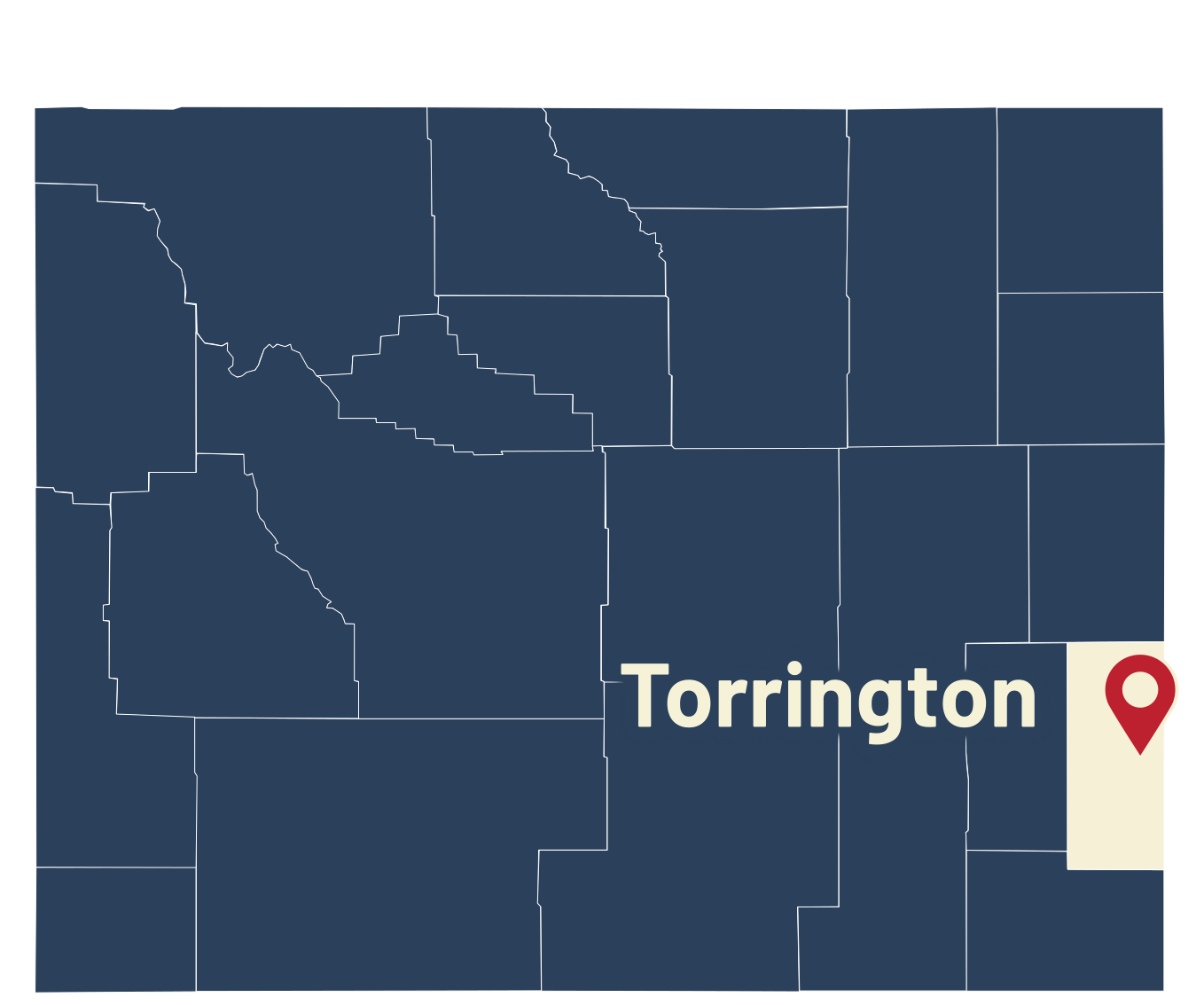
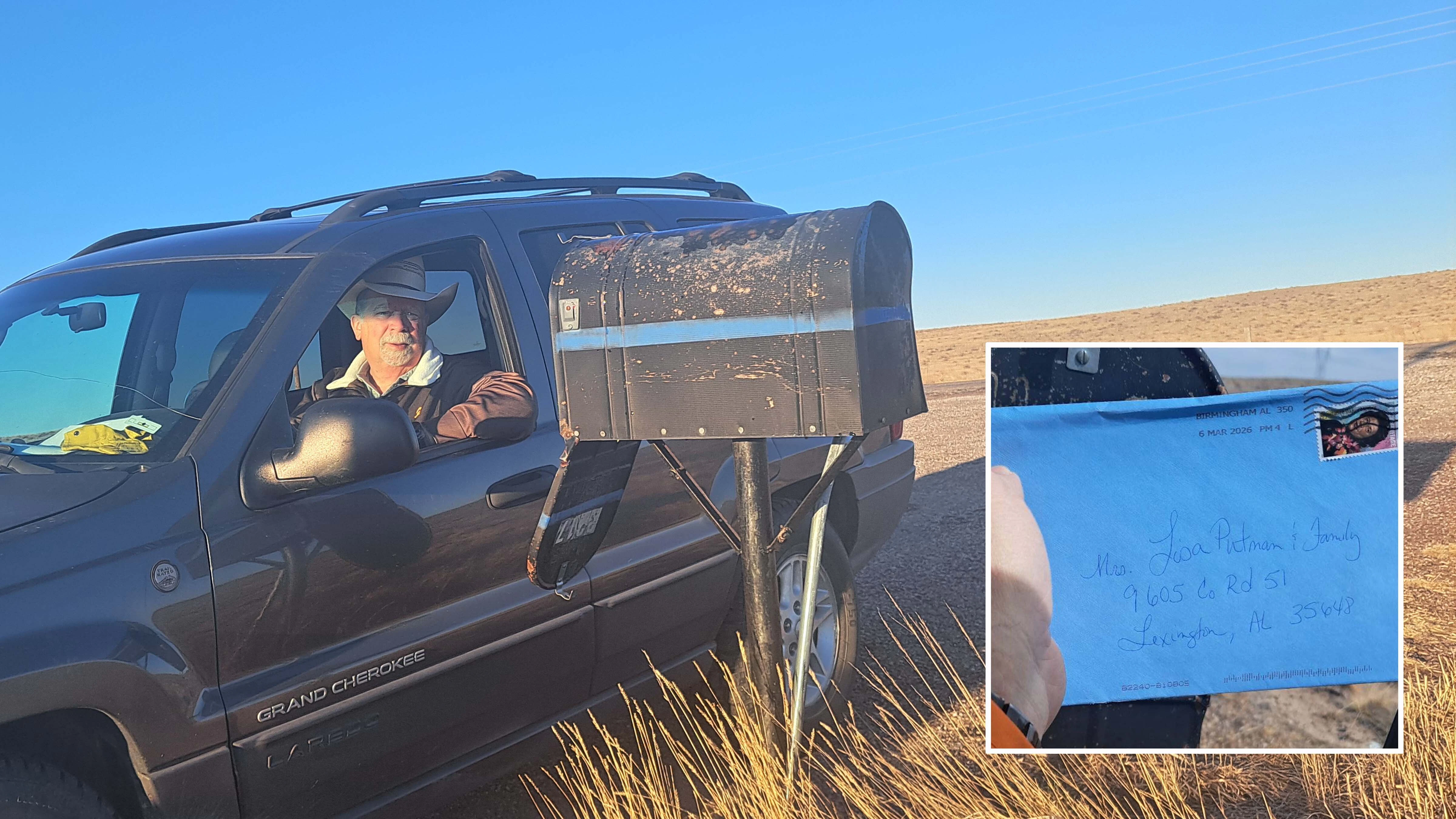
A greeting card meant for Alabama resident Lisa Putnam instead traveled much farther, landing in the mailbox of former state legislator Roger Huckfeldt in Torrington, Wyoming.
It was a head-scratcher for Huckfeldt, who told Cowboy State Daily that the name and address on the envelope were both clear and legible.
Yet, it still took a month to mistakenly land in his mailbox more than 1,250 miles from where it was supposed to be delivered.
It’s not the first time Huckfeldt has received misdirected mail in his box. But the name “Roger” isn’t similar to “Lisa” at all, and Torrington is a long way from Alabama.
“Why didn’t the carrier notice?” he wondered. “It was a different color than any other mail, and it was the only letter delivered that day.”
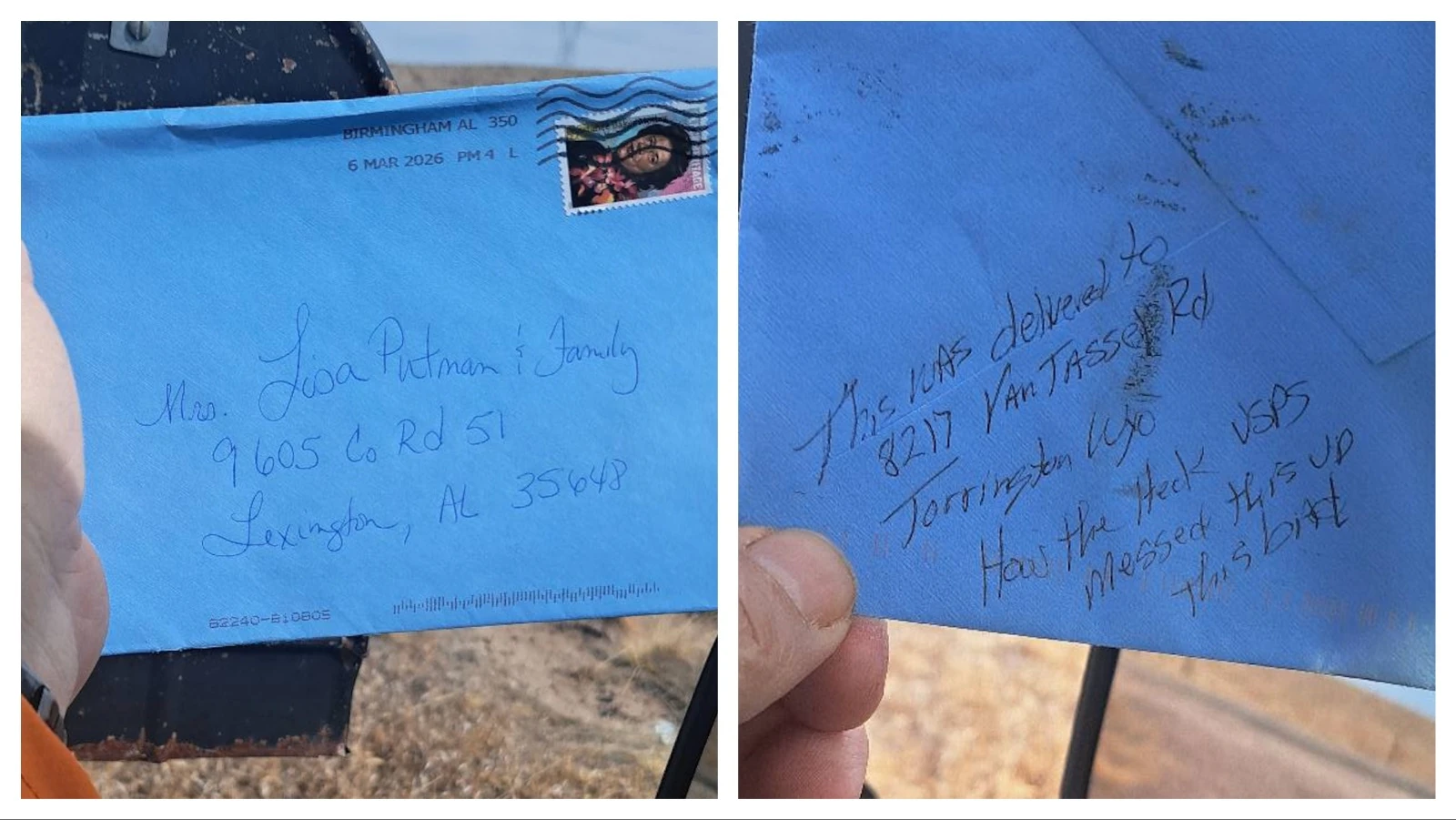
The card was sent on March 6 from somewhere in Alabama, sealed in a blue Hallmark envelope addressed to Lisa Putnam and family in Lexington, Alabama.
Huckfeldt wrote a message on the back of the letter and returned it to his mailbox.
“I hope the person who received it contacts me back,” he said. “I gave them my address to let me know when they receive it.”
Machine Error
U.S. Postal Servioce spokesman James Boxrud explained that despite having a clear address, high-speed machines now do most of the sorting of mail. Sometimes, those machines make mistakes.
“Based on the photos provided, it appears an incorrect barcode was applied during initial processing, which resulted in the piece of mail being misdirected,” he told Cowboy State Daily by email. "Most likely it was stuck to another mail piece. The Postal Service uses high-speed automated sorting technology to read handwritten addresses.
"Occasionally, if a machine misinterprets a digit in a ZIP code, it applies a barcode for the incorrect destination.”
Once the barcode is printed, that becomes the letter’s destiny, even if the barcode is completely wrong. Subsequent machines will route the letter automatically, based on the code, he said.
“This process is entirely automated,” Boxrud said. “A human typically does not sort the piece again until it reaches the local carrier for final delivery.”
Boxrud recommended that misdirected mail like this be returned to the local post office, or handed to an individual’s carrier, rather than just dropped back in the mailbox.
“That allows us to intercept the piece, obscure the incorrect barcode, and resort it correctly,” he said.
Boxrud characterized this instance of misdirected mail as rare, saying the Postal Service processes hundreds of millions of pieces of mail daily with “an extremely high accuracy rate.”
“While rare, mechanical sorting errors can occur,” he said. “We apologize for the inconvenience and remain committed to the reliable delivery of every piece of mail.”
Torrington Take
Huckfeldt doesn’t believe the problem is that rare.
For one thing, it’s not the first time misdirected mail has landed in his box.
“I know our post office can be overwhelmed at times,” he said. “They’re delivering a lot of packages for Amazon and others, I’m sure.”
But misdirected mail happens often enough now that Huckfeldt has learned to sort his mail at the box so he can put back the letters that don’t belong to him.
Huckfeldt also has neighbors who tell him they’re sometimes waiting six months to receive mail they know was supposed to be delivered to them.
“They eventually did get all of their mail, but it was just sitting in limbo,” Huckfeldt said.
Huckfeldt has also been the victim of misdelivered mail, including a bill payment that didn’t go anywhere close to where it was supposed to go.
“I got a late notice back that I hadn’t paid my bill,” Huckfeldt said. “And gosh, I’m sure I had sent it, but the check hadn’t been canceled.”
Huckfeldt went ahead and took a check to the business in person, hand delivering it to the individual.
Eventually, he received a letter in the mail from someone in Wisconsin, who had received Huckfeldt’s bill payment instead of the intended recipient in Wyoming.
“He says, ‘They delivered this to my address, and I want to make sure you get it back, because it looks like it was important,’” Huckfeldt said. “So, I don’t think this is an isolated incident at all. And I don’t know why whether it’s automation or whether it’s something else.”
Broader Mail Issues In Alabama
There may be an explanation other than automation errors. Lexington is located in Lauderdale County in North Alabama, where residents have reported significant mail delays, characterized by long wait times, lost or damaged items, and opened or misdirected mail.
In early January, U.S. Rep. Dale Strong, R-Huntsville, called out USPS for mail delivery problems across North Alabama, blaming them on USPS’s Delivering for America Plan, which postal officials have said will improve efficiencies by “modernizing” the service, as well as trim costs.
Strong successfully sought language in key appropriations bills that call USPS on the congressional carpet, forcing them to brief lawmakers on the impact of consolidating the Huntsville Processing and Distribution Center, as well as review local ZIP Code inaccuracies.
“The Postal Service’s short-sighted decision to strip Huntsville of its processing and distribution center has failed North Alabama communities,” Strong said at the time in a media statement. “This consolidation has led to delays, inefficiencies, and frustration for my constituents, and I will continue pressing USPS for answers and accountability.”
The USPS had a similar consolidation plan in Wyoming — also part of its Delivering for America agenda — which would have removed both Cheyenne and Casper’s large mail processing capabilities, placing that function in Denver and Billings, respectively.
Wyoming critics of the USPS’s Delivering for America Plan said the approach would dramatically slow deliveries to rural areas, as did an advisory opinion from the Postal Regulatory Commission, which found it would detrimentally affect nearly half of all ZIP Code pairs in America.
After a huge outcry, which included Wyoming’s Congressional delegation, USPS said it would walk some of the plan back in Wyoming. The Cowboy State would still not get a Regional Processing and Distribution Center, but neither would Cheyenne and Casper lose their local mail processing capabilities.
Local Efforts To Improve Rural Mail Service Continue
Secretary of State Chuck Gray is among state officials who were vocal about the Delivering for America proposal to remove all of Wyoming’s large mail processing.
“This troubling incident is another example of why I’ve been so vocal about the need for Wyoming mail to continue to be processed in Wyoming,” he said. “Wyoming mail should be processed in Wyoming — period.”
U.S. Sen. Cynthia Lummis, R-Wyoming, said she’s continued to work on rural mail issues to push for better service.
“I’ve always said that everyone is looking for a reason to head to the Cowboy State, and it looks like that even applies to mail from Alabama,” she said. “I’ve worked closely with the Trump administration to address some of the issues with our mail processing to ensure residents in rural states like Wyoming get their mail in a timely manner, and I hope to continue that important work to ensure letters only end up in Wyoming if they’re meant to.”
U.S. Rep. Harriet Hageman said that she, too, is still pushing for better postal service in rural areas.
“The U.S. Postal Service is a source of frustration for many Americans,” she said. “My team is always happy to investigate and work with local and regional USPS offices to find answers.
"I continue to lead a bipartisan crusade with multiple pieces of legislation to increase transparency, safeguard rural mail access, and keep the Postal Service from eliminating services for rural communities."
Renée Jean can be reached at renee@cowboystatedaily.com.