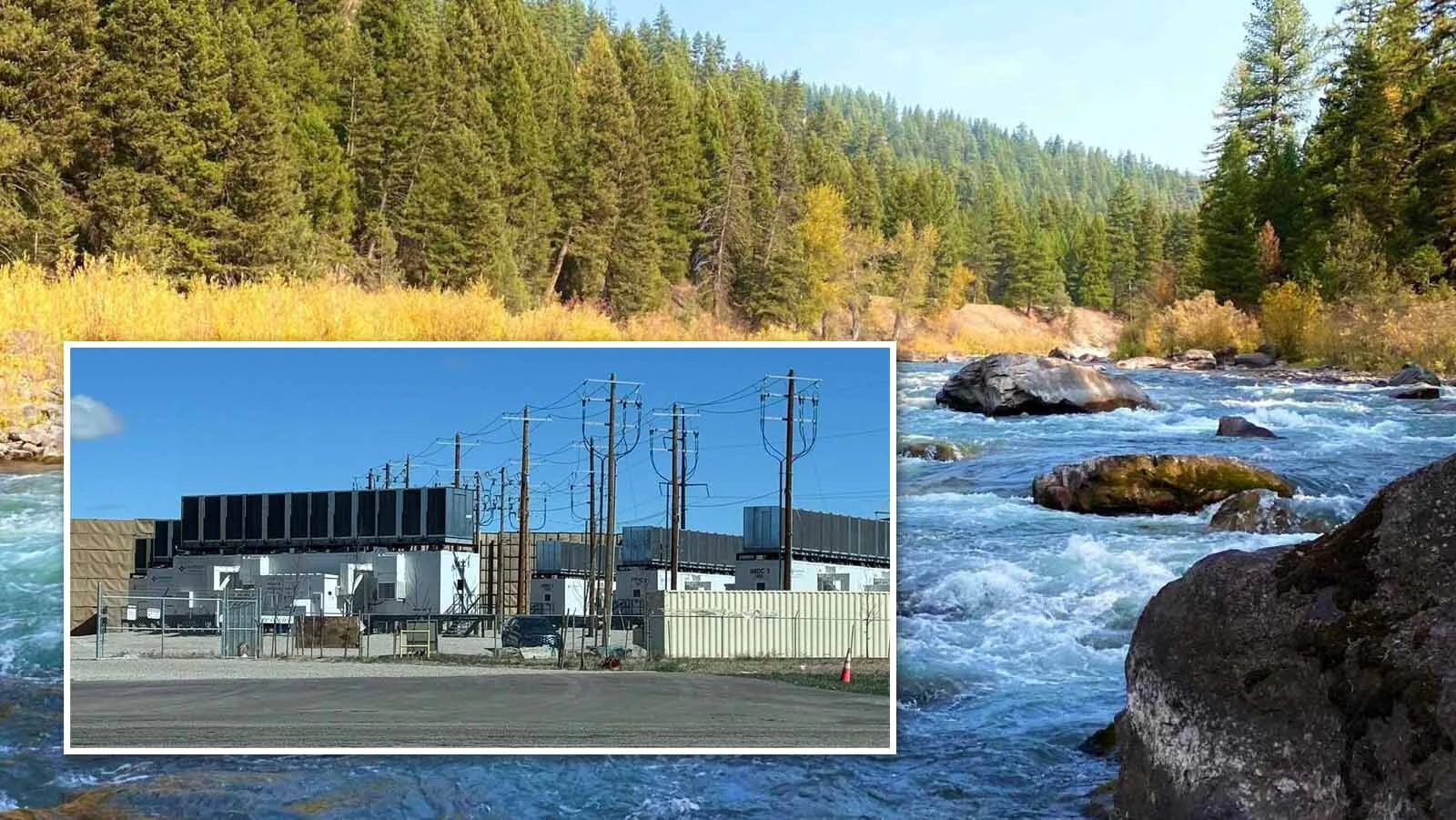
At the Bonner Mill Industrial Park along Highway 200 in Montana, a manufacturing space is being eyed for a different kind of work than the trim-board production it once housed.
Idaho-based KRAMBU, Inc. has applied to install an artificial intelligence (AI) data center inside the cavernous structure at the confluence of the Clark Fork and Blackfoot rivers — the same Blackfoot whose blue-ribbon trout water inspired Norman Maclean’s novel "A River Runs Through It" and Robert Redford’s 1992 film adaptation starring Brad Pitt.
The Bonner proposal is the latest test of a question now being asked in rural states like Wyoming and Montana: What does a community get — and give up — when a data center moves in?
Gary Matson, a volunteer director with Friends of Two Rivers, has watched the Bonner Mill Industrial Park site cycle through its various industrial lives.
Before sitting empty, it housed United Forest Products' Edge trim-board operation, which closed last fall. Before that, the same footprint hosted a cryptocurrency mining operation.
That crypto outfit, in Matson's telling, "was very, very noisy and it just drove people nuts."
The backlash pushed Missoula County to require every data center and cryptocurrency operation in the county to offset its energy use with new renewable generation.
The crypto operator left town shortly after, said Matson.
Local response to KRAMBU's pitch, Matson said, is "generally negative," shaped in part by that earlier experience.
At a recent question-and-answer session that drew more than 100 residents, questions about water dominated.
KRAMBU has described a closed-loop liquid cooling system drawing minimally from an on-site well rather than the Blackfoot River. It’s a design that, if accurate, would mean almost no impact on the river, the company says.
Site Selection
Tracey Hyatt Bosman has spent two decades helping companies decide where to put facilities like the one proposed in Bonner.
As managing director at BLS & Co., a boutique location advisory consultancy, Bosman works with data center operators and developers across roughly 20 states on siting and incentives.
Increasingly, she said, her job involves the harder problem of community acceptance.
"Ten years ago, you could walk into any community and say, 'I've got a data center project for you,' and they'd roll out the red carpet," Bosman told Cowboy State Daily.
Property tax revenue arrived without the school-system demands that come with housing developments, she said. Utilities welcomed the steady electrical load.
"Now, you're not really sure what you're going to get,” she added.
Wyoming was an early embrace, Bosman said.
Cheyenne in particular built a reputation on strong fiber connectivity along the national backbone and federal facilities that demonstrated the region's capabilities.
"Wyoming has generally been welcoming of data centers," she said. She has worked on Wyoming sites without yet placing a facility in the state.
Sites in Wyoming also tend to pencil out, she added.
"It's been a cost-effective place to have a data center," Bosman said, pointing to real estate and utility expenses.
Don’t Have To Be Huge
Bosman warned against treating "data center" as a single industry category. The headlines focus on the largest hyperscale and AI campuses, she said, but the industry is broader than that.
"It always concerns me a little bit that data centers have become this monolithic tag," she said. "There are a lot of variations in the types of data centers that end up at sites."
The siting playbook itself has been rewritten by tight supply and heavy demand, explained Bosman. Where firms once started with a national map and whittled down to optimal locations, the process now often runs in reverse.
The new approach is identify a candidate site with seemingly favorable conditions, then push it through due diligence to see if it survives.
Community sentiment has moved to the front of that screening, alongside electric capacity, parcel size and floodplain checks.
BLS now monitors news coverage, council minutes, zoning actions and legislative activity from the earliest stages of a search.
Bosman uses the term "NIMBYism" to describe some local pushback, but said the bigger concern for her clients is what she half-jokingly called "moratoriumism" — the prospect of legal barriers at the state level.
New York has proposed a three-year moratorium on permits for data centers of 20 megawatts or larger. Proposals to slow or restrict data center development have also surfaced in Georgia, Virginia and Illinois, according to a recent blog post by Bosman.
“Moratoriumism” appears to have a foothold in Maine and Montana as well.
Beyond water and electricity, Bosman said the recurring local objections involve construction noise, generator testing, low-frequency vibration and the visual impact of large industrial buildings.
Some of those concerns are well founded, she said. Some reflect mistrust or misinformation.
Bosman emphasized how impacts vary case by case. Some communities have seen electricity rate increases tied to infrastructure upgrades. Others have actually seen rates fall when a steady data center load made the broader system run more efficiently.
Other Side
For a counterweight to the resistance she sees in the field, Bosman points to a recent essay by Shawn Clark, chief strategy officer at Clayco, a construction firm that builds heavily in the data center space.
In a February LinkedIn post titled "Why Your Community Should Welcome Data Centers — Not Fear Them," Clark argued that $64 billion in data center projects have been blocked or delayed by local opposition based on misinformation.
Clark cited a 2025 PwC and Center of Your Digital World study finding that the U.S. data center industry contributed $715.5 billion in federal, state and local tax revenue between 2017 and 2023. He pointed to Ohio, where he said the data center ecosystem supported 82,800 jobs in 2023.
"These aren't warehouse jobs," Clark wrote, noting that Clayco-built data centers under construction are on track to have more than 4,000 workers at peak, followed by ongoing maintenance work as servers and cooling systems cycle through upgrades.
"Data centers are the railroads of the AI era," Clark wrote, arguing that towns that welcomed the railroad in the 1800s became economic hubs while those that fought it "got bypassed."
Outside Eyes
The debate in Wyoming over where to put data centers is now the subject of research by outside academics. Annika Cobb, a Ph.D. student at the University of California, Berkeley, is studying energy transitions in the Rocky Mountains.
Cobb's research focuses on how communities perceive and experience rapid changes in energy development, from fossil fuel extraction to renewables and nuclear.
She is trying to pinpoint where future debates about data centers and energy consumption might unfold.
Data centers, she said, sit at an awkward intersection for anyone who has spent time working on climate and decarbonization policy.
"Now there's this challenge of having an energy transition while data centers are adding massive amounts of energy consumption to what's already growing energy consumption," Cobb said.
"You're starting to see this resistance of communities against data centers," she added. "That community involvement with energy ties in nicely to how people are thinking about it, and then how that impacts their politics, their voting."
Picture Problem
Back in Bonner, Matson was asked about the artist's rendering KRAMBU circulated with its Montana announcement.
The image, apparently generated by AI, shows a sleek facility nestled below snowcapped peaks with a river and trees in the foreground.
Matson laughed.
"That was an artist's conception, and it would be nothing like that," he said.
The community knows the actual building KRAMBU is proposing to occupy doesn’t resemble the image in the rendering, he said.
For Matson, the polished image captures a broader problem with the way data centers arrive in places like Bonner — they can look too good to be true.
“We're just a little bit cynical," he said. "If what they say is true, then there would be almost no impact on the Blackfoot. But we're still a little bit cynical, because of the reputation that data centers have of giving one kind of information and actually doing something else."
David Madison can be reached at david@cowboystatedaily.com.