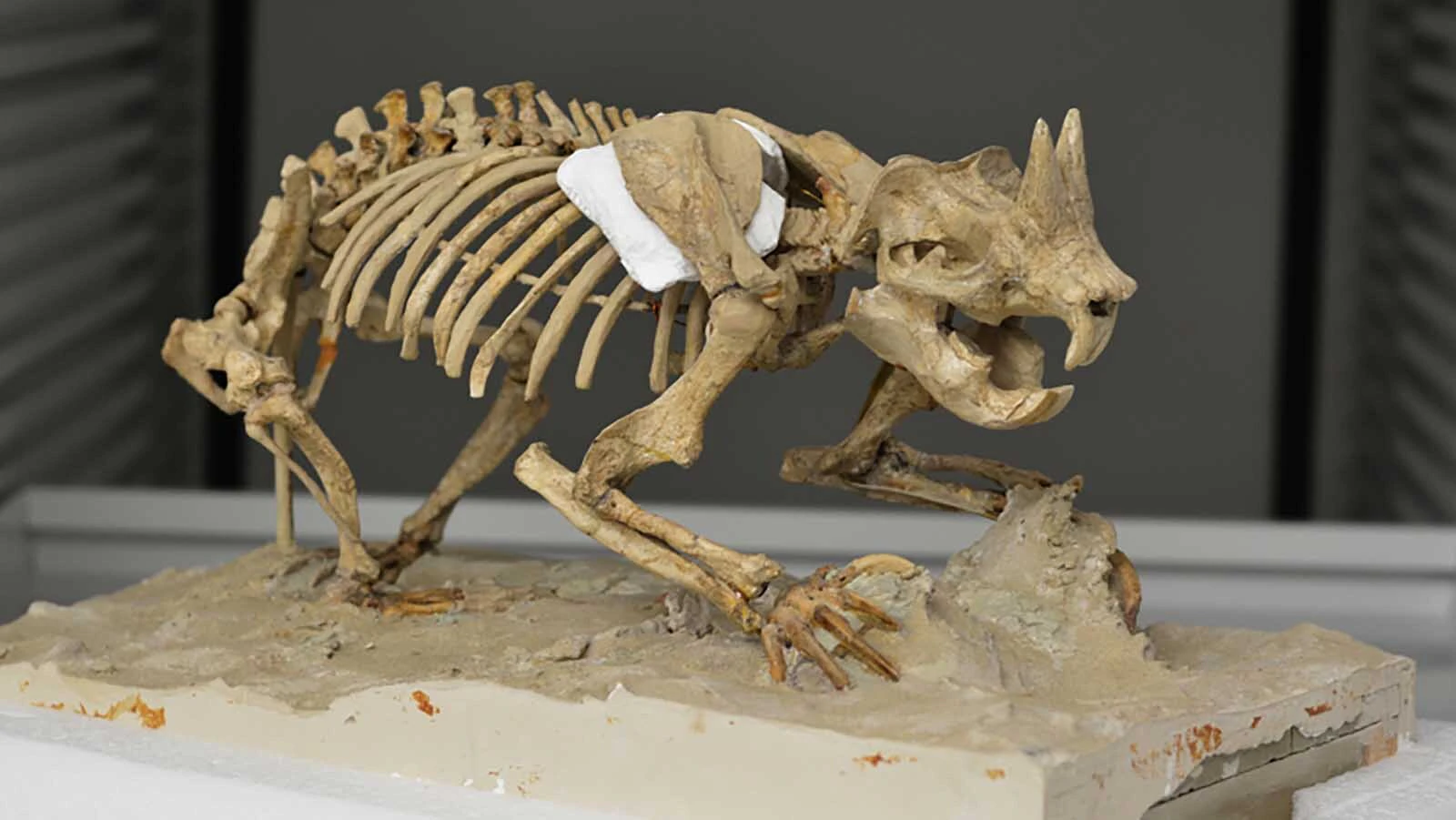
Wyoming’s legendary jackalope is just that: a legend. Many Wyomingites don’t know that the closest thing to it, an actual rodent with unusual horns, went extinct more than 5 million years ago.
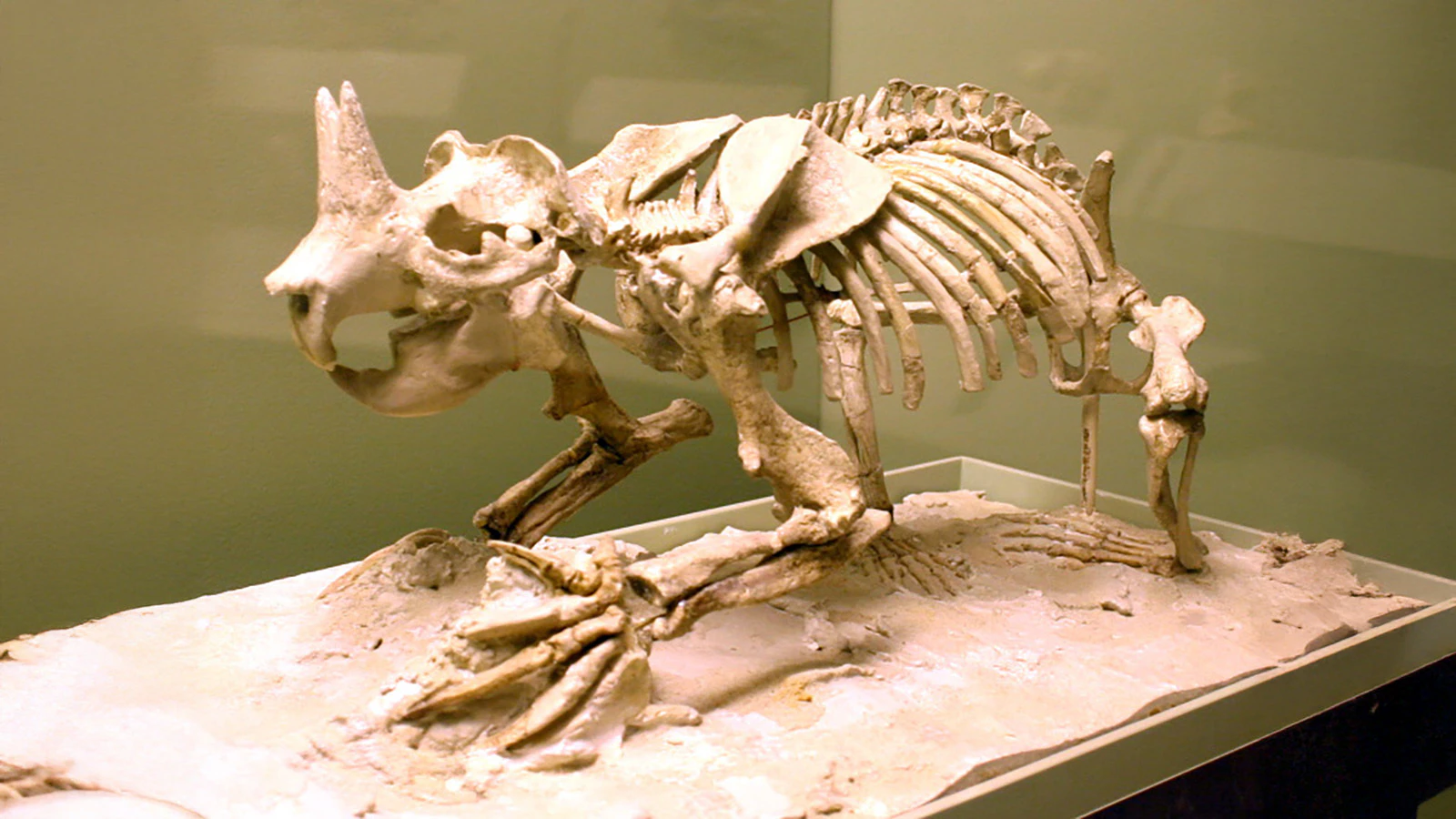
Ceratogaulus rhinocerus is the smallest horned mammal in the fossil record. The plucky little burrower has been a favorite of paleontologists since it was first discovered because of the two large horns in the middle of its tiny head.
Animals have horns for several reasons, but Ceratogaulus was literally built differently. It took its enemies head-on, which kept it alive for more than 8 million years.
“You think about the Jackalope as a sassy rabbit that can defend itself,” said Samantha Hopkins, a professor of Earth Sciences at the University of Oregon. “Jackalopes are not really, obviously, but there are real parallels with Ceratogaulus. It was a self-possessed, squeaky little creature with horns on its head.”
The Horned “Gopher”
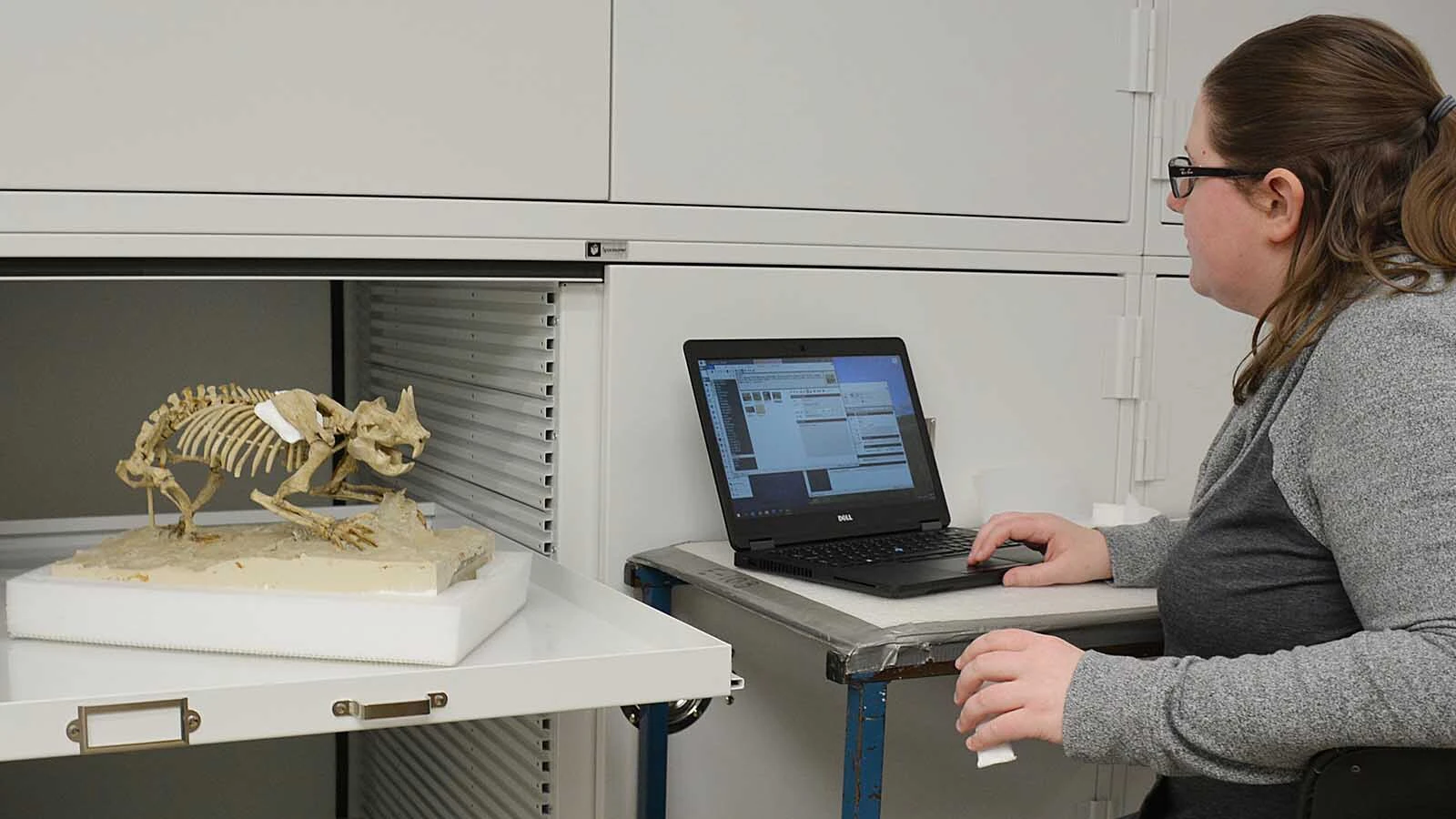
Hopkins specializes in studying the evolution of fossil rodents, so Ceratogaulus is definitely in her realm of expertise. She called it “my favorite fossil.”
“It’s one of those fossils that breaks everything,” she said. “You look at that you know there has to be something really strange going on to make it work, because there’s nothing like it today.”
Ceratogaulus is in the Mylagaulidae family, an extinct group of squirrel-like rodents. They lived in Asia and North America for over 20 million years, during the Miocene and Pliocene epochs.
While it’s commonly called “the horned gopher,” Hopkins said that’s a misnomer. Their closest extant relative of Ceratogaulus is the mountain beaver, which is similarly misunderstood.
“It doesn’t really live in the mountains, and isn’t closely related to the beaver at all,” she said, saying the tiny rodent is more closely related to squirrels than beavers.
Some biologists say its primitive characteristics make it a “living fossil.” Many people consider it a pest, as it tends to eat sapling trees in areas that are being reforested.
Hopkins’s research has focused on the biology and evolutionary history of the Mylagaulidae family, which means she’s given Ceratogaulus a lot of attention.
“I love it because it’s so weird,” she said.
Horns, Not Antlers
The mythical Jackalope has antlers, but the actual Ceratogaulus has horns. That, according to Hopkins, is an important distinction for many reasons.
“Antlers are bone, but it’s bone that’s shed on an annual basis,” she said. “Ceratogaulus has horns like cattle, so they’re permanently attached to the skull.”
Ceratogaulus’s horns would have been covered with a layer of keratin, giving them a hard outer layer for added strength and durability. That’s unusual for any rodent, let alone one that lived and burrowed underground.
Hopkins noted that there are no horned burrowing mammals alive today. The only other horned rodent in the fossil record is Mylagaulus, which lived in the same time and place as Ceratogaulus.
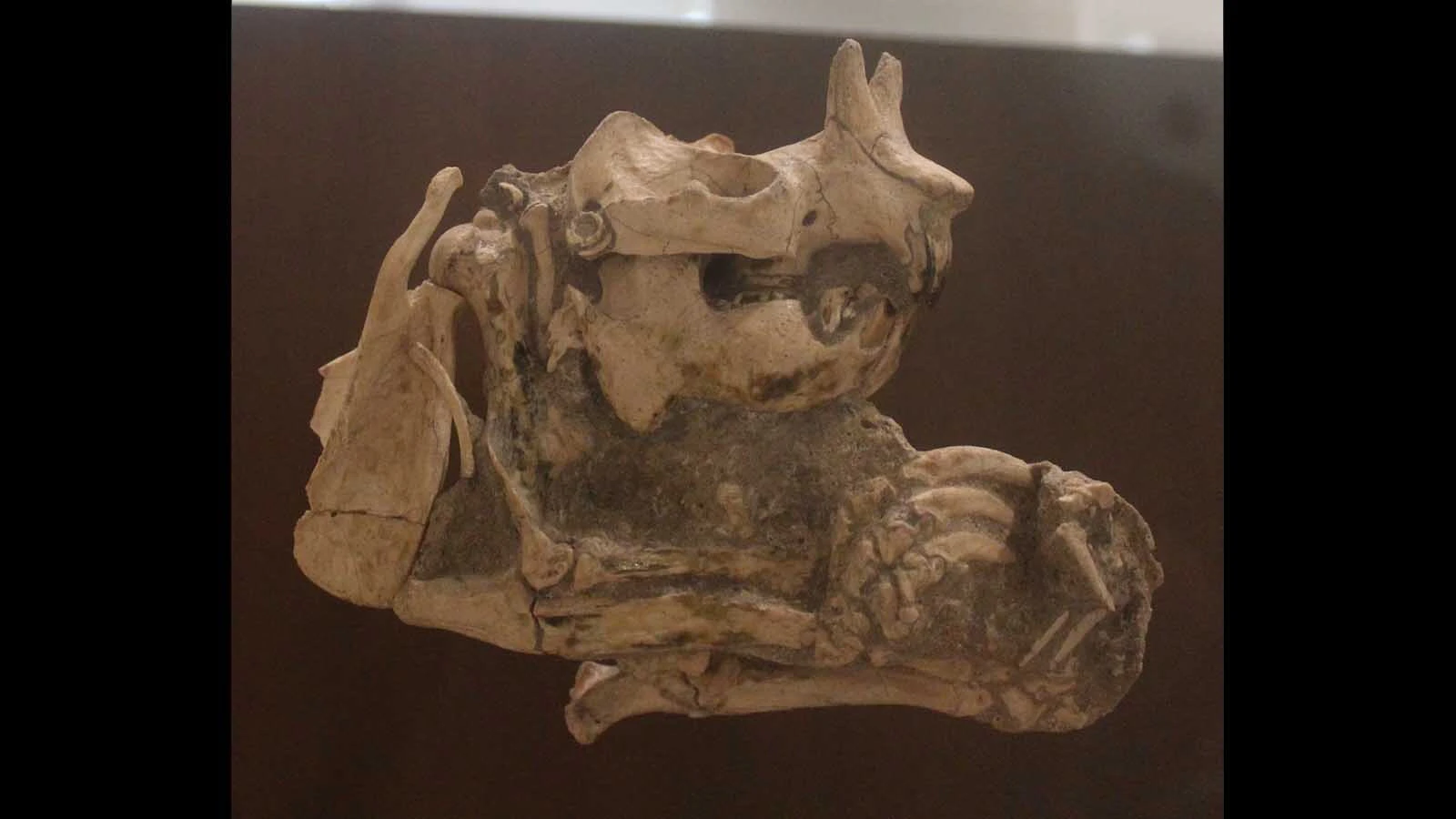
Nevertheless, Ceratogaulus’s horns are larger and more robust. That’s why Hopkins made a point to study their skulls to determine why a burrowing mammal would have such usually large bony structures.
“There are a lot of reasons why having horns is not the best idea if you live in a hole in the ground,” she said. “It’d be like working on a submarine with giant antlers on your head. It’s not easy to make that work, so there must have been a reason.”
Chicks Don’t Dig It
Hopkins published a research paper on the adaptive role of horns in the Mylagaulidae family in 2005. Her conclusions were surprising.
When Ceratogaulus was first discovered in 1902, the horns were thought to have been used for digging it burrows. It was the overall shape and size of a modern-day burrowing mammal, like the prairie dog, so having a digging apparatus on its head would make sense.
After studying the horns, Hopkins ruled that option out.
“If you look at the biomechanics, the horns are not shaped in a way that would allow them to excavate a hole,” she said. “If they tried to do this, they’d be basically whacking the tip of their nose into the dirt the whole time.”
The most common explanation for horns, spikes, and other structures in modern and prehistoric animals is attracting and fighting for mates. That’s the primary use of antlers in Wyoming’s modern-day elk, deer, and pronghorn.
When Hopkins started her research, the most commonly held theory among paleontologists was that Ceratogaulus’s horns were used for intraspecies combat and as display structures for males to attract females.
That was the obvious answer, but Hopkins determined that was also unlikely. Ceratogaulus probably didn’t see the sexual allure of the horns, or much of anything.
“If you look at the shape of the skull, the little hole in the skull that the optic nerve goes through is really, really tiny,” she said. “They, like a lot of burrowing mammals, were probably nearly blind, and the thing about showing off for mates is that it only works if they can see it.”
Headstrong
Hopkins’s research concluded that the horns of Ceratogaulus were primarily defense structures. It’s another usual aspect about the prehistoric rodent.
“Looking at the evidence that we have, both the shape of the horns and the time and place of occurrence and so forth, best support the idea that these horns were there for defense against predators,” she said.
Defensive structures, specifically for protection against predators, aren’t as common as many people think. Even the spiked tail of Stegosaurus and the horns of Triceratops, famously defensive dinosaurs, are believed to have been for display primarily and defense secondarily, if at all.
Hopkins said Ceratogaulus horns as defensive structures not only make sense anatomically, but ecologically.
“Some novel predators appeared in North America about 15 million years ago,” she said. “Badgers and some new lineages of snakes get here around that time, and they be sticking their heads into burrows looking for food.”
Snakes have been the eternal enemy of burrowing rodents. A new species of prehistoric rubber boa, Hibernophis breithaupti, was found inside a 38-million-year-old burrow, dug by a burrowing mammal, where they had sought shelter during a volcanic eruption.
With its sizeable horns, Ceratogaulus would have been able to confront would-be predators head-on. When a snake, badger, or the weasel-like predator Zodiolestes stuck their head into a burrow, they might be greeted by an aggressive, hard-headed Ceratogaulus.
The pointy horns and aggressive posturing might have made the tiny rodent appear too difficult and dangerous to attack. Further studies suggest the horns improved over time, evolving to grow larger and further back on its head for better leverage and mobility when attacked.
There’s a contemporary example living in Wyoming today.
Biologists believe that posterodorsal horns of horned lizards help reduce predation, positioning their heads to thrust their horns upwards or backwards to defend themselves, a defensive strategy that Ceratogaulus might have also employed.
“They’re not the thing that a badger would be expecting down the hole,” she said. “You think you’re going to get a nice big chunk of rodent to eat, and then you get a face full of horns.”
Anyone who’s dealt with an angry squirrel, prairie dog, or rabbit understands the terrors of an angry rodent.
Home Under The Range
When it wasn’t heading up an “offense is the best defense” strategy, Ceratogaulus lived a quiet, unobtrusive life under the feet of giants. The surface was dominated by large mammals the two-horned rhinoceros Diceratherium, the awkwardly proportioned herbivore Moropus, and the fearful horse-sized omnivore Daeodon.
Hopkins said Ceratogaulus appears to have thrived in a specific biome. Geologic evidence collected from the rock preserving the fossils show a transitioning landscape, from the tropical forests of prehistoric North America to the modern-day plains of the American West.
“If you go back, say, 40 million years ago, North America was covered in trees,” Hopkins said. “Even Wyoming would have been forested. Around 15 million years ago, there’s a mix of patches of woods with some open, grassy spaces in between. It would have been a funny in-between of little wooded patches and a whole lot of grass.”
Hopkins said Ceratogaulus is one of many families of rodents that evolved to thrive in these new open grasslands. Burrowing mammals overall become much more common in the Late Miocene, where the oldest fossils of Ceratogaulus have been found.
“If you can’t go up a tree to hide from predators, you have to dig a hole to keep yourself safe,” she said.
While other burrowing Miocene mammals like Palaeocastor, an actual beaver ancestor, dug deep, spiraling burrows to avoid predators, Ceratogaulus preferred the direct approach. It would have thrived on the grasses and shrubs growing between the forested areas.
Over time, the environment changed. As the western U.S. slowly started drying out, transitioning into the modern-day biome, the forests gave way to vast temperate grasslands.
Ceratogaulus’s horns could defend it against snakes and badgers, but not climate change. According to Hopkins, the extinction of Ceratogaulus aligns with this widespread palaeoecological shift.
“When habitats got really open and dry, Ceratogaulus doesn’t seem to have been able to keep up with the pace of things,” she said. “We’re still working on exactly what drove the extinction, but habitat change seems to be the main factor.”
The Real Jackalope
Hopkins is still investigating the rise and fall of North America’s prehistoric horned rodents. For her, Ceratogaulus is the gift that keeps on giving.
“Right now, we’re thinking a lot about species extinction, what drives extinction, and what makes some groups more prone to extinction than others,” she said. “Ceratogaulus and the Mylagaulidae is a good group to understand the diversification and the subsequent extinction of those long-lived lineages.”
The best specimens of Ceratogaulus have been found in Nebraska and Kansas. While Hopkins said it’s “not super-common” in Wyoming, she has seen and collected specimens of the horned rodent from rock deposits near Split Rock in central Wyoming.
There’s something to be learned from the success of Ceratogaulus. Its fossils have been found in many different rock formations from different epochs of Earth’s history, giving it a lifespan of over eight million years.
With the modern-day ubiquity of the Jackalope, Hopkins can’t help but be amused that the mythical creature has so many similarities to an actual, long-extinct rodent. The Jackalope wasn’t inspired by Ceratogaulus, but it’s the closest that Wyoming ever got to its favorite cryptid.
“The folktale mythology of the Jackalope is a rabbit with weaponry,” she said. “There’s a lot of fun in thinking about the ways in which the concept isn’t totally wrong. In that sense, the resemblance to Ceratogaulus isn’t trivial. Wyoming has a small, squeaky rodent with horns on its face.”
Andrew Rossi can be reached at arossi@cowboystatedaily.com.