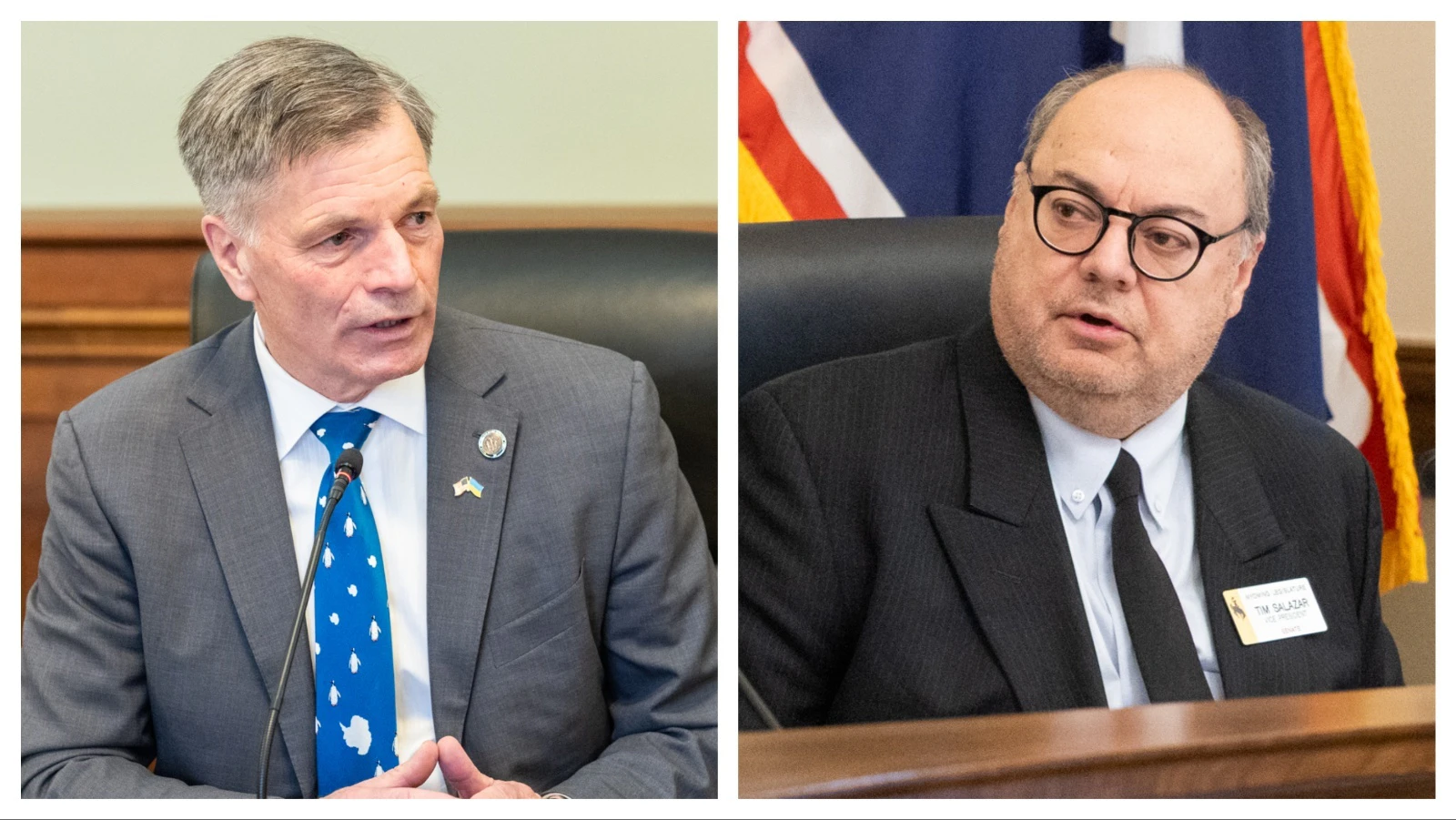
After Wyoming's highest state court decided that abortion access is a fundamental health care right, Gov. Mark Gordon urged the Legislature to use its 22-day lawmaking session to change the state Constitution so the state could restrict abortion.
The Legislature didn’t answer the governor’s call. The session ended March 11.
Changing the Wyoming Constitution would take a two-thirds majority in both the House and Senate, then a majority vote by the people at the next general election, which is Nov. 3 of this year.
Twenty-one lawmakers fielded an effort to do just that last month, through Senate Joint Resolution 7.
The resolution failed to clear its introductory vote Feb. 12 — the fourth day of Wyoming’s 22-day lawmaking session this winter.
Its language didn’t use the word “abortion.” It would have given the Legislature the ability to redefine health care — setting up a contrast to the judicial branch’s pronouncements that abortion is health care.
Multiple Republican senators who voted against introducing the resolution called it too broad, saying it would give the government too much control over other facets of health care.
That method also didn’t answer Gordon’s “primary call” for a route to restrict abortion, the governor told reporters during a Tuesday press conference.
The deadline to introduce new bills was Feb. 13, but lawmakers could have suspended the rules to run late legislation if they had two-thirds approval in either chamber.
After Senate Joint Resolution 7’s failure, no lawmaker fielded a second resolution draft. No one asked to suspend the rules and give the resolution a second chance.
Fear out-of-state money would scuttle a ballot initiative may have played into that, some lawmakers have since told Cowboy State Daily.
“I can’t speak for what happened in the Senate on that,” House Appropriations Chair John Bear, R-Gillette, told Cowboy State Daily in a phone interview this week. “I was rather resistant to (asking the people to change the Constitution) anyway.”
He said he would have voted in favor of introducing SJ 7 for the sake of debate. Legislators also could have tweaked its language before its passage.
Bear said, however, that other states that have posed abortion as a ballot question have met deluges of out-of-state money and activism, leading to a pro-abortion result on election day.
“The pro-abortion lobby comes in with a lot of money and tells lies and — you know, we just don’t have that much money in Wyoming, to keep the propaganda from being spread,” he said. “If you look at these other states that have tried to do an amendment to the Constitution to protect unborn life, several times it’s gone the other direction.”
Ten abortion ballot propositions in 2024 addressed the constitutional right to abortion access. Voters approved access rights in seven states that year, while defeating access rights proposals in three states.
The Wyoming House of Representatives took a more cautious, but litigation-certain course again this year, by advancing the Human Heartbeat Act — a bill to ban abortions, with emergency exceptions, after the point at which a fetal heartbeat can be detected.
The pro-abortion coalition that has successfully petitioned courts to block every abortion ban Wyoming has enacted since 2022 is now asking a judge to do the same to the Heartbeat Act.
Because the act is legislation, not a proposed ballot change, it defines policy rather than fundamental rights.
The Wyoming Supreme Court emphasized in its Jan. 6 ruling that the legislature can’t overcome the health care right without showing a compelling governmental interest and a narrowly tailored approach.
The Doubts
Bear said, “I don’t think it’s a slam dunk to put out a Constitutional amendment and expect the pro-abortion lobby not to twist it and get people to vote the wrong way.”
Rep. Ken Pendergraft, R-Sheridan, told Cowboy State Daily he could argue the strategy debate either way, but he agreed there’s “a lot of fear that (to advance a ballot question) we’d follow the pattern set in other states: a lot of outside money would come in, and we might actually have it work against us.”
The leader of Wyoming’s lone abortion clinic Wellspring Health Access sees the issue differently. The clinic’s president Julie Burkhart did not respond directly to a question about a deluge of out-of-state money, but said lawmakers merely know where Wyoming voters stand.
“Even anti-abortion politicians in Wyoming know that their constituents believe in their fundamental right to make decisions about their own lives and health,” she wrote in a Tuesday email to Cowboy State Daily. “It’s unfortunate that they continue to engage in attacks on reproductive health care, including the new six-week ban, when so many across our state are already struggling to access this care.”
Wyoming voters tried and failed in 1994 to enact an abortion ban – with exemptions – by ballot question. The proposed ban would have poised the state for a legal showdown against Roe v Wade precedent, but its proponents have since told Cowboy State Daily they saw high-court jurisprudence at the time that seemed to encourage such a battle.
Burkhart, whose clinic is among those challenging the new law, has identified the Heartbeat Act as a six-week ban since that’s often the point at which the first cardiac pulsing can be heard.
“We are committed to fighting back against these attacks, working with our state, regional and national allies to protect our patients’ rights and ensure that they can get the care they need,” added Burkhart.
‘Tried My Best’
Sen. Tim Salazar, R-Riverton, was the prime sponsor of SJ 7 . Twenty other lawmakers co-sponsored it with him, including Bear.
“I tried my best on my constitutional amendment,” said Salazar in a Feb. 23 interview with Cowboy State Daily in the Senate chambers. “I personally don’t have any plans to do anything more on that issue.”
Salazar added, “as you know, I feel strongly about it. But the Senate took a vote on it; made its decision. I don’t see anything right now on the horizon that addresses that issue after we’ve already voted on it.”
The One We Didn’t See
Rep. Elissa Campbell, R-Casper, announced Jan. 8 – two days after the high court’s “health care” ruling and one month before the legislative session started – that she had filed a joint resolution to propose a constitutional amendment that would prohibit abortion: “sending the question directly to Wyoming voters.”
She said in her Jan. 8 press release that it was time for finality on the matter.
“Wyoming is full of independent-minded people who don’t want their lives governed by a never-ending tug-of-war between politicians and courts,” Campbell said at the time. “On an issue this personal, the people of Wyoming deserve a direct say. This is how we bring clarity and a durable answer from the voters.”
Campbell’s proposal never entered the session’s public legislation roster, however.
No constitutional amendments surfaced this session under her name in the roster.
Campbell did not respond to a February text message request for comment on the matter; she did not immediately respond to a Thursday request for comment.
House Speaker
House Speaker Chip Neiman, R-Hulett, sponsored the Heartbeat Act, which is now law, though vulnerable to a potential court injunction.
He told Cowboy State Daily at a press conference Feb. 27 that he “just couldn’t hardly believe” Salazar’s resolution didn’t clear introduction in the Senate as well.
He spoke of a challenge legislators face in even-numbered years, which are reserved for building the state’s budget: non-budget bills need a two-thirds approval to clear introduction.
He said he hoped the Heartbeat Act would be helpful in the abortion policy space anyway, and predicted correctly that, later that day, lawmakers would give the bill a safety net.
The Heartbeat Act’s safety net says that if a court blocks it, a ban on abortions after the point of viability would trigger into law. That’s the same language Wyoming had before it tried to ban abortion outright starting in 2022, when the U.S. Supreme Court overturned the federal right to abortion.
While a fetal heartbeat can be detected after about six weeks’ gestation, viability is at about 23 weeks.
Gordon told reporters Tuesday he knew the Heartbeat Act would be challenged, but he’s “excited that it does have a fallback provision.”
“We needed to do something. We had no regulation at all,” said Gordon, explaining why he signed the bill. Still, he added, “I would have loved to have seen some kind of constitutional amendment.”
Some lawmakers – including the state House’s Democrats – have indicated they believe a post-viability ban would be found constitutional and would overcome the courts’ recent pattern of blocking abortion restrictions.
“I think (the bill) is a step in the right direction,” Gordon said Tuesday.
Rape And Incest
The governor has said he is pro-life but supports rape and incest exemptions. He signed the Heartbeat Act into law even though it doesn’t have those exemptions.
The rape and incest exemptions affixed to earlier Wyoming abortion bans did not help them in court, however.
That’s because the state tried to defend its abortion bans by saying they would protect unborn children.
The Wyoming Supreme Court put it this way:
“The exemption, which allows an abortion simply because conception occurred as a result of incest or a sexual assault, does nothing to further the State’s interest in protecting unborn children and the State does not advance any other compelling interest to justify the exception.”
The new legal challenge against Wyoming’s Heartbeat Act is ongoing.
Clair McFarland can be reached at clair@cowboystatedaily.com.