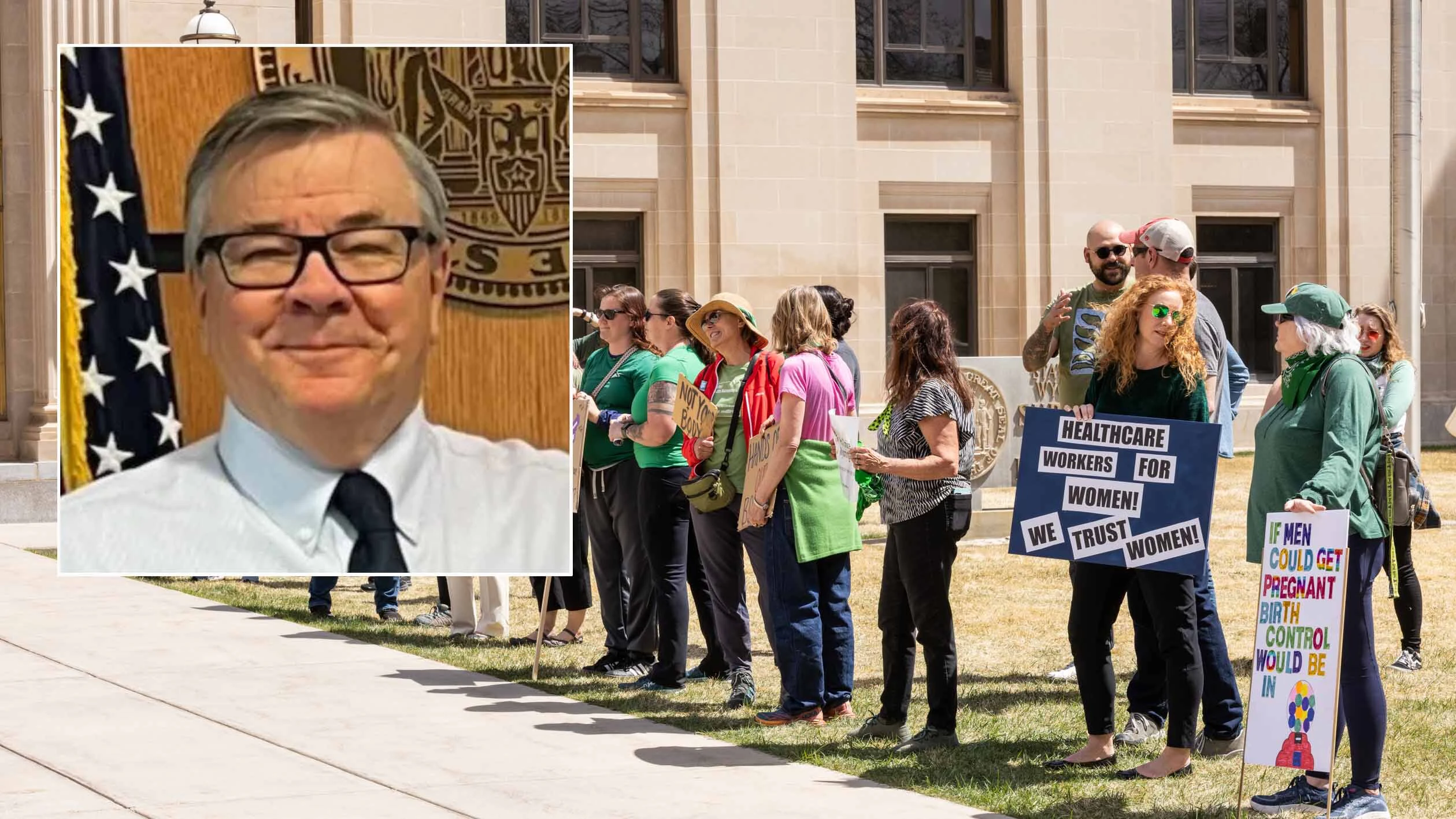

Two Republican lawmakers declaring bids for the same northern-Wyoming Senate seat jousted via separate interviews Thursday across the divide between Wyoming Freedom Caucus and non-Freedom Caucus-style governance.
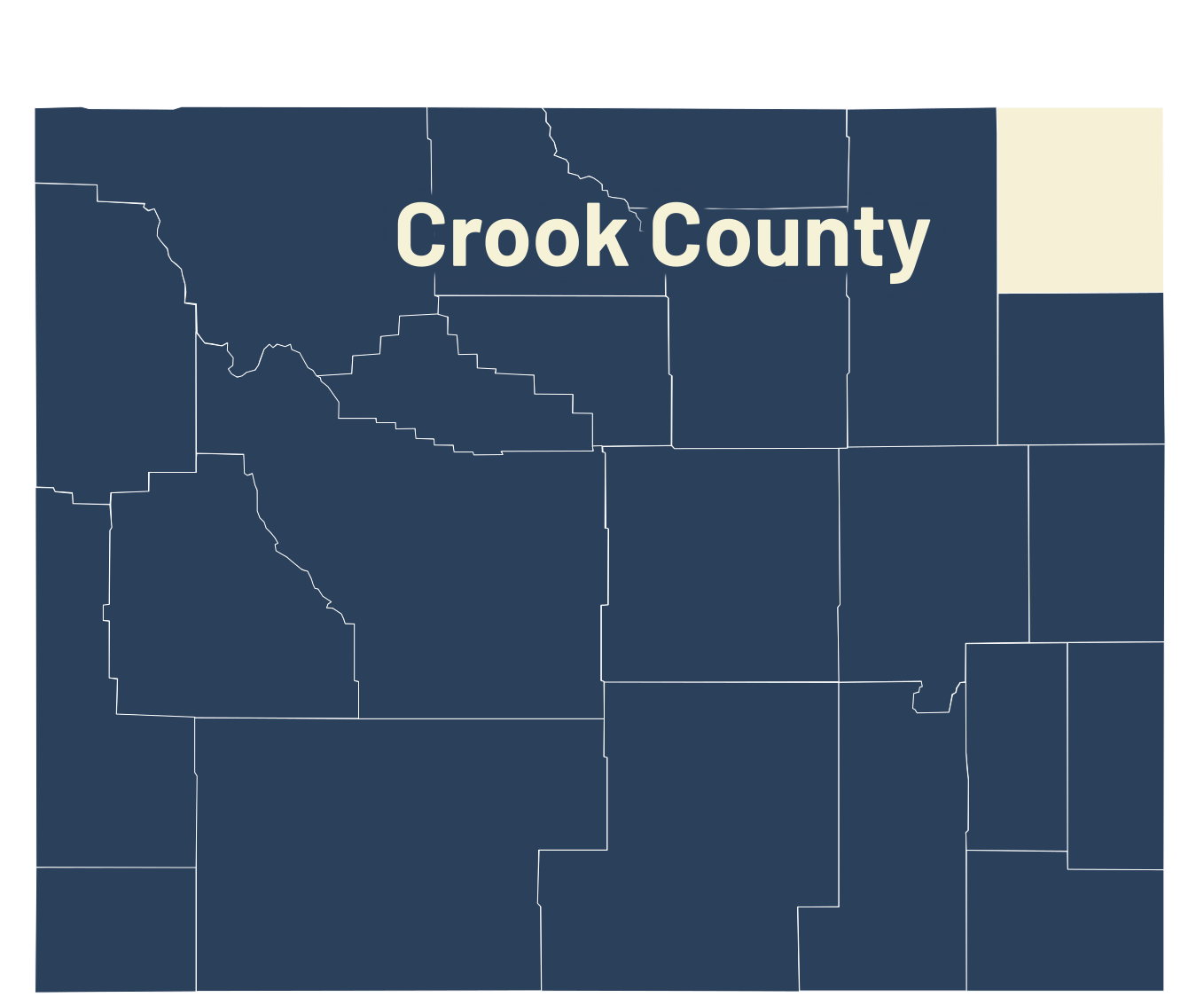
Sen. Ogden Driskill, R-Devils Tower, has held a Senate seat representing all of Crook County, much of Weston County and part of Campbell County since 2011.
He had said before that he didn’t plan to run again this year.
Some local pressure changed that, Driskill told Cowboy State Daily in a Thursday phone interview.
But to win the Republican nomination — and ultimately re-election once again this year — Driskill must first face state House Speaker Chip Neiman, R-Hulett.
Both men have served in leadership: Driskill, 66, is a former Senate President.
Neiman, 59, is a member of the Wyoming Freedom Caucus — a group of Republicans focused on social-conservative, pro-life, small-government policymaking.
Its opponents call it heedless and divisive, while its proponents call it the true voice of the Wyoming political right.
Driskill is not a member of the Freedom Caucus. He said he sees its work, particularly four years of failed efforts to enact an abortion ban that could survive court scrutiny, as counterproductive.
Driskill took the first swing Thursday upon hearing of Neiman’s state Senate bid, calling the Freedom Caucus long on rhetoric and short on results, prone to groupthink and clumsy.
Neiman fired back, saying Driskill is broad-brushing him and the issues in general, and that Driskill loves to grow government and foment insider-style politics.
Both men deny the other’s characterization.
‘Yes I’m Gonna Run’
Driskill said he changed his mind and seeks his own seat again because “there’s just been an overwhelming number of people in my district asking for me to run. They do not want to see the Freedom Caucus move to the Senate.”
People in Wyoming aren’t happy with the Freedom Caucus, Driskill theorized.
He pointed to the January actions of the Joint Appropriations Committee, the House side of which contains at least four known Freedom Caucus members.
“The Freedom Caucus has been very anti-business across the board,” said Driskill. “Doesn’t matter if it’s bringing rodeo to Wyoming; if it’s supporting rare earths up in our district. You know, the Business Council, across the board — they fought data centers.”
Driskill said the Freedom Caucus opposes wind energy development, carbon sequestration, “anything green, anything wind — they’re all negative. And they want to suck it in and want Wyoming to go backwards.”
Driskill said he’d “step up” and bolster economic development in Wyoming.
He also said he has deep Wyoming roots as his family has ranched in the state since the 1800s. He officially moved to the state from South Dakota in about 1975, he said.
Neiman is a fourth-generation Wyoming rancher who said his great-grandfather, great-grandmother, and his then-child-aged grandfather crossed into Wyoming in an unexpectedly small wagon that now sits in the Hulett museum.
Defensive Teams Go
Some of Driskill’s critiques left Neiman confused, he said, since he supported the state’s $16 million grant offering to rare earths businesses projects in Wyoming.
“I supported it from the beginning, as a grant,” he said.
It’s an area where Neiman disagreed with his fellow Freedom Caucus member, House Appropriations Chair John Bear, R-Gillette.
Bear, a former chair of the Freedom Caucus, first opposed the grant offering during a January budget planning marathon, then relented by saying Wyoming should be keener to offer it as a loan, not a grant.
After the full Legislature grappled with the budget, the offering ended as a grant.
“If it got over to the House still as a loan, it was going to (become) a grant if I had anything to say about it,” said Neiman.
He pointed to another area in which he pushed for state-backed economic development by co-sponsoring the Energy Dominance Fund. That bill, which is set to become law, carves out $105 million to back traditional- and uranium-sector energy projects with grants or loans.
The new fund “shall not” support or invest in wind or solar projects, the bill says.
“If he wants to go and throw that kind of crap around, he doesn’t know what he says,” said Neiman of Driskill’s critiques. “He’s got Freedom Caucus derangement syndrome.”
Bear had opposed the Energy Dominance Fund. He voted against it along with a handful of Freedom Caucus-aligned Republicans and four of the House’s six Democrats.
Bear has routinely derided what he calls “corporate welfare,” the promotion of private sector companies with public funds.
Neiman commented on the division between himself and the former caucus leader.
“I had my own Freedom Caucus people jumping my neck about (the Energy Dominance Fund),” he said. “But I said, ‘Guys, where I’m at is, we have (a presidential) administration right now amenable to energy. They’re wanting to see if we’re going to invest in our own deals.'”
Neiman said he’d rather see investments via tax breaks or other policy-embedded incentives. But some of those efforts are in their embryonic phase as well, he noted.
As for the University of Wyoming, Neiman said he’d like to see more accountability from the institution since it uses public money.
His fellow House members who opposed a $40 million cut Neiman backed questioned why Neiman and other proponents were pushing for a nearly across-the-board cut, rather than surgical cuts of disfavored or ineffective programs.
Neiman has said that the blanket cut was meant to reserve some autonomy for the university, to cut where it saw fit.
Neiman reiterated his past criticisms of the Wyoming Business Council.
He had advanced an amendment to the budget to spin the council’s $55 million Business Ready Communities program into community consensus grants largely focused on infrastructure.
That amendment did not survive the full budget process.
Gov. Mark Gordon also struck a budget footnote that would have defunded the Business Ready Communities program, and the House failed to override him.
CheckGate
Driskill pointed to the check-passing controversy Capitol insiders have called “CheckGate.”
Conservative activist Rebecca Bextel handed out checks to four House lawmakers on the chamber floor after it had adjourned for the day Feb. 9.
Rep. Karlee Provenza, D-Laramie, shot a photograph of the exchange, which she found “an egregious use” of the people’s House, she’s since said.
There was no rule against the simple act at the time.
But as Bextel backed at least one bill this session, House Bill 141, Rep. Mike Yin, D-Jackson, told his fellow House members Feb. 11 that voting for that bill after Bextel handed out checks on the floor would bring bad “optics.”
Bear challenged Yin on a point-of-order procedural objection.
“Representative, what is your point?” asked Neiman of Bear.
Bear said, “I believe the representative is making accusations of an individual that cannot be substantiated, and that accusation is offensive to this body.”
Bear later told Cowboy State Daily that Bextel had handed him a campaign donation check Feb. 10, but not on the House floor.
Neiman told the House publicly Feb. 18 that Bextel brought him a campaign donation — which they’d discussed weeks before session started — in his office. He handed it off to his wife Joni and didn’t think further of it at the time.
Neither Bear nor Neiman appear in security footage of Bextel handing out checks on the floor Feb. 9. Bear was slated to chair a House Appropriations Committee meeting upon adjournment that day.
Provenza moved the House Feb. 12 to convene an investigative committee into the check-passing on the floor and determine whether it constituted bribery or legislative misconduct.
Every member of the House present voted in favor of her motion and the committee’s formation. Neiman appointed the committee members.
Driskill voiced two primary qualms with Neiman’s conduct: Neiman’s handling of Bear's point of order, and Neiman’s selection of the investigative committee members before the public knew Bextel had given him a check.
“CheckGate kinda showed that, a little of the ethics and morals they have,” said Driskill.
Driskill agrees with the general Legislature’s consensus that no laws were broken in CheckGate, he said.
“There was an ethical violation that was unspeakable, and that was when Chip Neiman and John Bear had checks in their pockets,” Driskill said. "They’d taken checks the day before — they knew very well the checks were out there.
"They feigned absolute anger when it came up on the floor. They feigned ignorance about it. That was bad, dishonest and wrong.”
On the House floor Feb. 11, neither Bear nor Neiman sounded angry.
According to their public statements since then, neither knew about the floor incident at the time, though both had received campaign donation checks elsewhere.
“I had no idea people had accepted checks on the floor of the House,” Bear told Cowboy State Daily in his own interview Thursday. “I didn’t know what had happened ‘til I saw the picture.”
Referencing Driskill’s characterization of that floor discussion, Bear said, “Driskill has no idea what’s going on, other than what he reads in the paper. He wasn’t in that chamber.”
The Committee
Driskill derided Neiman’s selection of investigative committee members before telling people he’d received a check.
“He does not disclose to the body he knows what’s going on, and is a part of it, and one day later comes out and comes clean that he’s got a check in his pocket and has had one since the day before it started?” asked Driskill. “(That’s) not very ethical.”
Neiman said he was advised by legal counsel not to speak publicly about the check until his committee called him to testify. So, he tried to stay quiet.
But when the Laramie County Sheriff’s Office called for an investigation that could take weeks or months, said Neiman, he defied that advice and went public.
He said he couldn’t wait months to say what had happened.
“I will maintain this 'til I’m dead,” said Neiman. “I never even considered the idea that this was bribery.”
Neiman said “Ogden fails to share” that Neiman and others implicated in the checks controversy had voted in favor of a 2025 bill that, once amended, contained the same provisions as House Bill 141 had this year.
Neiman also emphasized that he had signed up to cosponsor House Bill 141 long before the check incident happened.
“So the idea that somebody was going to hide something, it’s just B.S.,” said Neiman. “He just defies logic. He doesn’t think before he speaks.”
Neiman lamented that, though every House member who received a check on the floor was ultimately cleared of wrongdoing from a legislative vantage, “you can’t unring that bell.”
He said it’s been hard for him to watch colleagues who prized their reputations and legacies to face bribery allegations, and he’s been tempted toward anger.
“But the gal that God gave me — handpicked for me — she says, 'Chip, you’ve got to forgive them,'” said Neiman.
Provenza and Yin also did not commit legislative misconduct, House Speaker Pro Tem Jeremy Haroldson, R-Wheatland, concluded Wednesday after an ethics probe.
Haroldson chided the two Democrats for not running their issues through House leadership and making public statements instead.
While the Legislature has a rule that outlines how to file an ethics complaint, it does not bar a lawmaker from taking his concerns to the press instead of filing a complaint.
Driskill said he disagrees with Neiman letting House members attack Provenza and Yin’s actions verbally from the House floor, as many did throughout the CheckGate controversy.
“Does that look like forgiveness?” asked Driskill. “They’ve never said they’re sorry. They’ve never said anything that it even was close to wrong. Legally, they’re correct. Ethically and morally they’re bankrupt.”
Unpack This One
In January the legislative Joint Appropriations Committee, of which Neiman is not a member, proposed hundreds of millions of dollars’ worth of cuts and denials to Governor Gordon’s November draft of the state’s two-year budget.
Under Neiman’s leadership, the House adopted the committee’s draft of the budget as a starting point during budget deliberations in the February-March lawmaking session.
Under Driskill’s urging, the Senate reverted to the governor’s draft as its starting point.
The Senate’s draft ended $1 million under Gordon’s. The House’s draft ended $171 million under Gordon’s
Gordon called some of the House’s savings measures “cuts in name only,” such as a plan to fund executive branch agencies’ tech upgrades for one year rather than the full budget term of two.
The Joint Appropriations Committee had advanced a plan to defund the Wyoming Business Council, which is a state agency that gives grants and loans to businesses and communities in the name of economic development.
Neiman backed that move, but it didn’t hold. The joint budget Gordon signed last week funds the internal operations of the Wyoming Business Council for one year while the Legislature considers reforms to the agency.
Neiman also backed a proposed JAC move to cut the University of Wyoming’s state funding by about 10%, or $40 million, while denying it about $20 million in additional spending requests.
The University of Wyoming is still set to receive its full $40 million block grant plus the roughly $20 million in exception requests for which Gordon had recommended it.
‘Zero’
Neiman had spoken against a bid to give state employees raises by moving their pay to 2024 market values.
Driskill emphasized the point.
“What has he done for business? For the state of Wyoming? To support state employees?” asked Driskill. “The answer is zero. It’s not there.”
Driskill said that the two years he spent as Senate president, Wyoming put more money in savings that ever before.
“(That’s) $120 million a year interest income right now, that money equates to,” said Driskill, who also pointed to Freedom Caucus efforts to move several million Gordon intended for investment accounts into a more accessible savings account.
“I’m excited to run, and it’s been a pleasure to serve the people, and I look forward to good ethical, local leadership,” said Driskill.
Open Fire
Though Neiman did not open fire first, he also took shots at Driskill.
“While he’s over there having spasms and saying we’re here to burn the place down ... Ogden’s answer is more government,” said Neiman. “His answer is, bigger government is better.”
Driskill parried in his own interview.
“Not even close to true. We’ haven’t grown any government. It’s stayed stable, it hasn’t grown,” said Driskill, citing inflation for the growth in Wyoming’s recent biennial budgets.
Neiman also noted that Driskill is currently in Mexico.
Neiman cast that as the explanation for why Driskill did not return to the Senate with the rest of the chamber Wednesday for veto override votes.
Driskill confirmed Thursday that he’s in Mexico. He said he also had a business meeting in the “north” earlier this week, and Senate leadership excused him from attending Wednesday.
Driskill’s “excused” non-vote works like a no vote on a veto override, which requires a two-thirds majority to succeed.
He would not have voted for any of the three overrides the Legislature contemplated Wednesday anyway, he said.
All three override attempts failed.
Gordon successfully vetoed the proposed repeal of a state projects account, a bill that sought to penalize Wyoming agencies for working with federal agents to enforce federal gun laws, and a bill to ban government entities from collecting union dues via paycheck deductions.
In The Senate …
Both Neiman and Driskill are married and have children and grandchildren.
Both are ranchers.
Driskill has passed bills establishing food freedom and blockchain technology in Wyoming, efforts he said created more jobs in the state.
In 2013, Driskill also helped pass a bill that allows hunters to use silencers, legislation he said partly inspired an ammunition manufacturer to move its headquarters to Sundance.
This year he worked, successfully, to advance a $15 million grant offering so that the Professional Rodeo Cowboys Association would bring its headquarters and museum to Cheyenne.
Driskill has said economic development from this project will make up for the money in the long run.
He resisted efforts to defund the Wyoming Business Council, but said the agency needs to be reevaluated and potentially reformed.
He’s pushed multiple bills to expand charter school options in Wyoming.
And In The House ...
Neiman has been a House representative since 2021, representing all of Crook County and part of Weston County. He ascended quickly to leadership, becoming House Majority Floor Leader in his sophomore term and House Speaker in his third term.
He was a primary sponsor of Wyoming’s “trigger” abortion ban, which was enacted briefly when abortion-rights case Roe vs. Wade was overturned in 2022.
A Teton County District Court judge soon blocked the law from being enforced, and nearly four years of new bans and restrictions — and litigation blocking those laws — followed.
This year Neiman sponsored the Human Heartbeat Act to ban abortion after a fetal heartbeat can be detected. This bill has a safety net, which says a ban on abortions after viability would become law if a court blocks the heartbeat ban.
Neiman has also attempted multiple times without success to enact a law for runoff elections for statewide office candidates, when no candidate receives more than 50% of the vote.
He successfully advanced a measure to remove restrictions so homeschoolers could teach students outside their immediate family.
Last year and into this winter, Neiman participated in a recalibration, or effort to determine what K-12 education costs in Wyoming.
His and others’ efforts culminated in a recalibration bill becoming law for the first time in 15 years. Many lawmakers celebrated this as a victory, since the Legislature was 10 years overdue on passing a recalibration bill, and was recently under a court order to do so.
Clair McFarland can be reached at clair@cowboystatedaily.com.