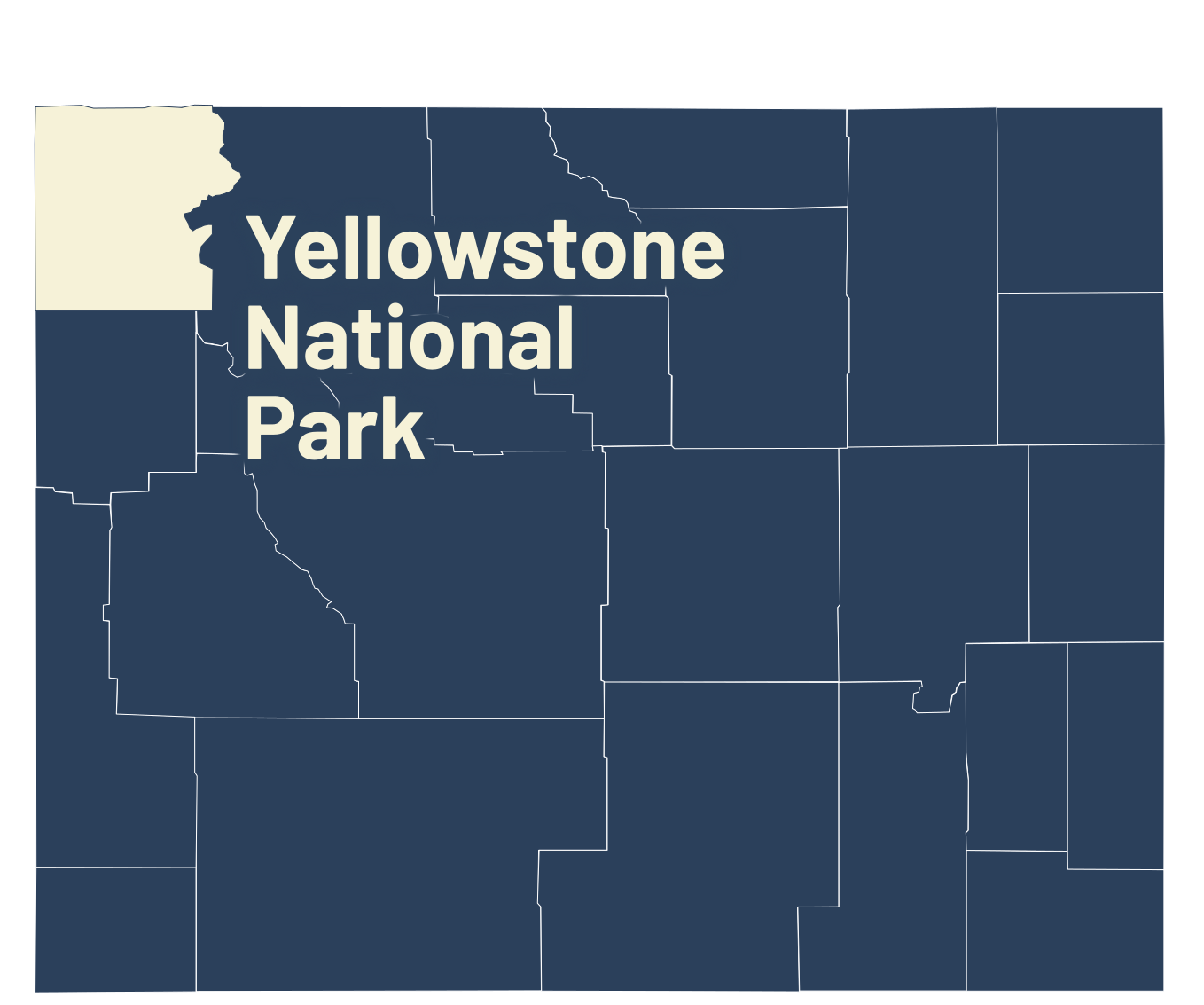
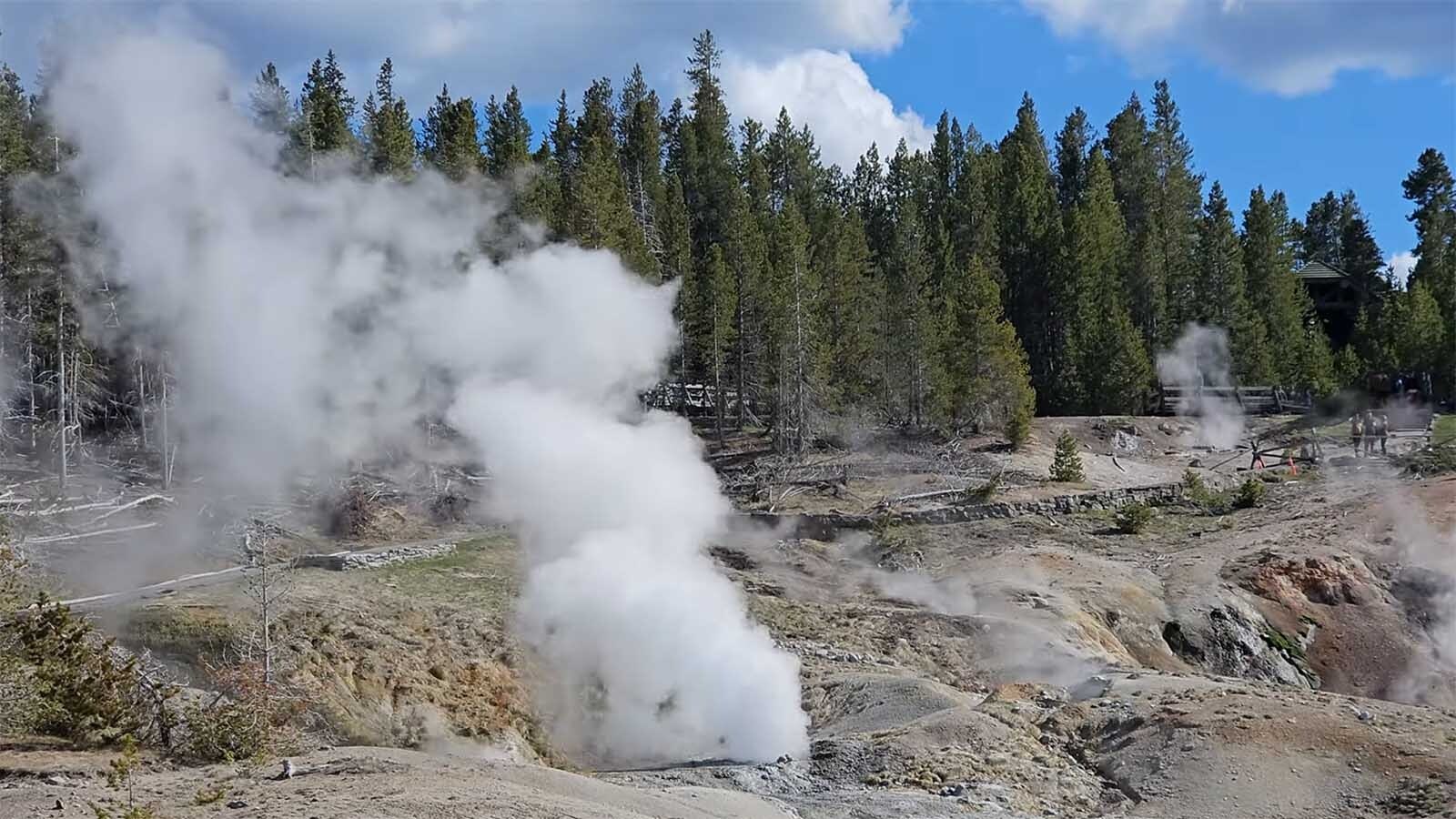
Yellowstone National Park may present a few lucky visitors with an unexpected Valentine’s Day gift. Valentine Geyser is once again filling the hearts of geyser gazers with excitement.
The Yellowstone Volcano Observatory has been monitoring ongoing activity at Valentine Geyser, and its companion Guardian Geyser, in the Norris Geyser Basin. It’s the first time in two decades that the pair of partnered geysers have been active.
“It used to be one of the more active geysers in the park,” said Mike Poland, scientist in charge of the Yellowstone Volcano Observatory. “These are its first documented eruptions in 21 years.”
Be My Valentine
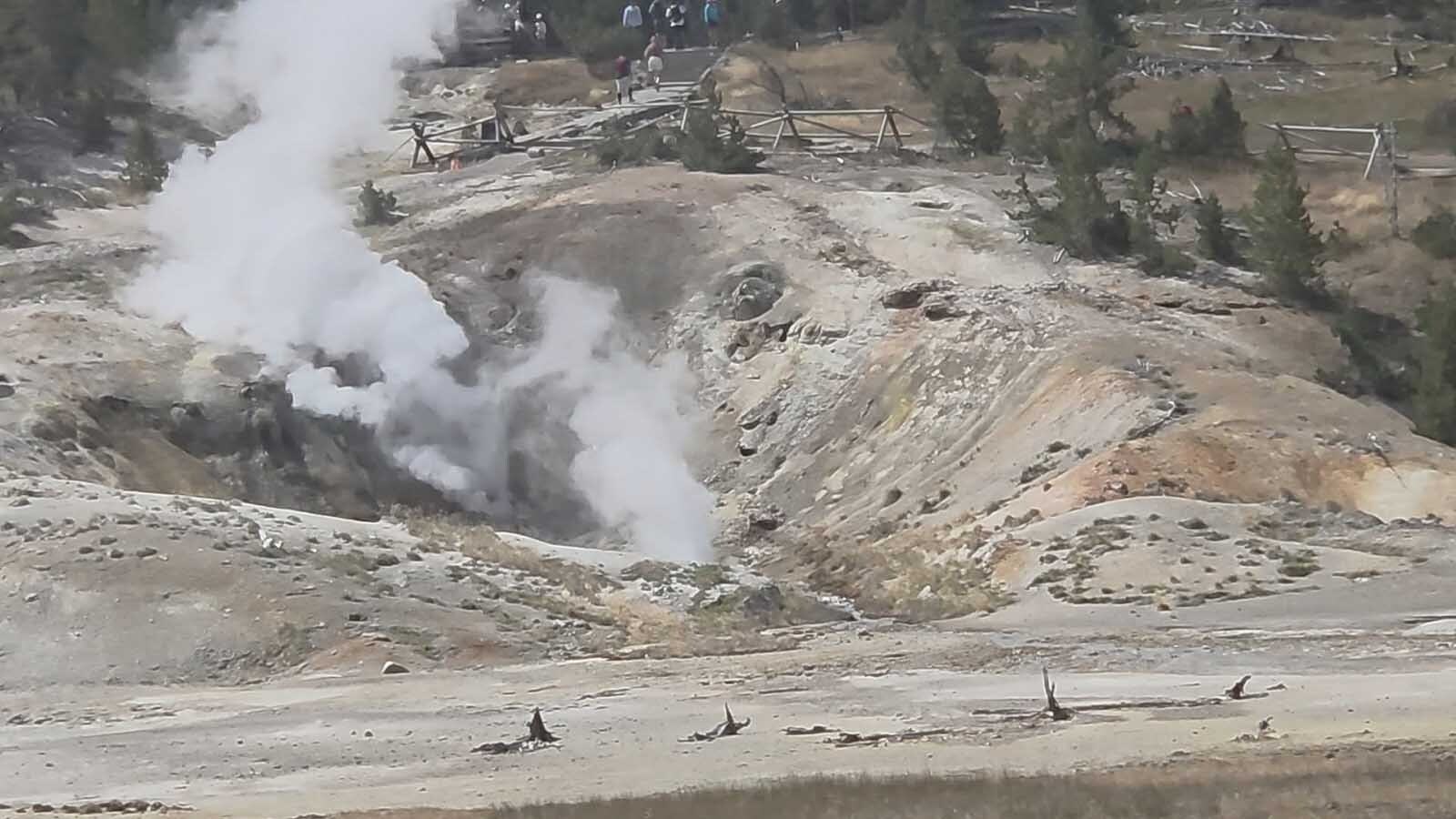
Valentine Geyser is located in a small ravine on a hillside, directly below the Norris Geyser Basin Museum, in the Porcelain Basin. It was named by C.W. Bronson, a hotel manager, and his wife on Valentine’s Day 1909 (or 1907, as the historical records aren’t consistent).
“I heard a lot of noise across the basin and went to tell my wife that something was blowing up on the other hillside,” Bronson wrote. “We both watched it and, on coming closer, found that it was coming from what had been a very small hot spring – one which up till then seemed to be just barely alive.”
The Bronsons watched as water, rocks, and mud were ejected from the active hot spring. By the time it finished, there was “a huge pit” left behind.
According to Lee H. Whittlesey’s book “Yellowstone Place Names,” Bronson placed a sign with the word “Valentine” next to the active geyser. It’s been Valentine Geyser ever since.
Poland said this historical account correlates with what they know about Valentine Geyser’s behavior. It now consists of a six-foot-tall sinister cone and can lovingly shoot water between 75 and 135 feet into the air.
“The park put out a trail map in 1982 that said, ‘Did you see Valentine erupt?’ It was one of the more active geysers at Norris,” he said.
There were also sensational reports of Valentine Geyser erupting “ice-cold water” that would create a “furor among geologists.” While that certainly would be sensational, Poland’s professional opinion is that these were “weird rumors” without a basis in scientific fact.
Ups And Downs
Like many thermal features in Yellowstone, Valentine Geyser has its own personality and eruption timetable. It has erupted as frequently as once every 24 hours during its active periods, which have occurred several times over the last century.
“Eruptions have been up to a week apart during its current active phase,” Poland said.
Valentine Geyser had been dormant since September 2004 until it unexpectedly erupted for the first time in 21 years on Aug. 7, 2025. It’s had 14 documented eruptions since then.
According to the website GeyserTimes, Valentine Geyser’s last documented eruption was on Oct. 13. Poland said there’s every possibility the geyser’s still active, but they can’t confirm it at the moment.
“We haven’t been able to download any information from the sensors since the Norris Geyser Basin closed in October,” he said. “We don’t know exactly what it’s been up to since then.”
Valentine Geyser doesn’t act alone. According to Poland, the nearby Guardian Geyser seems to share the same plumbing system, as indicated by their similar behaviors.
“When Valentine erupts, Guardian erupts,” he said. “There’s a clear connection between these two geysers, as they have sympathetic activity, just like Steamboat and Cistern Spring.”
It’s well documented that Cistern Spring completely drains before a major eruption of Steamboat Geyser, the tallest active geyser in Yellowstone and the world. That’s a clear indication that these thermal features, also in the Norris Geyser Basin, are connected in some way.
Valentine Geyser underwent active periods in the 1960s and the late 1980s, when it erupted 32 times in 1989 alone, before entering a period of infrequent, irregular eruptions in the 1990s.
The flurry of activity at the end of 2025 suggests Valentine Geyser has entered another highly active period. It’ll be something Yellowstone visitors will want to keep on their wish lists when they visit in Summer 2026.
Owner Of A Lonely Heart
Whenever a Yellowstone geyser unexpectedly reawakens, people inevitably try to connect it to some doomsday prophecy or another sign of an imminent supervolcanic eruption. For Poland, that couldn’t be further from the truth.
“What does it mean? Well, it means nothing, really. This is the way geysers work,” Poland said.
Discounting the plethora of scientific evidence indicating that Yellowstone’s subterranean magma chamber isn’t capable of another eruption, Poland said the behavior of geysers at the surface doesn’t indicate anything. It’s especially “meaningless” when anything happens at Norris.
“Norris is in a class by itself,” he said. “It’s one of the most active thermal basins in an incredibly active place, and it’s always changing.”
In December 2024, a new baby-blue hot spring suddenly appeared in Norris after a minor hydrothermal explosion. That had nothing to do with the ongoing decline of Steamboat Geyser, which ended its latest active period while Valentine Geyser picked up the slack.
Poland said it’s best to scrutinize most of Yellowstone’s thermal features as individual units rather than as an intricately connected system. Valentine and Guardian Geysers are connected, but they are isolated from everything else in their vicinity.
“What’s happening at Valentine Geyser doesn’t even reflect what’s happening in the Norris Geyser Basin overall,” he said. “It’s just a change in that specific area.”
Love Isn’t Forever
The Yellowstone Volcano Observatory isn’t sure what Valentine Geyser has been up to for the last few months, but they’re eager to collect more information once the area is accessible this spring. Poland suspects it and Guardian Geyser have erupted several times since October 2025.
“We don't have that many observations for this feature,” he said. “The best tools we have are eyewitness accounts and a temperature monitoring sensor that can give us a sense of how often it's erupting. We’ll be able to collect that data once it's open.”
Many people may be fortunate enough to see Valentine Geyser erupt during their next visit to Yellowstone. Then again, it might break their hearts before they get the chance.
“At some point, Valentine is going to turn off,” he said. “That may not be quite as newsworthy or catch as much attention as when the geyser comes back to life after a long period of dormancy, but geysers turn off eventually. That’s how they work.”
Andrew Rossi can be reached at arossi@cowboystatedaily.com.