

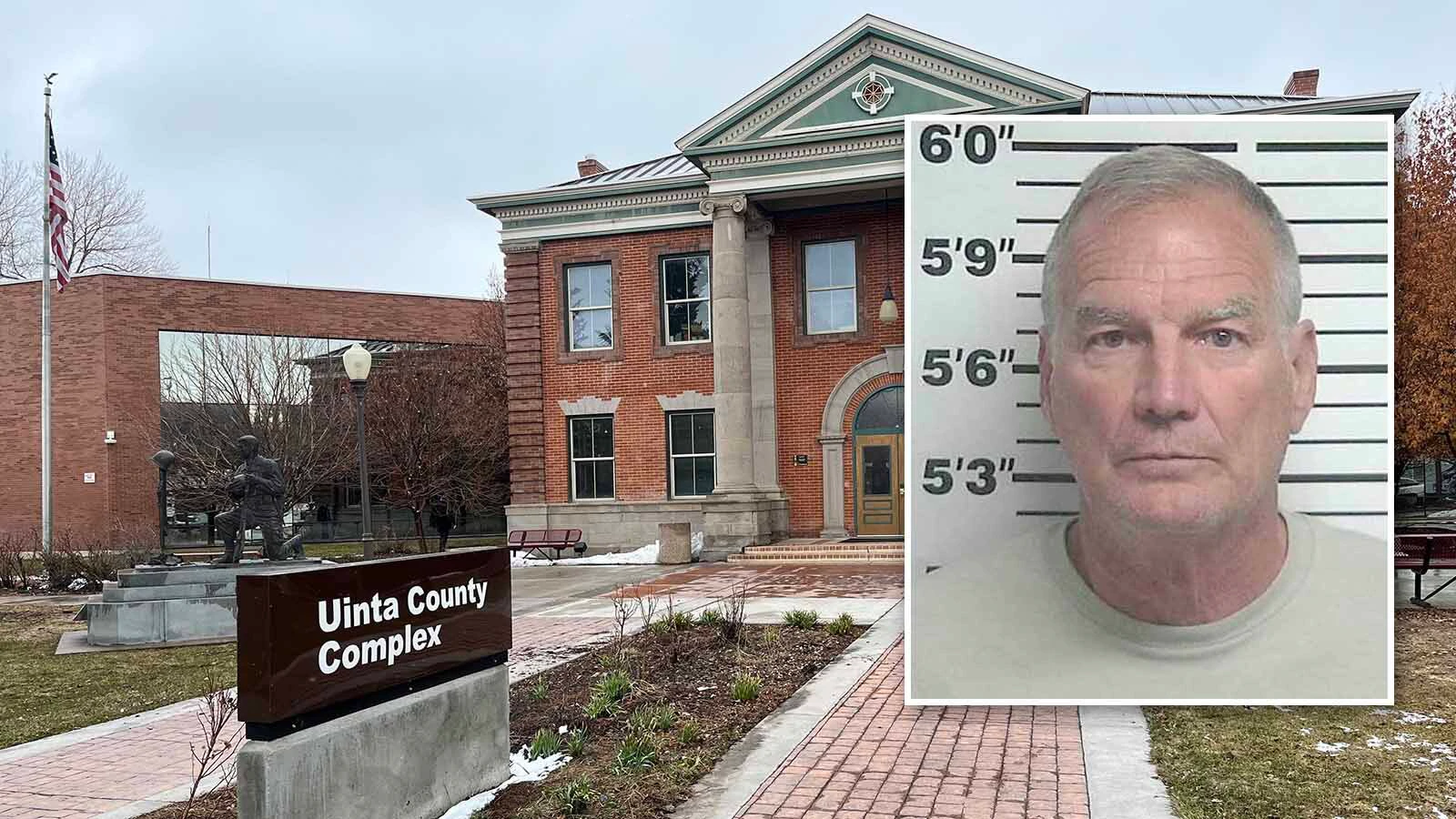
Four days after longtime Uinta County Coroner Gregory Crandall is scheduled to be in an Evanston courtroom for a preliminary hearing on allegations he stole public money, intentionally falsified a death certificate and three other felony criminal charges, Crandall is set to be re-elected unopposed on the Nov. 3 general election ballot.
His re-election won’t be a slam dunk if some in the southwest Wyoming community have anything to say about it as they organize a last-minute write-in campaign to oust Crandall from office after 23 years.
Crandall owned Crandall Funeral Home in Evanston until he sold it to his son-in-law Allen Kopp in July 2024. Kopp unsuccessfully challenged Crandall for county coroner this election cycle, but lost in the August primary.
Now there’s a push for voters to write Kopp in.
News of Crandall’s arrest and the crimes he’s being accused of committing — which along with the felonies include official misconduct, conflict of interest and neglecting his duties in a criminal case — motivated Evanston resident Jennifer Wilson to cast a write-in vote for Kopp.
"There have been whispers in the community for the past year and a half about stinking corpses, officers transporting bodies in their vehicles, all crazy stuff that you don't repeat because it's too outrageous," Wilson told Cowboy State Daily on Thursday.
"Then you read an article one day and suddenly the whispers can no longer be ignored,” she added. “You read about bodies in blankets and unrefrigerated samples, and it all comes into focus."
The rumors Wilson described have not been independently verified.
Bernadette Ottley also plans to cast a write-in vote for Kopp, saying she was impressed by his willingness to question county spending during his unsuccessful primary campaign.
"During his campaign, I watched him ask questions about where funding was going, and that really stood out to me," Ottley told Cowboy State Daily.
"In light of recent news, those questions stand out to me even more,” she said. “I have a great deal of respect for someone willing to ask difficult questions and seek accountability, even when doing so isn't easy."
Crandall made his first appearance in Uinta County Circuit Court on Wednesday, and he was set free on a $10,000 personal recognizance bond.
Attempts to reach Crandall on Friday were unsuccessful, but in a short letter to the editor to the Uinta County Herald the newspaper posted Friday to its Facebook page, he denies all the criminal allegations.
It reads:
Editor: I hope you will give me the same opportunity you have given my accusers by publishing this in your paper and on your Facebook page today.
I would like the citizens of Uinta County to know that I adamantly deny all allegations against me.
I wish I could respond to any and all questions about the coroner office but on attorney advice I can’t.
My innocence cannot be litigated through Facebook or social media.
Sincerely,
Greg Crandall
Would Kopp Want To Be A Write-In?
Kopp did not respond to Cowboy State Daily's request for comment Friday and it’s unclear whether he would welcome or actively pursue a write-in campaign for county coroner.
However, he’s been an outspoken critic of his father-in-law as coroner, and how the office has been run was prominent in his campaign this summer.
During a candidate forum hosted by the Evanston Chamber of Commerce, Kopp alleged that the county had failed to reimburse his funeral home for cremation services provided to indigent people, despite maintaining a county burial fund.
Kopp said he had attempted to recover the money but was told his invoices were insufficiently itemized.
He questioned why his funeral home was being held to billing requirements that he said had not previously been imposed on the coroner's office when Crandall owned the funeral home.
"A simple public record search going back will show that the coroner's office has never had to submit an itemized invoice to be paid in account of," Kopp said during the forum.
"It's criminal," he added about the county's handling of the bills. "I paid these bills ... for the county to turn their back on me."
Kopp also leveled broader criticism at the office his father-in-law had occupied since 2003.
"What has happened in the coroner's office, for years, is criminal," he said.
Kopp purchased Crandall Funeral Home from Crandall on July 1, 2024. Crandall had operated the Evanston funeral home for much of his tenure as county coroner.
The business relationship between the two men, along with their family connection and subsequent political rivalry, adds another dimension to the unfolding controversy.
The Allegations
Crandall faces 11 criminal charges overall, including five felonies, that allege official misconduct, issuing false certificates, neglect of his duties in a criminal case, theft, conflict of interest and multiple counts of making false written statements.
During a nearly 19-month investigation that dates back to March 12, 2025, the Wyoming Division of Criminal Investigation conducted an independent investigation into Crandall and his office.
DCI reports uncovering “a broader pattern of financial fraud, official misconduct, evidentiary and administrative irregularities,” Agent Daniel Allison wrote in an affidavit of probable cause filed in Crandall’s case.
After Uinta County Attorney Loretta Howieson-Kallas requested DCI do an independent investigation of Crandall, the agency found numerous alleged illegal activities and examples of shoddy work by the coroner and his deputies, the affidavit says.
In one case, Crandall convinced the state of Wyoming to change the cause of death on a woman’s death certificate to cover up mistakes he made in contaminating the body, the affidavit alleges.
In another case, a body was sent to a pathologist in Colorado wrapped simply in a blanket without any of the required documentation and evidentiary paperwork completed, Allison wrote.
The county attorney “outlined severe operational and evidentiary failures, highlighting a March 12, 2025, officer-involved shooting where a decedent was transported to Colorado wrapped solely in a blanket without a sterile bag, evidence tape, or clear chain of custody,” the affidavit says.
After Crandall sold his funeral home, which also served as the official coroner’s office, Kopp also made a number of disturbing discoveries, Allison wrote.
Photos provided by Kopp showed “pervasive evidence mishandling at the facility, including Ziploc bags of loose prescription drugs, unfilled laboratory envelopes, unrefrigerated tissue and blood samples stored in desk drawers or plastic bottles,” according to the affidavit.
There also was pervasive commingling of sensitive official county coroner files with the private business records.
The county attorney also noted an instance where one of Crandall’s deputy coroners “admitting to being physically unable to respond to a scene due to alcohol consumption.”
The Death Certificate
One felony charge Crandall faces for issuing false certificates stems from an incident that began April 3, 2025, when a 56-year-old woman died in Evanston, the affidavit says.
Crandall initially issued a death certificate stating that the woman died a “natural death” caused by complications of Type 2 diabetes. However, a toxicology report dated May 13, 2025, “revealed an extraordinary and lethal concentration of methanol … commonly formaldehyde,” Allison wrote.
Despite Evanston police indicating there were no substances in the woman’s apartment that could account for that, Crandall didn’t initiate an investigation.
Instead, he sent an email to the state Department of Health Vital Records requesting the cause of death on her death certificate be changed to “menthol poisoning” and the method of death as “accident.”
In the process, Crandall allegedly was covering up the likelihood that the contamination with formaldehyde came from the funeral home, the affidavit says.
“By certifying to the state that the death as an ‘accidental’ poisoning while actively ignoring that no methanol-bearing items were found at the scene, and that his office likely contaminated the blood sample during embalming, Crandall knowingly issued a false official statement,” the affidavit says.
Even more evidence was ignored when police documented at the scene of the woman’s home that an alleged illegal drug dealer had been seen at the apartment doing drugs with her shortly before her death, the agent wrote.
“This created an inescapable legal duty” for Crandall, the affidavit says. “If the blood was drawn before embalming contamination occurred, a lethal chemical poison in a home devoid of methanol products represented a potential homicide or suicide requiring a formal criminal investigation.”
On the other hand, if the contamination came after embalming, that represents “severe evidence spoilation and improper evidence handling in a coroner’s case,” Allison wrote.
Instead of performing his duties, Crandall instead “misdirected” officials to rule the death an accident, the affidavit claims.
“The evidence strongly supports the conclusion that Crandall’s total lack of investigation into the lethal methanol levels was a deliberate attempt to cover up a critical error made by his office,” the document concludes.
The Theft
The investigation also included an exhaustive audit of 14 years’ worth of Uinta County financial records and vouchers for the coroner’s office, along with a 26-year review of county commission meeting minutes.
That revealed a not-so-elaborate scheme in which Crandall would overcharge the county for his services as coroner, or charge for services that were never performed, Allison wrote.
Overall, DCI found more than $41,000 worth of those charges.
“Between July 2021 and July 2024, Crandall exploited his dual capacity as elected county coroner and private owner of Crandall Funeral Home Inc. to manipulate county disbursements for his direct personal and business financial gain,” the affidavit says.
He’s accused of grossly overbilling the county for some service, along with submitting vouchers for other services that were never done, the document adds.
Allison calls some of these nonexistent services “phantom cases,” where in fiscal year 2024, medical examiners performed 12 physical autopsies for Uinta County, but Crandall submitted vouchers for 30 cases.
Many of these charges were for facility usage fees, billing the county for the use of his funeral home to do county business. However, the investigation revealed that Crandall Funeral Home never had a contract with the county to use his private business for official business.
“As the elected Uinta County Coroner, Crandall held the sole administrative discretion over local post-mortem intake, body storage, and facility selection,” the affidavit says. “Crandall abused his official discretion by funneling county business directly to Crandall Funeral Home Inc., a private business he owned and operated.”
One allegedly egregious example was a 2023 autopsy that Crandall sent a body to Lander to have done. He also billed the county $2,000 for his own “facilities usage” even though the autopsy was performed somewhere else, the affidavit says.
When he sold the funeral home, “this county-backed revenue stream collapsed entirely, exposing that the entire billing structure was a product of dual-role self-dealing,” the affidavit says.
The Charges
Overall, Crandall faces 11 criminal charges, five felonies that could get up to a maximum of 35 years in prison, and six misdemeanors with various ranges of jail time and fines.
• Theft, a felony, punishable by up to 10 years in prison, a fine of $10,000, or both.
• Issuing false certificate, a felony, punishable by up to 10 years in prison, a fine of $10,000, or both.
• Three counts of false written statements, a felony, punishable by up to 5 years in prison, a fine of $5,000, or both.
• Conflict of interest, a misdemeanor punishable by a fine of not more than $5,000.
• Failure to maintain confidentiality of reports, photos and recordings, a misdemeanor punishable by up to 6 months in jail, a fine of not more than $1,000, or both.
• Neglect of ministerial officer to perform duty in a criminal case, a misdemeanor punishable by up to 6 months in jail, a fine of not more than $500, or both.
• Issuing a false certificate, a misdemeanor punishable by up to 1 year in jail, a fine of not more than $1,000, or both.
• Possession of a controlled substance in pill or capsule form, a misdemeanor punishable by up to a year in jail, a fine of not more than $1,000, or both.
• Official misconduct, a misdemeanor punishable by a fine of not more than $5,000.
What Happens Next?
Despite Crandall's arrest, his name remains on the general election ballot.
Under Wyoming law, being charged with a crime does not automatically remove an elected official from office or disqualify that person from appearing on the ballot.
Wyoming also does not provide for recall elections for county officials.
There is, however, a process by which qualified electors can seek the removal of a local elected official.
Residents may submit complaints to the governor, who can investigate the allegations and determine whether to direct the attorney general to pursue a civil action seeking the official's removal.
Such proceedings are exceptionally rare.
Although Wyoming has seen an unprecedented number of requests for gubernatorial investigations during Gov. Mark Gordon's administration, civil actions to remove elected officials have happened only about twice in the past century.
Cowboy State Daily contacted Gordon's office Friday to ask whether the governor intends to investigate the allegations against Crandall. The office did not respond before publication.
In the meantime, voters have another avenue available to them at the ballot box: writing in the name of someone other than the candidate listed.
With the general election less than two weeks away, the controversy has left Uinta County voters facing an unusual choice: re-elect a longtime incumbent facing criminal allegations or write in someone whose name does not appear on the ballot.
Kate Meadows can be reached at kate@cowboystatedaily.com.


