

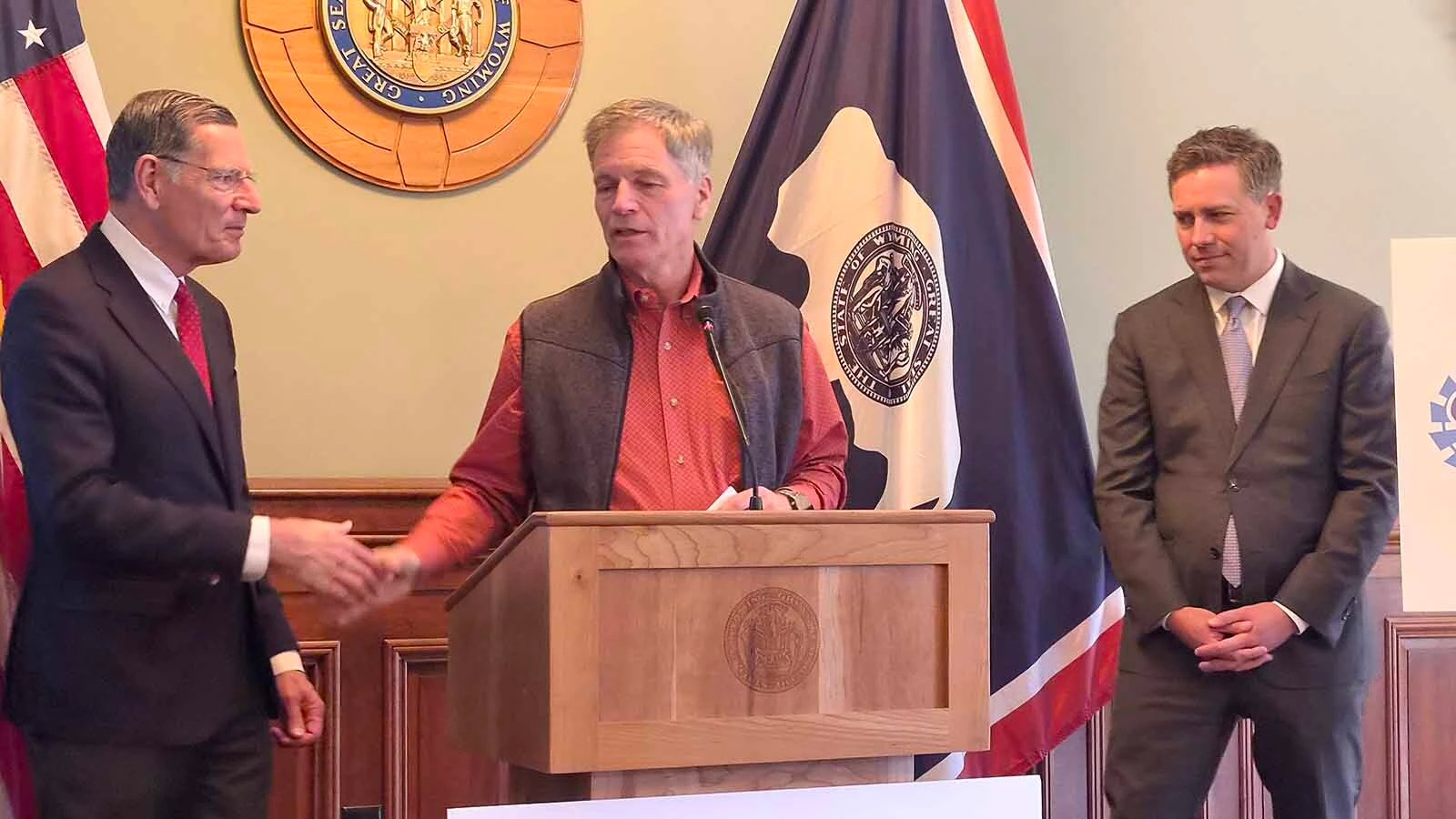
CHEYENNE — As he rolled out Wyoming’s plan to spend $205 million in federal money to improve rural healthcare Friday, Gov. Mark Gordon stressed that measuring how well the state can decide whether new programs are succeeding will be a big part of the process.
“One of the driving forces for me is that we actually have ways to [measure] performance, not just that we have new trinkets or goodies that look like they can manage things more efficiently,” Gordon said.
The governor was joined by other officials at the state Capitol for a press conference to announce where in Wyoming that federal money is going.
The governor said two of the many health services that should be improved under the Rural Health Care Transformation Program will be about improving emergency medical care and maternity care.
Gordon said that nearly $92 million will be spent on emergency care, including EMS, labor and delivery for mothers, and trauma services, and to change how the state delivers and pays for basic care in rural and frontier areas.
The long-term goal, he added, is to ensure that such services are sustainable.
Gordon, a Buffalo rancher and state treasurer before his two terms as governor, said he remembers how emergencies were typically handled over the years in Buffalo.
“If somebody got hurt, we put them in the back of the pickup or station wagon and drove to town,” he said. “To have an ambulance and make sure it could serve for years to come, that's the key to making it work in Wyoming.”
‘One Big Beautiful Bill’
The Rural Health Transformation Program is part of the “One Big Beautiful Bill” that President Donald Trump pushed through in July 2025.
States will divide a total of about $50 billion over the next five years.
Gordon and health officials at the news conference said the initial $205 million for Wyoming is just a start, and more ideas and programs will likely be added each year.
Increasing the rural workforce supply will get $56.3 million of the award. Much of that will be used for education and training from community colleges, the University of Wyoming, and other resources.
That will include WWAMI, a coalition of states — Wyoming, Washington, Alaska, Montana and Idaho — who send students to the University of Washington’s Medical School.
Students return to their home states for their internships. If they decide to stay and work in a rural area, their student debt is forgiven.
Stefan Johansson, director of the Wyoming Department of Health, said the retention rate of students is about 50%.
Tech Boost
Health technology will receive a $16.9 million grant.
Johansson said it’s going to be used to help groups of hospitals and rural health providers care for people closer to home, manage chronic diseases, increase access to critical consults and improve healthcare effectiveness through collaboration.
Finally, $38.6 million will go to the Make Wyoming Healthy Again award.
A portion of these federal dollars will be spent to expand primary care that is integrated with behavioral health, healthy diets, exercise programs and infrastructure.
Johansson said reducing Wyoming’s “maternity desert” — communities that lack labor and delivery services and obstetricians — has been a goal of Gordon’s administration, and there are opportunities to do so under the federal and state requirements.
“Carbon County has a specific priority for labor and delivery for areas that might not have it or areas that have closed in the recent past,” he said. We have start-up funding, totally voluntary, but an incentive to bring back [those services].
“We also have incentive payments, including OB-GYN,” Johansson added. “If you sustain this service, or you bring it back online, there is a payment to help sustain that.”


