

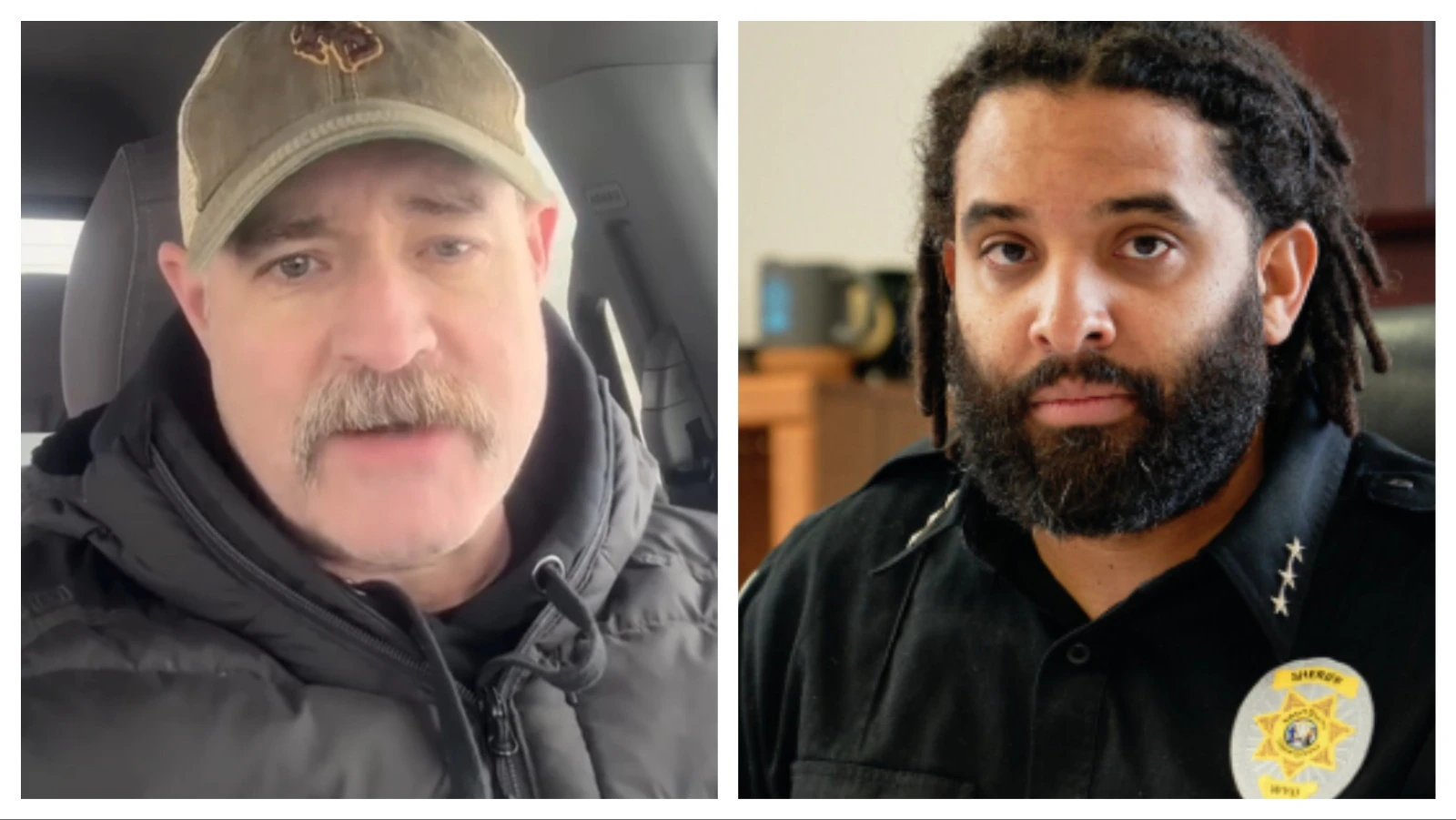
The Albany County Sheriff’s race pits a longtime law-enforcement investigator who’s worked challenging jurisdictions in California against the self-described “hometown” incumbent who’s run the office for six years.
It also casts the controversy of a high death rate in Democratic Sheriff Aaron Appelhans’ jail against Republican candidate Daron Wyatt’s use-of-force history.
Appelhans, 45, originally from Denver, has spent his entire adult life in Laramie, where he got his law-enforcement start at the University of Wyoming Police Department 16 years ago. He’s urged a local focus in his campaign and cast himself as the “hometown” candidate.
Wyatt, 59, has 38 years of law-enforcement experience, including as a homicide and cold-case detective. He told Cowboy State Daily he and his wife moved to Albany County in 2019 after falling in love with Wyoming and buying their retirement home in the area three years earlier.
The Feud
This campaign is a feud.
Wyatt retired from the Anaheim Police Department in southern California on Dec. 26, 2019. His semi-retired life includes operating a woodworking and laser engraving business, and performing pre-employment background checks for law enforcement, his website says.
“I thought I’d be retired — until I saw issues in the sheriff’s office that I thought were causing liability for the community,” said Wyatt in a Thursday phone interview. “And I figured the only way to change it was from the inside, and I decided to run.”
Of 17 Wyoming jail deaths from 2019 to July of this year, five happened in Albany County custody, according to a tally the Wyoming Attorney General’s office sent Wyatt in a records request.
One was natural, three were suicides and one is listed as “undetermined” in cause.
During an Oct. 5 sheriff’s debate, Wyatt grilled Appelhans over policies and practices.
Appelhans told Cowboy State Daily in a Thursday interview that suicides are always tragic, “and we continue to do absolutely everything in our power, to do everything we can to mitigate and make sure that those don’t happen.”
Appelhans noted that Wyoming consistently ranks as one of the highest states for suicides per capita, and people are three to four times more likely to attempt suicide when incarcerated.
He said the sheriff’s office has been providing more medical and psychiatric care, bringing in alternative medicine, and deploying improved practices and techniques at the jail.
Appelhans said the agency signed a contract with the Wyoming Department of Health last week to fast-track inmates waiting on evaluation from the Wyoming State Hospital while their court cases are still ongoing.
ICE Detainers
U.S. Immigration and Customs Enforcement will issue detainers to jails that have inmates the federal agency wants for immigration proceedings.
That generally involves a request to hold someone up to 48 additional hours after they’re eligible for release, so that ICE can collect that person at the jail.
Appelhans and Wyatt parried repeatedly at their debate about whether this is legal.
Many courts have been critical of ICE detainers, but the basic practice has not been outlawed and is still in use in nearly all Wyoming counties.
Appelhans noted that detainers are administrative requests from one agency to another. They don’t carry the same legal weight as a warrant signed by a judge.
“And as sheriff, it's my job to make sure that the rights of everybody, whether you're arrested or not, are being met,” he said during the debate. “And so we only honor holds from any department, local, state, or federal, that provides a warrant for them to extend that hold.”
Wyatt questioned then why Appelhans honored ICE detainers before the spring of 2025.
A detainer list from ICE shows Appelhans honoring detainers before then.
Wyatt in his interview emphasized that Appelhans has given varying answers to the question of which ICE detainers he’s honored.
Wyatt argued that Appelhans is breaking the law. The Wyoming Legislature in 2025 banned local governments from creating policies that block cooperation with federal immigration officers.
“By him not honoring ICE detainers, he has created a de facto sanctuary county in Albany,” said Wyatt.
ICE gave a partial confirmation of the data its public-records counterpart sent to Wyatt on Appelhans’ office. The agency said Appelhans has honored “less than 100%” of its detainers in 2025 and 2026.
Appelhans told Cowboy State Daily that his stance toward ICE never changed, though he clarified it in the spring of 2025.
A Cowboy State Daily public records request to ICE is pending.
In The Streets
Wyatt said he wouldn’t make decisions about ICE in a vacuum. He’d seek advice from the county attorney and honor any opinion from the state attorney general on detainers.
He also said he won’t build a 287(g) agreement with ICE. Those agreements can turn the local jail into a longer-term ICE holding facility, give jail officers immigration investigation powers, or let deputies enforce immigration law out in the community.
Wyatt, who described himself as a moderate Republican, said those agreements can breed fear and erode trust in law enforcement.
But he wants to honor detainers, said Wyatt, so that when ICE wants to apprehend someone, it can do it in the controlled environment of the jail instead of on the streets of Albany County. He also said honoring detainers lets ICE focus on the person arrested for a crime, rather than a potentially undocumented but non-criminal family back at his house.
Appelhans called Wyatt’s concern about ICE working in the streets “a little bit of fear-mongering.”
“We’ve had this policy for quite a while, and ICE is not slipping into the streets, snatching up everybody in an uncontrolled environment here.”
The Shooting
Policing in Anaheim and other areas of California involved tough beats, Wyatt recalled.
In 2009, Wyatt and another officer stopped a reportedly weaving driver, Adolf Anthony Sanchez Gonzalez, after 2 a.m. in Anaheim.
Gonzalez refused to comply with orders to turn off his van and open his hands, the Orange County Register reported. The other officer tried to grab his hand through the driver’s side while Wyatt, who thought he saw Gonzalez reach down, reached into the passenger side.
Police Magazine elaborated, reporting, “The man suddenly moved his right hand up to his mouth and threw something, presumably drugs, into his mouth.”
A struggle followed. Gonzalez shifted into drive and the van surged forward with Wyatt inside it, Gonzalez still ignoring Wyatt’s orders to stop and swatting the officer’s hands away when he tried to halt the vehicle.
With Wyatt in the cab, the van accelerated rapidly northbound on the small residential street and about 600 feet ahead was a T-intersection, Wyatt told Police Magazine, adding that he had three immediate thoughts: ‘I'm going to die. I didn't get a chance to hug my wife and kids before I left for work. I must win this fight!’”
Wyatt drew his weapon and shot Gonzalez fatally in the head.
Investigation revealed the deceased suspect was a 21-year-old parolee, an active gang member and was in possession of a sales quantity of methamphetamine, Police Magazine reported. Investigators also discovered there was a knife in the driver's door pocket where the suspect was reaching.
The vehicle’s halt slammed Wyatt into the windshield, resulting in numerous later back surgeries.
Robbie
Critics have linked this incident with the 2018 shooting in which former Albany County Sheriff’s Deputy Derek Colling, who had a use-of-force history before the department hired him, shot and killed Robert “Robbie” Ramirez during a traffic stop while the latter was unarmed.
Dave O’Malley was still sheriff at that time, but when he resigned Appelhans was appointed in December 2020 to fill the position.
Albany County paid $1.2 million to Ramirez’s family in a civil settlement five years after the shooting.
The incident wracked Albany County with controversy.
Appelhans said critics are fair to link the Colling incident with Wyatt’s past use of force.
“The community really doesn’t want to have that happen again,” said Appelhans. “It really rocked our community.”
The department has not had any officer-involved shootings during Appelhans’ tenure, and he’s never been involved in an OIS either, he said.
Rubbish
Wyatt said those comparisons are “complete rubbish.”
“The circumstances of my fatal shooting were a lot different than that,” he said. “The person I shot and killed was an armed and dangerous parolee, at-large gang member who was selling meth.”
Wyatt said minutes before the Anaheim officers contacted Gonzalez, “he texted a friend and said he was never going back to prison.”
Wyatt said in Anaheim he policed areas ranging from the ultra-wealthy east side to gang-infested ghettos resembling a third-world country, teeming with drugs and violence.
He also said it’s common for police to be sued in California.
Wyatt was not found criminally culpable, and after a trial, he was also exonerated for civil liability in the incident.
The Confession
That wasn’t Wyatt’s only high-profile civil trial.
When he was investigating a murder-for-hire case in which a woman’s newlywed husband conscripted gang members to kill her for her life-insurance policy, Wyatt got a false confession from Rafael Miranda Garcia.
Miranda Garcia went back and forth during Wyatt’s interview on whether he had acted as a middleman connecting the husband and gang members, ultimately confessing to doing so.
Miranda Garcia had not been the middleman, the case later revealed.
But once released, Miranda Garcia accused Wyatt of coercing a confession by threatening to take away his children, and by beating him.
Wyatt suspected Miranda Garcia was lying when he confessed, he told Cowboy State Daily.
When Wyatt won that civil jury trial, Miranda Garcia appealed.
Wyatt’s appeal argument relates part of the confession, where Miranda Garcia said he was scared of the gang members.
“They work through that fear, where if you talk, we’re going to get your kids, OK?” says the court transcript.
That case had other issues: Wyatt had failed to burn the video portion of the interrogation onto a disk, as he had done for the audio. The department in those days burned the audio and video of its interviews separately.
The case judge emphasized that Wyatt failed to preserve the video evidence, which a department head later deleted once Wyatt was no longer part of that unit. But the judge said Wyatt hadn’t committed a willful “spoliation.”
That appeal concluded in Wyatt’s favor.
Brady List
Appelhans said during the Oct. 5 debate that Wyatt is on a “Brady” list, or document listing untrustworthy law-enforcement officers.
There’s no official public Brady list, though prosecutors often keep their own.
Wyoming Peace Officer Standards and Training (POST) investigated and could not find Wyatt on any Brady list, according to POST documents.
Appelhans spoke to his debunked claim.
“I know there’s been questions, you know, on that. I relied on the information I had from an initial search,” said the sheriff.
He said he feels he must trust POST’s result, but he also found it “strange” that POST “immediately released” its findings to Wyatt throughout the process.
Appelhans drew the Brady dispute to Wyatt’s past use of force and the lawsuits he faced prior.
“Most law enforcement officers don’t end up in those situations in the first place,” said Appelhans, who has questioned whether Wyatt’s incidents create a pattern.
Wyatt said the violent encounters have been harrowing and tragic.
“Anybody you’ve ever talked to that’s been in a fatal, officer-involved shooting, it’s not a circumstance where you go home and high-five your wife,” said Wyatt. “It’s also a traumatic event for the officer and his family.”
License Plate Reader Cameras
Appelhans and Wyatt say they both oppose the use of license-plate reader cameras in the Albany County Sheriff’s Office.
Appelhans said the department doesn’t have them or any other kind of mass surveillance, and the community doesn’t want them.
Wyatt said they can be a good tool but they’re not appropriate for a community this size.
Appelhans has said Wyatt’s signature is on a petition for Proposition 1, the ballot initiative asking voters to cut residential property taxes by 50% on qualifying home structures.
The Wyoming Association of Sheriffs and Chiefs of Police had not taken a formal stance on Prop 1 as of Thursday, but many law enforcement officers and first responders statewide oppose it.
Property taxes fund schools and local services, including emergency response and law enforcement.
Appelhans opposes Prop 1.
Wyatt said he does, too.
He vaguely remembers signing some kind of petition before running for office, he said.
“I do have a vague memory of someone standing outside the post office, grabbing people and saying ‘Would you like to see your property taxes go down? Sign here.”
Wyatt has said he could find ways to absorb the cut if Prop 1 passes, but he emphasized to Cowboy State Daily that he has spoken against it throughout his campaign.
Appelhans said, “I don’t think it’s a good idea to defund your county resources that provide the services that county residents have come to rely on.”
Transparency
The sheriff weathered critique this week from the local newspaper’s manager David Watson, who said transparency from the sheriff’s office plummeted once Appelhans was appointed in 2020.
Watson said the sheriff’s office no longer releases arrest lists.
Appelhans said reporters are still welcome to go to court for documents or request information about specific inmates, but he doesn’t release the arrest list “because these folks are innocent until proven guilty in a court of law.”
Clair McFarland can be reached at clair@cowboystatedaily.com.


