
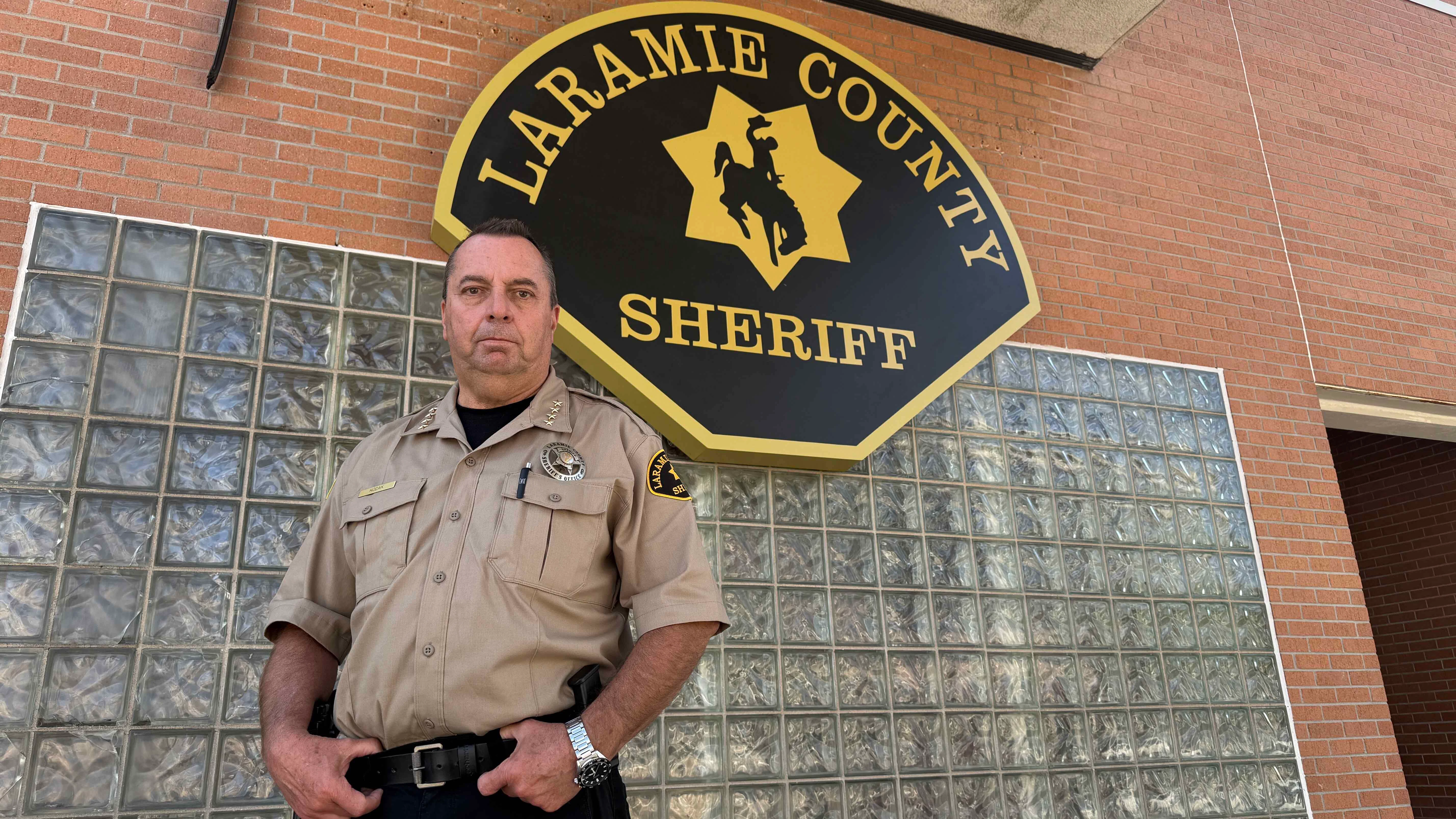
Laramie County District Court Judge Robin Cooley is deciding whether to hold Laramie County Sheriff Brian Kozak in contempt of court on claims his office disobeyed the judge’s earlier order to produce documents pertaining to the case of a Cheyenne man taken into Immigration Customs and Enforcement custody after a traffic stop.
Cooley will issue a written decision “as quickly as possible,” she said during a hearing Friday morning in Cheyenne.
Cooley heard arguments both for and against holding Kozak in civil contempt.
Drake Hill urged the court to issue the contempt finding.
Hill said that in response to the plaintiffs’ requests for documents about the Mexican national Mario Fabian Valenzuela Robles, the sheriff’s office produced conflicting accounts of his April 23 encounter, didn’t produce any communications with ICE about it though ICE was involved, and handed over a messy tranche of documents containing unreadable computer code on Aug. 7, two days after the deadline Cooley set.
Hill alleged that his clients needed to obtain these documents for Valenzuela Robles in a timely fashion to fight the man’s federal and immigration court cases, but the sheriff’s office has a pattern of not producing necessary documents until Hill’s team takes court action against it.
“We have no communications – those communications with ICE are missing,” said Hill. “We’d like to know where those are. If there are none then certify that there are none. I can’t believe there are none, but we have none.”
Producing 7,700 documents
Hill represents Colorado-based firm Lichter Immigration, which represents Robles in a federal immigration case. Hill also represents Kevin Lewis, who is an investigator for Lichter and is Hill’s business partner.
Laramie County Attorney Mark Voss argued on Kozak’s behalf that what Hill calls unreadable computer code opened readably on the county’s devices. He conceded he was two days late producing documents, but said that’s because the search terms agreed upon produced 7,700 documents and he and others had to review those for privileged information, and he also combed through them for relevance.
Voss said he sympathizes with Valenzuela Robles’ plight and appreciates Hill’s concern over it.
The county attorney also conceded that an early attempt to hand over the case records “was disordered at best.”
But he emphasized that the Friday hearing was about whether Kozak’s office “willfully” disobeyed the court’s order – and he said it did not.
“Mr. Hill, who writes very well, basically spends a great deal of time (in his contempt motion) essentially engaging in derogatory comment about the sheriff, and very little time arguing about the law in regard to the Public Records Act,” added Voss.
Judge Grapples With ‘Additional Information’
Cooley’s decision is pending.
“I thought I had the pretty full picture walking into the proceeding this morning,” she said, “but with a little bit of additional information, the court is going to take this under advisement; and will issue a written decision as quickly as possible.”
Civil contempt cases tend to involve a judge ordering some ongoing penalty against a party until that party does what the court originally ordered.
Cooley didn’t specify what “additional information” gave her pause, but earlier in the hearing Hill produced a copy of the sheriff’s office’s 287g agreement with ICE, which Hill said specifies that the sheriff’s office should keep records and have a record-keeping policy.
Cooley had called that agreement “additional information.”
Background Now
Lichter Immigration and its investigator Lewis filed this lawsuit against Kozak and his office June 30.
The lawsuit complaint accuses Kozak’s office of wrongly withholding body camera video and information that Valenzuela Robles needed for his ongoing immigration case.
The sheriff’s office detained Valenzuela Robles on April 23 “as part of a wider effort directed by Defendant Kozak,” says the complaint.
An order in Valenzuela Robles’ federal wrongful-detention case says he was detained starting about April 23 through at least May 27, after a Cheyenne police officer initiated a traffic stop on him because his taillights were “kind of dark” and his truck had “tinted windows.”
ICE agents were on scene within the span of time Valenzuela Robles took to provide his ID to the officer, the order says, adding that Valenzuela Robles asserts he was given a choice between $2,600 to return to Mexico or face ICE detention. He opted for detention, the order says.
The order recounts assertions by Valenzuela Robles that he’s lived in the U.S. for 20 years and has no criminal history, plus has three children who are U.S. citizens.
Voss noted in court Friday that Valenzuela Robles is “not a criminal.”
Hill said Valenzuela Robles’ children were in Cooley’s courtroom Friday.
Hill filed the motion asking Cooley to hold Kozak in contempt Aug. 6, after a back-and-forth over how the county should search and provide documentation to Hill’s clients.
Hill alleged that Kozak’s office disobeyed Cooley’s order to turn over documents pertaining to Valenzuela Robles.
Kozak bristled at the filing and cast the case’s motivation as politically motivated, pointing Cowboy State Daily to Hill’s tangential connections to a gubernatorial candidate whom Kozak is investigating for alleged bribery.
Kozak said his office turned over the body camera video, which he indicated was initially withheld to ensure it could be released according to the narrow provisions allowed in public-records law.
In Court
In court Friday, Voss said body camera is difficult to vet for privileged information such as people giving their driver’s license numbers, Social Security numbers, or mental-health diagnoses. If a law enforcement encounter lasts 30 minutes but three deputies capture it via body cam, that’s an hour and a half through which records staff must scour to edit out confidential information. That duration expands if dash cameras also capture the encounter, he said.
Plus, Voss noted, Wyoming law applies much narrower grounds for releasing officers’ video than other documents.
Voss cast the records search and demands as an information technology (IT) nightmare, repeatedly conceding to Cooley that these efforts were messy. He said the sheriff's office is inundated with records requests, and the sheriff may have to request a budget boost to get more staffers to field them.
Voss said he should thank Hill for prompting the formation of a new records policy at the sheriff’s office, as this case marked the "first meaningful request for records regarding ICE detention that we had received."
The sheriff’s office sent Cowboy State Daily its new records policy in a Friday email.
Hill, conversely, read dubious behavior into the sheriff’s office’s responses.
“I believe these delays do mean that they are not honoring the court’s order and that it’s intentional,” said Hill. “You cannot know about a court deadline and not meet that deadline without intentionality.”
He noted that the earliest released report about Valenzuela Robles’ arrest was, in the words of one Cheyenne Police Department staffer, a “complete fabrication.”
Voss countered, saying one of the deputies had conflated the traffic stop with another later but similar one, but that was corrected.
Hill also said the body camera video his team ultimately obtained doesn’t match the deputy reports.
“I’m sure the defendants disagree,” said Hill.
He added that the deputy who made the stop said, “Well, I pulled you over for failure to use your turn signal, but I really couldn’t see it.”
Other aspects of the body camera are “very concerning,” said Hill.
ICE’s main report of the incident, according to Hill, claims Valenzuela Robles didn’t have a current registration or tags on his vehicle, nor current insurance.
“Well, the body camera video shows that he did. And they had it in their possession,” said Hill.
Hill asserted that deputies didn’t have probable cause for the initial stop.
Voss urged Cooley to rein Hill back to the hearing’s purpose, of a proposed contempt finding.
Cooley agreed.
“I find the background information is peripherally important,” said Cooley over Hill’s due process concerns for Valenzuela Robles.
“But the standard here really is whether there was a clear and effective order, the defendants knew of that order and they did not comply with that deadline – and that their failure to comply was willful or intentional,” said Cooley, listing the basis of the contempt hearing.
Privileged
Hill also took issue with Voss saying 40 emails were deleted, and contained privileged communications between his office and other county agencies, not the sheriff’s department.
Hill said descriptions of those should rather have been listed in a “privilege” list.
Cooley asked Voss about that.
Voss agreed he hadn’t provided the privilege log, saying “I guess maybe I misunderstood the instruction in the order.” But he emphasized that he explained to Hill why he withheld those emails, and said none of them were communications with the sheriff’s office.
Clair McFarland can be reached at clair@cowboystatedaily.com.


