
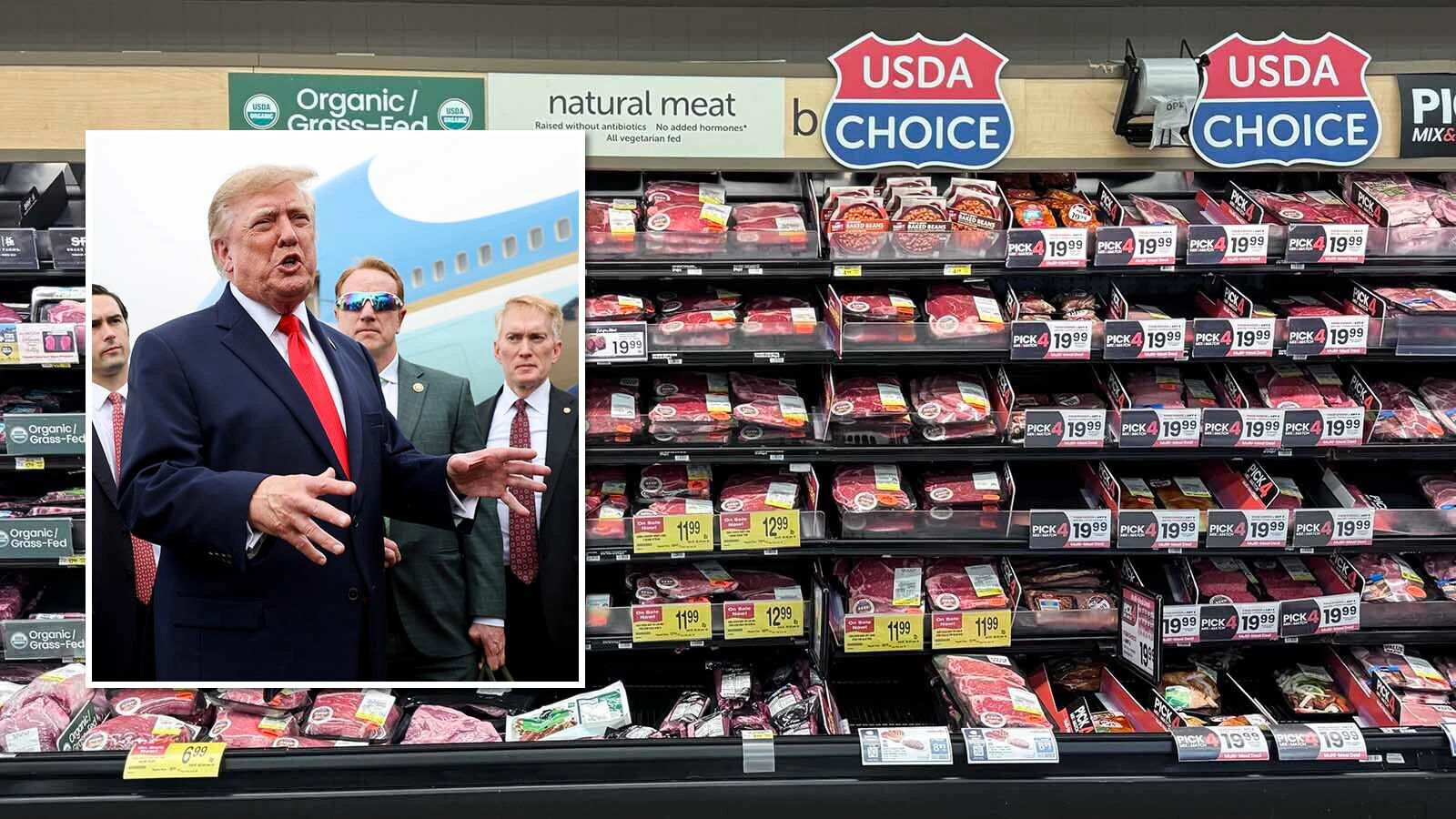
A month after President Donald Trump moved to increase beef imports in an effort to bring down the high cost of meat in the United States, ground-beef prices have not budged for consumers.
Wyoming ranchers aren’t surprised.
“It does no good to say, ‘I told you so,’” Crook County rancher Tyler Lindholm told Cowboy State Daily.
Lindholm has a simple explanation for why consumers aren’t seeing lower beef prices at the grocery store.
“The intent was that by flooding the market we would see a reduction in price,” he said. “If all things were created equal, fair enough. Imported meat might have scratched that itch. But not all things are created equal.”
Trump announced in August that the United States would allow up to 300,000 metric tons — about 661 million pounds — of lean beef trimmings to enter the country over a 90-day period without the usual out-of-quota tariffs beginning Sept. 1.
The administration said the move was intended to increase beef supplies and lower prices for American consumers. The imported beef was expected to be sold at a 25% discount to the market price.
Prices Remain Unchanged
But a month into the import program, the promised savings haven’t happened.
Kerin Clark, executive vice president of the Wyoming Farm Bureau Federation, said consumers are seeing exactly what she and other Farm Bureau officials expected.
“We knew the decision wouldn’t lower beef prices,” Clark told Cowboy State Daily.
The American Farm Bureau Federation has been tracking daily prices for 80% lean ground beef at 41 grocery stores in 22 states since Sept. 2, the day after the program took effect.
According to the organization's tracking, prices remained unchanged at 30 of the 41 stores.
For Clark, that was no surprise.
“It really didn't come as a surprise that prices were not lower,” she said.
The reason has less to do with a lack of beef and more to do with how beef moves through the supply chain, they say.
'No One Is Going To ... Buy Trim'
According to Lindholm, the major meatpackers – rather than consumers or grocery stores – stand to benefit most from the policy.
“No one is going to the grocery store to buy trim,” he said.
Lean beef trimmings are primarily used by meat processors to blend with fattier beef to produce ground beef. They are not the same product consumers see packaged and priced on the grocery store shelf.
That distinction, Lindholm said, is important.
“Once again, due to federal policy, multinational corporations made a good sweetheart deal on the back of taxpayers and consumers,” he said.
The administration's move was based on the idea that increasing the supply of lean beef would help bring down prices throughout the beef market.
But beef does not move directly from a rancher's pasture to a grocery store.
There are cattle producers, feedlots, packers, processors, distributors and retailers involved along the way, each with their own costs, contracts and margins.
And Wyoming ranchers say adding imported beef at one point in that chain does not necessarily translate into lower prices at another.
Prices Remain High
Consumer beef prices continue to remain high in large part because the nation's cattle herd is historically small while consumer demand remains strong.
Imports can add to the supply chain, but Wyoming ranchers say they don't address the underlying shortage of U.S. cattle.
And that shortage creates a difficult situation for ranchers who might otherwise be looking to rebuild their herds.
The U.S. cattle herd has been shrinking for years, with drought, high input costs and other factors contributing to herd reductions.
Now, with beef prices high, ranchers have an incentive to retain more heifers and rebuild their herds.
But rebuilding a cattle herd is a long-term investment.
Clark said the federal government's decision to increase imports sends a conflicting message to ranchers who are considering whether to make that investment.
The Farm Bureau has asked that the import decision be reversed, she said, because increasing imports could reduce the incentive for ranchers to expand.
“It's a tough time to say we're going to rebuild the herds as we have more cow herds,” she said.
The concern is that ranchers could spend years and significant money rebuilding their herds, only to face increased competition from imported beef if the federal government continues to turn to imports whenever domestic supplies tighten.
The import decision came one day after Trump hosted Brazilian billionaire Joesley Batista, co-owner of JBS, the world's largest meatpacker, to discuss solutions to soaring beef prices and historically low U.S. cattle numbers.
'Talk To The Ranchers'
Jim Magagna of the Wyoming Stock Growers Association previously told Cowboy State Daily the federal government should allow the market to work rather than attempting to manipulate it through short-term policy decisions.
“It's a supply-and-demand market,” Magagna said. “It shouldn't be driven by extraneous government policy.”
The frustration among Wyoming ranchers goes beyond the current import program.
They say Washington is trying to solve a problem without sufficiently talking to the people who actually produce the cattle.
Lindholm said the disconnect is particularly frustrating because ranchers understand consumers are struggling with high food prices.
They also understand that simply increasing imports isn't likely to solve the underlying problems facing the domestic cattle industry.
The issue, he said, is who gets to decide how those problems should be addressed.
“If we want to stop being manipulated by foreign national corporations, we're going to have to take the reins of our own future,” Lindholm said.
Who Gets The Food Dollar?
The difference between what consumers pay for beef and what ranchers receive for their cattle is another part of the equation.
According to the USDA Economic Research Service, the share of each food dollar received by farmers and ranchers has declined significantly as more of the consumer's dollar goes toward processing, transportation, marketing and other costs beyond the farm or ranch.
The American Farm Bureau Federation has cited USDA data showing farmers receive only a small portion of the consumer food dollar after accounting for the costs associated with getting food from the farm to the grocery store.
That means a lower price for beef at one point in the supply chain does not necessarily result in an equivalent reduction at the grocery store.
For Wyoming ranchers, that's the central issue.
They aren't arguing that consumers shouldn't get relief from high beef prices.
They are questioning whether importing more beef is the right way to achieve it.
Instead, they say policymakers should be talking directly with cattle producers about what is keeping domestic supplies tight, what would encourage ranchers to rebuild their herds and how to ensure that more of the money consumers spend on beef reaches the people raising the cattle.
Kate Meadows can be reached at kate@cowboystatedaily.com.


