
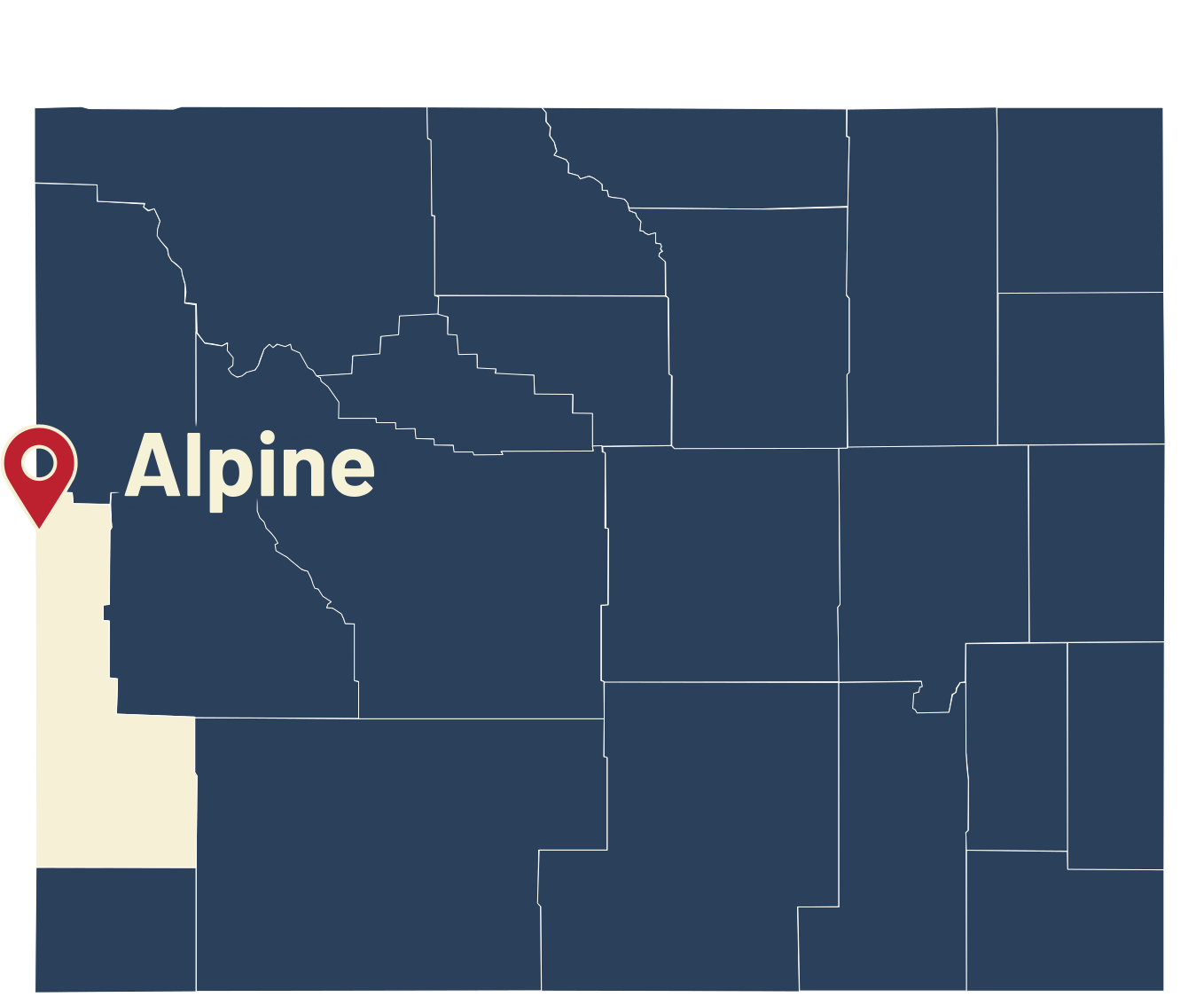
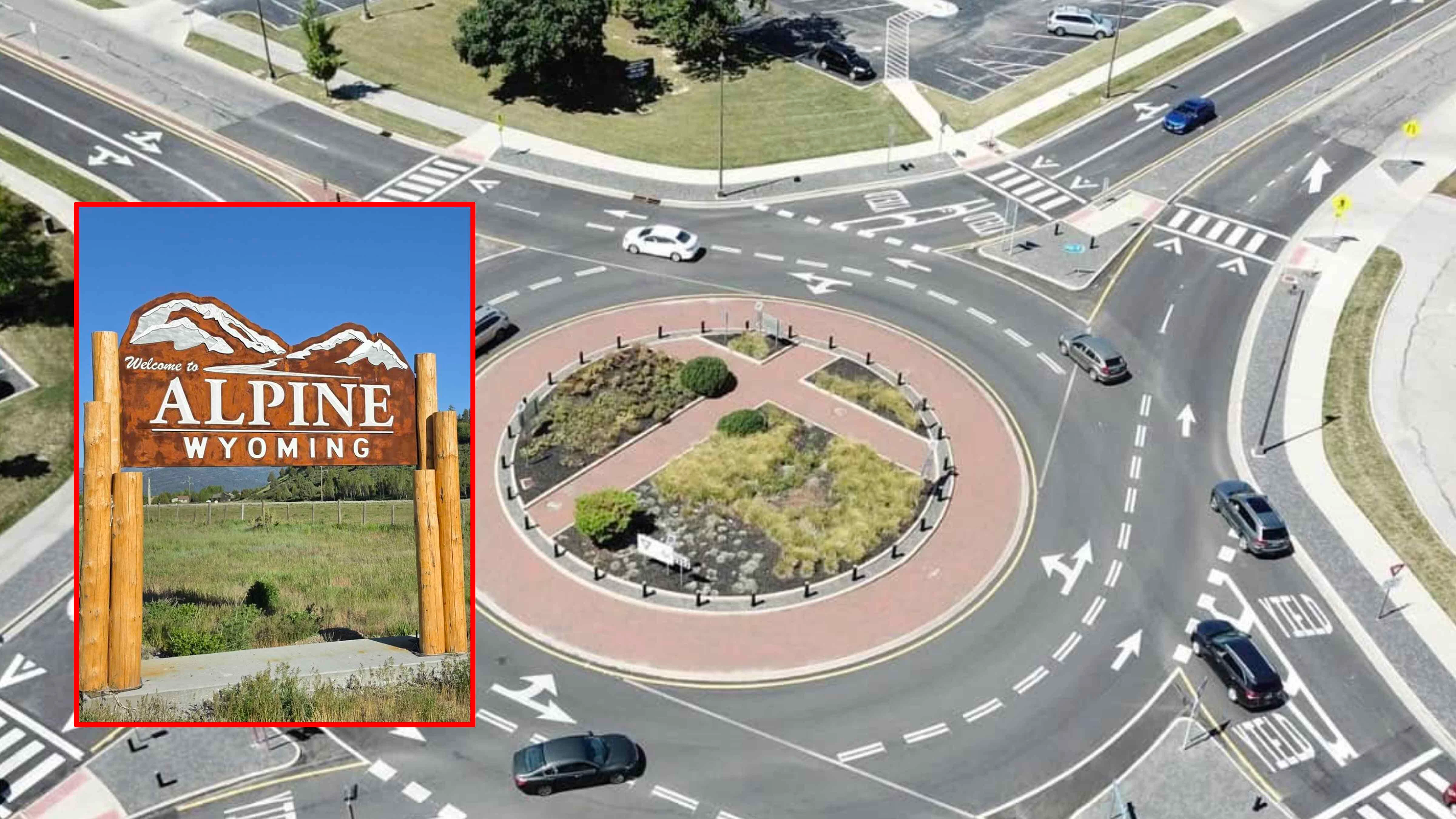
The Town of Alpine is testing the potential of a traffic roundabout with a 22-day temporary demonstration, and as much vitriol is going around it as vehicles.
A temporary roundabout at the intersection of Greys River Road and U.S. Highway 89 opened Sept. 22. It will remain until Oct. 14, when crews remove the plastic bollards and pavement markings, and traffic returns to normal.
By the end of the demonstration, city officials will have plenty of information on the effectiveness of a roundabout for the growing community.
They’ve already gotten plenty of community feedback, and it’s been less than enthusiastic.
“Stupid is as stupid does,” an Alpine resident who goes by the handle “Gilligan Jackwagon” told Cowboy State Daily. “For all those claiming they ‘work everywhere else,’ please tell me how many of them do not have skid marks across them.”
Eric Green, mayor of Alpine, anticipated some blowback.
Not this much.
“I have to admit I never thought that people would show so much negativity toward roundabouts in general,” he said. “I hope that people are patient with this process and give us their real feedback after the three weeks it’s there, not the first 24 hours.”
Slower For A Grower
When Green ran for mayor, one of his campaign promises was to slow down traffic in Alpine.
“That was laughed at,” he said. “Previous administrations had talked to WYDOT and always said there's no way you're going to be able to slow traffic below 35 miles an hour in town.”
This temporary roundabout demonstration is more than fulfilling a promise for Green. It’s about finding a solution that makes sense for a growing community.
“Alpine is one of the fastest-growing towns in Wyoming,” he said. “The sign says 1,220 people, but the current census is around 1,360 people, so we’re growing very fast.”
Greys River Road, which runs through Alpine, is the busiest access corridor for Bridger-Teton National Forest. Thousands of vehicles turn off Highway 89 and onto the road year-round.
This has created a problem with traffic speed, Green said. City officials and the Wyoming Department of Transportation (WYDOT) have known about it for years.
“After working with WYDOT for a few years, it became apparent that we would have to do something to facilitate lowering the speed limit,” Green said. “We received a federal Safe Streets and Roads for All grant to develop a Transportation Safety Action Plan.”
With a $300,000 federal grant and another matching grant, city officials hired Kimley-Horn, a planning, surveying, engineering, and design consulting firm, to present three traffic options to study.
Of those, the roundabout stood out. And they had just the spot to test its effectiveness.
A Rough Start
The roundabout demonstration didn’t get off to a good start. Even Green acknowledged that.
“We had one day with the contractor to install the temporary roundabout, and they fought Mother Nature all day long,” he said. “They had to remove the old striping and put new striping down for the demonstration project, and they can't paint the road when it's raining.”
Because of the wet weather, the striping was delayed for three hours. Crews were still flagging traffic at 6:30 p.m., in the thick of the evening commute.
“There were people who were very frustrated, but it was essential for the project to get installed on that one particular day,” Green said. “It would have cost us more money to bring them back a second day.”
That experience further soured people already hostile to the idea of a roundabout, and Green understood that.
“I totally understand their frustration, and I apologize that that happened,” he said.
The intersection was large enough for the temporary demonstration, and it’s the ideal location for a potential future roundabout. However, an actual roundabout would need to be much larger.
Since the demonstration began, one of the primary complaints has been about the roundabout's small size. Green acknowledged that shortcoming as well.
“A permanent roundabout would be much larger,” he said. “This one is definitely small, but the only way to test a roundabout was to put one in the current three-lane highway.”
Immediate Results
The main goal is to get data on how much a roundabout slows traffic. From what Green can see, that’s already happening.
“I can definitively tell that the demonstration project is already working, because traffic is slowing down to 15 miles an hour just to get around the roundabout,” he said. “The only way that WYDOT would be open to reducing the speed limit (through Alpine) is by putting in something like this.”
According to Green, WYDOT hasn’t changed the speed limit on Highway 89 because there wasn’t enough “traffic friction” to justify it.
“They told previous administrations there was no way to slow traffic below 35 miles per hour in town because, as they claimed, there aren't enough cars, trees, park benches, and things of that nature on the side of the road,” he said.
To justify a lower speed limit, Alpine would need something like a roundabout. That added further impetus to the demonstration.
A week after it began, vehicles were already slowing to 15 mph as they navigated the roundabout, Green said.
That’s vindicating.
“It's the best of both worlds,” he said. “We can get a lower speed limit through Alpine, and we have new infrastructure that makes it so cars have to slow down.”
But that doesn’t mean it’s been popular.
Curt Comments
Green anticipated some pushback. He didn’t expect the intense wave of vitriol he and other city officials have heard about it.
“There’s been a ton of comments,” he said. “Things like, ‘Roundabouts are stupid, this is the dumbest thing I’ve ever heard, whoever the idiots were that planned this need to get voted out of office.’ Things of that nature.”
The irony for Green, as one of those “idiots” who should be voted out of office, is that he got elected on a pledge to slow down traffic in Alpine.
Some critics say a better option would be to install a traffic signal at the intersection. Green said that has been a non-starter.
"If you talk to traffic engineers or WYDOT, they would much rather install a roundabout than a traffic light," he said. "They've told me they're safer and that they keep traffic moving. A traffic signal wouldn't make sense."
Jeremy Larsen, who's running to be Alpine's next mayor, seemed broadly supportive of the roundabout. He noted the public's opinion when he stopped by.
"I was down at the roundabout Friday morning observing traffic, pedestrians, and how people are using the temporary configuration," he wrote. "While I was there, I had people give me a middle finger, and I had others give me a thumbs-up and say thank you. That's Alpine."
Larsen concluded that the roundabout demonstration "wasn't perfect," but that a test of its effectiveness was warranted.
"This is a test," he wrote. "This is only a test."
Some residents see what the City of Alpine and WYDOT are trying to accomplish. Alpine resident Sadie Kinslow has used the roundabout multiple times since the demonstration started and felt it “worked well.”
“I think it's just fine, and I am thankful they are trying to improve traffic situations in the area,” she said. “Getting off the Greys River Road to the main road can be such a struggle sometimes, especially during rush hours. I'm excited to see how it helps those coming off that road.”
One of the most prominent criticisms is that the roundabout is too small for semi-trucks and people hauling trailers. Kinslow said she believes “that can be figured out.”
More importantly, Kinslow hates how the 22-day demonstration has stirred up so much negativity.
“I am shocked by how much hate and discontent it has stirred up in the community,” she said. “We drove through it Wednesday and Thursday, and it flowed through just as it should and worked well. I'm honestly excited for improvements to travel.”
Bigger, Better, More Expensive
Alpine’s roundabout demonstration will end Oct. 14. By then, city officials and WYDOT will have plenty of data to analyze as they decide whether a permanent roundabout would benefit Alpine.
Green said a permanent roundabout is still a long way off, assuming it’s approved. If it is, it will be larger and more expensive than the demonstration.
“This is only a study,” he said. “If this proves to be successful and we find the money to implement a permanent roundabout there in the coming years, it would be similar to the roundabout that's at Hoback Junction, south of Jackson.”
The Hoback Junction roundabout opened in August 2012. Aside from a few significant issues, such as a flipped semi-truck in 2024, the roundabout has had no major problems, Green said.
He said the roundabout will make Alpine safer for vehicles and pedestrians. And because the right-of-way through Alpine is 200 feet wide, there’s enough space for “a very large roundabout.”
“Any-size vehicle would be able to navigate it just fine,” he said.
That said, Green doesn’t expect the naysayers to warm to the concept over 22 days. This is one instance where hard data will speak louder than public opinion.
“As elected officials, we have to do what's best for the community that we represent,” he said. “If the data shows that this is going to reduce the speed limit and make the road safer, then it's something that we must take seriously. We will see if this is something that we want to pursue in the future.”
Andrew Rossi can be reached at arossi@cowboystatedaily.com.


