
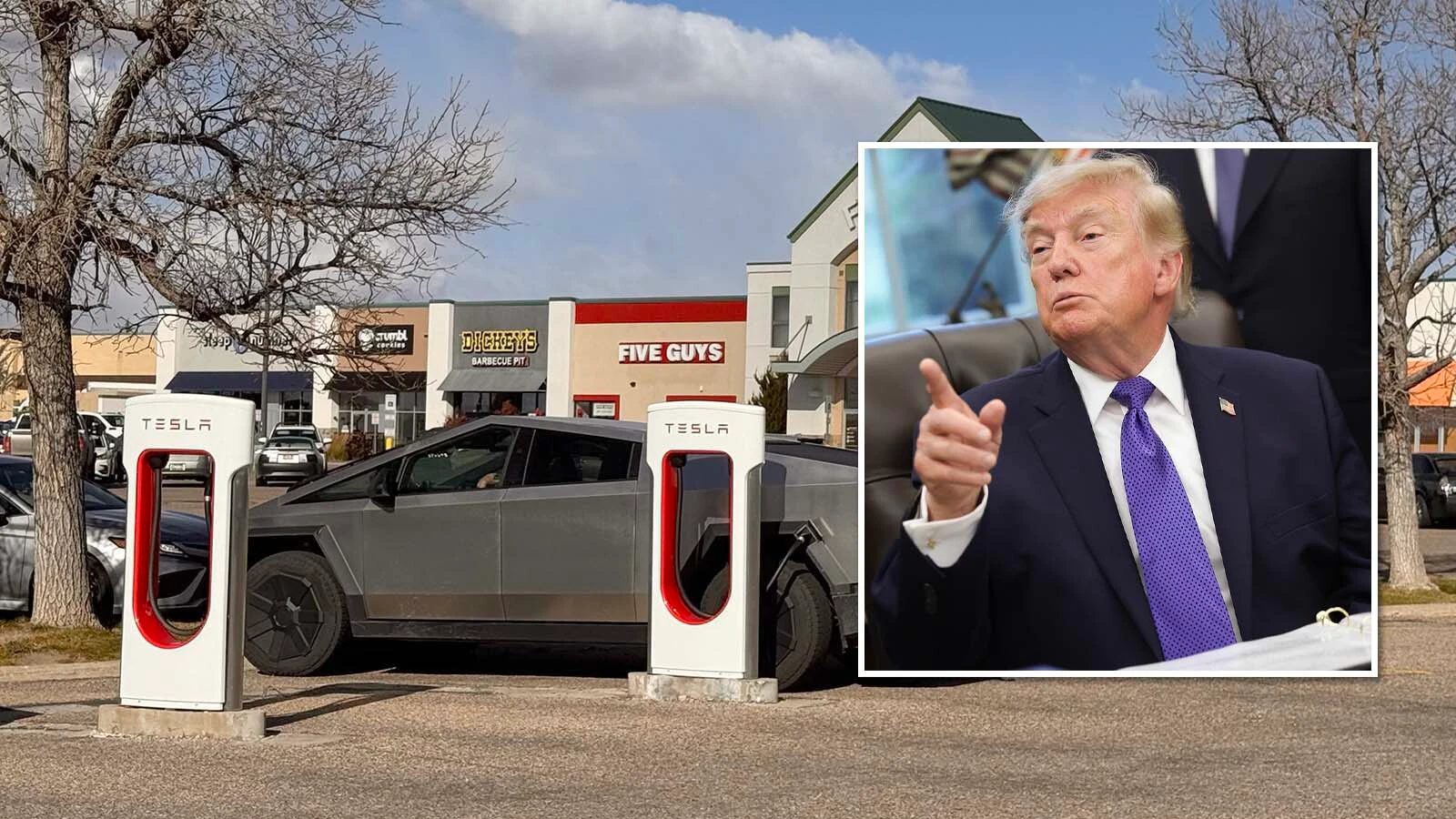
As Wyoming moves to finally spend nearly $18 million in Biden-era federal money to build fast-charging EV stations, the Trump administration is making clear that it wants the country to move the other way.
A day after the Wyoming Department of Transportation announced that — after years of delays — the state is ready to expand EV charging across the state’s interstates, President Donald Trump took to Truth Social on Saturday.
Trump announced on his social media platform that he'd approved new fuel economy standards, calling them the end of the Biden-era EV policy.
“The Dumocrats cost our Great Auto Manufacturers $Billions, forced Americans into cars they never wanted, and wasted Billions on Chargers that were never built,” Trump wrote.
On Monday, the U.S. Department of Transportation finalized the fuel economy standards Trump had announced.
The administration argues that the Biden-era standards were set so high that automakers had to sell more electric vehicles just to comply, calling it a "backdoor" EV mandate.
Doug McGee, WYDOT’s public affairs officer, told Cowboy State Daily the federal shift doesn’t change anything for Wyoming’s plans to use that money.
“Those funds were authorized by Congress,” McGee said. “We will proceed until we're notified otherwise by the (Federal Highway Administration).”
On, Then Off, Now On
After pausing Wyoming efforts to establish a fast-charging network, a leadership shakeup and years of drafting, WYDOT is finally ready to move ahead with using the $17.9 million in federal money it has.
The money comes from the National Electric Vehicle Infrastructure program that allocated money to every state.
Wyoming’s program hit a snag in 2023 after its top transportation official retired and a contractor who helped build the effort left amid worries the state could get stuck with a massive bill if unprofitable stations were abandoned.
WYDOT restarted the effort that December, but was still working with a consultant to draft a request for proposals — aka bids from companies to do the network — in 2024.
That spring, the agency also said it did not expect to apply for another $1.3 billion in federal charging grants, a separate pot of money, because the state had only about 800 registered electric vehicles and little need for a network larger than its 44 existing fast-charging stations.
Rep. Mike Yin, D-Jackson, told Cowboy State Daily on Monday that expanding the state’s EV charging infrastructure isn’t just about Wyoming’s EV owners.
“It's making sure that everyone in the United States can get around Wyoming,” Yin said. “Tourism is our second-biggest economy.”
EVs And Tourism
Yin, who founded OtterSpace LLC, a company that runs charging stations for travelers in Pinedale, Lander and Dubois, raised that exact problem with WYDOT in 2024.
In comments to the agency, he urged more flexibility so stations could be placed where electric-vehicle traffic actually is, including the tourism corridors leading to Yellowstone and Grand Teton national parks.
"There were very stringent distance requirements that made it hard to actually cover Wyoming in a way that made sense for the ways that Wyoming is driven through,” Yin said.
“People don't just drive through our interstates. They drive across all of the roads in Wyoming,” he added.
Now, Yin said the request for proposals addresses that concern, thanks to a change in federal rules last year.
In August 2025, the U.S. Department of Transportation dropped the requirements that stations be no more than 50 miles apart and no more than a mile from a highway exit, freeing Wyoming to spend money beyond its interstates.
WYDOT's request for proposals takes advantage of those looser guidelines, expanding the allowable distance to three miles from an exit.
That enables companies to bid on sites deeper within host cities and along rural highways rather than strictly right off interstates.
“We think these strategic clusters will help alleviate EV driver range anxiety in rural areas,” WYDOT chief engineer Keith Fulton said in a statement.
Yin called the change an improvement, but said getting chargers into the national parks, where many of Wyoming's visitors are headed, will still be a challenge.
“Building in the national parks is super difficult,” he said. “It's difficult for good reason, but I do think that, even with this grant funding, they're likely going to be one of the last places to see EV chargers built out, just because of how difficult it is to build electrical infrastructure into the park.”
Funding Reduction
Wyoming's original share of the federal funding was about $26.8 million, but now about $17.9 million remains, McGee said.
Most of the difference, McGee said, is due to the 2026 Consolidated Appropriations Act cutting funding for about 30 states, including Wyoming.
A much smaller amount has been spent on consultants to put together the request for proposals, he added.
“We’ve only spent a couple hundred thousand or so on consultant work to get us where we are,” McGee said, adding that the state’s slow pace to this point has been intentional.
"Our strategy has not changed since the beginning, which is to be cautious, slow, and with a heavy reliance on private industry," he said.
The state won't build the chargers itself.
Instead, WYDOT passes the money along as grants to private companies, which put up 20% of the cost and both own and run the stations.
‘Consistency In The Law’
As WYDOT issues a request for proposals (RFPs), companies weighing bids also will be working under a new tax on EV charging, one that Yin pushed through the Legislature this year.
Under House Bill 145, which took effect July 1, Wyoming taxes only fast chargers, like the ones the state wants built, at a flat 3.5 cents per kilowatt-hour.
The charging tax no longer applies to slower chargers, electricity sold at fast chargers is exempt from sales tax, and the annual registration fee for all-electric vehicles drops from $200 to $100.
Before that, WYDOT had begun enforcing a state law last October that taxed station owners about 24 cents per gallon-equivalent of electricity, plus a $25 annual license and monthly reports. Wyoming EV owners also paid a separate $200 annual registration fee.
Yin said the new law's main benefit is clarity.
"It provides consistency in the law,” Yin said. “So, people know what the costs are going to be to operate a charger and what that profitability is.”
The old rules had already cost one Wyoming city a charger.
When WYDOT began collecting the tax last October, Yin predicted some owners would pull their chargers instead of paying.
By February, Rock Springs had done just that, removing a free downtown charger after WYDOT said the city owed tax on electricity it gave away and the unit couldn't measure how much that was.
Under the new law, fast chargers must be metered, so owners of the new stations will know their tax rate up front.
Yin said OtterSpace plans to bid, and if it wins funding, the money would likely go toward backup equipment at his existing stations and one or two new hires in Wyoming to help maintain them.
“None of my stations have used taxpayer funds yet,” Yin said. “But my preference is to be a local partner rather than have a national group swoop in to take the money.”
Emma Jane Jackson can be reached at emma@cowboystatedaily.com.


