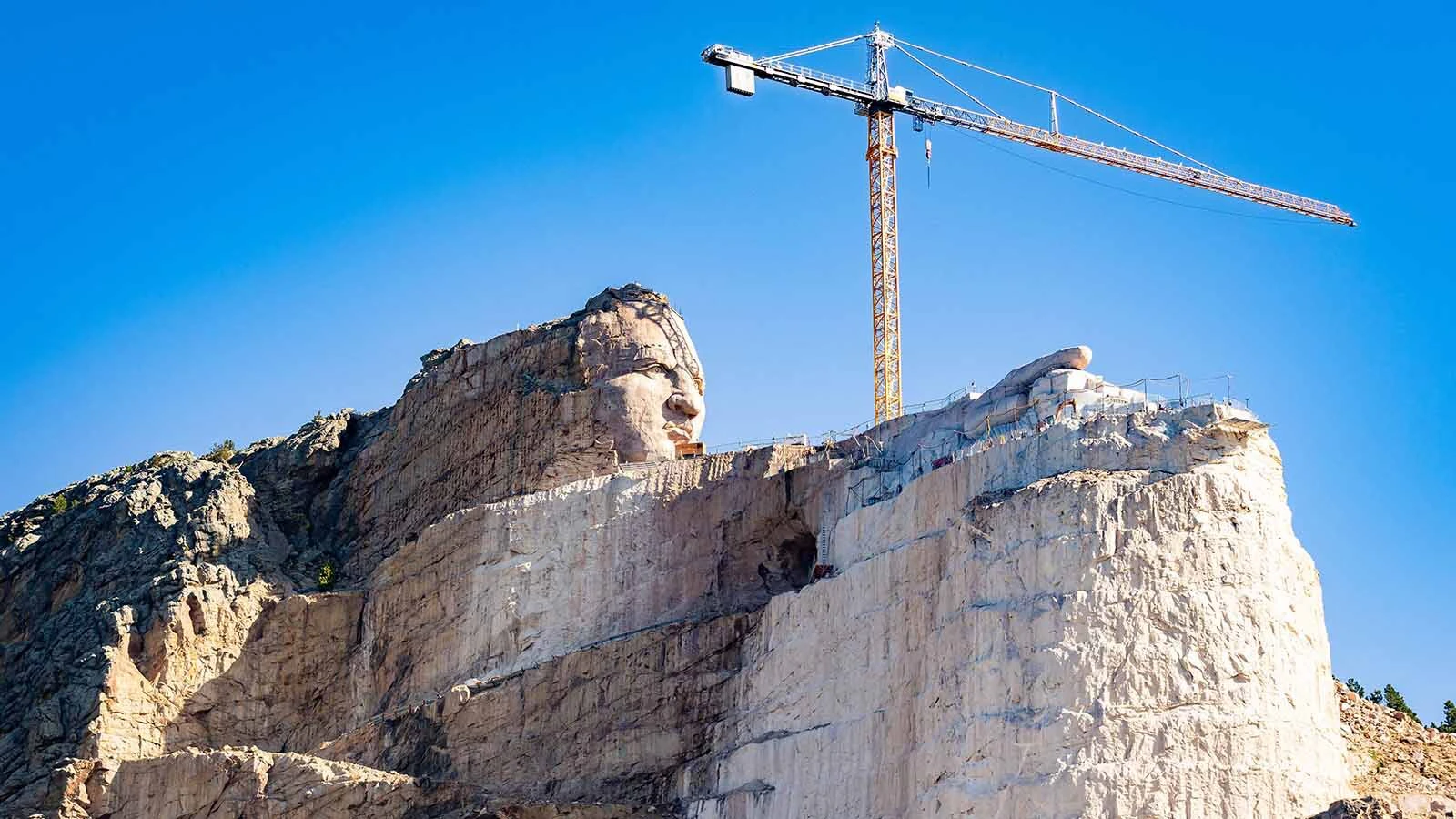
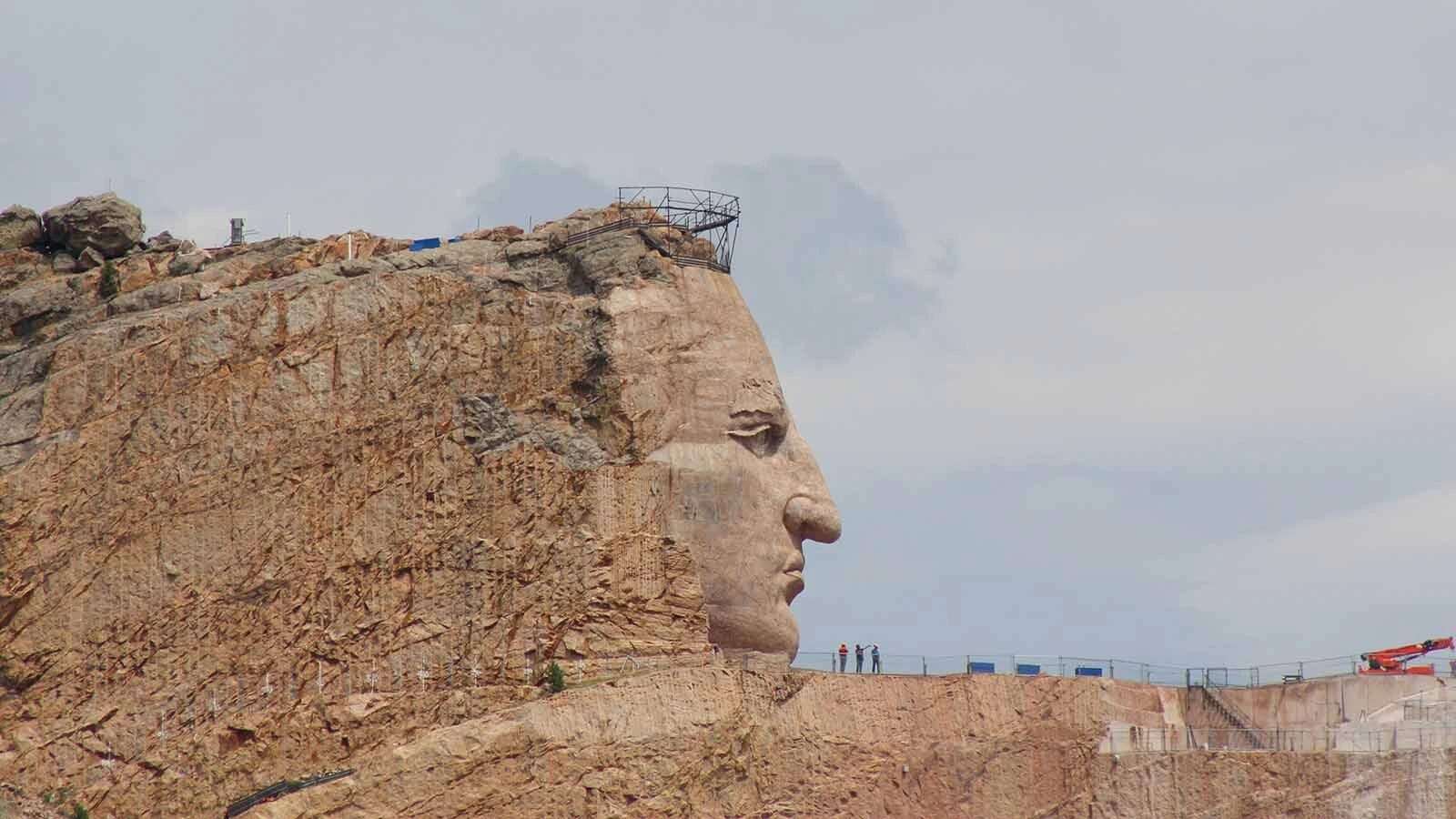
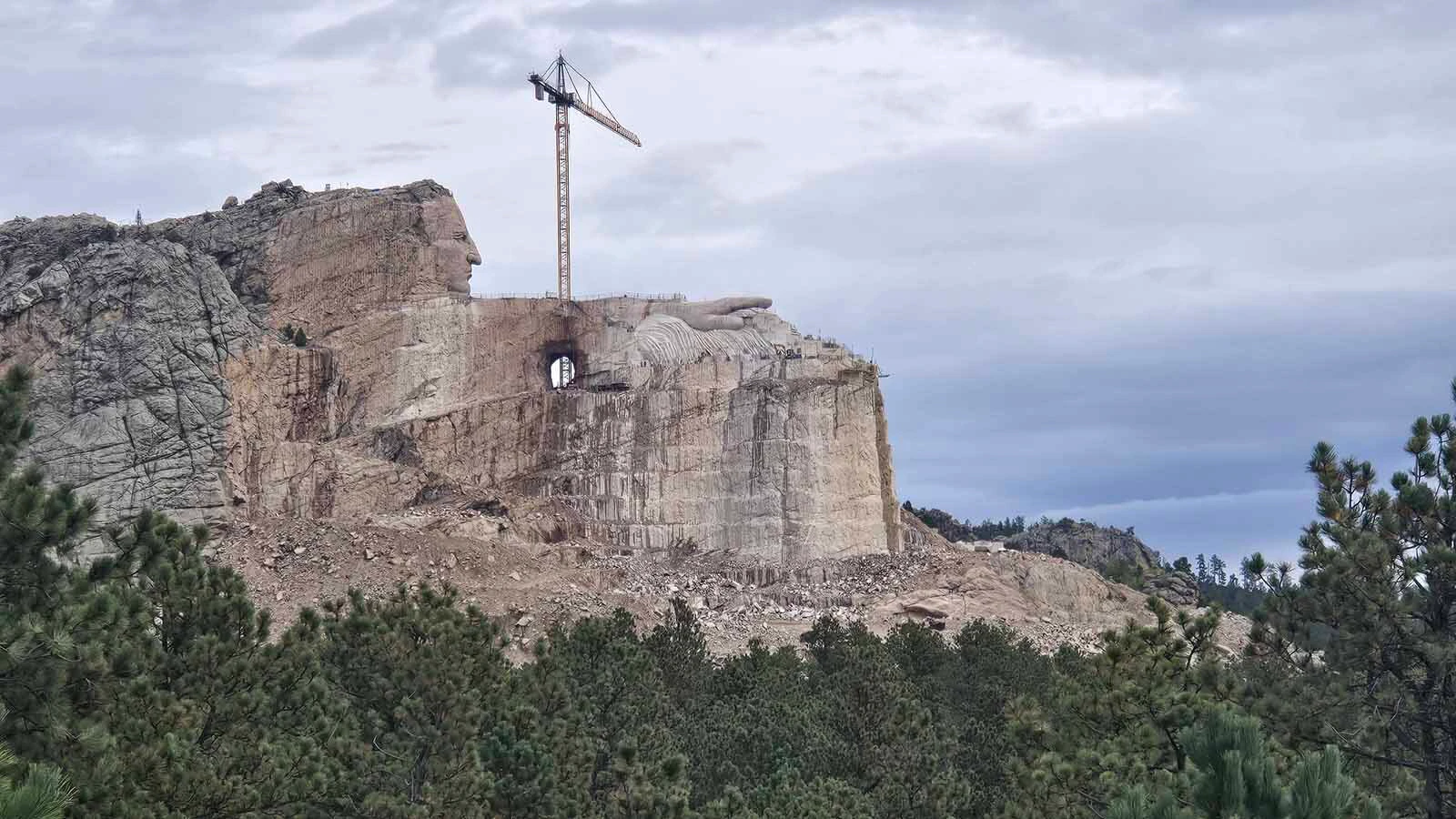
The face in the mountain is 87 feet tall.
The arm stretching across the granite is 243 feet long, ending in a nearly 30-foot-long pointing finger.
The horse’s head, still emerging from the mountain, will stand 219 feet high.
And after nearly 80 years of blasting, drilling, carving and hauling untold tons of granite off a Black Hills mountainside, the Crazy Horse Memorial south of Hill City, South Dakota, still isn’t finished.
Which leads to the question everybody asks:
“When is it going to be done?”
If the monument's original sculptor Korczak Ziolkowski were still around, he might answer the way he did during his lifetime.
“Maybe it’ll take a hundred years," he said. "What difference does it make? Isn’t time relative? One minute, one hour, one year?”
On a Wednesday morning in September, the air is cool and low clouds hang over the Black Hills.
South of Hill City, roughly 40 miles east of the Wyoming border, the four-lane highway winds through the hills before the landscape opens.
And suddenly, there it is.
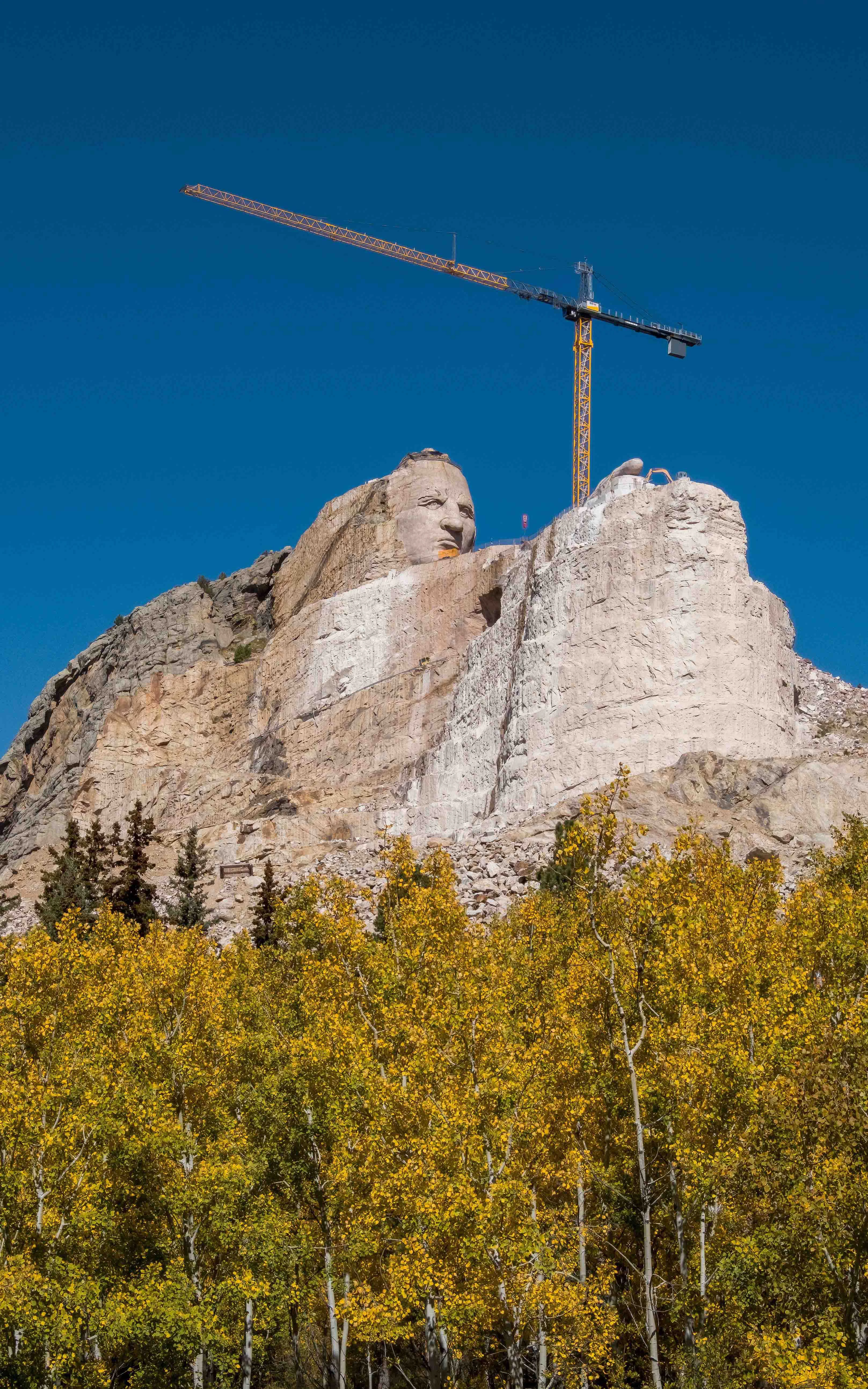
High above the trees, gleaming white against the darker granite, is the unmistakable face of Crazy Horse.
It is enormous.
That might be the first lesson of Crazy Horse Memorial: Everything here is bigger than you think.
The carving itself is larger than nearby Mount Rushmore, with the American Indian’s head outsizing the 60-foot-tall heads of its presidential neighbors.
But the mountain is only one piece of an even larger undertaking — one that began not simply with the idea of carving a man into stone, but with a fear that if it didn’t happen an entire culture and its stories could disappear.
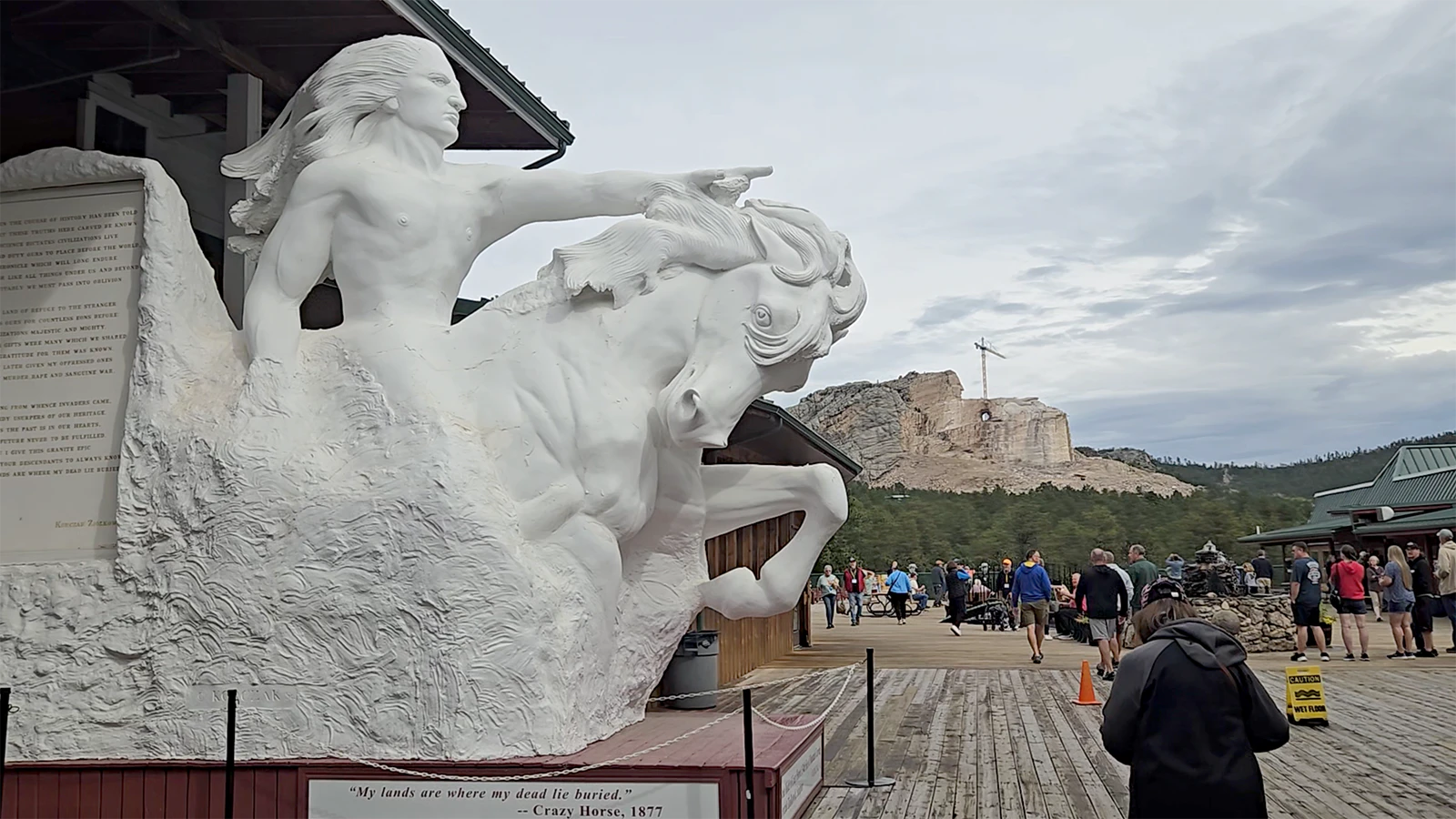
After 80 years, the Crazy Horse Memorial continues to emerge from Thunderhead Mountain in the Black Hills of South Dakota. (Kate Meadows, Cowboy State Daily) 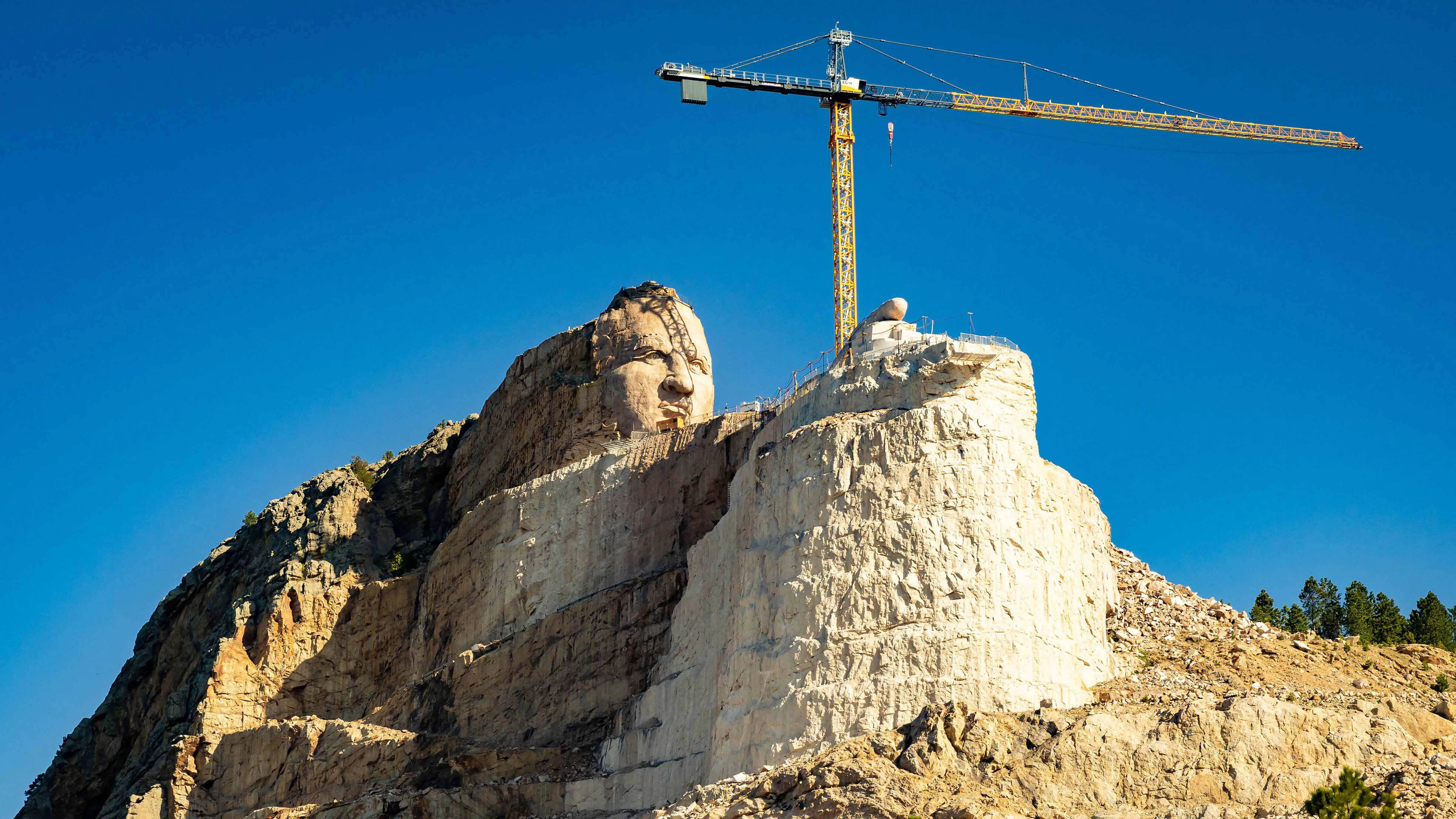
Close up view of Crazy Horse Memorial under construction at sunrise in South Dakota (Alamy) 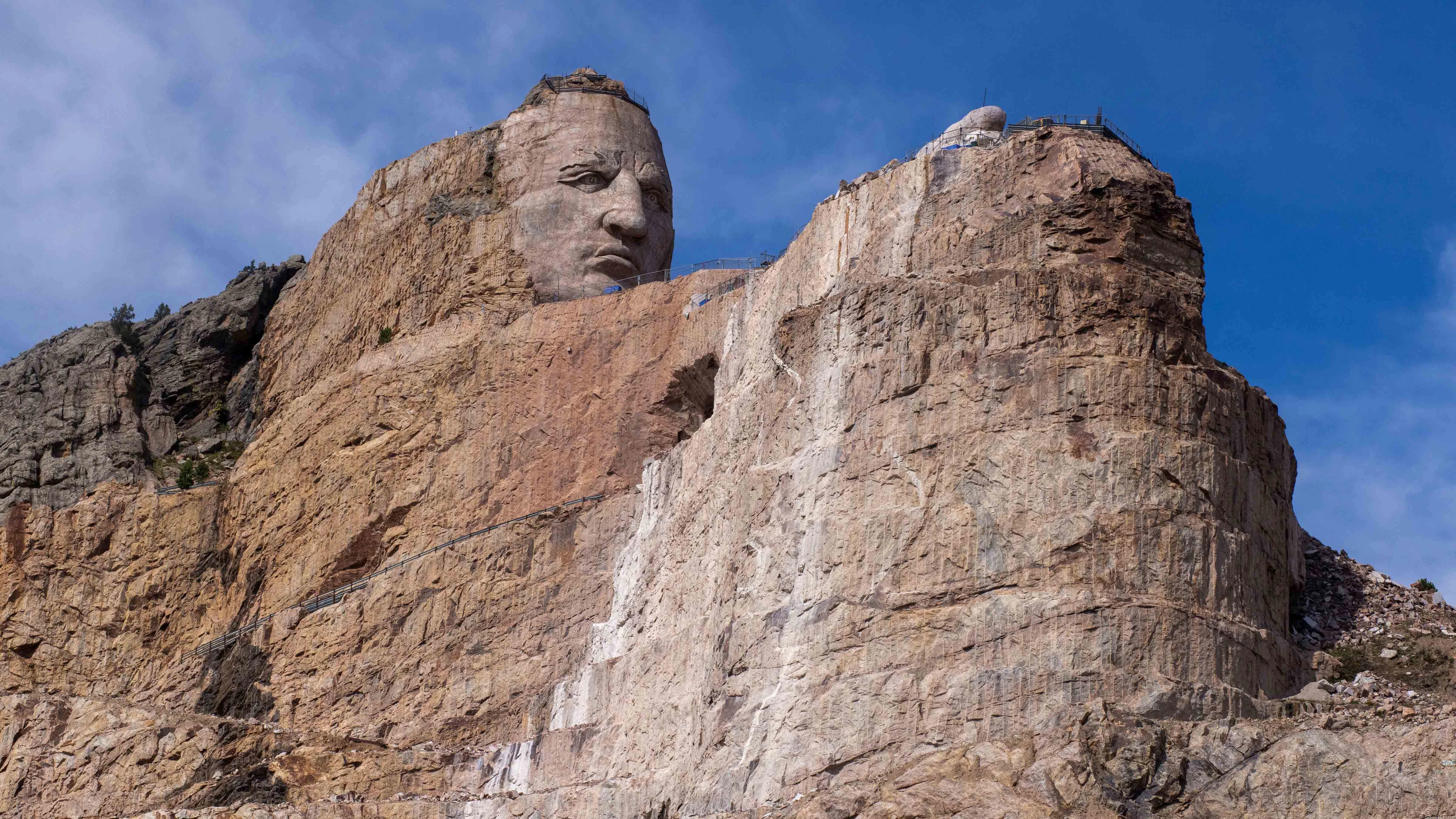
The first lesson of Crazy Horse Memorial: Everything here is bigger than you think. The carving itself is larger than nearby Mount Rushmore, with the American Indian’s head outsizing the 60-foot-tall heads of its presidential neighbors. (Tim Clark, Alamy) 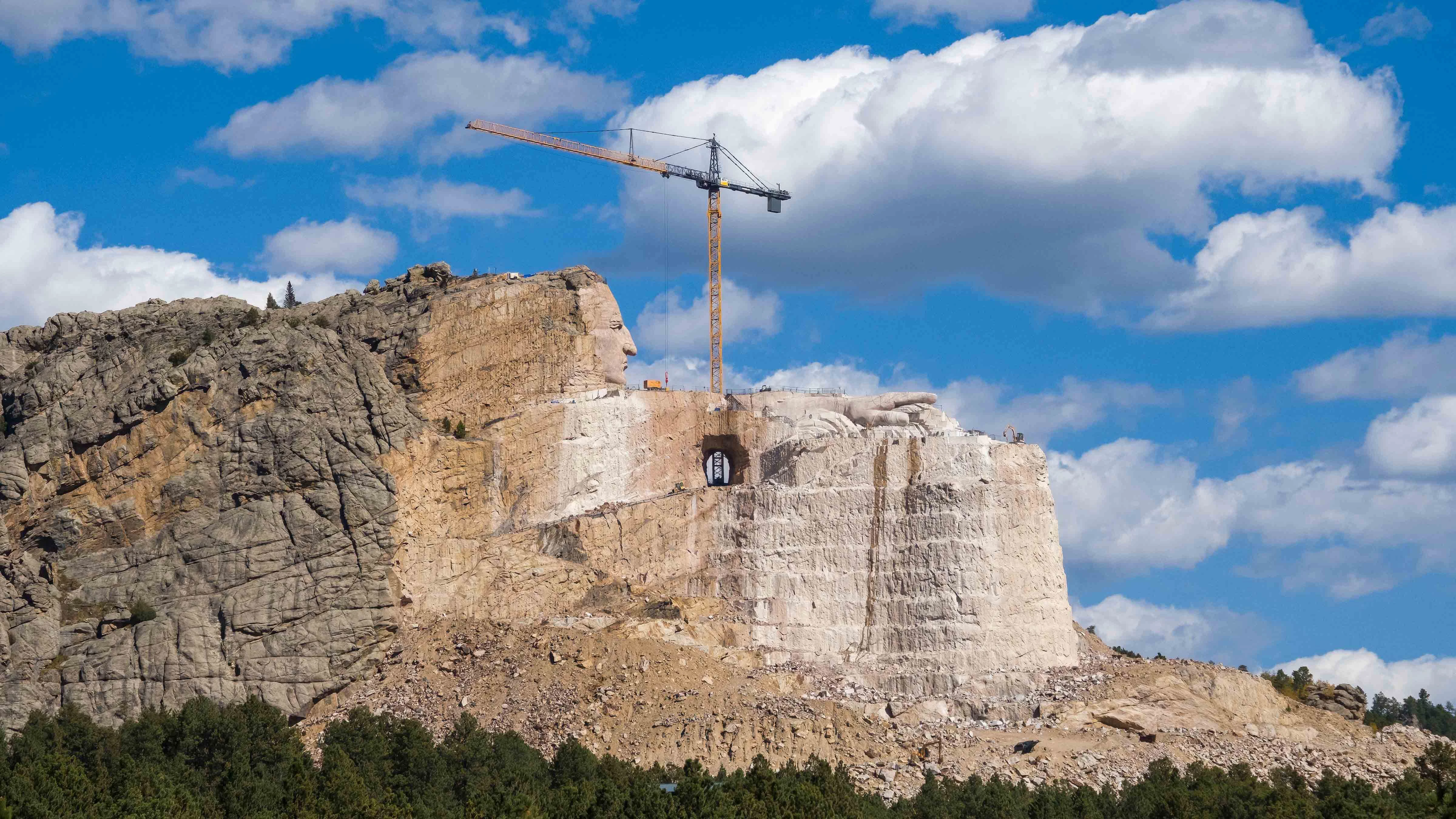
The face in the mountain is 87 feet tall. The arm stretching across the granite is 243 feet long, ending in a nearly 30-foot-long pointing finger. The horse’s head, still emerging from the mountain, will stand 219 feet high. (David DesRochers, Alamy)
A Man Of Mystery
Crazy Horse remains one of the most recognizable names in American history and, at the same time, one of its more mysterious figures.
Born around 1840 near Rapid Creek, he grew up in the traditional Lakota way and was originally known as Curly.
He was different from other children, said Whitney Rencountre, executive director of the Crazy Horse Memorial Foundation.
His hair and complexion were lighter. He was picked on. Rather than spending all his time with other children, he often wandered alone in nature and spent time around elders.
In some ways, Rencountre said, that forced him to grow up early.
And eventually the boy who didn't quite fit in became one of the Lakota's best-known warriors.
Crazy Horse played prominent roles in battles, including the Fetterman Fight in northern Wyoming, near the modern towns of Story and Banner, and the Battle of the Little Bighorn. While he was instrumental in the death of Lt. Col. George Armstrong Custer – after whom the town nearest to the Crazy Horse memorial is named – history does not record who fired the fatal shot.
The name, Crazy Horse, is sometimes misunderstood. Rencountre said the Lakota word translated into English as “crazy” carries a meaning closer to “fearless,” while the name more directly translates to “His Horse Is Crazy.”
Even Crazy Horse’s death remains wrapped in mystery.
He died in 1877 at Fort Robinson in Nebraska after being stabbed with a bayonet during a struggle while being taken into custody.
Where he was buried remains a secret.
There is another reason so much about Crazy Horse can be difficult to pin down.
For generations, Lakota history wasn't kept in libraries or filing cabinets.
It lived in people.
“Our culture and history, we didn’t have paper and documents,” Rencountre said. “So much is oral.”
Among the historical records were winter counts – buffalo hides on which a symbol representing the most important event of each year was painted. Stories were passed from elders to children, generation after generation.
“They would sit down often with the children and the community and tell stories,” Rencountre said.
Trying to understand the man Crazy Horse, then, becomes something of a metaphor for trying to understand his culture.
You have to listen.
A Cousin's Dream
Chief Henry Standing Bear understood what was at stake.
A first cousin of Crazy Horse and an interpreter for the Oglala Lakota people, Standing Bear watched as American Indians were driven from ancestral lands and traditional ways of life were threatened.
He feared their cultures could eventually be forgotten.
He dreamed of something audacious: Carve a mountain as a way to preserve history and educate people from all walks of life.
The man on that mountain would be Crazy Horse, but the memorial would stand for something larger – the Indigenous people and cultures of North America.
Standing Bear began looking for someone capable of doing it.
He eventually read about a Polish-American sculptor from Boston named Korczak Ziolkowski, whose sculpture of Polish pianist and statesman Ignacy Jan Paderewski won first prize at the 1939 World's Fair.
Ziolkowski had also worked briefly on Mount Rushmore.
Standing Bear wrote to him. Would he come to the Black Hills and carve a mountain?
Ziolkowski had served during World War II and had opportunities to remain in Europe carving war memorials.
Instead, the more he learned about Standing Bear's vision and the history of American Indians, the more compelling the invitation became.
“A little Polish boy from Boston?” Ziolkowski later said in footage now shown at the memorial's visitor center. “What an honor.”
There was some disagreement about where that honor should unfold.
Ziolkowski favored the mountains of Wyoming.
Standing Bear insisted on the Black Hills, because it was the homeland of his people.
Ultimately, the Black Hills won. The men settled on a colossal granite mountain – a chunk of rock big enough to accommodate the massive full-figure carving of a warrior on a horse they envisioned.
Ziolkowski would name it Thunderhead Mountain.
There was just one problem.
Neither man had money.
Rencountre tells the story this way: “Korczak showed up. He said, ‘I’m here. I don’t have any resources. Can you help me?’
Standing Bear said, ‘I don’t have any resources either. This is a dream. This is a vision.”
As it turns out, that was enough to get started.
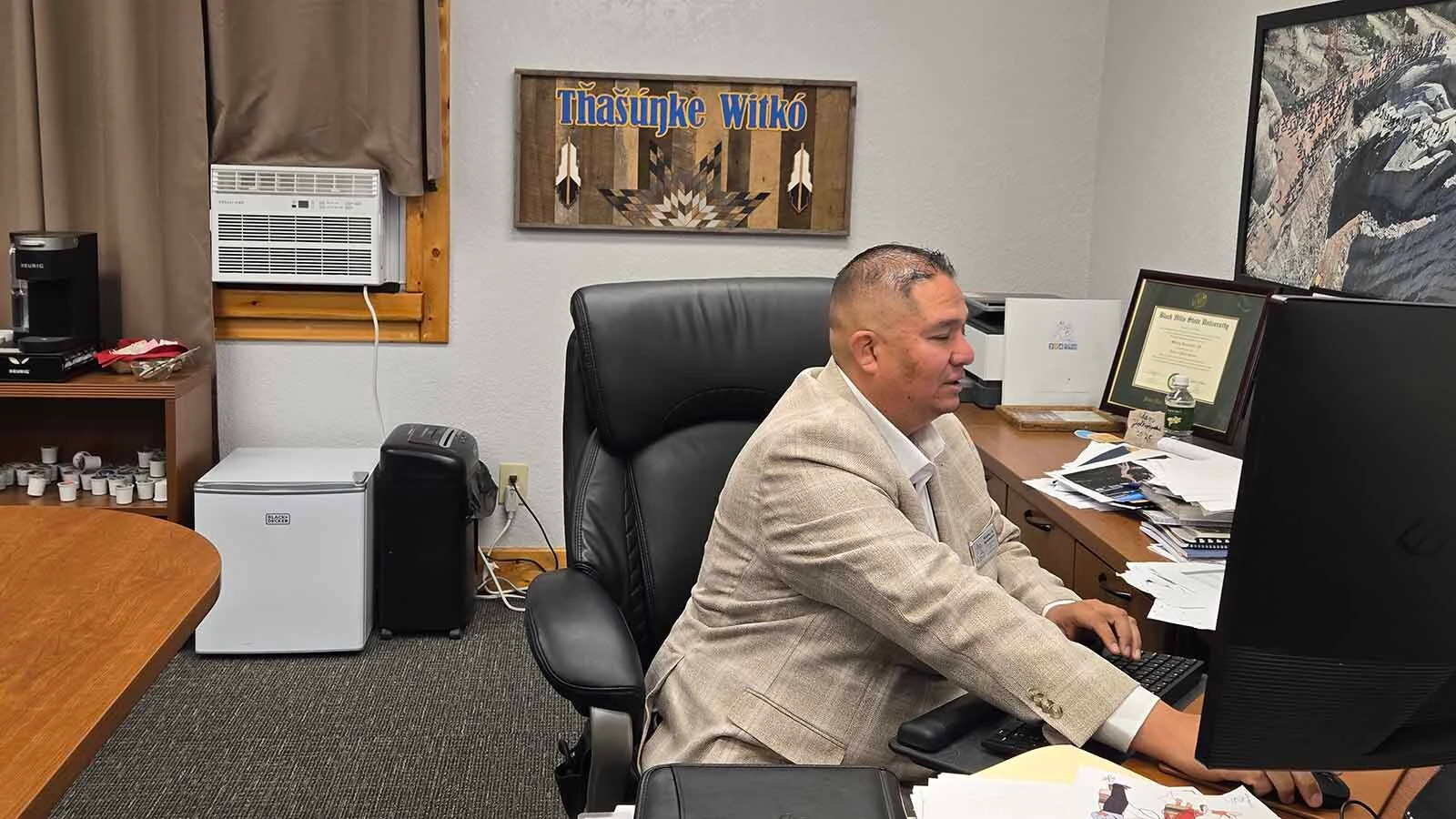
Whitney Rencountre works in front of a sign bearing the name Crazy Horse in Lakota. (Kate Meadows, Cowboy State Daily) 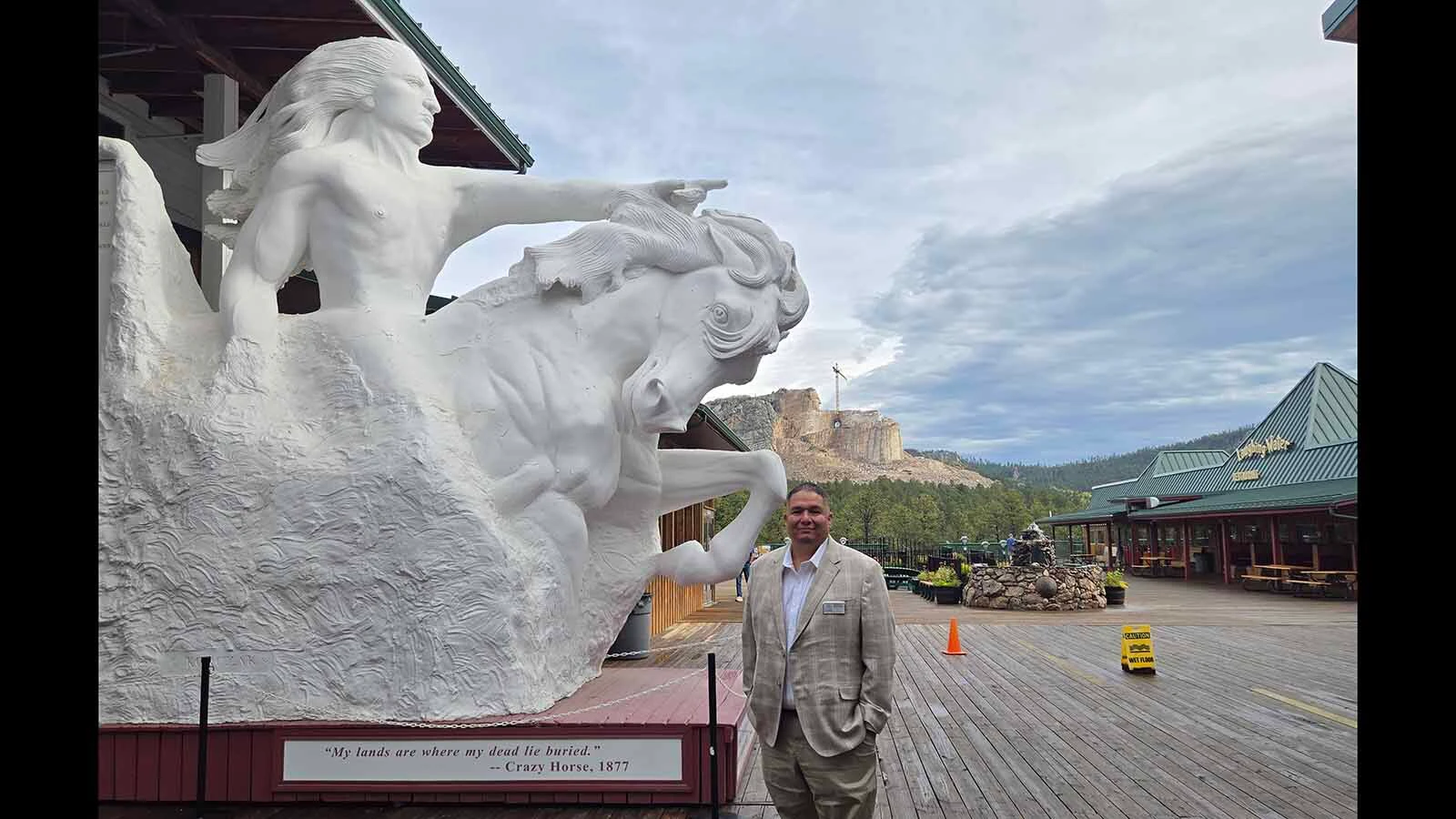
Whitney Rencountre in front of a finished model showing what the mountain carving will look like. (Kate Meadows, Cowboy State Daily)
A Man, A Mountain, A Lot Of Stairs
By May 1947, Ziolkowski was living in a tent at the base of the mountain on the Black Hills National Forest.
To acquire the land, Standing Bear offered 900 acres of tribal land to the U.S. government.
Ziolowski then used his own money to purchase Thunderhead Mountain and adjacent property.
Before he could sculpt it, he had to figure out how to get up it.
He built roads, operated a lumber mill and dairy farm to help support the work and constructed more than 700 steps to reach the carving area.
Then he started climbing them.
In old footage shown at the visitor center, Ziolkowski describes carrying a 50-pound box of dynamite on his shoulder with drilling bits hanging around his neck as he climbed 741 steps toward the blast site.
There were no specialized mountain-carving tools waiting for him.
In many ways, there still aren't.
Crews have adapted equipment and created their own solutions over the decades, sometimes working while suspended from the mountainside.
The first blast took place June 3, 1948. Chief Frank Fools Crow offered prayers. Five survivors of the Battle of the Little Bighorn attended, along with Native American elders and then-South Dakota Gov. George Mickelson.
Standing Bear would live only five more years.
He had known from the beginning that he would never see the memorial completed.
Ziolkowski wouldn't either. He died in Sturgis in 1982 at age 74.
But that didn't stop either of them.
Ziolkowski eventually passed that same philosophy to his 10 children with a family motto:
“Strong backs, good minds and believe in living for other people.”
Today, his grandson Caleb Ziolkowski serves as mountain carving director, carrying into a third generation a project begun by two men who knew they were starting something they could not possibly finish themselves.
‘By The People’
There was another principle Standing Bear and Ziolkowski considered nonnegotiable.
They would accept no federal money.
The decision was rooted in the history between the federal government and tribes, Rencountre said.
“They felt like this project had to be by the people,” he said.
Ziolkowski twice rejected federal offers of $10 million, according to the memorial. Over the decades, the foundation has continued to rely on admission fees and private donations, on which work on the mountain is contingent.
More than $250 million in private funds have gone into the project, Rencountre said.
That means the speed of the carving depends heavily on how much money comes in.
Lately, progress has accelerated.
Crazy Horse's face took a decade to carve, from 1988 to 1998.
His left hand was completed in 2024 after roughly a year of concentrated carving work.
Visitors can now begin to see the horse’s mane and ear emerging from the granite.
If funding and the current pace continue, Rencountre said the right one-third of the mountain — including the hand resting on the horse's mane, the horse's head and part of its leg — could be completed in roughly 10 years.
The center portion could take another 15 or 16.
Put everything together and perhaps the answer to that inevitable question is another 30 or 40 years.
Perhaps.
But the project has never operated according to a tidy construction schedule.
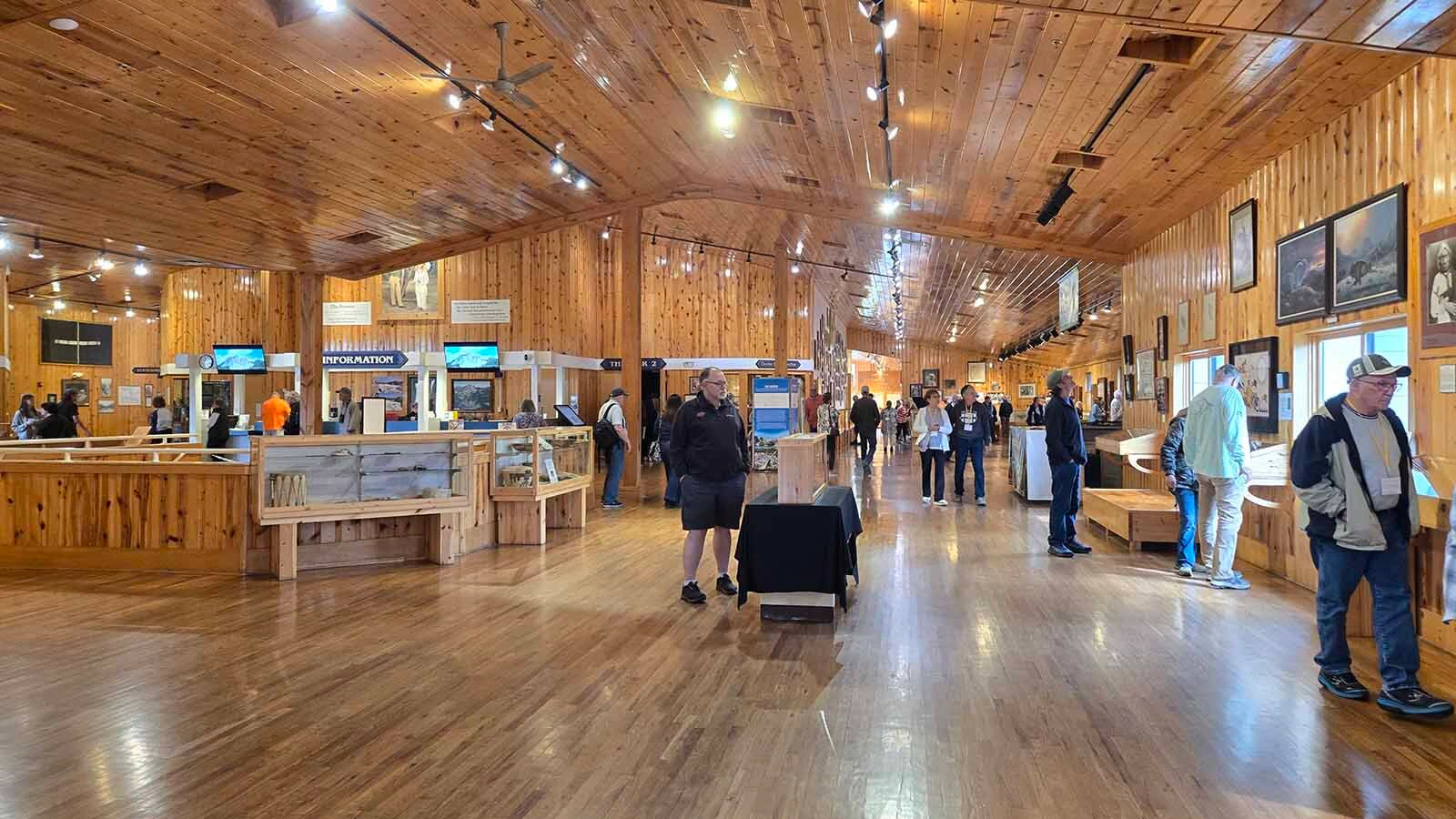
The Crazy Horse Monument, and the work that continues on it, is a big tourism draw. (Kate Meadows, Cowboy State Daily) 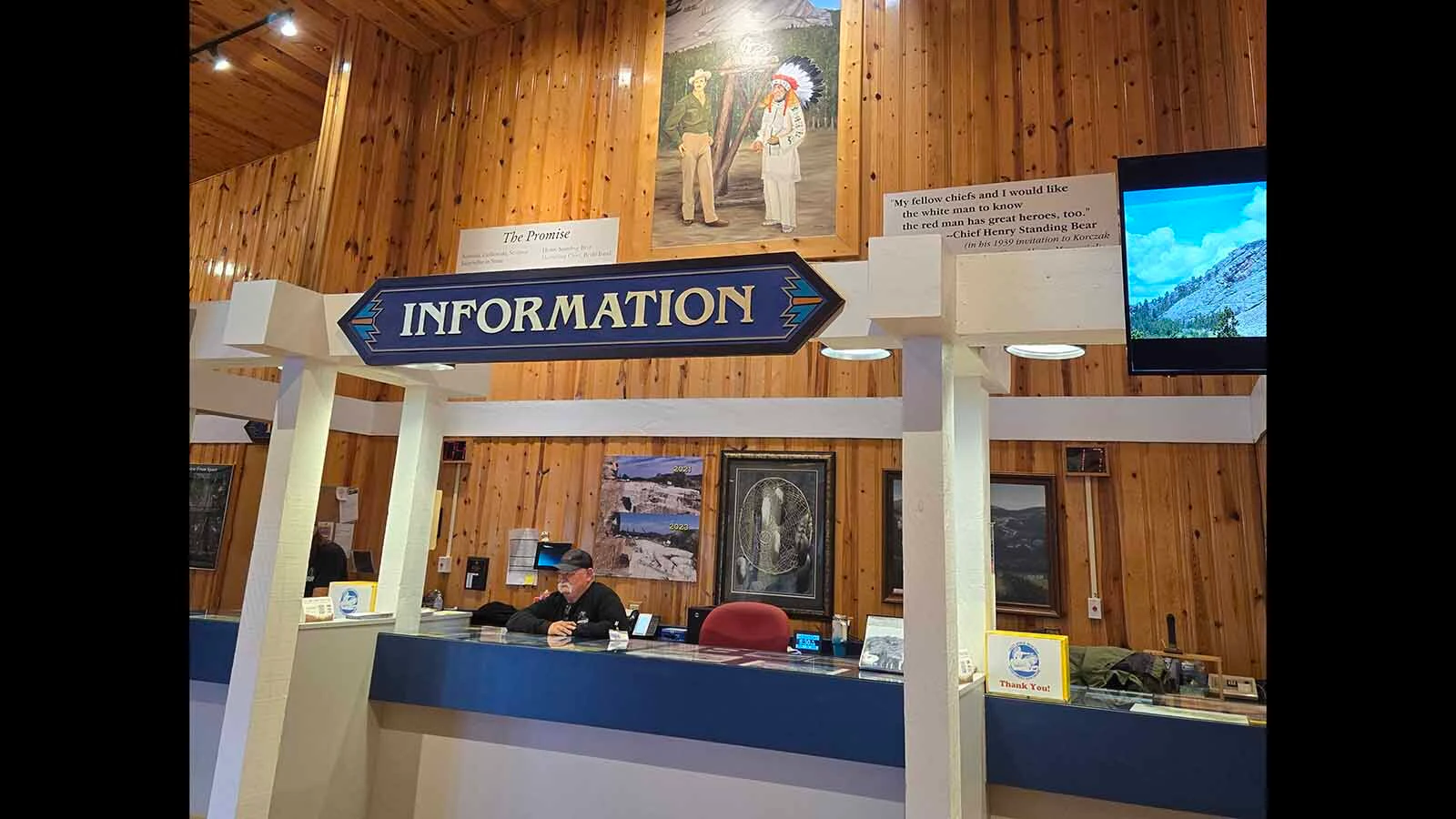
The Crazy Horse Monument, and the work that continues on it, is a big tourism draw. (Kate Meadows, Cowboy State Daily)
More Than A Mountain
Drive through the Black Hills in summer and there's a good chance you'll see license plates from nearly every corner of the country.
Many of those visitors came for Mount Rushmore.
Then, Rencountre said, they discover Crazy Horse.
“What I hear a lot is people will come to South Dakota to see Mount Rushmore, because that's nationally known,” he said.
Once they're here, they make the drive to Crazy Horse.
“And it gives them a look into something they had no idea about,” Rencountre said.
Dennis Layton II extended his vacation from West Virginia by an extra day just to see the memorial. Rain and low-hanging clouds had kept the mountain from being easily visible on the day he planned to come.
Extending his vacation by a day was worth it, he told Cowboy State Daily.
“It’s something everyone should see,” he said, adding that people deserve to know about the rich, if complicated, history.
Sam DeBoer of Northfield, Minnesota, was seeing Crazy Horse for the second time, having visited the monument as a kid.
The building and carving that has taken place since he was last at the site was astounding for a man who expected to see that nothing had changed over the past nearly four decades.
“The only thing here was his face,” DeBoer said. “I was only expecting to see the face again.”
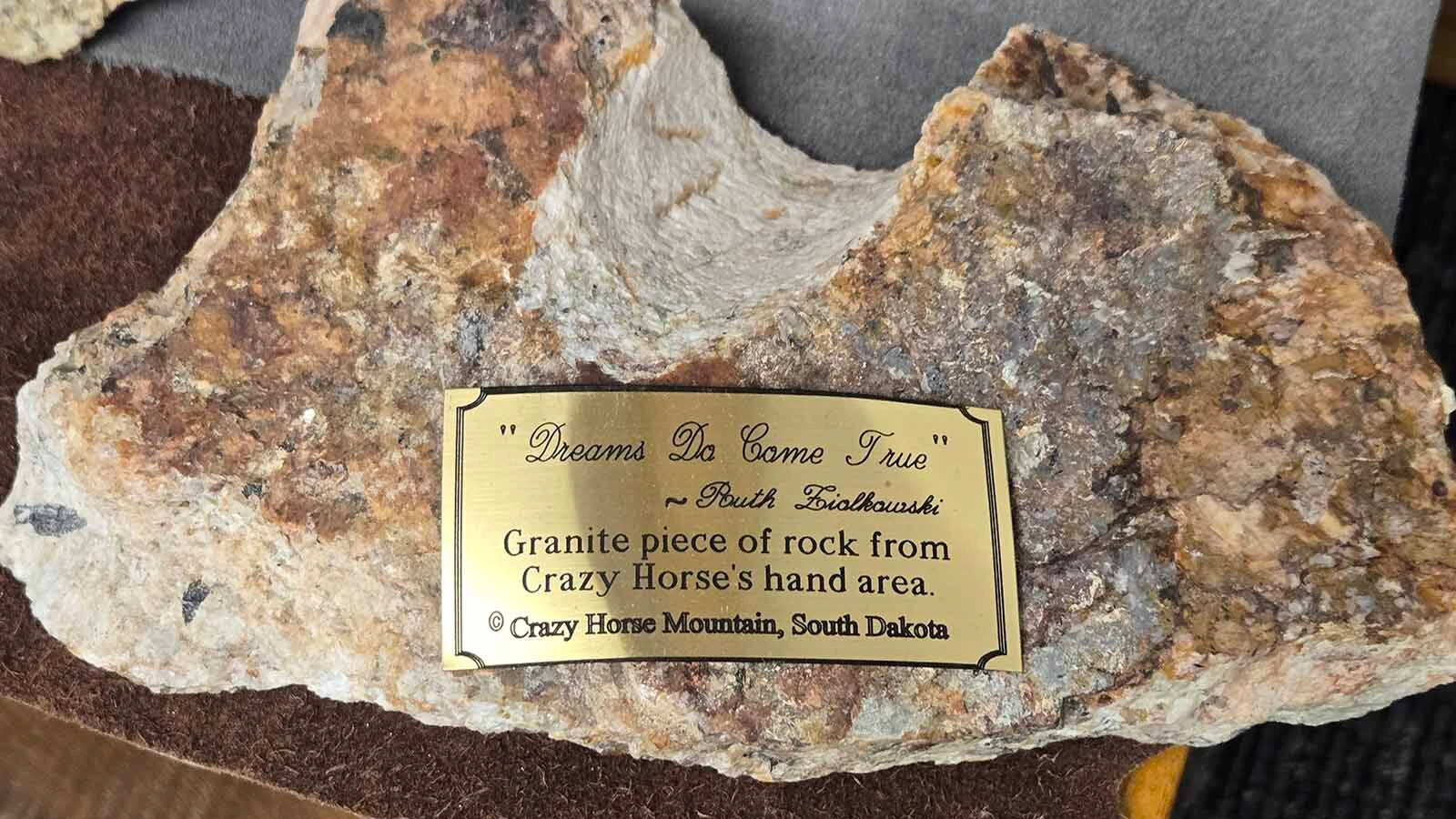
Piece of granite rock from Crazy Horse's hand. (Kate Meadows, Cowboy State Daily) 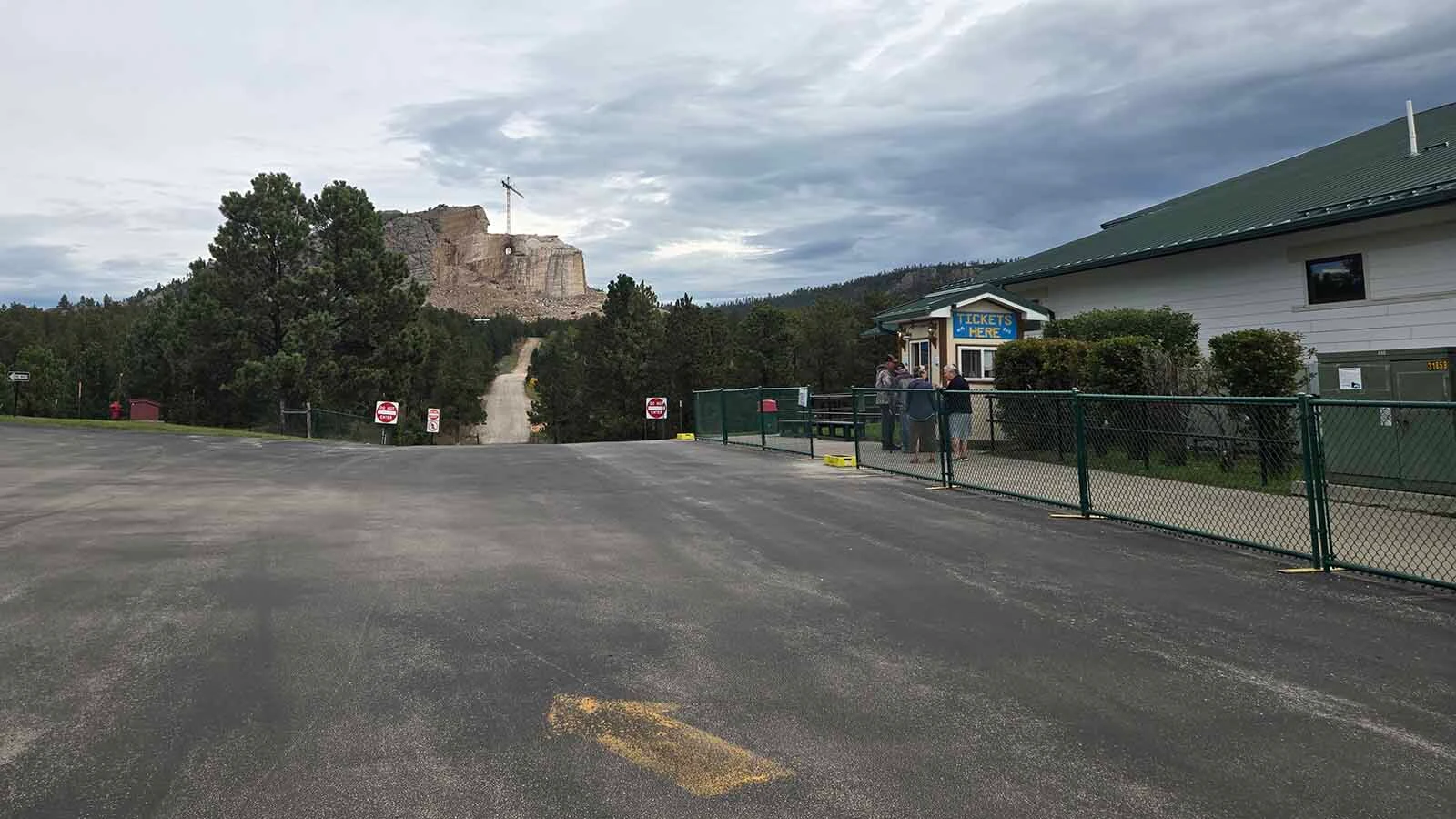
After 80 years, the Crazy Horse Memorial continues to emerge from Thunderhead Mountain in the Black Hills of South Dakota. (Kate Meadows, Cowboy State Daily) 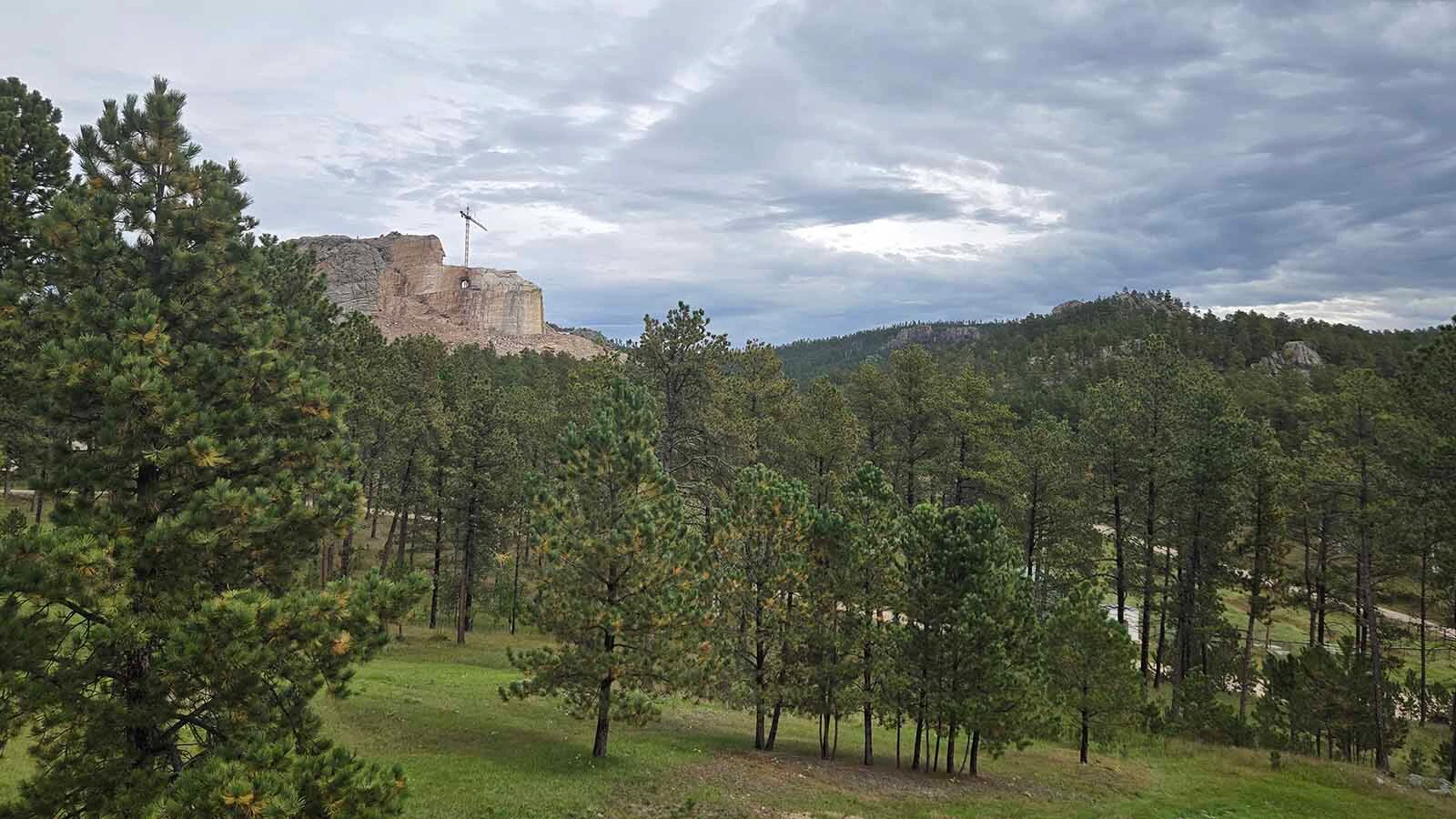
After 80 years, the Crazy Horse Memorial continues to emerge from Thunderhead Mountain in the Black Hills of South Dakota. (Kate Meadows, Cowboy State Daily) 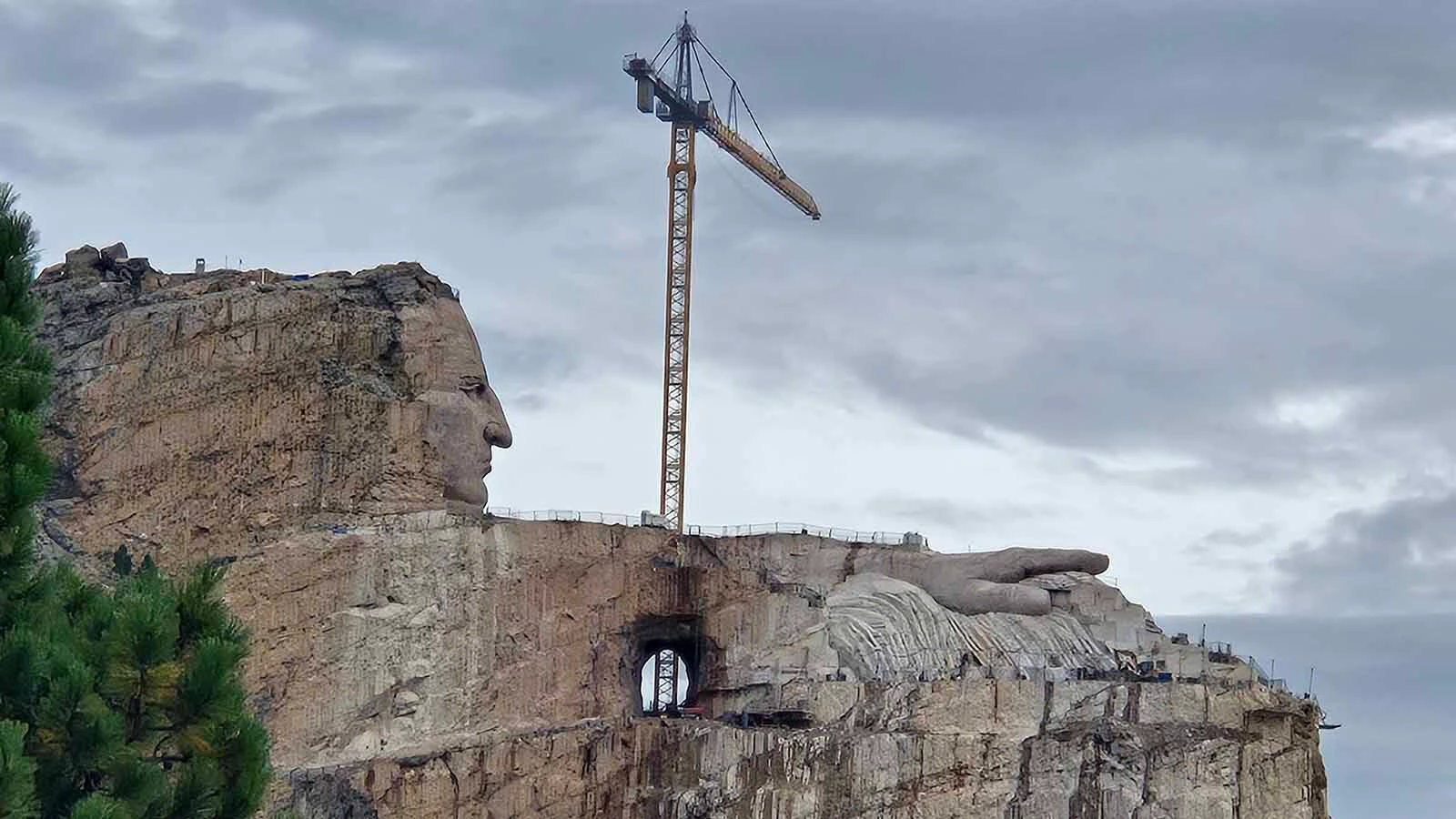
After 80 years, the Crazy Horse Memorial continues to emerge from Thunderhead Mountain in the Black Hills of South Dakota. (Kate Meadows, Cowboy State Daily)
'Pretty Humbling'
Terri Williams of Evansville, Indiana, was part of a tour group that recently visited the memorial.
“It’s pretty humbling,” she said. “You don’t realize the people who dedicated their lives to this.”
Williams said what she learned she wished she would have learned decades ago, in school.
That may be where Standing Bear's original vision becomes clearest.
The mountain was never supposed to be the whole memorial.
“We try to tell the stories of as many tribes as we can,” Rencountre said.
The campus includes the Indian Museum of North America and cultural performers and artists in residence who can tell their own stories directly to visitors.
There is also a university program.
The Indian University of North America broke ground at the memorial in 2009 and has traditionally offered eight-week summer programs in partnership with Black Hills State University.
Beginning in 2027, Rencountre said, classes will be offered year-round.
The program primarily serves American Indian students but is also open to others interested in working with Native populations.
It is another piece of Standing Bear's vision: Create a place where Native American culture isn't simply remembered but where it is continued and shared by the very people who know it inside-out.
When Will It Be Finished?
The founders understood something the rest of us aren't always very good at accepting: Some worthwhile efforts take longer than one lifetime.
Perhaps the person who plants the tree never sits in its shade.
Perhaps the person who begins carving the mountain never sees the final masterpiece emerge.
You do the work anyway.
Rencountre insists that the memorial will be completed.
“Regardless of when the mountain is completed – and it will be completed – there is pride from our founders,” he said.
But even when that day comes, he said, the larger work won't be finished.
Most Americans still know relatively little about Native American cultures, histories and traditions, he said.
Those cultures aren't relics. They are alive.
And Standing Bear's dream was that people from different backgrounds could come together to understand that.
“We don't all have to agree,” Rencountre said. “We don't all have to align.”
What matters is being willing to learn from one another.
“I believe people do better when they know better,” he said.
Nearly 80 years after that first dynamite blast echoed through the Black Hills, Crazy Horse is still emerging from the mountain.
And the story Standing Bear was afraid the world might forget is still being told.
Kate Meadows can be reached at kate@cowboystatedaily.com.