
A Colorado woman named McKenzie recently arrived at Wyoming's southern border with a familiar set of behavioral issues.
She wore Patagonia clothing, made campsite reservations months in advance, and held a delusional belief that mixed greens are a main course.
But don’t worry, because she's being rehabilitated in order to become a productive member of Wyoming society.
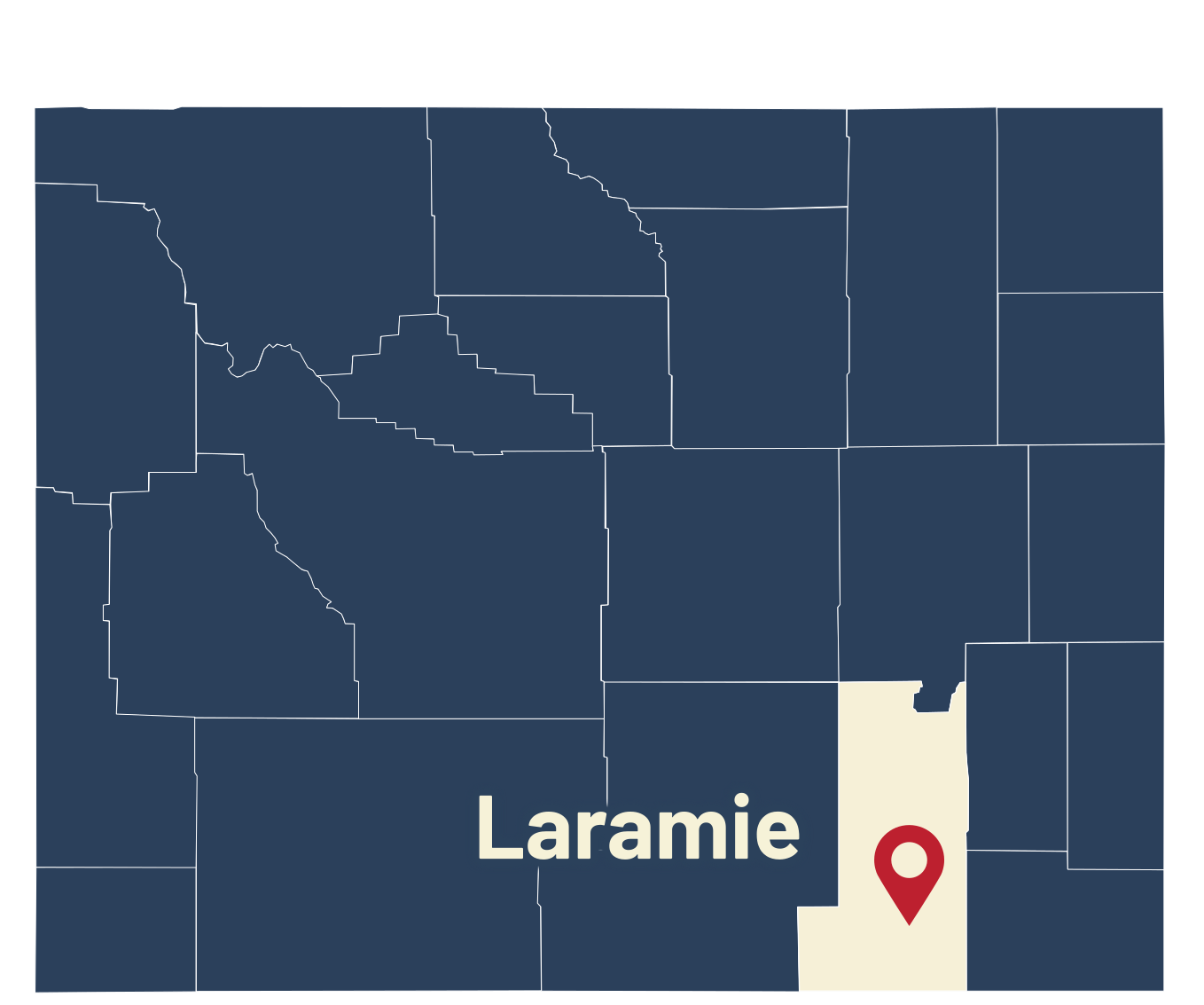
That's the premise of the "Adopt a Coloradan” campaign, the latest hit from Wyoming Border Patrol, a Laramie-based apparel company that’s built a growing business around Wyoming's favorite pastime: making fun of Coloradans.
The plan initially was to make funny videos poking fun at Coloradans to help sell T-shirts, like their popular “Cuck Folorado” T-shirt marketed for the annual University of Wyoming vs. Colorado State University Border War football game.
But the videos have become a business of their own, using artificial intelligence to document the herculean efforts of Wyoming Border Patrol agents Buford and Rip to indoctrinate misguided Coloradans in Wyoming’s blue-collar Western culture.
“With help, even a Coloradan can learn to become a productive member of Wyoming society,” says a sympathetic voiceover in the Patrol’s “Adopt a Coloradan” video.
“It won’t be easy, there may be accidents, they may attempt to reserve campsites months in advance,” the voice continues with the melancholy strains of Sarah McLachlan’s 1997 pop ballad “In the Arms of an Angel” in the background. “And some will continue telling you how much better the restaurants were back home.”
“That’s usually when we put them back up for adoption,” interjects Agent Buford.
Those Videos — And Jokes
The company now says content revenue for the Wyoming Border Patrol’s AI adoption force videos is on pace to surpass apparel sales.
“I think we're going to be able to monetize the content more than the actual apparel,” said Rowdy Yeatts, CEO of Wyoming Border Patrol. “We haven't even paid for any ads or anything. This is all completely organic.”
In the last month alone, its videos have drawn nearly 2 million views.
Its first installment of “Adopt a Coloradan” is closing in on 1 million views and more than 7,000 shares, all in under a week.
Some things never get old.
“Since I was 5 years old, I've been hearing jokes about Coloradans,” said Art Delgado, a standup comedian who performs in Wyoming and Colorado. “Now (40 years later) people are still telling Colorado jokes, and it’s still making me laugh.”
The main difference now, however, is that they’re using artificial intelligence to do it.
To the surprise of many first-time viewers, “Adopt a Coloradan” was created using AI tools, allowing a three-person team in Laramie to produce viral videos in a matter of days, without actors, film crews or traditional sets.
Of all the moments to go viral using AI, Wyoming Border Patrol broke through during a week dominated by headlines screaming “AI could cause human extinction by 2030.”
It remains to be seen how ambivalence toward the technology will affect their following, but as of now the pushback on their use of AI has been minimal, according to Yeatts.
What about pushback for shamelessly stereotyping an entire state?
“More of our fans are actually in Colorado than Wyoming,” Yeatts said.
“I’d say we're at 98% positive feedback and maybe 2% negative feedback,” mostly for the use of AI, he said.
Technology is changing. The joke is not.
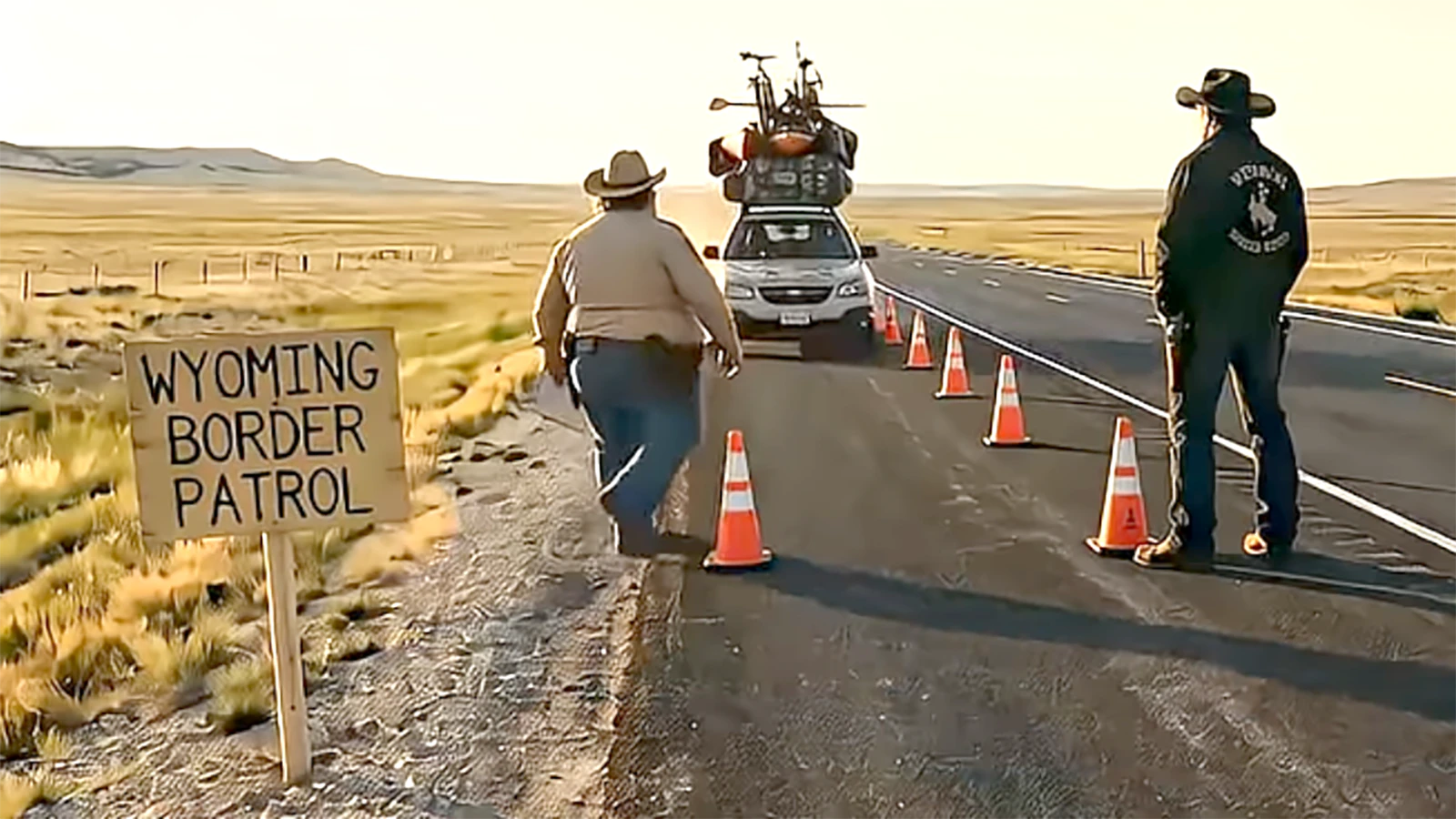
Wyoming Border Patrol Agents Buford, left, and Rip stop a Coloradan coming into the state on Highway 287 driving a Subaru with six bicycles strapped to the top. (Wyoming Border Patrol) 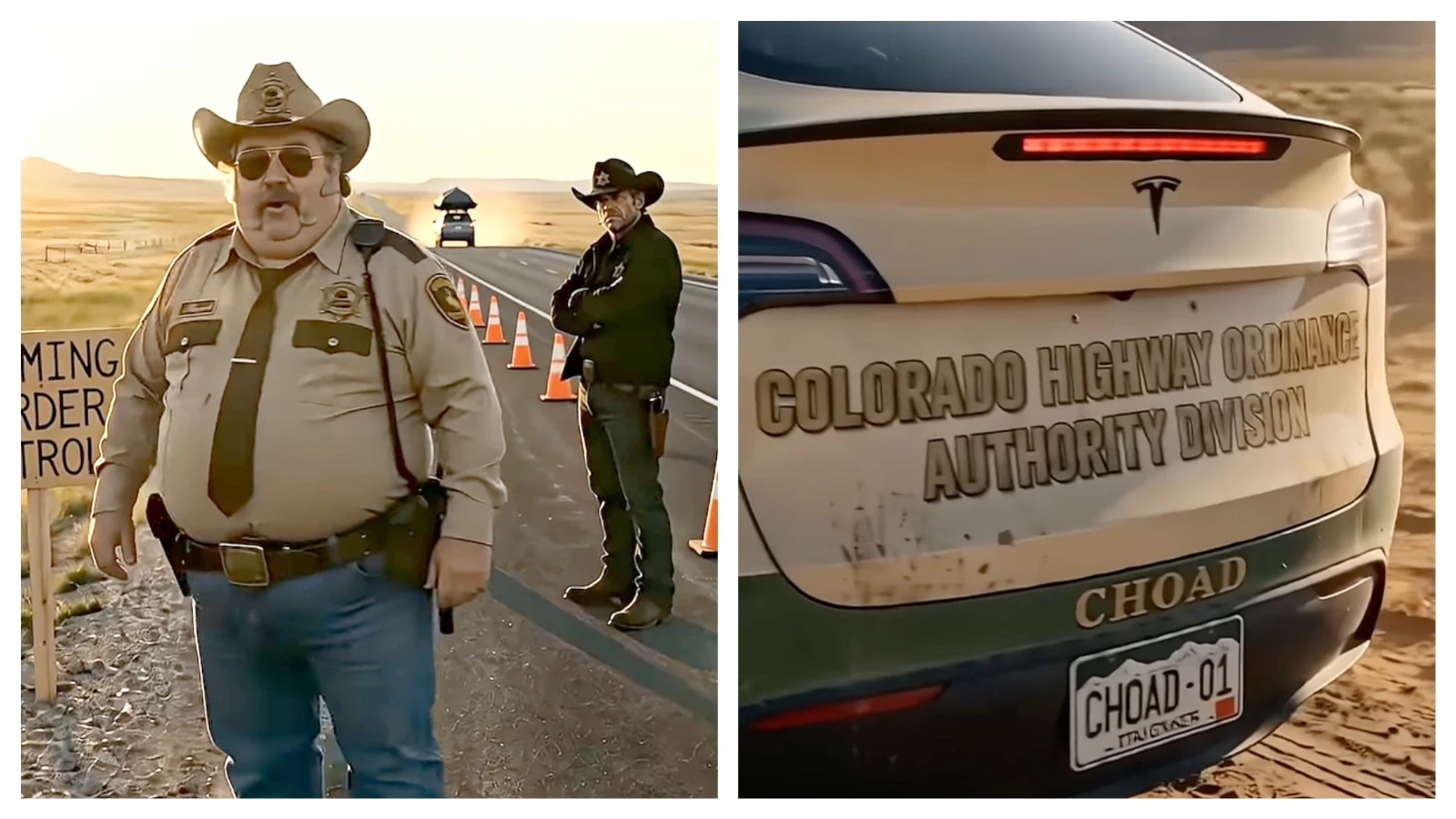
Wyoming Border Patrol Agents Buford and Rip, left. At right is a Tesla belonging to the fictional Colorado Highway Ordinance Authority Division — aka CHOAD. (Wyoming Border Patrol) 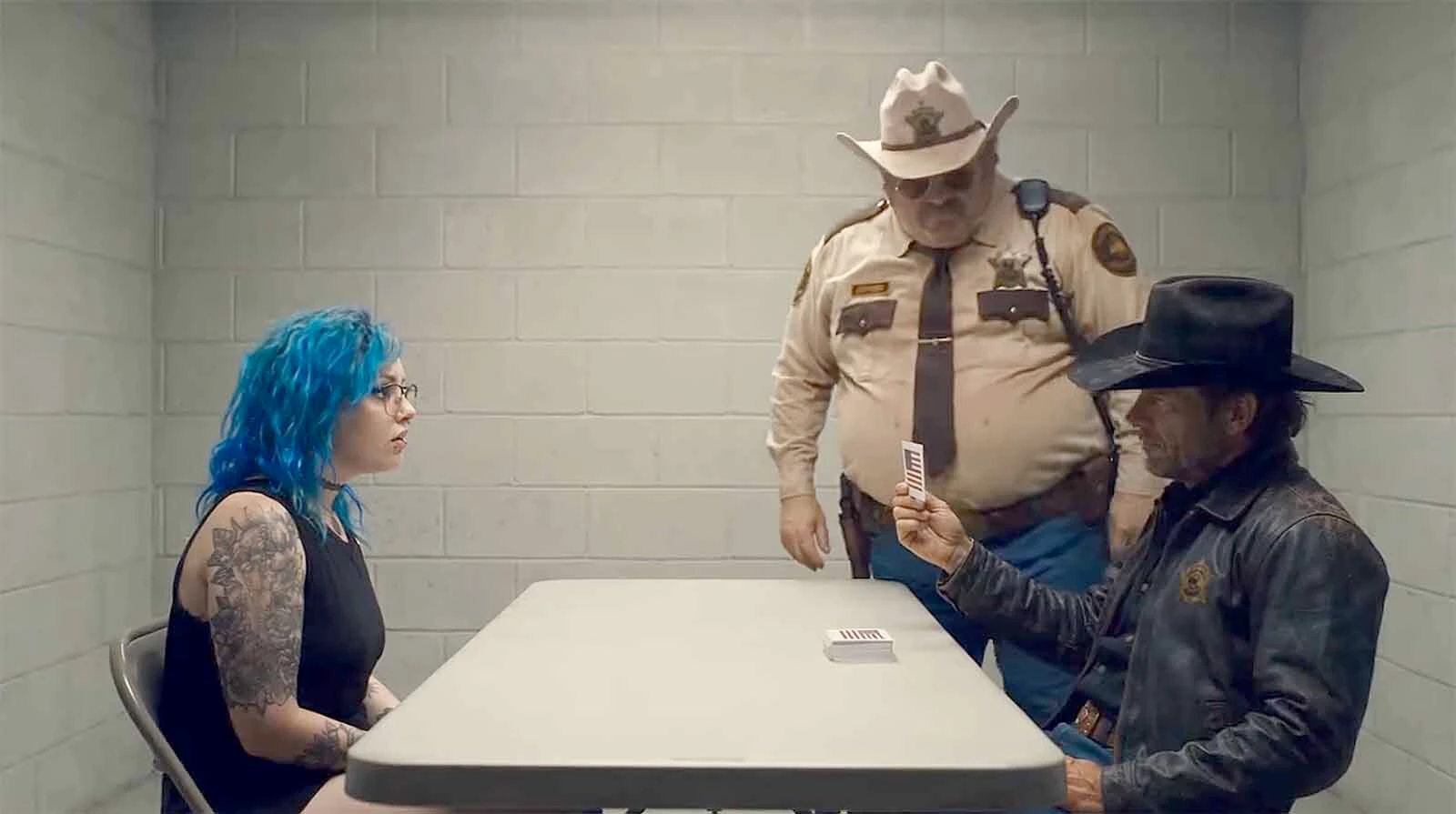
Wyoming Border Patrol Agents Buford and Rip question a Coloradan who wants to come to Wyoming. "What flag is this?" Rip asks while holding up a photo of an American flag. "Malaysia?" the Coloradan answers like a question. (Wyoming Border Patrol) 
Wyoming Border Patrol Agent Buford questions a Coloradan for potential adoption into Wyoming. (Wyoming Border Patrol)
What Makes It So Funny?
The adoption kennel is just one corner of Wyoming Border Patrol’s fictional universe.
The principals in this world are Agent Buford, a portly lawman who gives buzz-cuts to purple-haired, poly-gender Denverites; and Rip, a stoic enforcer who throws rattlesnakes at moving vans with California license plates.
Elsewhere, they’ve imagined a Colorado Highway Ordinance Division — CHOAD, naturally — where deputies begin traffic stops with polite inquiries about pronouns and treat feelings as tantamount to law.
“At CHOAD, we don’t enforce rigid laws based on facts. We enforce how situations make us feel,” a CHOAD deputy says in one clip.
The humor lands because the characters are instantly recognizable, says Casper-based comedian Delgado.
“For the most part, my friends in Colorado, and even other comedians in Colorado, are those people,” Delgado said, referring to the parody of Denver residents who proudly declare the city was better before everyone moved there — despite being transplants themselves.
Even though it traffics in stereotypes, the humor never feels like it's punching down. The trick, Delgado said, is the exaggeration.
"You want to make the stereotype so absurd that nobody in their right mind could possibly believe it would happen," Delgado said.
Coloradans treated as rescue animals? Vegans bottle-sprayed for choosing salad?
“So absurd!” he said.
Delgado has been laughing at Colorado for 40 years, but the jokes are older than that.
‘They’re Really Making Fun Of Boulder’
Patricia Limerick is a historian at the University of Colorado Boulder who’s spent decades thinking about the many identities of the West.
She hasn’t had a laugh like this in ages.
“This is wonderful! This is so great,” Limerick said in a phone interview, “Adopt a Coloradan” playing from her laptop in the background. “It brought tears to my eyes, I’m laughing so hard.”
In some ways, Limerick sees herself in the joke. More specifically, she sees her city: Boulder, the self-serious center of the Front Range stereotype.
“When people are making fun of Colorado, I think they’re really making fun of Boulder,” she said.
“People along the Front Range are very interested in self-care and self-cultivation,” she added. "There’s a susceptibility to take yourself quite seriously, and that makes you very good material for humor.”
As the force behind a project called “The Five States of Colorado,” however, Limerick also sees what a WBP audience might not.
“A rancher in Meeker or someone on the Western Slope is not the same as a Front Range Coloradan, but the stereotype steamrolls those differences,” she said.
“There are parts of Colorado that are more Wyoming than Colorado,” she said, explaining that it’s why many Coloradans recognize the caricature, even if they don't see themselves in it.
The satire has even begun to attract attention from Colorado's political figures, like Victor Marx, Colorado's Republican gubernatorial nominee.
Wyoming Border Patrol made a social post expressing support for Marx’s campaign slogan, “Make Colorado Work Better,” because if the state worked better, Coloradans might stop moving north, WBP said.
The candidate liked the post, commented on it, then shared it with his followers on X.
“We're actually influencing Colorado elections at this point,” Yeatts joked.
But Limerick suspects Coloradans' willingness to laugh at the stereotype runs even deeper.
Coloradans have played both roles in the Western migration story, and they’ve spent decades making similar jokes about Texans and Californians, she said, using humor to manage anxiety about newcomers and change.
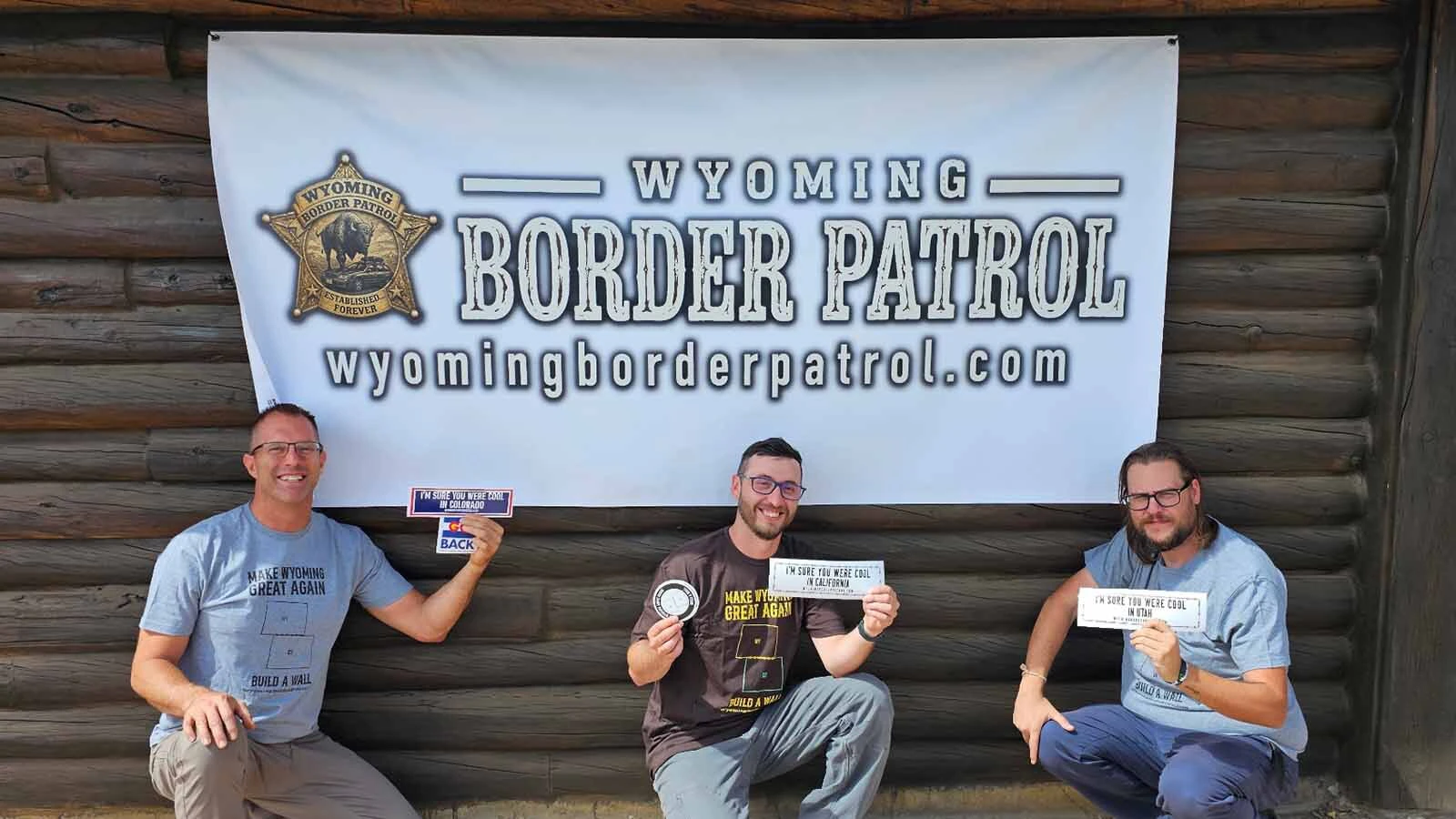
A pair of AI Wyoming Border Patrol agents named Buford and Rip are turning lessons for Coloradans to "become a productive member of Wyoming society” into a real business for a Laramie group. It works because it's so absurd and over the top, observers say. (Wyoming Border Patrol) 
“Since I was 5 years old, I've been hearing jokes about Coloradans,” said Art Delgado, a standup comedian who performs in Wyoming and Colorado. “Now (40 years later) people are still telling Colorado jokes, and it’s still making me laugh.” (Wyoming Border Patrol) 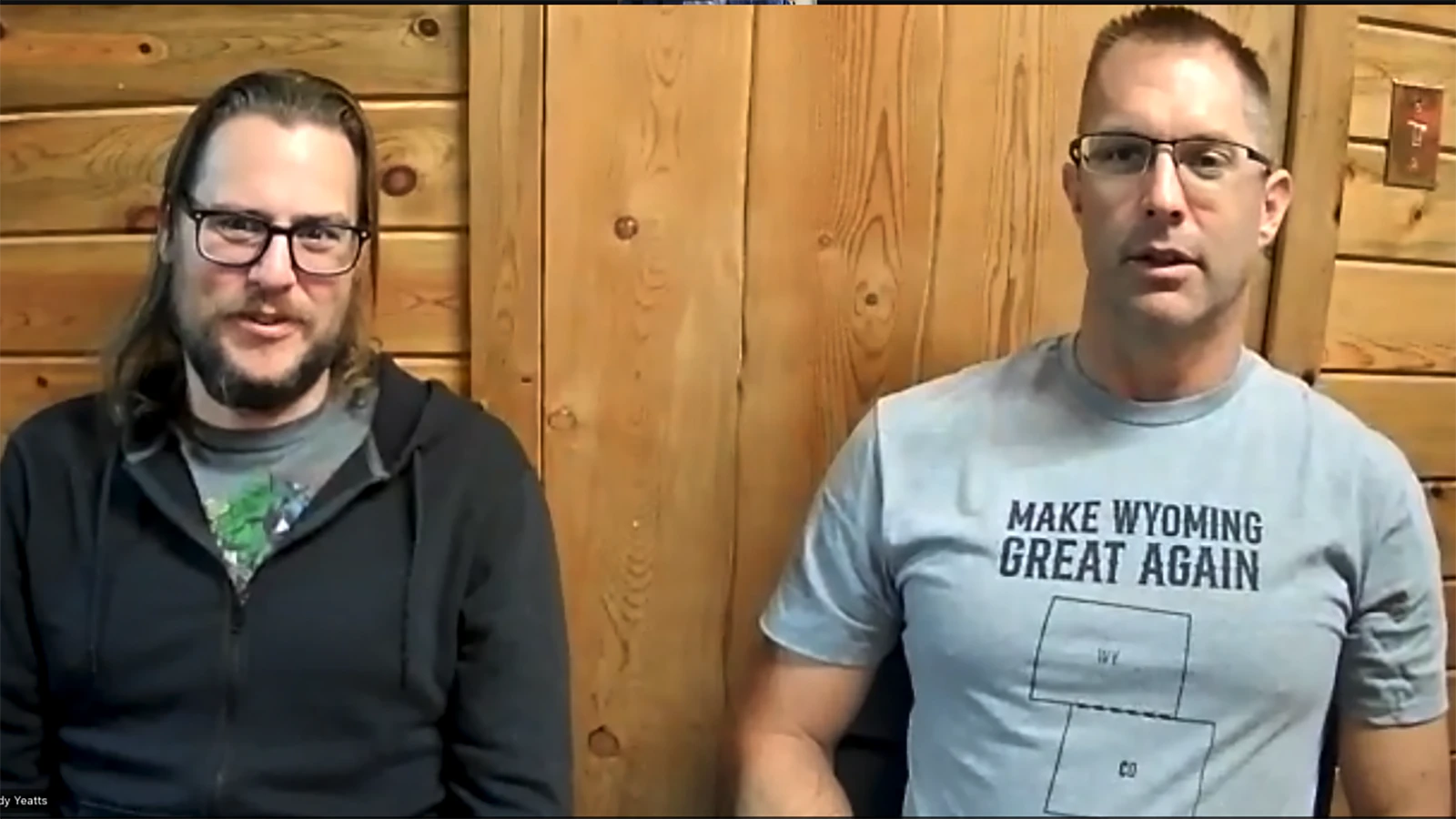
Wyoming Border Patrol CEO Rowdy Yeatts and marketing director, Chris, in the mastermind room. (Wyoming Border Patrol) 
“Since I was 5 years old, I've been hearing jokes about Coloradans,” said Art Delgado, a standup comedian who performs in Wyoming and Colorado. “Now (40 years later) people are still telling Colorado jokes, and it’s still making me laugh.” (Wyoming Border Patrol)
Is The Invasion Real?
One reason Wyoming Border Patrol's satire feels so recognizable is that Colorado-to-Wyoming migration is real.
In the decade ending in 2025, nonresident workers grew from 8.7% of Wyoming's workforce to 15.9%, according to Michael Moore, research supervisor for the Wyoming Department of Workforce Services.
Increasingly, those workers are coming from Colorado.
Between 2005 and 2024, an average of 5,030 workers moved annually from Colorado to Wyoming, compared with 4,258 making the trip in the opposite direction. Most found jobs in construction and leisure and hospitality.
At the same time, Wyoming continued losing resident workers to retirement and out-migration to other states.
“Employers typically turn to nonresidents only after they have exhausted the resident labor force,” Moore said.
The joke, in other words, leaves out an important detail: Wyoming depends on the very people it likes to make fun of most.
Buford For Governor?
Wyoming Border Patrol’s online success has shifted how they think of their company. But it hasn’t changed their creative process.
“We have what we call our mastermind group where the three of us get together and we laugh, scream, yell, laugh more, and we come up with all the ideas,” said Yeatts, adding that it can get awkward for other professionals in their shared office building.
“The engineers are in the next room over listening to this nonsense we're screaming out, and they're thinking, ‘What in the world is going on over there?’” he said.
The joke has been getting more absurd.
A Colorado gubernatorial candidate has already shared one of the group's posts. Bars have approached them about public appearances. Yeatts believes political candidates may someday pay for endorsements from their fictional characters.
And then there's Agent Buford, the mustachioed border boss who’s become so popular the team is discussing his 2030 run for governor.
It’s funny, because they are not joking.
The paperwork could be filed by a real person, but the candidate on the ballot would be Buford. It would give a whole new meaning to identity politics.
“It seems absurd to think about paying an AI character to endorse your campaign to win a real election,” Yeatts said. “But the only thing more absurd than that is if we actually try to win an election with an AI candidate.”
It sounds unlikely, but don’t rule them out.
After all, Wyoming Border Patrol was supposed to be a T-shirt company.
Zakary Sonntag can be reached at zakary@cowboystatedaily.com.