A $30,000 two-year commitment allowing the Glenrock Police Department to use five Flock cameras is approaching automatic renewal, and residents who have raised concerns about the surveillance system say they still don't know whether the town council will have a chance to publicly consider it before the deadline passes.
The contract is scheduled to automatically renew Oct. 14 for two more years unless the town provides written notice of non-renewal by Monday.
Monday is also the date of the Glenrock Town Council's next regularly scheduled meeting.
As of Wednesday, no agenda had been posted for that meeting, and town clerk Tammy Taylor told Cowboy State Daily she did not know whether the Flock contract would be included.
"They have not brought that to me," Taylor said.
That leaves open a basic question residents and others want answered: Will the council have an opportunity to vote on or publicly discuss the renewal before the town is locked into another two years?
Police Chief Colter Felton has not returned Cowboy State Daily’s multiple messages via phone, text and email. Neither has Mayor Bruce Roumell. No members of the town council – Judi Colling, Roy Kincaid, Russ Dalgarn or Margaret Nunn — responded to Cowboy State Daily’s questions about the autorenewal.
The issue has become increasingly contentious in Glenrock as residents question both the technology and how the town entered into the contract in the first place.
Five Cameras, A Much Larger Network
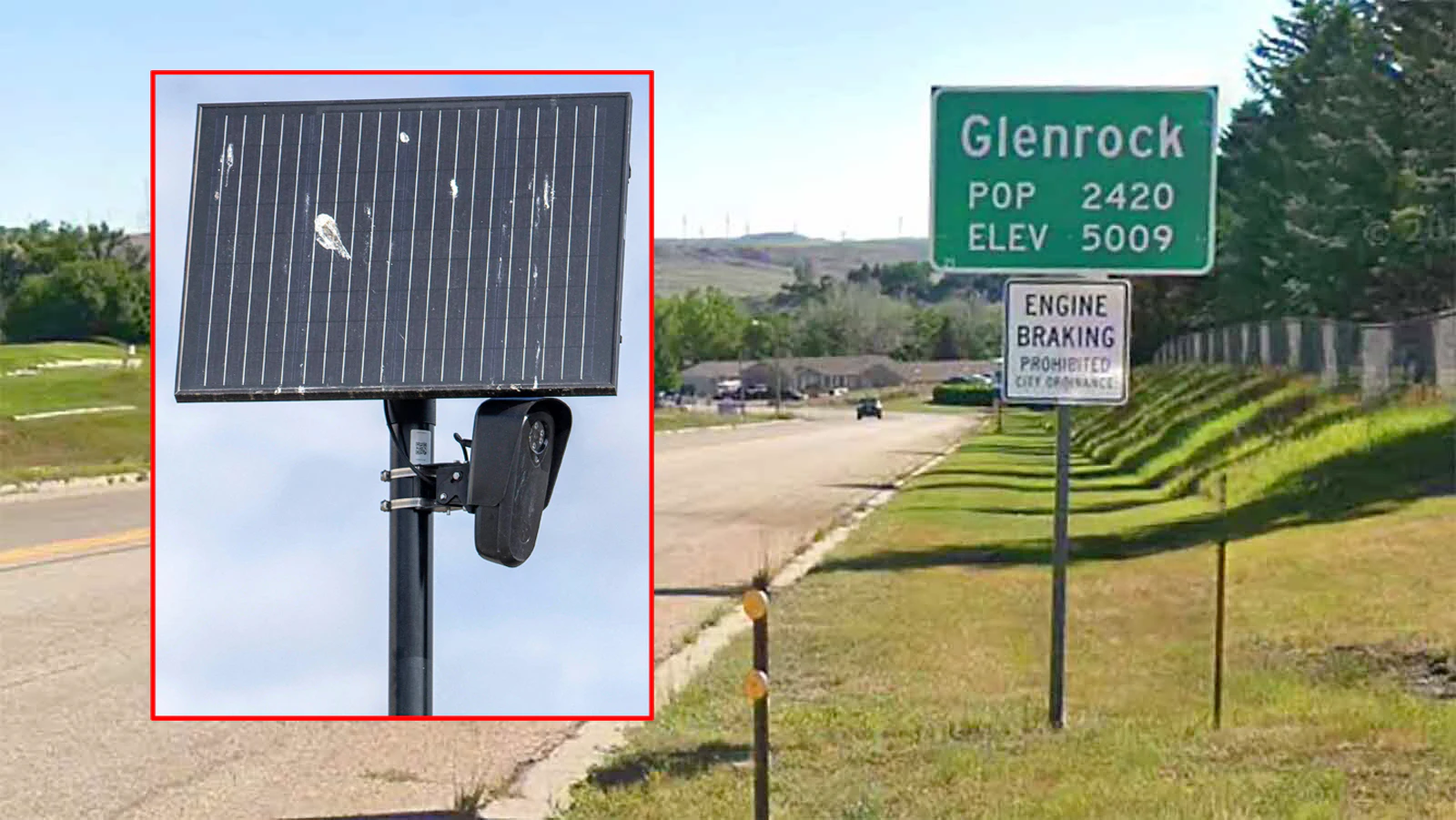
The Glenrock Police Department operates five Flock Falcon 2.2 cameras – four in Glenrock and one in nearby Rolling Hills.
The initial contract, signed July 24, 2024, committed the police department to $34,450 for two years of Flock Safety equipment, including $4,450 in one-time professional services fees for implementation and testing.
Public records viewed by Cowboy State Daily show the town was invoiced $15,000 for the first year, plus the professional services fees, on July 24, 2024. An invoice dated Oct. 17, 2025, totaled another $15,000, or $3,000 per camera.
The proposed renewal would cost $30,000 for another 24 months.
But critics say describing the system simply as five cameras or license-plate readers doesn't tell the whole story.
According to resident John Gallaway, the five cameras Glenrock operates feed into a much larger network.
For example, an audit log from Nov. 16, 2025, shows a search categorized as a drug investigation reached 6,281 camera networks nationwide.
That means a query entered by a Glenrock officer reached thousands of camera systems belonging to other law- enforcement agencies and private customers around the country, Gallaway said in an email to Cowboy State Daily on Wednesday.
"License plate reader” accurately describes one function of the technology, Gallaway said, but not everything the system can do.
The cameras can provide alerts when a license plate appears on a hot list, such as a stolen vehicle, felony warrant or AMBER Alert.
They also contribute to a searchable database containing photographs of vehicles that pass the cameras, allowing users to search for vehicle information and cross-reference it with cameras elsewhere.
"Calling that a license-plate reader is a little like calling a wiretap a telephone," Gallaway said.
Where Was The Vote?
One of the questions surrounding the renewal is how the original contract was approved.
Glenrock's 2024-25 budget, adopted through Ordinance No. 749, lists the police department's budget at $1,537,732. The budget does not specifically mention a Flock camera system.
Gallaway said that means residents and council members looking at the budget would not necessarily have known they were approving the Flock contract.
"Nobody voting on that ordinance was voting on this contract, and nothing in front of them would have told them they were," he said.
Felton previously told Cowboy State Daily that the initial purchase and use of the Flock system was approved in a budget hearing and not during a regular town council meeting.
Town Attorney Amy Iberlin told Cowboy State Daily she was not presented with the original Flock contract in 2024 and was reviewing the second contract Wednesday.
She said the council would consider the contract renewal at Monday’s meeting.
Iberlin, who has represented the town of Glenrock for about a decade, said that as an attorney representing multiple municipal clients she does not necessarily know the town's day-to-day operations.
"To me, that's the beauty of being in a small town in a lot of respects," she said. "You're putting really good people you trust to make those kind of important decisions for their respective communities."
She said deference was given to Police Chief Felton to determine that the technology was in the best interest of community welfare and safety.
But as residents have raised concerns, Iberlin said she believes it is appropriate for the town to take another look.
"To the extent that this changes and the community comes forward and raises concerns, I'm glad that the council is willing to take a second look and have those conversations," she said, "because maybe it isn't in the best interest of the community to move forward."
Residents Want Answers
Resident Eric Farrington said he is particularly concerned about the timing of the council meeting.
The town's written notice deadline for the Flock autorenewal falls on Sept. 14 — the same day the council is scheduled to meet.
"There's a severe disconnect between city government and the will of the people," Farrington told Cowboy State Daily. "They're basically ignoring the will of the people when they have an issue and aren't going to talk about it beforehand."
Resident Shalyn Kovach has organized a petition opposing the autorenewal. A meeting regarding the petition is scheduled for 6 p.m. Thursday.
Kovach said she is also working on a statewide petition and has been seeking information about Wyoming legislation concerning automatic license-plate readers.
Sen. Brian Boner, R-Douglas, told Cowboy State Daily he has been in contact with constituents concerned about privacy issues related to Flock cameras and has offered to connect residents with ongoing statewide legislative efforts concerning Fourth Amendment and privacy issues.
"There are multiple avenues Wyoming citizens can take," Boner said, adding that part of his role is making sure constituents' voices are heard.
Farrington called the petition a "powderkeg."
"If the town council is going to ignore a petition and are not even concerned enough to create a special session to address it, a lot of people are going to have a lot of faith lost in the city government," he said.
What The Cameras Have Been Used For
Felton has previously directed Cowboy State Daily to Flock's transparency data in Glenrock, which offers up-to-date information about how the system is being used.
According to data available Wednesday, Glenrock's cameras had detected 17,551 unique vehicles during the previous 30 days. Six searches had been initiated during that period.
The top offense categories included traffic infractions, "other," hit-and-run or car accidents, and larceny/theft.
Glenrock's own Flock LPR policy says officers may query the database only for specified purposes, including a possible threat to public safety or enforcement of criminal law, an official missing-person alert, reasonable suspicion of criminal activity, an active investigation or the prevention of crime.
The policy also permits searches for proper training of new users or maintenance and calibration.
Audit logs reviewed by Cowboy State Daily from October 2024 through June 2026 show searches involving possible burglaries, felony warrants, government threats, larceny, missing juveniles, drug investigations, hit-and-runs, animal offenses and trespassing, among other categories.
Nearly 100 searches are categorized as "test" or "training." Felton has not responded to Cowboy State Daily’s question about what justifies “test” or “training” as a reason for that number of searches.
Other questions also remain unanswered, such as how many crimes the cameras have helped solve and how town leaders justify the cameras initially being approved during a budget hearing rather than a council vote.
No audits were conducted in March, July, August or October 2025.
The department's policy states that LPR photographs will be stored for no more than 30 days before being automatically purged from the system.
Wyoming Lawmakers Are Looking At LPRs
The controversy in Glenrock comes as Wyoming lawmakers are also examining how government agencies use automatic license-plate reader technology.
The Legislature's Select Committee on Blockchain, Financial Technology and Digital Innovation Technology considered a draft bill this summer addressing biometric data, geolocation information and automatic license plate readers.
The draft, 27LSO-0033, originally addressed all three areas, but the committee directed the Legislative Service Office to narrow the measure and focus its efforts on automatic license plate readers. A revised LPR bill is scheduled to be considered at the committee's Sept. 28-29 meeting in Laramie.
The current working draft would generally prohibit governmental entities from obtaining, retaining, accessing or using automatic license-plate reader systems to identify motor vehicles, as well as installing such systems on public buildings, roads and highways. The draft also would establish restrictions on how covered information could be used and shared, along with warrant requirements and a civil cause of action for violations.
The legislation is still a working draft and has not become law.
What Happens Monday?
For now, the immediate question in Glenrock is much more local.
The town's current contract is approaching its renewal deadline, residents are asking for answers and the council has yet to publicly indicate whether it will consider the issue.
Under Section 11.15 of the contract, the town has an option to terminate for nonappropriation without penalty, according to the contract language reviewed by Cowboy State Daily.
That means the town could, at least according to the contract, decline to appropriate money for continued service and avoid a penalty – potentially giving town officials time to establish clearer rules governing the technology before deciding whether to continue using it.
But whether the council will exercise that option, discuss the renewal or simply allow the contract to roll over remains unclear.
Kate Meadows can be reached at kate@cowboystatedaily.com.