

The alleged sex predator didn’t get far.
Less than five hours after driving to Wyoming to pick up a 15-year-old Sundance girl, Dalton Renollet, 36, of Maricopa, Arizona, was arrested Aug. 31 during a traffic stop on Interstate 90 in South Dakota.
He was taking her to Ohio to move in with one of his family members, Renollet reportedly told authorities.
Initially, he tried to mislead investigators, according to court documents, claiming the girl’s name was “Lorelel” and that she was a hitchhiker he picked up on the highway between Sundance and Spearfish, South Dakota.
When pressed about the sexually explicit texts and photos found on the teen girl’s electronic devices, Renollet changed his story. He claimed he was rescuing her from an abusive home situation, and that the explicit exchanges between them were his attempt "to keep her from killing herself," according to the affidavit of probable cause.
Yes, he knew she was underage but claimed she would sometimes tell him she was 15, other times 16 or 17 — all still well below the legal age of consent.
The teen also tried to protect him, claiming he was her “uncle” and that they were on their way to Ohio, before eventually admitting he was her “boyfriend” upon further questioning by investigators.
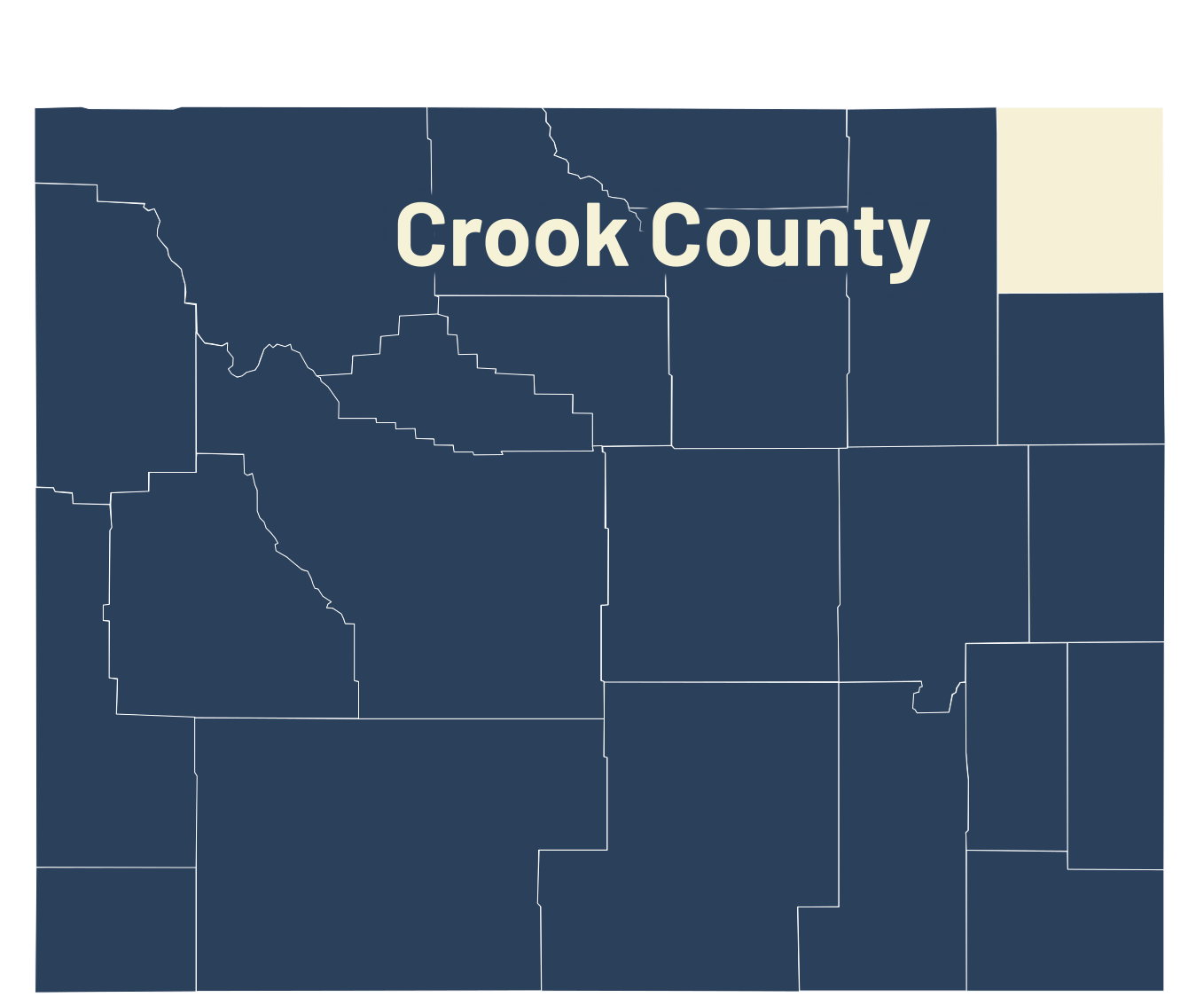
This case ended well, said Crook County Sheriff Jeff Hodge, who had immediately enlisted the help of the Wyoming Division of Criminal Investigation (DCI) Internet Crimes Against Children (ICAC) division and South Dakota and federal authorities for help.
An investigation was already underway when they realized the teen was missing.
Renollet is now facing a list of charges in Wyoming, among them grooming of a minor for sexual offense, under a new law that took effect this summer, as well as an additional charge in South Dakota and potentially more charges federally.
It was an incident where all the agencies worked well together to make the arrest, Hodge said.
Troubling Trend
It could have ended much worse, Hodge acknowledged. Still, he finds it troubling that this is the second incident in Crook County in the past month where a predator showed up in person to meet the teens.
The other incident also involves a 15-year-old girl, from neighboring Moorcroft, who reportedly also met a man online. In this case, she lied about her age, saying she was older.
When the man arrived in Wyoming, he immediately turned around when he realized she was underage.
How do two teen girls in small towns in Wyoming of just over 1,000 residents meet older men online? Even more concerning is that the men turned up in person, Hodge said.
The reality of this prompted him with a plan to provide educational presentations for parents and guardians about the dangers of online predators. In Crook County, teens take a class on internet safety in school called “Freshmen Impact” that educates them about destructive choices, he said, but he wants to extend the training to adults.
Doing Everything Right
It’s a lot more common than one might think, says a Wyoming anti-human trafficking expert, who — along with Hodge — warns parents and guardians to monitor their children’s online activity, talk to them about internet safety and grooming, and to recognize the signs.
In this case, the parents of the Sundance teen did just that.
Hodge said they recognized their daughter was acting differently. Suddenly, she was secretive. Rather than spending time with the family in the living room, she retreated to her bedroom, obsessively on her computer behind closed doors.
They were right to be suspicious, as they later learned after she got into trouble and her dad confiscated her phone. Hidden behind a secure password-protected folder with a man’s name were sexually explicit messages and photos between the two of them.
When her father discovered these in mid-July he immediately turned over her devices to the Crook County Sheriff’s Office, which in turn called in ICAC for help.
“They did everything right,” Hodge said.
The teen met Renollet on Discord, which is a free communication app that allows users to talk, text and video chat with friends and in online communities – or chat rooms – known on the app as spaces or channels.
In this case, the teen was helping Renollet work out bugs in a video game under development, according to the affidavit of probable cause. One night, she confessed she had a crush on Renollet, which led to the two exchanging private sexually explicit material over messages and video calls.
It’s not clear from court documents how long the relationship had been going on though there were clear suggestions of grooming, including sending the teen gifts.
This included a ring, pillows, stuffed animals, earbuds, a phone holder and a Fanta soda via Walmart delivery, according to the affidavit of probable cause.
In one case, she returned the favor, sending Renollet $10 over a money app to help him pay a credit card.
She considered and referred to Renollet as “her boyfriend.”
This Is Grooming
All of these behaviors are indicative of grooming, explained Terri Markham, executive director and co-founder of the Sheridan-based anti-human trafficking nonprofit Uprising, which is the deliberate process of building trust and an emotional connection with a child or vulnerable person for the purposes of manipulation, control, exploitation or abuse.
It can take place in a matter of minutes or over a period of months and years.
Predators search for vulnerabilities to exploit, Markham said, whether that’s emotional voids or physical items such as money, food, clothing or shelter.
A lonely teen looking for connection. A child that can’t afford what their peers have. Or a teen desperate to fall in love.
“It could be anything under the sun,” Markham told Cowboy State Daily. “I like to describe it as cracks in the glass. They’re going to try to fill those cracks to create that dependence.”
Predators know exactly what they are doing and how to exploit these vulnerabilities, Markham noted.
They’re also shrewd at infiltrating online spaces where teens tend to congregate, Markham said. Video games are common as are places such as Discord, which Markham said has limited oversight and protections for teens.
In fact, online safety experts such as Titania Jordan, author of “Parenting in a Tech World,” repeatedly warn parents about this platform in general due to the amount of inappropriate content, bullying and predation, according to an article on Care.com.
Both Hodge and Markham urge parents to monitor their child’s online activity.
“The biggest thing I want parents to understand is that they need to know what their children are doing online and who they are communicating with,” Hodge said in a statement after Renollet’s arrest that he shared with Cowboy State Daily.
“That doesn't mean every social media app or online game is dangerous. It means parents need to understand how those platforms work and whether strangers can privately communicate with their children," he added.
Severe Outcomes
Predators know exactly what they are doing, Markham noted, and don’t mind playing the long game.
She described one case in Wyoming in which a man groomed a 17-year-old girl for months, waiting until her 18th birthday to send her a plane ticket to California— old enough, legally, to board the flight on her own.
“Luckily, her parents were able to talk her out of going,” Markham said.
Otherwise, she would have been free to go and potentially expose herself to a sex or human trafficking situation in which it would have been much harder to escape.
They were lucky, Markham said, because once formed, the emotional bond with a predator can be hard to break.
She’s seen the extremes go in both directions.
In some cases, Markham has seen youth immediately bounce back after they quickly realize they’re in a bad situation and make the choice to leave. Other times, she’s seen teens escape from one grooming situation only to jump right into another.
It can require intensive therapy or family counseling, she noted, because the trust has been completely fractured on both the part of the parents and the child.
“It will wreak havoc in your life,” Markham said, “and the outcomes are usually very severe.”
Upstream Prevention
One thing is certain, both Hodge and Markham said, and that’s predators aren’t going anywhere and will continue to target victims.
The key is educating both parents and children about the dangers of online grooming and to tackle the issue in advance by having honest conversations, they said.
This is what Markham does for a living. She holds trainings for teens, parents, law enforcement and others about the dangers of online predation and its nexus to human trafficking.
While these sessions are valuable, she emphasizes that the foundation must be laid at home. In fact, she argues, these conversations should begin much earlier, arming young children with the critical awareness to identify manipulative behavior, assert personal boundaries, and cultivate a safety net of trusted adults and peers to whom they can turn among other skills.
“We have got to tackle this early and start having these communications as they’re being introduced to technology, so we can equip them with the information to notice those red flags,” she said.
These conversations aren’t easy, she noted, but unfortunately, they’re necessary to keep children safe. In fact, she’s working on a book she would like to have for her trainings – a book she says doesn’t yet exist.
Simply monitoring a child’s activities online doesn’t help protect them against their own destructive activities online such as sending explicit images of themselves, which is becoming increasingly more acceptable among youth and which they don’t even realize is illegal.
A 2025 study of 1,000 youths between the ages of 9 and 17 by Thorn, a national nonprofit founded by actors Ashton Kutcher and Demi Moore to protect children from online abuse and exploitation, found that one in nine teens have shared nudes online.
Among these minors, 30% confessed to sending nude images to individuals they thought were adults, while another 20% did so with people they had only encountered online.
Furthermore, within the same group, nearly one in 10 children aged 9 to 12 considered it acceptable to share nude images, a figure that more than doubled to nearly a quarter among adolescents aged 13 to 17.
This is a big problem, Markham noted, for a variety of reasons and underscores the need for adults to have these conversations with young people, so they understand healthy boundaries and relationships.
These conversations can be uncomfortable, Markham said, but they can also be the very thing that keeps a child safe. Her own children, she noted, are living proof — including her 17-year-old daughter, who has not only learned to recognize the warning signs but now actively looks out for others in her own peer relationships.
Not that this is a full-proof answer, Markham acknowledged, because sometimes there’s no way to protect a young person from being victimized no matter how armed with information that person might be.
However, it’s better than nothing in the face of predators intent on finding victims. Arming young people with the necessary skills is the best solution to tackling a problem that shows no signs of going away.
“Your chances are so much higher if you have created that open communication around technology,” she said. “If you help them set really good, healthy boundaries and have talked to your kids about the dangers that exist out there.”
Jen Kocher can be reached at jen@cowboystatedaily.com.


