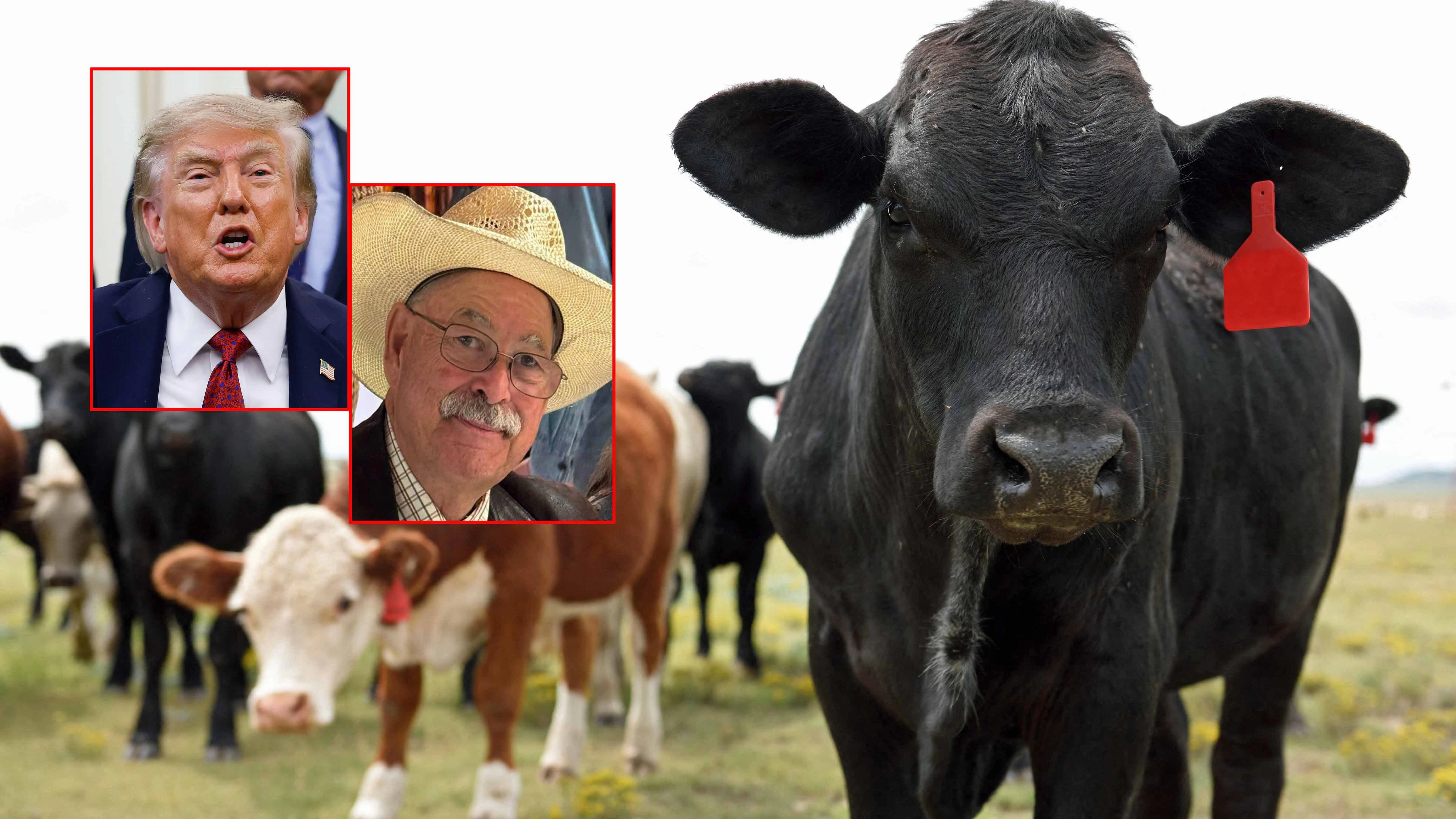
A Wyoming lawmaker and longtime Crook County cattle rancher is fuming after learning that President Donald Trump hosted a Brazillian billionaire at the White House one day before announcing he would temporarily allow an additional 300,000 metric tons of lean beef trimmings to enter the U.S. at a lower tariff rate for 90 days.
Wyoming Rep. Ogden Driskill, R-Devils Tower, said he was stunned to learn that Joesley Batista, co-owner of JBS, the world’s largest meatpacker, met with Trump on Aug. 20 to discuss solutions to the country’s soaring beef prices and record low cattle numbers.
Driskill told Cowboy State Daily he learned about the meeting through social media.
“Guess who has access to the Oval Office?” Driskill blasted on social media after learning of the meeting. “Doesn’t look like a fellow rancher to me.”
The decision has angered Wyoming cattle producers, who say increasing imports could undermine the rebuild of the nation’s shrinking cattle herd.
Driskill's reaction came a day after Wyoming cattle rancher Tyler Lindholm told Cowboy State Daily the president and his advisors don’t understand the U.S. cattle market.
"If they really wanted to do something that would be helpful, they should talk to Wyoming ranchers,” Lindholm said.
The administration said the move was intended to bring down prices for American consumers and that the imported beef would be sold at a 25% discount to the market price.
“I don’t want to say which countries — but there are a few countries — but they’re going to be sending in the highest quality beef, and it’s something that we need,” Trump told the media.
According to a Wall Street Journal report published Monday, Batista urged Trump to reduce the 26% tariff on Brazilian beef. Trump announced the beef-import plan the next day.
Brazil is the world’s largest beef producer, and JBS has a major presence in the U.S. beef industry.
Batista sits on JBS’s board at a time when the meatpacker is consolidating its operations because of the nation’s shrinking cattle herds. JBS is one of the four major meatpackers in the country being investigated for antitrust concerns.
JBS, Tyson Foods, Cargill and National Beef Packing Co. control about 85% of the cattle processing market. Trump referred to the big four as a “nasty monopoly” when he announced late last week he wanted to give small, local producers more opportunity to process and sell their own beef across state lines.
‘Immediate impacts’
For Driskill, the timing of Trump’s meeting with Batista is difficult to ignore.
“It literally cost Wyoming millions of dollars,” he said.
Driskill was serving on a livestock producers board the day after Trump announced the import plan. He said he watched as ranchers pocketed several hundred dollars less per head than they would have before the tariff announcement.
“It has immediate impacts on people’s lives,” Driskill said. “I’m one of those. I make my living off cattle I sell one time a year.”
Driskill sold his calves about a month ago, when cattle prices were at record levels. Ranchers selling cattle now, he said, could receive $400 to $500 less per head.
For a rancher with a 500-cow operation who sells 400 to 500 calves, that difference is significant.
“That decision just cost you a new pickup or the ability to pay off a loan,” he said. “Whose side is (the president) on?”
The U.S. cattle herd has been reduced to its lowest level in about 75 years following years of drought and other pressures on producers. The administration says increasing imports will provide consumers with more affordable beef while ranchers work to rebuild the domestic herd.
Driskill sees the situation differently.
He argues that importing more beef when American ranchers are finally receiving historically high prices could discourage producers from making the long-term investment required to rebuild the cattle supply.
‘What really is happening in the White House?’
Driskill also takes issue with Batista's role in the meatpacking industry.
“He’s a criminal that’s part of our largest beef packing operation,” he said.
Batista and his brother, Wesley, previously admitted to bribing Brazilian politicians in a corruption scandal more than a decade ago, the Wall Street Journal reported.
“What really is happening in the White House?” Driskill said. “Who’s he dealing with and why?”
Driskill said he believes the meeting went beyond a discussion about beef prices.
“It’s pretty obvious the two of them sat and talked about business, not just about beef but about business,” he said. “It’s spooky when you think about it.”
JBS stands to benefit from increased access to the U.S. market at a time when the company is restructuring its domestic operations.
“It breaks my heart that someone who runs these meatpacking monopolies decides the fate of my industry,” Driskill said, “when I who raise Wyoming cattle can’t even get good access within my own government.”
Driskill said he has never had access to the Trump White House despite traveling to Washington, D.C., numerous times to advocate on issues involving meatpackers and the livestock industry.
“We haven’t been able to get any help from the administration,” he said.
Meatpacking industry under pressure
The controversy comes as the meatpacking industry is also adjusting to a shrinking supply of cattle.
JBS announced in June that it would close its beef production facility in Souderton, Pennsylvania, and a value-added facility in Memphis, Tennessee. The company later said beef harvesting and processing there would end Aug. 14, with the facility being converted to a value-added operation.
The company announced in a press release these actions are part of a broader strategy focused on growth, modernization, and long-term competitiveness in the United States.
Batista’s brother, Wesley Batista Filho, spoke on behalf of the company.
Tyson Foods, another of the big four, also announced plans in August to close two facilities and sell another, further reducing domestic processing capacity.
For ranchers, fewer processing plants create another problem.
“What that means when those close is as the beef herds grow, it’s harder for us to kill that beef,” Driskill said.
That could make the United States increasingly dependent on imported beef, he said.
“They could easily displace a huge chunk of our country’s beef market and impact Wyoming’s economy,” Driskill said.
USDA data shows Brazilian beef imports to the United States were up about 10% during the first six months of 2026.
Driskill said he supports some of Trump's efforts to change the beef industry and believes the president has accomplished positive things.
But he said he cannot remain silent when decisions made in Washington could have long-term consequences for ranchers who produce the nation's cattle.
“But I’m not going to sit quietly by when someone causes my industry structural (damage),” Driskill said. “Why can’t we have our voice at the table?”
Kate Meadows can be reached at kate@cowboystatedaily.com.