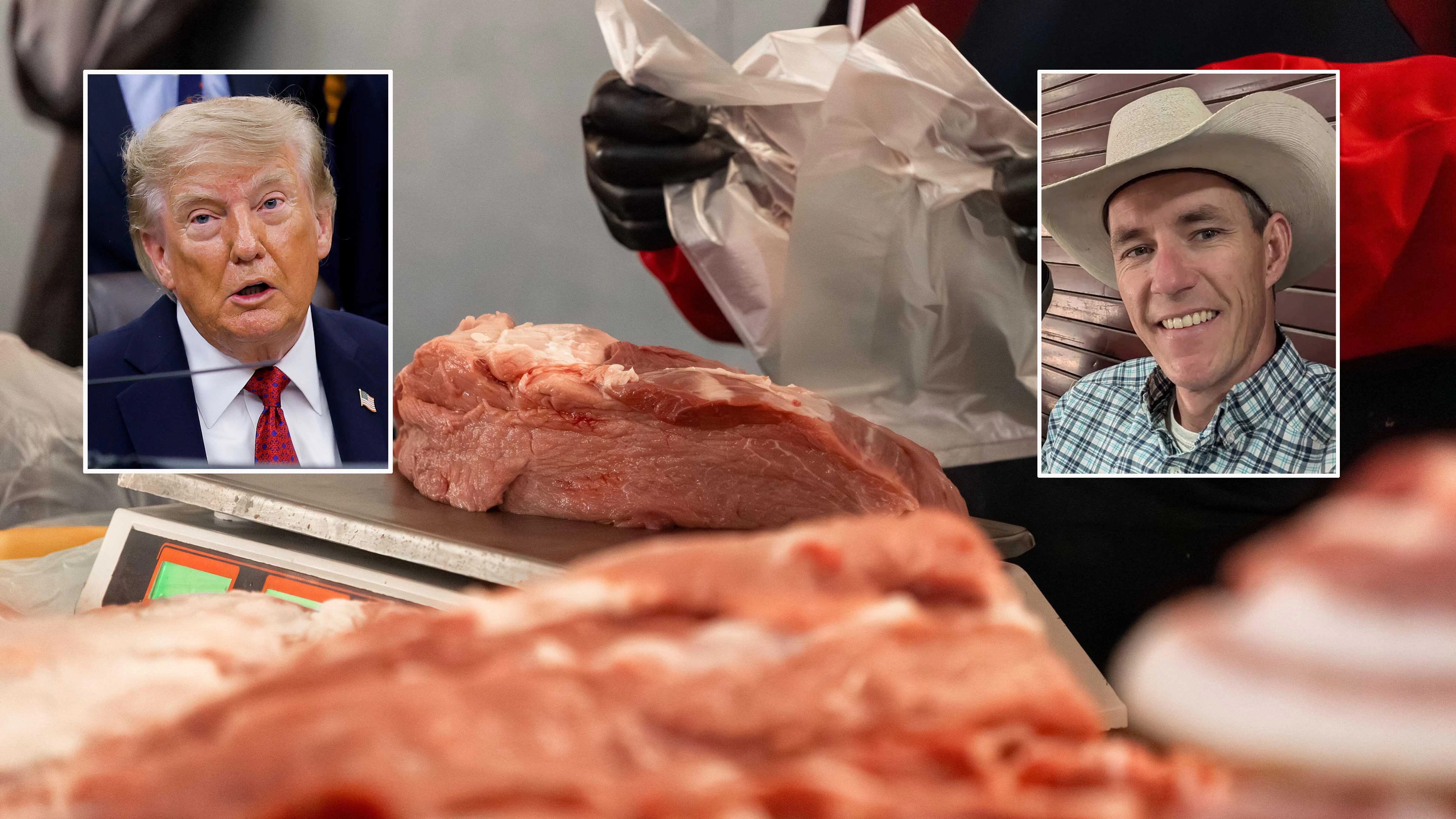
President Donald Trump’s promise to take on what he calls a “nasty monopoly” in the nation’s meat-processing industry could open new opportunities for Wyoming ranchers — but agriculture leaders say exactly how that happens will matter.
Trump announced Friday that his administration intends to make it easier for farmers and ranchers to process their own food, including beef, as part of an effort to increase competition in an industry dominated by four major companies.
The announcement comes as the nation’s cattle herd sits at a 75-year low and beef prices continue to climb.
“Our producers need open and transparent markets, fewer and less burdensome regulations and long-term certainty to grow their herds and businesses,” Rep. Harriet Hageman told Cowboy State Daily in an emailed statement Monday.
U.S. Agriculture Secretary Brooke Rollins followed Trump’s announcement Monday with a series of initiatives aimed at rebuilding what she called the “Great American Beef Herd” and expanding regional meat-processing capacity.
The U.S. Department of Agriculture is creating a SPUR Guaranteed Loan Program to support regional processing, including processor cooperatives and expanded small-business operations, Rollins announced Monday.
The USDA also plans to establish a Regional Processor Continuity Effort geared at strengthening regional processing capacity.
With recent announcements of processing-plant closures, the USDA estimates nearly 20% of beef-processing capacity could become available as the nation’s cattle herd grows.
“This is a tremendous opportunity to shift this capacity toward American-owned independent small, mid-size, and new co-ops and keep our critical meat supply out of the hands of foreign control,” Rollins said in a statement.
But Wyoming agriculture leaders say more details are needed before they can determine how much difference the administration’s plans will make for the state’s cattle producers.
‘Only The Beginning’
In Wyoming, ranchers already can process their own meat for personal use. The difficulty comes when they want to sell it.
Beef intended for commercial sale generally must meet federal inspection and food-safety requirements established by the USDA.
Rollins has indicated that the administration’s upcoming actions could include cutting red tape in meat processing, expanding ranchers’ ability to sell meat across state lines, and rescinding what she called outdated guidance.
Trump, however, has not yet specified which regulations he intends to change.
That uncertainty has Wyoming cattle producers watching closely.
Tyler Lindholm, a former Wyoming lawmaker who has advocated for greater direct-to-consumer meat sales, said he is unimpressed so far.
“Those people around the president don’t understand what’s at play in the cattle market,” Lindholm said in a Monday interview with Cowboy State Daily. "If they really wanted to do something that would be helpful, they should talk to Wyoming ranchers.”
Lindholm and Jim Magagna, executive vice president of the Wyoming Stock Growers Association, both criticized the lack of specifics surrounding Trump’s announcement.
Trump has said the administration is drafting legal documents to implement the plan.
“That’s insanity,” Lindholm said. “What does that mean?”
Magagna said the Stock Growers Association strongly supports allowing interstate sales of locally processed, state-inspected beef.
But he said Trump’s announcement is too vague.
“It’s typical when those statements come out you don’t know what it really means,” Magagna said. “It sounds good but it’s only the beginning as far as we’re concerned.”
Path From Ranch To Table
Lindholm said the administration could have a significant effect on both producers and consumers by changing the federal meat-inspection laws.
Simply providing loans to build processing plants, he said, isn’t enough.
“If (Trump) wants to be remembered as the president who fixed the cattle market, he’s got to fix it by amending the federal meat inspection acts,” Lindholm said.
Wyoming needs more processing capacity, but Lindholm said he believes the most significant change would be allowing ranchers greater ability to sell beef directly to consumers.
“The best thing to ease consumers’ pain at the grocery store is by shortening that market structure – by vertically integrating where more ranchers feel incentivized to go directly to consumers,” Lindholm said. “We will never do that by saying, ‘All you have to do is fill out this mountain of paperwork.’”
Beef prices have steadily climbed since 2021, driven largely by shrinking cattle numbers and strong consumer demand.
At the same time, four companies — Tyson Foods, Cargill, JBS and National Beef — control roughly 85% of U.S. beef processing.
That concentration has drawn scrutiny from federal officials, including a U.S. Department of Justice investigation into possible antitrust issues.
Lindholm said allowing more direct sales could shorten the path between Wyoming ranchers and consumers.
Right now, ranchers commonly sell beef directly to consumers by the whole animal, half or quarter.
That can make direct purchases difficult for lower-income consumers, he said.
A single parent, for example, might not be able to afford a quarter of a beef animal — or have enough freezer space to store it.
“Why are we blocking folks that need a help up from shopping out of a rancher’s freezer?” Lindholm said.
Laura Mengelkamp, a spokesperson for Sen. John Barrasso, said he is in contact with Wyoming’s ranching communities about how the latest administration policies might impact producers.
Safety Remains A Concern
While Wyoming agriculture leaders say more processing options would be welcome, they also caution that food-safety requirements cannot simply disappear.
Magagna said more efficient processing and inspection of locally sourced meat is particularly important in Wyoming.
“We produce far too much beef in Wyoming to eat it all here,” he said.
But meat would still need to be processed and inspected under strict standards.
Loose restrictions would “put our whole industry at risk,” Magagna said.
That’s a sentiment that Mark Eisele, former National Cattleman’s Bee Association president, echoed in his own interview Friday.
“The food safety thing has got to be a big concern,” Eisele said. “If we have one illness or one outbreak, it would just be a black eye to the industry.”
Lindholm said the current system places too many obstacles between ranchers and consumers.
“The cheapest beef that can be bought is from the rancher directly to the consumer,” he said. “We’ve got to get the hell out of their way.”
Wyoming Has Possible Blueprint
One proposal Wyoming ranchers are watching is the PRIME Act, federal legislation introduced by U.S. Rep. Thomas Massie, R-Kentucky, and co-sponsored by Hageman.
Lindholm said passing the PRIME Act could be the single most significant action the Trump administration could take to help Wyoming cattle producers.
The legislation would expand opportunities for smaller processors and local meat sales.
A pilot version of the PRIME Act was included in the Farm Bill that passed the U.S. House in April.
But the Senate Agriculture Committee’s version failed to advance Aug. 6 when committee members voted 10-11 against moving the legislation to the full Senate. Committee leaders plan to revisit the legislation when lawmakers return from their August recess.
Lindholm has argued that allowing more direct sales could increase consumer access to locally raised beef while reducing dependence on foreign beef supplies.
“If Trump really wants to lower prices, then he should get the regulations out of the way and let the states dictate their own futures,” Lindholm has said.
Wyoming has already taken steps in that direction.
State Sen. Tim Salazar, R-Riverton, sponsored a 2024 “trigger” bill that would allow direct-to-consumer sales of uninspected meat if the federal PRIME Act becomes law.
The Wyoming PRIME Act passed the state Senate and would still require meat to be processed by a Wyoming slaughterhouse inspected by the state.
Whether Wyoming facilities would need additional inspections, equipment or employees to qualify for interstate sales will depend on what regulations the federal government ultimately changes.
The Processing Bottleneck
Wyoming has seen an increase in USDA-inspected processing facilities in recent years, but they remain small, Magagna said.
Producers sometimes have to schedule processing a month or two in advance.
The problem, he said, isn't necessarily a lack of facilities. It is a lack of capacity.
Some Wyoming agriculture leaders have discussed the possibility of building a midsize processing facility in the state.
But such projects face significant hurdles.
“Economics haven’t always panned out to where they were able to obtain resources to build a facility,” Magagna said.
Processing plants also need access to workers and other resources, he said, making location important.
“Labor is an issue,” he said.
Community resistance can be another obstacle. Not every community wants a slaughter facility nearby, Magagna said.
That leaves Wyoming ranchers waiting for the Trump administration to fill in the details.
The president’s promise to break up the nation’s meat-processing bottleneck could offer a new path to market for Wyoming beef.
But for producers like Lindholm and Magagna, the question is whether the administration will make meaningful changes to the rules governing who can process beef, who can inspect it and where it can be sold.
For now, they say, the announcement is encouraging, but it is only a beginning.
Kate Meadows can be reached at kate@cowboystatedaily.com.