
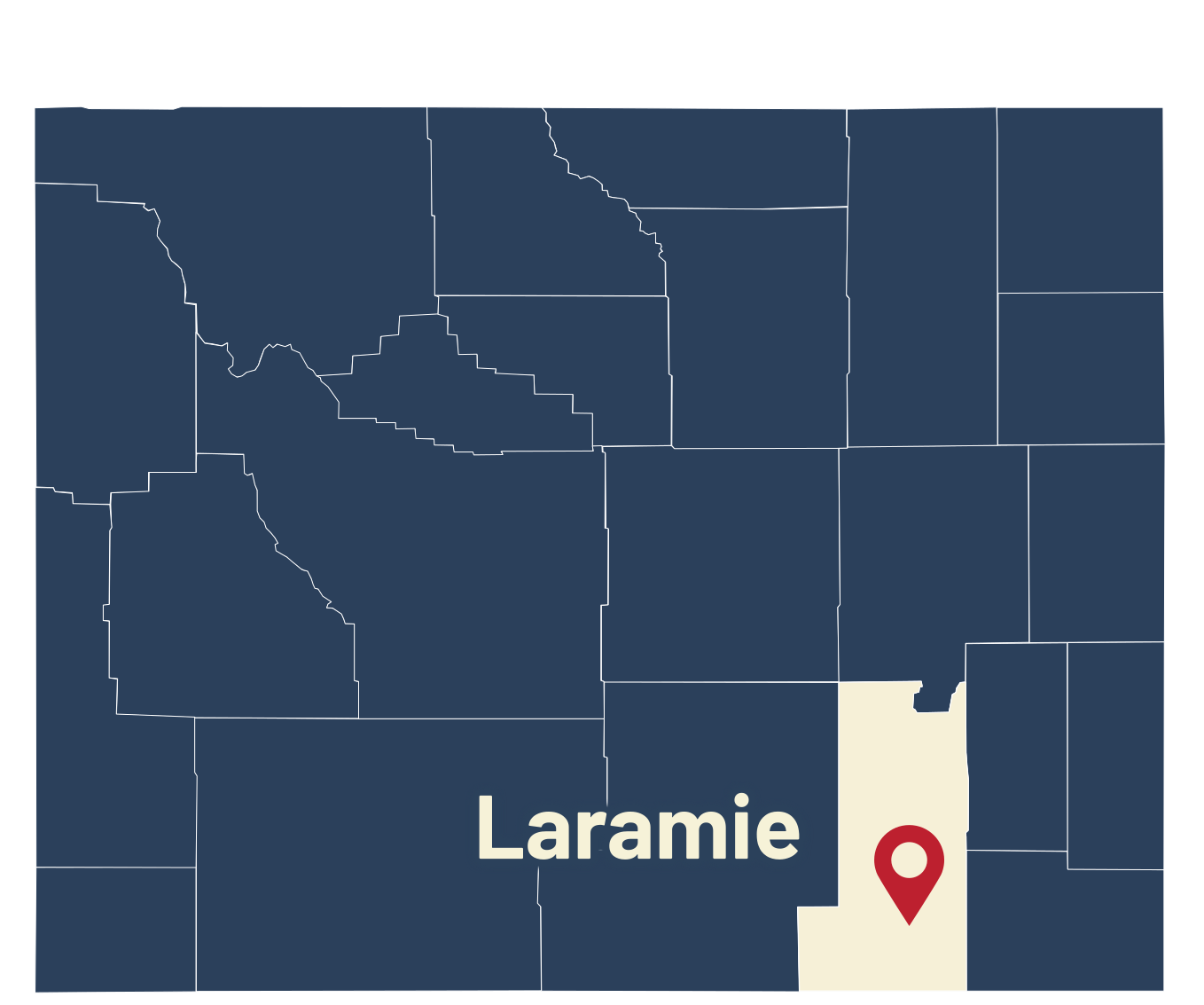
A Laramie-based judge is considering whether one of Wyoming’s most outspoken transgender activists acted in self-defense when racking and pointing a gun toward a man who had just shoved the activist to the ground, and reportedly shouted slurs against LGBT people.
In a case that has drawn the attention of the New York Times, Rihanna Kelver, 28, faces the felony-level charge of aggravated assault in Albany County District Court. The charge is punishable by 10 years in prison, and describes threatening another person with a deadly weapon.
Kelver, through defense attorney Andrew Holcomb, argued in court Wednesday that Kelver acted with reasonable self-defense, and was not the initial aggressor in the incident that unfolded Sept. 13, 2025, outside the Crowbar in Laramie.
Albany County Attorney Kurt Britzius argued back that Kelver started the incident by approaching a group of men aggressively, one hand on a satchel later found to contain a pistol.
Around 20 people watched the hearing, plus five reporters specially credentialed. Kelver testified and called one special investigator with a law enforcement background and self-defense training, Jeffrey Donnell, to testify.
Britzius called two Laramie Police Department officers and one eyewitness to testify.
Albany County Judge Misha Westby said she’d take the argument under consideration and issue a decision quickly.
If the judge dismisses the case, Kelver will no longer be prosecuted. If the judge keeps the case alive, Kelver can still argue self-defense to a jury at a later trial.
Court documents say Kelver was outside the Crowbar when a man, Scott Durham, yelled, according to Kelver’s interview, “Hey, the Crowbar should be closing, you bunch of f*gs.”
Kelver answered with “What the f*** did you just say?” Kelver told police that night.
Urging Onlookers To Walk Away
A video of the incident displayed Wednesday in court shows Kelver striding across the intersection, hand on hip, to face Durham, who was crossing from the opposite side of the street. Durham shoves Kelver to the ground.
Laramie Police Department Officer Seth Meyer testified Wednesday that when he watched the video, he could see Kelver drawing a firearm, and racking it in Durham’s direction. An eyewitness, Brandon Kautz, testified that he heard the gun rack that night and urged onlookers to walk way because they would have been in the line of fire if the gun discharged.
The video shows Kelver gathering possessions that scattered during the fall, walking two-thirds of the way across the crosswalk, turning and bending to retrieve one more object, then leaving the street.
Durham was reportedly with two other men. Kelver described Durham to police as being 5 feet tall, other body camera videos show.
Holcomb said in court Wednesday that at least two of the men were over 6 feet tall.
Kelver also told police repeatedly, and adamantly, that night that it wasn’t a gun drawn, but a knife.
Police never found a knife, officers testified Wednesday. They did find the gun in Kelver’s satchel after Kelver’s employer alerted them to it, and Kelver let an officer retrieve it, according to body camera video and court testimony.
The defendant said giving police incorrect claims about pulling a knife stemmed from a wave of post-traumatic stress disorder from which Kelver was already suffering.
Kelver testified Wednesday that Durham had verbally threatened to harm Kelver just before the incident.
Kelver had not told police about those alleged verbal threats the night of the incident, according to court testimony.
'Threatened Deadly Force'
Holcomb told the court Kelver wasn’t the initial aggressor, and so retained a right to act in self-defense because the evidence shows Durham was the first person to launch a physical attack. Holcomb also noted the higher rates of violence documented against transgender people, and said while that’s not justification to draw a gun, it played into Kelver’s fear and rationalizing the situation as meriting self-defense.
“So when Ms. Kelver heard targeted slurs, heard threats, then was shoved to the ground, her fear did not come from nowhere,” said Holcomb. “It came from the circumstances.”
Britzius countered, noting Kelver’s body language showing one hand on the satchel containing the gun, while Kelver crossed the street toward Durham. The prosecutor also cast Kelver’s response to the shove - reportedly pulling and racking a gun toward Durham - as excessive.
“This was threatened deadly force,” said Britizius. “This was the pulling of a handgun. It was chambered and ready to go.”
When police took the gun later they found a round in the chamber, according to body camera video and testimony shown Wednesday.
Westby questioned Holcomb about Kelver’s body language - arm cocked backward in a 45-degree angle that, Laramie Police Department Officer Seth Meyer testified, is associated with retrieving an object or weapon, and tends to put responding law enforcement on high alert when encountered on the job.
The judge asked whether that should factor into her analysis of who launched the attack.
Holcomb pointed back to Durham’s shove, which Kelver testified resulted a bulging spinal disk.
Britzius in his closing statement asserted, “Ms. Kelver cannot assert self-defense for a situation she created.”
Westby parried.
“The case law seems to allow that,” said the judge. She asked when her analysis of Kelver’s threat perception should start.
The video shows that after Durham shoved Kelver, he walked away from Kelver almost instantly. Durham’s shove appears almost in stride with his general trajectory out of Kelver’s way.
But on the ground, in pain, looking up at three men, Kelver wasn’t in a position to rationalize clearly that the threat was over, Holcomb insisted.
More From Court
Kelver’s expert witness, Donnell, testified that for the circumstances unfolding in real time, Kelver behaved with reasonable self-defense.
“Do you believe Ms. Kelver had a realistic option of retreat at the moment she drew the firearm?” asked Holcomb.
“No,” answered Donnell.
“Would Ms. Kelver have had that same ability to play, repeat, make and informed decision (as those viewing the video after the fact)?” asked Holcomb.
“No,” answered Donnell.
“Why is hindsight dangerous?” Holcomb asked.
“These decisions have to be made in a split second,” answered Donnell.
Britzius called Kautz to testify as an eyewitness.
Kautz said he had gone to a University of Wyoming football game that day, started drinking during the game, and had gone out to the bars with friends when he heard shouting in the street.
He rounded a corner to find “two dudes” already shouting at each other, though he didn’t recall what they said, Kautz testified.
He said the “one guy” in front of the bar approached the “other guys” across the street and came within two or three feet of one of the men in the group.
Kautz said he believes from contextual evidence that the man in the group, identified as Durham, shoved the person who’d approached, but he was distracted in the crowd and missed that part, he said.
But Kautz testified that he distinctly heard the gun rack. He urged his girlfriend and others to “keep walking” because they would have been in the line of fire, he testified.
Back And Forth With The Cops
Holcomb asked both Meyer, and Laramie Police Department Officer Hunter Rope, whether they’d pull their guns in defensive situations.
If it rose to that level, both officers answered during their turns on the witness stand.
Holcomb asked Meyer whether he’d draw his gun to deter someone, and Meyer said he would not; he’d only draw if the circumstances met the threshold for returning deadly force, he said.
Holcomb also asked Meyer whether he was familiar with Kelver.
Meyer said he was not.
Holcomb pressed, asking if Meyer knows whether Kelver might keep one hand on a hip while waiting tables or tending bar.
Meyer conceded he’s not familiar enough with Kelver to make that call.
Kelver delivered a testimony that turned tearful occasionally, speaking of great fear and pain after being shoved to the ground.
A Little Law
Wyoming self-defense laws say a person who’s not the initial aggressor or behaving illegally, in a place they have a legal right to occupy, does not have a duty to retreat from a dangerous altercation rather than use force.
People are justified in using force if they do so in means a person in their shoes would find reasonable, and use no more than necessary to prevent the injury or loss they honestly perceive, whether that danger is real or apparent.
Judges are barred from allowing the state to prosecute someone who acted in reasonable self-defense.
To address this sort of pre-trial relief, Wyoming’s judicial branch has made a hearing style where the defendant argues he or she acted in self-defense, and the state argues otherwise.
The defendant has to make a “prima facie,” or at-first-glance showing of that self-defense. To overcome it, the state has to show by the preponderance of the evidence, which is a tougher standard of proof.
Wyoming calls these “John’s hearings” after their founding case State v. John.
The Protest
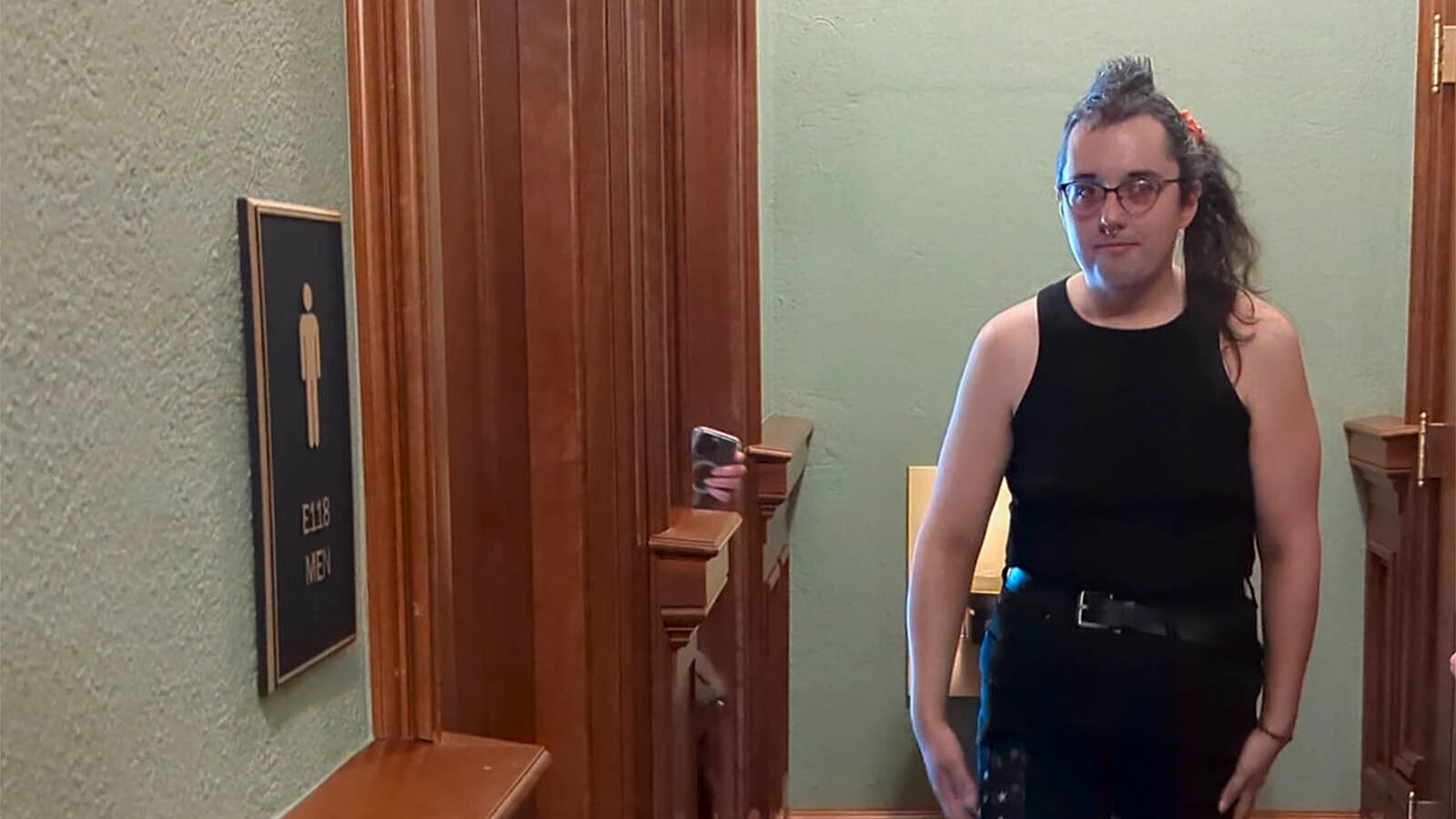
Kelver protested a new Wyoming ban on transgender use of public bathrooms last summer by using the women's bathroom at the state Capitol.
A person with Kelver at the time made sure no females were in the bathroom. That act technically removed any means Wyomingites would have had to enforce the law.
That's because the law doesn't punish transgender people. It subjects the public to lawsuit.
A female aggrieved by a male using the public women's bathroom or changing facility may, under that law, sue the governmental entity for allowing that to happen.
Clair McFarland can be reached at clair@cowboystatedaily.com.


