
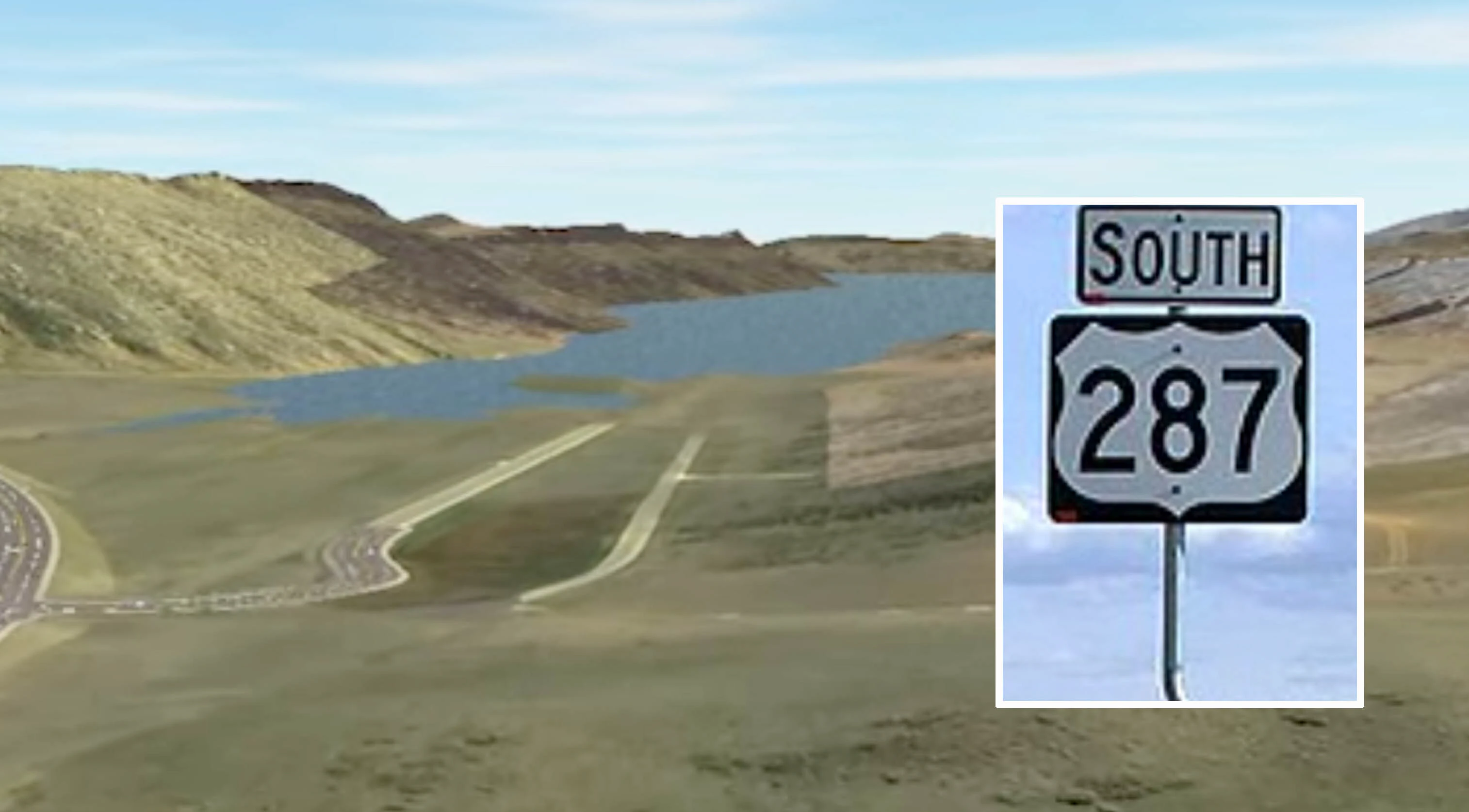
Someday, on the familiar run south from Laramie to Fort Collins, drivers on U.S. Highway 287 will crest a ridge in northern Colorado and look down on a sprawling blue reservoir.
Somewhere beneath it — under more than 200 feet of water — will be the highway they once drove.
The asphalt of the old Laramie-to-Fort Collins road will disappear beneath Glade Reservoir, a massive new body of water northwest of Fort Collins that Colorado developers have spent more than two decades fighting to build.
Northern Water, the public water agency overseeing the project, is building Glade as part of a $2.7 billion system designed to provide municipal water to growing cities and water districts across Northern Colorado.
Before they can fill it, they have to move the road.
"The old highway will be basically at the bottom of the reservoir," Northern Water spokesman Jeff Stahla told Cowboy State Daily on Tuesday.
The agency says approximately seven miles of U.S. 287 will be realigned east to make room for Glade Reservoir. Stahla said the work includes only a couple miles of entirely new roadway but will replace about 4½ miles of the existing route.
The new highway will remain two lanes and continue carrying traffic between Laramie and Fort Collins. It will be finished before the existing highway closes, Northern Water says.
Construction on the road is expected to begin in late 2027, Stahla said.
Wyoming Isn't Losing 287
Colorado is not rerouting U.S. 287 away from Wyoming.
An initial proposal was much more dramatic. A 2020 study examined moving U.S. 287 through Owl Canyon toward Interstate 25, a change that would have significantly altered the long-familiar and notorious Laramie-Fort Collins connection.
CDOT walked away from it.
Region 4 Communications Manager Jared Fiel told Cowboy State Daily the Owl Canyon concept was dropped because of the additional traffic and strain it could place on surrounding Larimer County infrastructure and because Fort Collins and Larimer County did not support it.
As far as CDOT is concerned, U.S. 287 will keep tying Laramie to Fort Collins for the long haul.
It just has to move over.
One Ridge East
Today, U.S. 287 drops through a dry valley north of Fort Collins, with ridges rising around the highway as it works toward Wyoming.
Glade Reservoir will occupy that valley.
Northern Water plans to build the dam across it, Stahla said, leaving the highway sitting where the reservoir needs to be.
To do so, engineers will shift U.S. 287 one ridge east, onto ground where no highway exists today.
For part of the drive, that ridge will actually hide Glade Reservoir from motorists on the relocated highway.
Then, heading north toward Wyoming, the road will curl around and cross the ridge.
"Then yes, drivers will be able to see the reservoir basically down that valley," Stahla said.
Today, U.S. 287 and Colorado Highway 14 share pavement north of Fort Collins until Ted's Place, where Highway 14 heads west toward Poudre Canyon while U.S. 287 continues north toward Laramie.
That split will move.
Stahla said the routes will separate farther east around North Overland Trail Road. Highway 14 will continue toward the reservoir and Poudre Canyon while relocated U.S. 287 swings north toward Wyoming.
Here Comes The Water
Glade Reservoir will not be a small lake tucked beside the highway.
Northern Water plans a reservoir roughly 5 miles long, capable of holding 170,000 acre-feet of water and reaching a maximum depth of about 280 feet.
Its storage capacity would make it slightly larger than nearby Horsetooth Reservoir.
Glade is an off-channel reservoir, meaning it is not being created simply by damming the Cache la Poudre River.
Instead, water will be diverted primarily during high spring runoff and moved roughly 2 miles through an inlet canal, forebay and pump plant before entering Glade.
The reservoir is the centerpiece of the Northern Integrated Supply Project, or NISP, which is designed to provide participating Northern Colorado municipal water providers with up to 40,000 acre-feet of new water annually.
The current estimated price tag for the project is $2.7 billion.
"The payers are the participants of the project," Stahla said. "It is those communities that are going to be getting water from the project (that)are paying for the highway to be moved."
More Than 20 Years
None of this happened quickly.
NISP has spent more than two decades crawling through environmental studies, public hearings, government approvals and court fights over what should happen to water in the river.
The federal environmental review dates to 2004. The U.S. Army Corps of Engineers issued its Clean Water Act Section 404 permit decision in December 2022.
Larimer County had already approved the land-use permit for Glade Reservoir, pipelines and recreation components in 2020.
The legal fight continued.
The environmental group Save the Poudre sued the Army Corps in federal court in January 2024, challenging its approval of NISP.
The case ended in a settlement with Northern Water in February 2025.
Under that agreement, Save the Poudre agreed to dismiss the federal case with prejudice, while NISP participants committed $100 million over two decades toward projects intended to benefit the Poudre River, including wildlife, recreation and water-quality improvements.
Northern Water says the project will primarily draw water during high spring flows and includes environmental protections and adaptive management intended to reduce impacts on the river.
This May, the Colorado Supreme Court unanimously ruled that the NISP enterprise has statutory eminent-domain authority, rejecting a challenge from a landowner fighting condemnation of easements for NISP pipelines and related infrastructure.
After all of that — more than 20 years of studies, permits and litigation — the project is finally moving toward the part where heavy equipment starts rearranging the landscape.
Brand-New Dirt
Major construction on Glade Reservoir is expected to begin in early 2028, Stahla said.
Building the dam should take about four years.
Northern Water hopes to begin slowly putting water into Glade during the 2032 runoff season while engineers conduct dam-safety testing. More substantial filling is anticipated in 2033 and 2034, Stahla said.
The unusual part is how the replacement highway gets built.
"This is a stretch of highway that is being built across basically ... unbroken territory," Stahla said.
Because the road is moving off the existing alignment, crews can build much of it across undeveloped ground while traffic continues using the old highway nearby.
That means they won't be rebuilding miles of roadway one lane at a time while funneling traffic directly through the middle of construction.
"Because it is not being used yet, they can build it faster and not have to worry about ... what is the current traffic situation," Stahla said.
Northern Water says the replacement will be complete before the existing highway closes.
'Highway Of Death'
U.S. 287 makes a roughly 65-mile run between Laramie and Fort Collins, carrying college students, commuters, semitrucks, Border War football traffic and generations of Wyoming families headed south to shop, catch a flight or simply spend a Saturday somewhere warmer.
It also carries a reputation.
Cowboy State Daily previously chronicled the corridor as the "Highway of Death", a name earned through decades of horrific wrecks along a road that can look deceptively easy until weather, wildlife, speed or one bad decision turns it into something else.
Between 2015 and 2024, the 25-mile Wyoming stretch from Laramie to the Colorado state line recorded 545 crashes. Eleven were fatal, killing 13 people, WYDOT statistics previously provided to Cowboy State Daily show.
The Colorado side has been similarly unforgiving. The roughly 30 miles south of the state line recorded hundreds more crashes, including 13 that killed 18 people between 2017 and 2024, CDOT data previously provided to Cowboy State Daily show.
Colorado now has a $65 million safety project underway from Ted's Place north to Wyoming, adding passing lanes, widening shoulders, improving intersections, installing wildlife fencing and resurfacing pavement through 2028.
WYDOT began widening its end south of Laramie in May, turning the two-lane highway between Huron Street and City Ranch Road into four travel lanes with a center turn lane. The agency expects to finish the work this fall, weather and materials permitting.
So while Wyoming widens 287 and Colorado tries to make it safer, several miles farther south another crew will soon tackle a more unique challenge:
The highway is in the way of a future lake.
Kolby Fedore can be reached at kolby@cowboystatedaily.com.


