
In the early territorial days of Wyoming, necessity functioned as the ruthless mother of invention.
Sitting at the apex of the continent, Wyoming serves as the headwaters for three major river systems — the Missouri, the Columbia, and the Colorado — yet faces a brutal scarcity of water.
In response, early Wyoming did not wait for federal bureaucracies.
The territory and State of Wyoming single-handedly invented the doctrine of prior appropriation, enforcing this revolutionary framework.
This stands as innovative law, within the American framework, at its absolute finest, subsequently copied throughout the American West and the entire arid world.
Legal titans like Dean Frank Trelease later cemented Wyoming as the undisputed global pioneer of water law.
Today, facing a new existential scarcity, the rapid erosion of humanity in the face of AI, Wyoming must once again become a preeminent innovator of the law.
The modern Artificial Intelligence empire operates on a dual axis.
Silicon Valley represents the ethereal brains of the operation, where tech oligarchs write autonomous algorithms and invent legal fictions to evade civil liability.
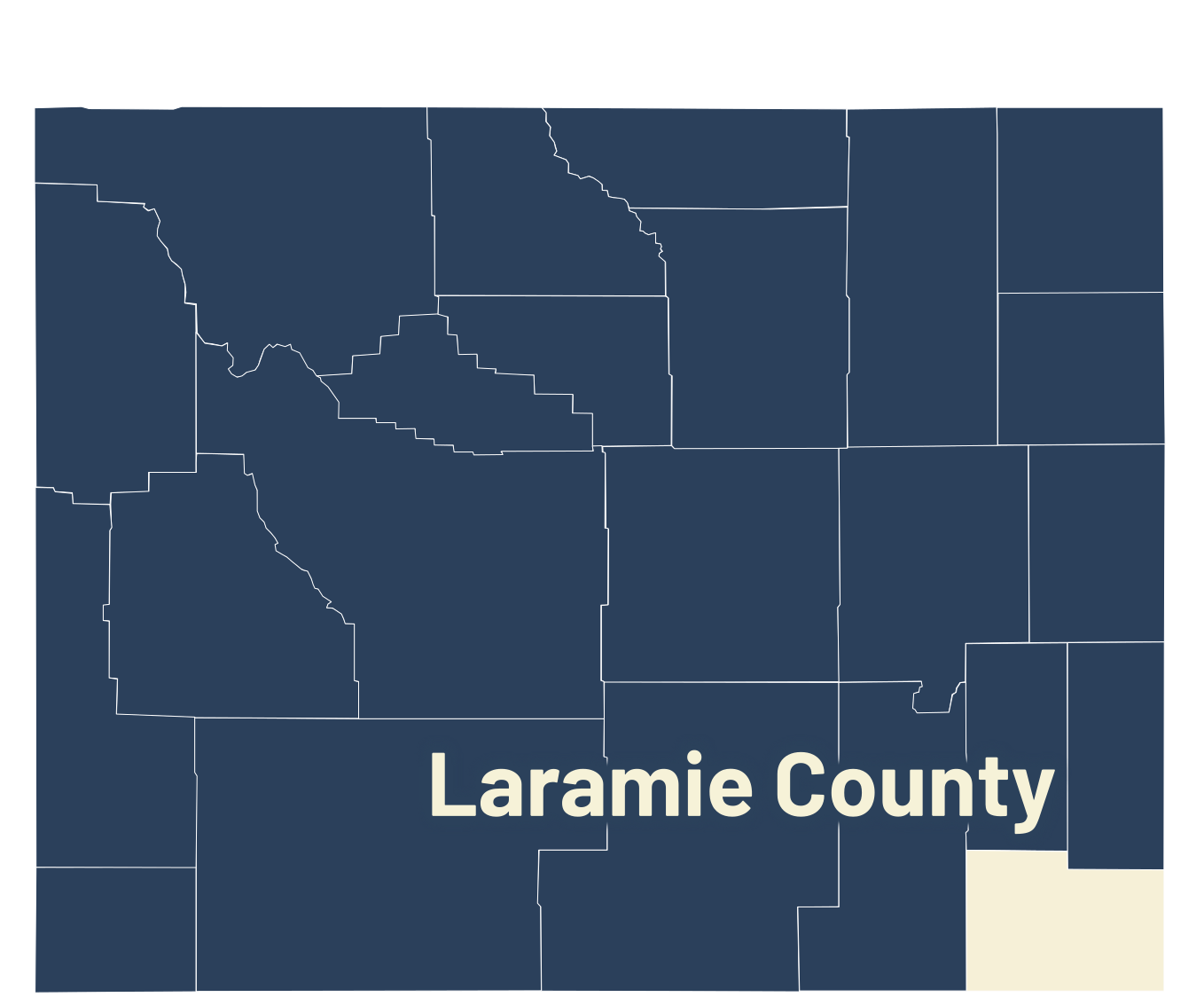
On the opposite end sits Cheyenne, Wyoming, representing the indispensable physical embodiment of AI data centers.
Massive hyperscale data centers currently flood our borders, positioning Wyoming as the preeminent location for AI infrastructure in the entire world.
Silicon Valley algorithms require immense amounts of our local land, water, and electricity.
This physical reality creates a massive corporate dependency and grants Wyoming a historic opportunity and a moral necessity to save the world from runaway AI.
We must build a fortress of new AI law that protects our citizens, establishing a dominant legal model the rest of the world can copy to defend its own rights.
To humanely anchor this technology, we return to the foundational architecture of human sovereignty.
The architects of the republic understood the absolute necessity of keeping ultimate power squarely in the hands of ordinary citizens.
Thomas Jefferson famously identifies this vital mechanism in 1789: "I consider trial by jury as the only anchor ever yet imagined by man, by which a government can be held to the principles of its constitution."
The Founders explicitly entrust the profound judgments of life, liberty, and property to twelve laymen.
We must put the weapon directly back into their hands by reviving the ancient Roman law principle where every citizen effectively serves as his own attorney general.
We cannot rely on underfunded and subverted bureaucracies to police three-trillion-dollar monopolies. We must guarantee an absolute Private Right of Action for every individual.
However, this ancient right means nothing without a champion to wield it.
The most important guardian of our liberty remains the humble trial lawyer. When tech elites unleash autonomous algorithms that systematically deprive individuals of their rights, you do not send a bureaucrat to fight them; you send a trial lawyer.
They stand as the indispensable bridge between the wronged citizen and the raw power of the jury box.
Yet, the trial lawyer cannot defend the public if the courtroom doors remain procedurally barred.
To take on AI, we must fiercely rein in the abuse of summary judgment.
Tech conglomerates weaponize summary judgment as a procedural guillotine, convincing judges to dismiss complex cases based on algorithmic affidavits before a jury ever hears the facts. We must statutorily restrict summary judgment in AI litigation.
The fundamental questions of algorithmic harm, systemic bias, and human agency belong exclusively to the jury. We must ensure the citizen can successfully hire a lawyer, survive procedural hurdles, and drag the digital oligarchs into a public courtroom.
Once in that courtroom, we weaponize the law into an instrument of absolute deterrence.
We empower citizens and their trial lawyers to seek statutory punitive damages set by percentages of a corporation’s global gross revenue.
If an executive deploys harmful code, they face strict liability.
When a trial lawyer strikes, the corporation does not pay a fine out of petty cash; it forfeits the enterprise.
Furthermore, we abolish the foundational error of modern tech law: treating data as a malleable privacy interest easily waived by a deceptive agreement.
Applying strict textualism, we recognize that an individual's digital footprint constitutes absolute, tangible property.
When an AI company scrapes this data without explicit compensation, it commits the ancient common-law tort of trespass to chattels.
By defining data strictly as property, we arm the trial lawyer to pierce the algorithmic veil.
We also universally adopt the upcoming Wyoming statutory standard: using an AI system to commit an offense never serves as a defense. If you build the engine, you own the damage.
Finally, Wyoming must reasonably wield its sovereign authority over physical infrastructure.
We do not view the taxation of AI as a punitive weapon designed to destroy the industry; rather, we reasonably tax AI to support the exact local infrastructure these massive data centers strain.
We treat algorithmic processing as a new frontier that augments our traditional severance taxes over time.
The immense energy required also bolsters our existing energy severance taxes.
Furthermore, adequately fueling these data centers likely necessitates localized nuclear energy, which carries specialized, unforgiving requirements.
Consequently, we must implement a targeted tax structure on nuclear generation to ensure we build the precise infrastructure needed to manage it completely and safely.
We must forge an international compact based on this Wyoming standard, demanding an unbending bright-line rule: no jurisdiction grants a single kilowatt of electricity to any AI project unless the corporate entity submits to algorithmic transparency, pays its reasonable infrastructure share, and waives legal immunity.
Wyoming must control the physical resources AI requires to survive.
If the tech elite refuse to submit to citizen enforcement and the American jury, we flip the switch and plunge their servers into total darkness.
The concrete tools of our defense sit right in front of us. We must wield these tools for our survival before it is too late.
Fred Harrison is an attorney in Cheyenne and served in the Wyoming Legislature from 1982 - 1992.
He can be reached at: Fred.Harrison@fjhlawoffice.com