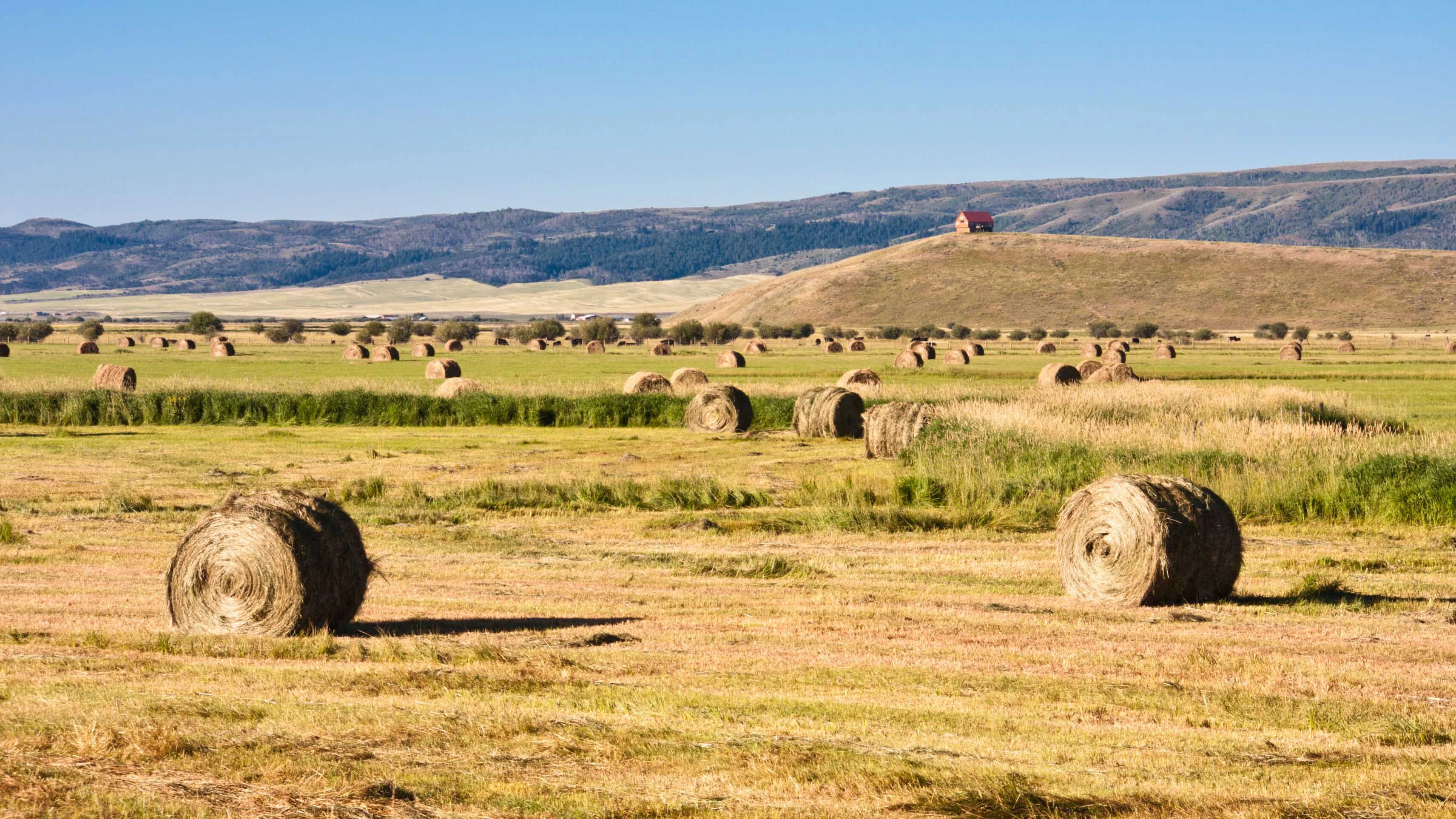
Many Wyoming ranchers are struggling with an existential problem that’s completely out of their control. Hay has become harder to find, harder to grow, and more expensive to buy.
With the lack of rain and ongoing drought, it’s harder to grow hay for feeding Wyoming’s cattle, horses and other livestock. Ranchers who have historically harvested their own hay might have to purchase it to keep their animals fed, and prices are constantly creeping upward.
In the short term, it’s enough to make ranching difficult. In the long term, some say, it could hasten the end of many family farms and ranches that can’t afford to feed their animals.
“If it’s not a problem now, it’s going to be,” said Dennis Sun, publisher of the Wyoming Livestock Roundup. “Some people are looking to sell cattle because they’re afraid they can't get the hay to feed them.”
Not A Hay Day
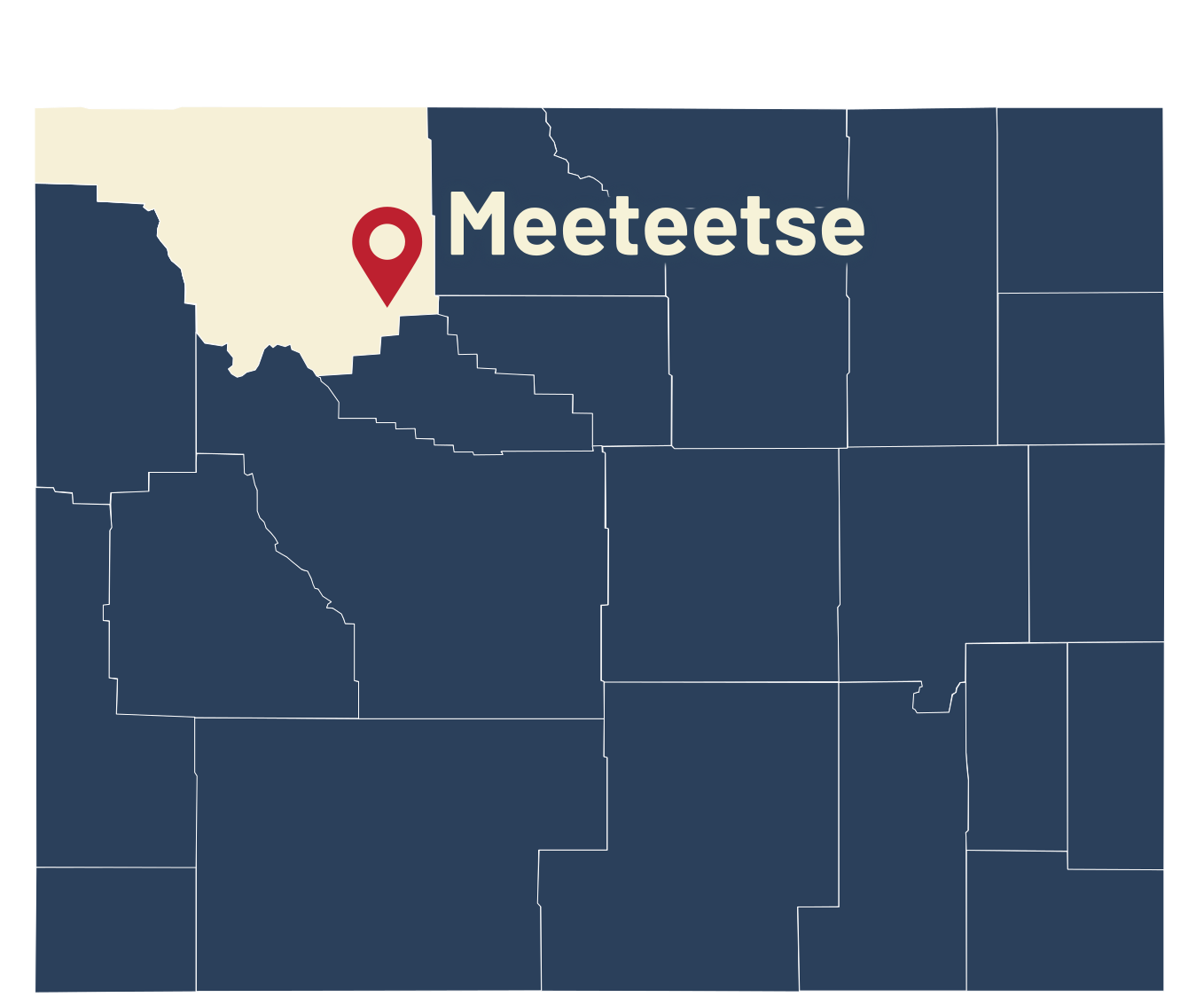
Meeteetse resident Mitchell Huene works with Cowboys with a Mission, a nonprofit that runs two annual Bible schools teaching kids to ride, brand, lay irrigation pipes, and understand “where their food comes from.”
“Whatever anybody needs us to do, we'll do,” he told Cowboy State Daily. “To facilitate that, we've got 43 horses we need to feed.”
In the past, Cowboys with a Mission got its hay from the Pitchfork Ranch. Huene learned in May that the ranch wouldn’t be able to supply them this summer.
“Because of how bad the winter was, nobody in the area has any grass,” he said. “They're grazing their hay fields at the Pitchfork.”
They found a new supplier near Powell that had enough hay in their price range. However, that deal fell through last week.
“There wasn't as much hay coming off the fields as he thought, and he had other customers to take care of first,” Huene said. “That was a bit of a problem for us, because we had about 10 days’ worth of hay left at that point.”
When Huene first arrived in Meeteetse 12 years ago, he was paying $100 per ton of hay. Last summer, it was $150 per ton.
This summer, finding hay for less than $200 per ton is a bargain, and even that’s a rare find.
“We’re seeing hay going for $300 to $350 per ton on Facebook Marketplace,” Huene said. “There was some hay down in Thermopolis posted for $450 a ton this morning. We're a nonprofit, so we're not exactly rolling in dough, and that’s three times what we were paying last year.”
Huene has heard similar stories from ranchers across Wyoming. They either can't produce enough hay or are worried about affording enough hay.
“One hay producer in the area said he got 250 tons off a field last year,” he said. “He got 100 off of it this year.”
No Hay, No Way
Hay is essential to Wyoming’s agricultural industry. Animals need it, and ranchers need to make sure they’re amply supplied to feed their livestock throughout the year.
The year so far has been a struggle for ranchers across the state.
“Most ranchers produce their own hay,” Sun said. “When there’s a drought, there’s not much going on. I'm hearing that ranchers aren’t getting enough water to put up their usual amount of hay.”
By Sun’s estimate, a 1,000-pound cow needs at least 20 pounds of hay every day, assuming it’s grazing and has its diet supplemented with other sources such as grain or corn.
A cow that isn’t grazing will need around 25 pounds of hay per day.
Many ranchers have reliably produced enough hay to keep their livestock well fed. Anything extra can be sold or stored.
That hasn’t been the case this summer. Sun has heard reports of ranchers who’ve only had a quarter of their usual tonnage.
“They'll either have to start selling livestock or buying hay,” he said. “It’s better when you can buy at $100 or $150 per ton, but you're not going to see any hay like that this summer.”
It Gets Worse
Jason Watts, co-owner of HayWerks in Buffalo, has been crunching the numbers. Overall, they aren’t good.
“Overall assessment for hay in Wyoming is down 60-70% of a normal year over a 10-year period,” he said. “Certain areas in Wyoming are much worse than other areas where snow packs were moderate this spring.”
One of Watts’s largest customers is the HF Bar Ranch near Buffalo. They typically order between 250 to 275 tons of hay per year to feed 200 horses.
On July 1, they ordered an additional 300 tons of hay.
“They began feeding their horses in late June this year because the pastures were too dry to graze during the summer months,” Watts said. “Now, take this example of one customer and how they are handling the hay situation and multiply this across Wyoming.”
Watts managed to meet the HF Bar Ranch’s order by studying drought maps and finding an area that had enough moisture to grow a surplus of hay. He found growers in North Dakota that could meet the ranch’s needs.
“Delivered prices this year are $125 a ton higher over 2025 prices,” he said. “I arranged transportation and began shipping hay (from Fargo, North Dakota) to the HF Bar Ranch. That’s 625 miles, one way.”
That’s a hefty cost for any ranch, but larger ranches have an easier time footing the bill. That usually isn’t an option for smaller ranches, or even people with small acreages with a handful of horses.
Watts said he works in a “small hay world,” selling only a few thousand tons of hay each year. That’s why he finds the current situation so concerning.
“I cannot imagine, on a state level, how much hay is needed to feed privately owned livestock,” he said. “Customers are scrambling to dig deep into their bank accounts to buy hay and keep the livestock they own.”
Grass Isn’t Greener
According to Watts, the HF Bar Ranch needed hay because there was no grass in its pastures. That, too, is a universal problem and growing concern.
“In a lot of places, there's no grass in the hills for the cattle to winter on,” Sun said. “If there’s no grass, you’re going to have to feed them more hay.”
It’s particularly bad for areas recovering from recent wildfires. Sun knows of several ranchers who have little to no hope of seeing any grass this year.
“If they got really affected by the fires last summer, there’s no new grass coming in where the fire was,” he said. “That’s going to make hay even more expensive.”
Even if a rancher can only buy at $450 per ton, they’ll be paying much more. According to Sun, that money covers the hay only.
“That doesn't cover the high cost of trucking it in from some place that does have hay,” he said. “For ranchers in droughty areas, it doesn’t look good at all, and that’s probably over half of Wyoming.”
Kitchen Table Decisions
Right now, the hay feeding Wyoming’s livestock is probably from out-of-state. Watts said importing hay from neighboring states “might” be enough to stabilize Wyoming, if only temporarily.
“Folks in Montana and North Dakota ship hay into eastern Wyoming,” he said. “Eastern Idaho has hay that will likely end up in western Wyoming. It’s the central and southeastern area of Wyoming that I cannot predict how they will improve on hay supply.”
Central and southeastern Wyoming are struggling because they’re competing with Colorado, Watts said, adding that Colorado is “pulling a lot of hay from multiple surrounding states” to cover its own crop losses.
While the pressure is certainly being felt now, Watts said he thinks the severity of Wyoming’s hay situation will come to a head this fall.
“When calves are taken to market, the decision to buy hay or sell (livestock) will be the topic at many kitchen tables,” he said.
That will be the reality unless something changes. And something can still change to improve the outlook.
“There's not going to be much improvement unless we get some of these monsoon rains,” he said.
Sun referred to 2025 as an example of a recent turnaround. The rains “stopped” in July and August, and it stayed dry until October.
“I had pastures with six inches of green grass in them in October,” he said. “These things can happen at any time, but they need to happen.”
Monsoonal rains are in Wyoming’s forecast, but favorable weather is never guaranteed. Sun is looking at this week’s forecast with increasing concern.
“If we don't get it here in the next few days, and it goes back to 98 degrees during the day next week, that’ll be a problem,” he said. “You don't want to stop doing your rain dances.”
“It’ll Break Us”
Faced with a growing shortage of hay, Huene turned to Facebook to see if anyone had anything extra that they’d be willing to sell at a reasonable price.
“The worst they can do is say no or ignore you,” he said. “They can't take away your birthday, right?”
Cowboys with a Mission has found a hay supplier in Bozeman, Montana, able to deliver for $310 per ton. Huene said that’s the best they can do for now, but he knows it isn’t sustainable.
“If that's the route we're going to have to go, it’s pretty well going to break us,” he said. “If anyone wants to help a registered nonprofit, we’re still hurting for hay. It’s brutal.”
Andrew Rossi can be reached at arossi@cowboystatedaily.com.