
When does a reckless act in Yellowstone National Park qualify as child endangerment? It’s a question many people are asking after recent events in the park.
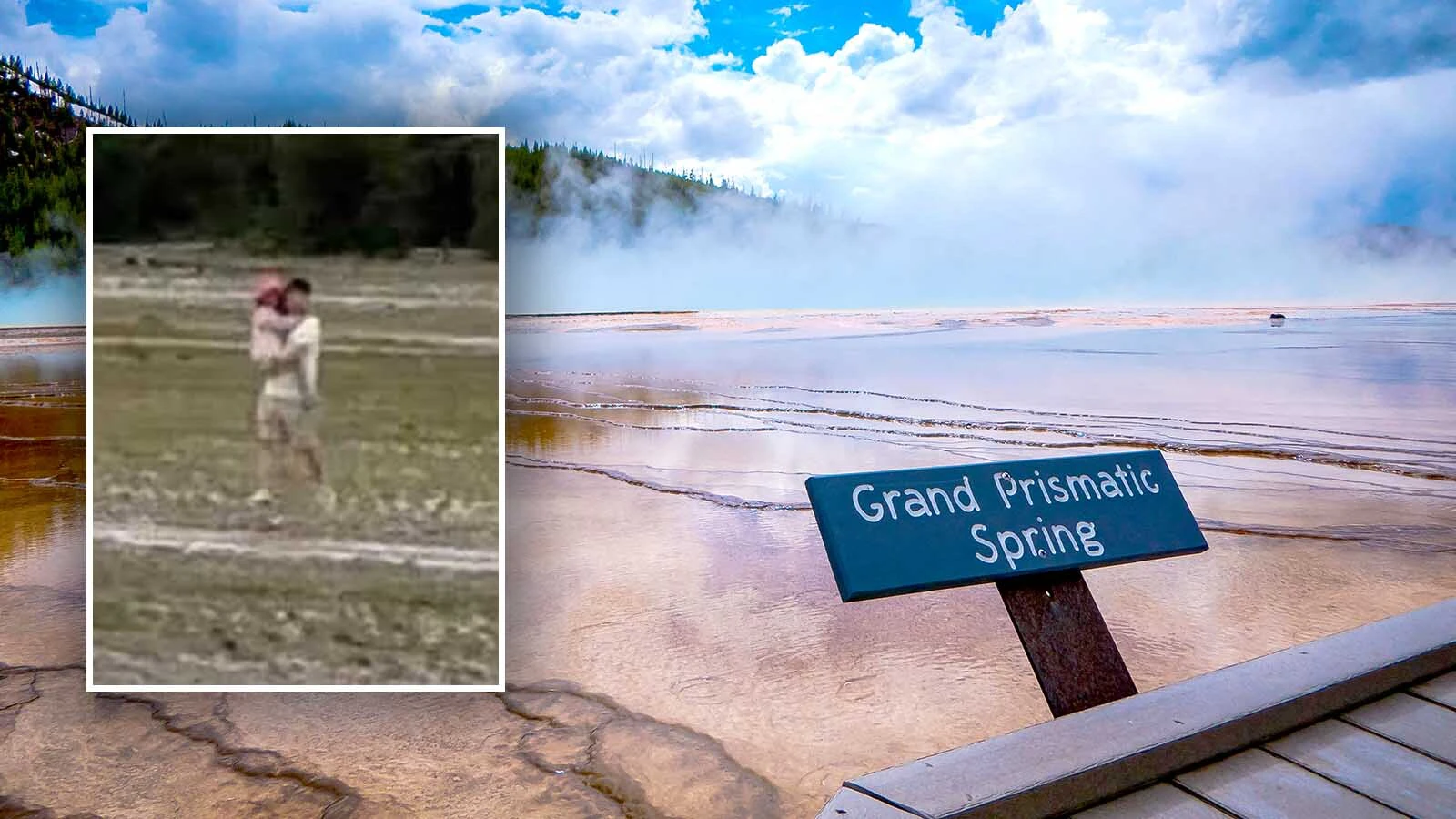
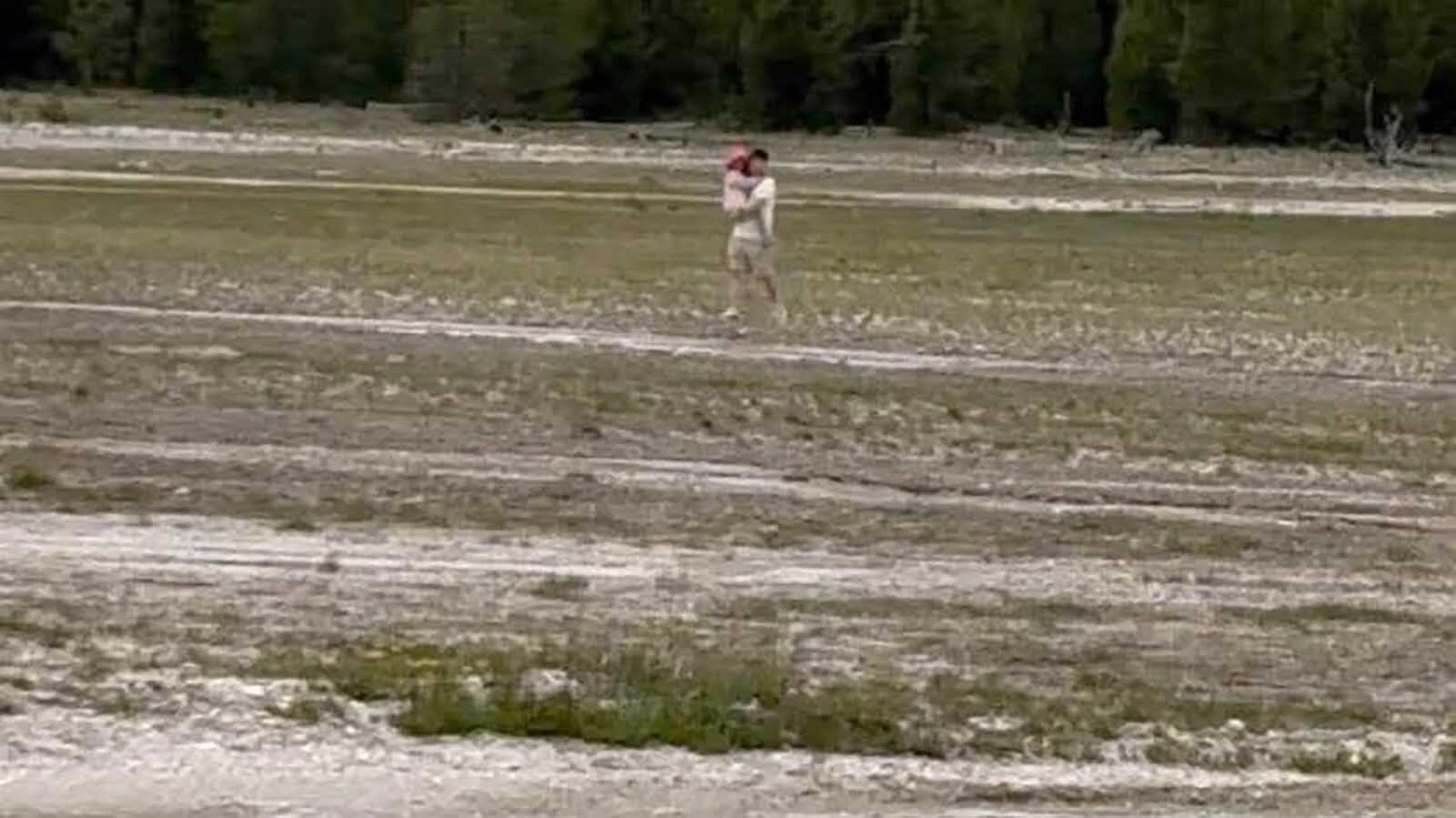
A photo circulating on social media shows a man carrying a child off the boardwalk in one of Yellowstone’s thermal basins. The photographer, Babi Lama, said he witnessed the incident near Grand Prismatic Spring.
"Dude is HOLDING HIS CHILD while walking around the thermal pools at Grand Prismatic Spring," he wrote. "What the hell is wrong with people?"
This follows the June 26 incident where a 12-year-old was injured by a bison near Mud Volcano.
Yellowstone visitors of all stripes are routinely cited for thermal trespass, disturbing wildlife, approaching wildlife illegally, and disorderly conduct. If any of these incidents involve a child, can the perpetrator be charged with child endangerment?
All The Signs
Greg Jackson is a former deputy chief for the U.S. Park Service’s Division of Law Enforcement, Security and Emergency Services in Washington, D.C. During his career, he was presented with several situations where a child endangerment charge was merited.
“I’ve done it before,” he said. “There are a lot of things that parents do that are placing children in danger but aren't necessarily obvious to them at the moment.”
After viewing the photo of the child-carrying man in Yellowstone, Jackson had several questions that would have factored into any citation.
“Generally, (Yellowstone) tries to prevent people from walking into hazardous areas,” he said. “I’m guessing there’s some system of warning people of the risk of that area that I can’t see in the photo.”
Plenty of warnings are posted throughout Yellowstone’s thermal areas. Boardwalks are the designated pathways to keep people safe.
Jackson also added that those same warnings are handed to every visitor, attached to the map they receive when entering the park.
“In a case like this, you’d attempt to document all the warnings that person had regarding the hazards, not just what may be apparent in the photo,” he said. “I’d want to know what signs were there. Is the area labeled as a geyser field or a thermal feature?”
Child Endangerment?
Wyoming Statutes Title 6. Crimes and Offenses 6-4-403 lays out the legal parameters and ramifications regarding the abandonment or endangerment of children. It specifies that no parent, guardian or custodian of a child shall “knowingly or with criminal negligence cause, permit or contribute to the endangering of the child's life or health by violating a duty of care, protection or support.”
That’s where citing a Yellowstone visitor for child endangerment can become tricky. In Jackson’s view, those charges usually come when there’s more overt malice rather than simple ignorance.
“It depends on how obvious the danger is,” he said. “If you're obviously exposing your kid to what most reasonable people would see as a reasonable danger, (child endangerment) would be on my list of reasonable actions.”
Jackson said the difficulty with child endangerment charges, in this context, would be “articulating the circumstances” to justify the citation. That case could be easier to do in Yellowstone, given the uniqueness of the environment, he said.
“Most people don’t walk around on boardwalks,” he said. “The fact that there are boardwalks and sulfur-smelling steam coming out of the ground indicates something unusual is going on in Yellowstone. That, to me, indicates there’s something worthy of caution.”
However, Yellowstone’s unique environment might make it more difficult to charge someone with child endangerment.
“If it's a person who has absolutely no clue that the ground around them is hazardous, then I don't think that charge would be reasonable,” he said. “I think most reasonable people would say there’s a reasonable danger, but someone could genuinely not perceive that danger.”
Oh, The Humanity
Jackson recalled issuing charges for child endangerment and disorderly conduct during his time at Lake Mead in the southwest U.S. There, issuing those citations and charges was more clean-cut.
“There were a lot of boating regulations that had to do with safety,” he said. “It's fun to ride on the bow of a boat, but when you fall off the bow, go under the boat and into the propeller, that stops being fun.”
Jackson regularly cited parents for letting underage children pilot or ride on certain spots of watercraft that were prohibited. However, the decision to cite someone for child endangerment was “a bit of a judgment” that erred toward humanity over legality.
“You tend to give parents the benefit of the doubt, somewhat,” he said. “From a human standpoint, you want to believe that nobody in their right mind would intentionally endanger their own child.”
Jackson couldn’t say whether the Yellowstone visitor in the photograph was intentionally endangering his child, but he doubted it.
“Sometimes, people will throw caution to the wind and cross a line for a once-in-a-lifetime experience or photo-op,” he said. “They become so enthusiastic with their exuberance of getting their children an up-close experience of a geyser that they don’t appreciate the danger. This incident looks fairly benign.”
The “worst thing” Jackson could imagine is a parent or guardian who recognizes and doesn’t care about the dangers to which they’re subjecting their children. While it’s not unheard of, he considered that scenario and mindset exceptional.
Clear And Present Danger
Overall, Jackson could see a case for charging parents with child endangerment or negligence for their actions in Yellowstone, but understands why park rangers might forgo such a charge.
“A child endangerment charge is going to depend on what the law says,” he said. “If they’re placing the child in danger, you're going to have to articulate that there was some danger and the person being cited was responsible for placing the child in that situation.”
In this instance, Jackson didn’t have enough information to say whether a child endangerment charge would have been appropriate.
“Was there danger? Yes. Was it apparent to the adult? I'm not sure. They might have been completely oblivious to the danger in that particular spot,” he said.
Child endangerment might stick more easily when it comes to wildlife offenses. Jackson’s seen plenty of people approach wild animals for photo-ops or try to get them to take food out of their hands.
“I never cited anybody, but I warned people that animals with big pointy things growing out of the top of their heads can really hurt their kid,” he said. “If you’re exposing your kid to an obvious danger, and the threat can be easily perceived, then there’s definitely a case to be made.”
Andrew Rossi can be reached at arossi@cowboystatedaily.com.


