
Another hydrothermal explosion has rocked Yellowstone National Park, only 100 feet from the pool that spectacularly blew in July 2024.
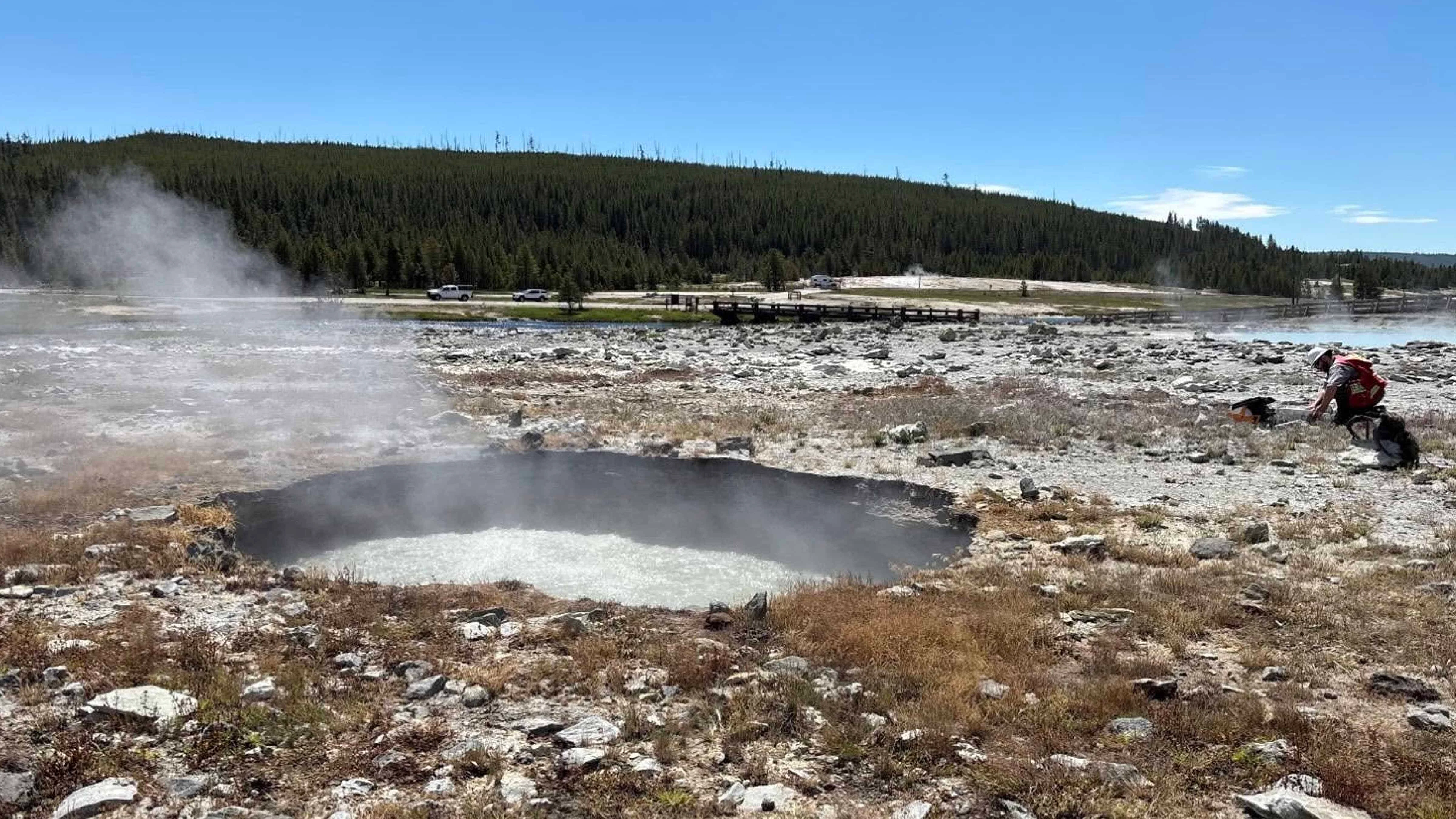
The Yellowstone Volcano Observatory confirmed that a hydrothermal explosion occurred around 5:09 a.m. June 13. When geologists went to evaluate the area the next day, they found a 21-foot-wide pool filled with boiling, silty water, a 60-foot fissure, and water spouting 30 feet into the air.
It was an unexpectedly dynamic event in Biscuit Basin, which has been closed since a similar explosion occurred at nearby Black Diamond Pool in July 2024.
“Black Diamond doesn't seem to have been affected by this event in a major way,” Mike Poland, scientist in charge of the Yellowstone Volcano Observatory, told Cowboy State Daily. “That’s a sign that these are very shallow events that impact individual features in a very explosive thermal basin.”
Big Blow Up
The observatory detected the explosion as soon as it happened. It was even captured on the camera installed in Biscuit Basin to monitor Black Diamond Pool.
When geologists got to the basin the next day, they found several significant changes. For one thing, there was the new 21-foot-wide crater filled with boiling water, which Poland wasn’t surprised to see.
“That’s pretty standard for Biscuit Basin,” he said. “It has a lot of high-temperature water.”
What was more surprising was a 60-foot-long fissure and several new vents.
“All of these vents were draining water into the Firehole River, and geologists found near-boiling waters in most of these vents,” Poland said. “They were draining enough water that the river itself turned a milky-white color for many miles downstream.”
Based on the scene, Poland said the event was a “relatively small” hydrothermal explosion. It occurred in an area with no existing thermal features.
After weeks of observation, the water-filled crater has shown some geyser-like behavior. Water was seen rising as high as 30 feet.
Poland was interested in the longevity of this behavior and all the new features in Biscuit Basin. It’s too early to say whether they’ll be long-lived or peter out over time.
“It’s completely unknown at this point,” he said. “Maybe that (spouting) was caused by a release of the pressure accumulated beneath the surface, or maybe this new pool will end up being a geyser-like feature. Clearly, there was a lot that went on the morning of June 13.”
Predicting The Unpredictable
Hydrothermal explosions are caused by water rapidly converting to steam. The rapid phase change from liquid to gas releases an enormous amount of energy, as evidenced by the incident at Black Diamond Pool on July 23, 2024.
“It’s a pressure-cooker situation,” Poland said. "When water turns to steam, it expands over 1,000 times. When that happens in a confined space, the space can't hold the rapid expansion of steam and can cause explosions.”
Biscuit Basin has been closed to the public since that day, but sophisticated equipment has been installed so geologists can monitor ongoing activity. Black Diamond Pool has erupted several times since then, but nothing as significant as the July 2024 event.
While the June 13 eruption wasn’t significant by Yellowstone standards, Poland is excited about what can be learned from it. It might help him and other geologists, hydrologists, and volcanologists predict the unpredictable.
“One of the problems with studying these explosions is that you really don't know where they're going to occur,” he said. “If you put out a monitoring station, you’re never guaranteed to catch an explosion, and we don’t know of any precursors that might indicate an explosion is imminent.”
This hydrothermal explosion occurred 400 feet from temperature sensors and sophisticated stations installed to monitor seismic and acoustic activity in Biscuit Basin. With this event and “a year’s worth of data,” Poland hopes they might find a potential precursor.
“This explosion happened in the middle of an area of dense monitoring, he said. “We've got an opportunity to dive into all of those data sets and see if there was some change in the system that was detected by the seismic and acoustic monitoring.”
Identifying a precursor to hydrothermal explosions will help keep people safe in Yellowstone and around the world, Poland said. It could inform scientists when a hydrothermal explosion is imminent, or the risk is higher based on temperature, acoustic signals, or some other change in the system.
Such a precursor isn’t known to exist, and Poland isn’t confident they’ll find one, but a prime opportunity to do so just presented itself.
“This was a pretty good situation,” he said. “We had all the monitoring instrumentation in the right place at the right time, lots of data already collected, and no one was threatened by this activity.”
It’s What’s New
Since June 13, Biscuit Basin has gotten less explosive. The real question is whether any of the changes will become permanent.
According to Poland, many of the vents opened by the explosion have since dried up. The collapsed crater is still filled with boiling water, but the geyser-like behavior hasn’t been observed since June 18.
“The future of any of these features is really unknown at this point,” he said. “Will they stay boiling or gradually cool down? Was there a change in the heat emission of Biscuit Basin? Those will be the interesting questions going forward."
Meanwhile, other than what Poland described as a “subtle bubble” from the pool’s vent, Black Diamond Pool doesn’t seem to have been impacted.
Poland sees that as evidence of how Yellowstone’s thermal features coexist. While most of Yellowstone’s geysers, hot springs, and steam vents share space with other thermal features, most tend to be separate rather than part of a vast, interconnected system.
“When the 2024 explosion happened, none of the other features in Biscuit Basin changed their behavior,” he said. “This explosion happened 100 feet north of Black Diamond Pool, and it doesn't really seem to have affected it in a major way. That’s a testament to how local all these events are.”
Andrew Rossi can be reached at arossi@cowboystatedaily.com.


