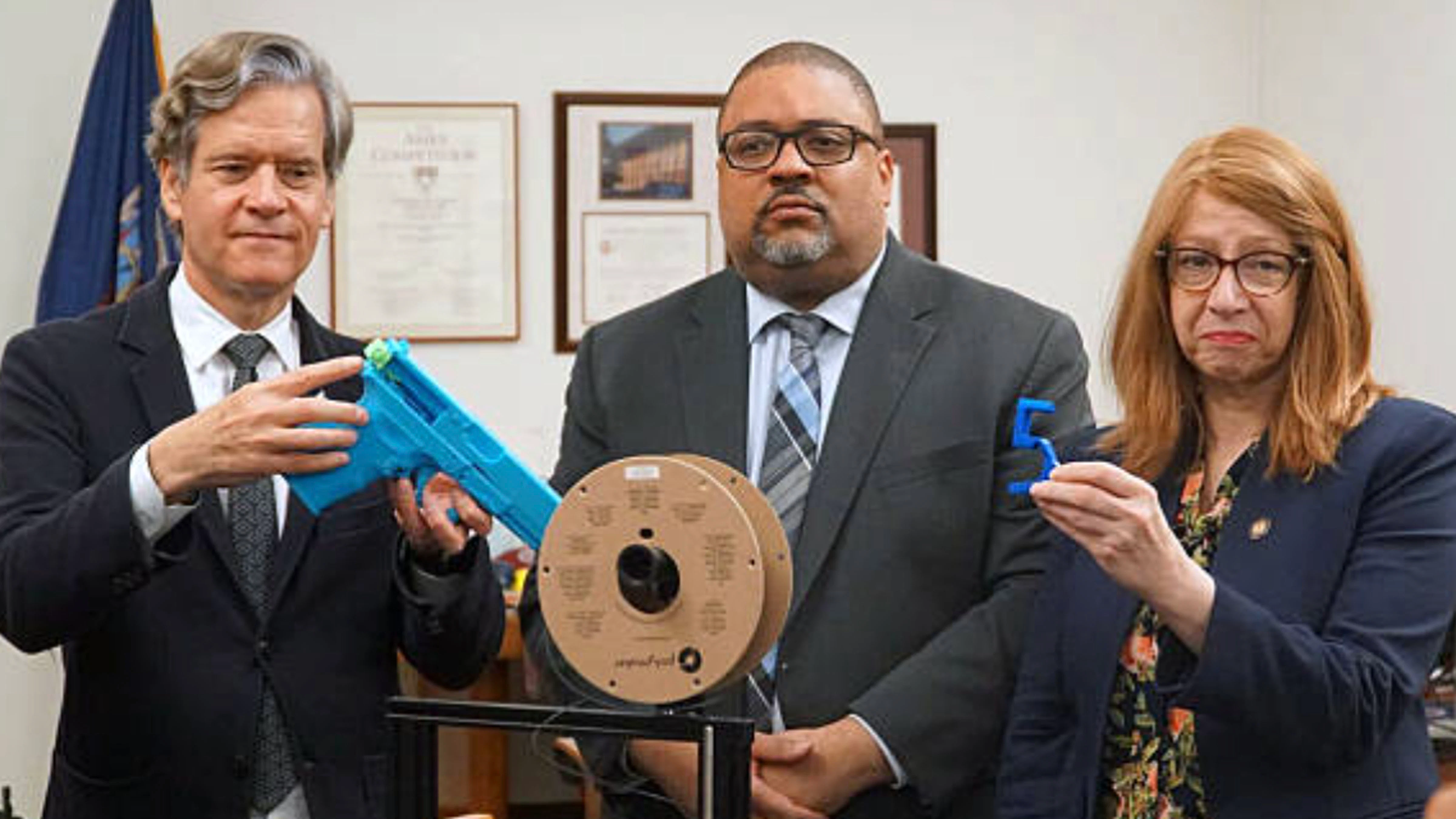
In the latest twist in efforts to ban 3D-printed “ghost guns,” New York state and California have moved to ban printers capable of making them.
A New York law signed last month states that 3D printers should come with technology blocking them from making firearms or firearms parts. A similar measure is before the California Legislature.
The gun-blocking technology for printers might not be available until 2029 at the earliest, the Associated Press reported.
Gun control advocates are hailing the printer ban as a way to get a handle on so-called “ghost guns,” or untraceable firearms made with 3D printers and lacking serial numbers.
Advocates for banning 3D-printed guns argue that those guns are increasingly being used in crimes.
In Wyoming, a gun rights advocate and 3D printing business owner told Cowboy State Daily that the California and New York measures are pointless.
People have always made their own firearms and should have the right to do so, said Mark Jones of Buffalo, a national director for Gun Owners of America (GOA).
Banning 3D-printed guns, or the printers that make them, won’t change that, he said.
From a technical standpoint, the bans won’t work, said Kevin Thomas, owner of T&G 3D Printing in Basin.
As he sees it, there’s no way to make printers that won’t produce certain items. Printers will produce whatever they’re programed to.
“The printer itself can’t determine what is being printed,” he said.
Telling Printers What Not To Do
The New York law and California bill direct experts to craft algorithms that could detect firearm blueprints.
Hypothetically, the technology would analyze 3D printing designs against a digital library of firearm parts, and reject those that match the parts.
Some industry experts have told lawmakers in those states that won’t work.
Thomas agreed, saying that’s because 3D printer operators would still have the final say through “G-codes” they enter in their machines telling them what geometric shapes to cut.
Trying to control G-codes would not only be impractical, but it would also amount to an infringement on freedom of speech and expression, Thomas said.
Moreover, major firearms manufacturers such as Smith & Wesson also use gun-design software, he said, adding that efforts to regulate firearms out of the 3D printing world will backfire.
“What will end up happening is there just won’t be any 3D printers for sale in California, so people there will just go across state lines to get them,” he said.
People Have Always Made Guns
Firearms parts or accessories can be 3D-printed for sale, except lower receivers, Thomas said. The lower receiver is the part of the firearm including, for instance, the trigger assembly.
Lower receivers can be created for personal use only.
Thomas said he doesn’t print firearms parts or accessories because of possible legal complications.
For example, if he made a rifle stock for a customer, and that stock became part of a firearm that was later used in a murder, that might come back on him, he said.
Jones said that concern over “ghost guns” is hyperbolic.
“People have been making their own firearms since 1776,” he said.
Democrats have also tried using firearms serial numbers to create databases for a national firearms registry, Jones added.
“It’s actually illegal to keep a registry of what guns people have, and we think it should be,” he said.
Mark Heinz can be reached at mark@cowboystatedaily.com.