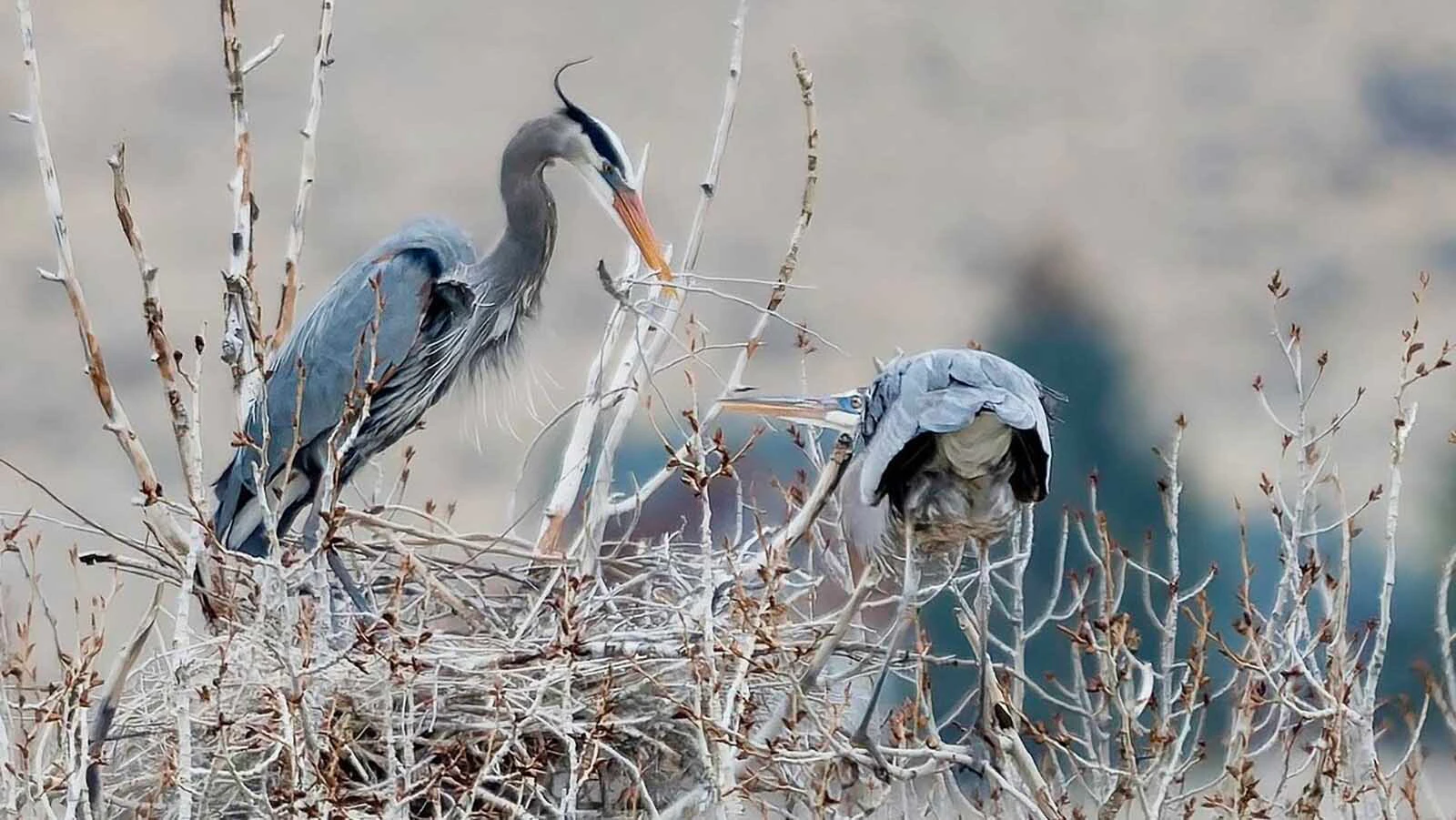
Though uncommon in Wyoming, great blue herons are thriving in a rookery, or collective nesting area, near Buffalo Bill Reservoir in Park County.
Wildlife photographer Phil Hilson of Cody told Cowboy State Daily that he first discovered the rookery about five years ago when there was just a handful of the gangly shore birds there.
Since then, “it’s been steadily growing,” he said. “This year, I think there may be eight families there.”
The first pair showed up about two weeks ago, he said.
The rookery is in a place that’s difficult to get close to, which Hilson sees as a plus because “people won’t bother them” where they are.
‘You Invaded My Air Space’
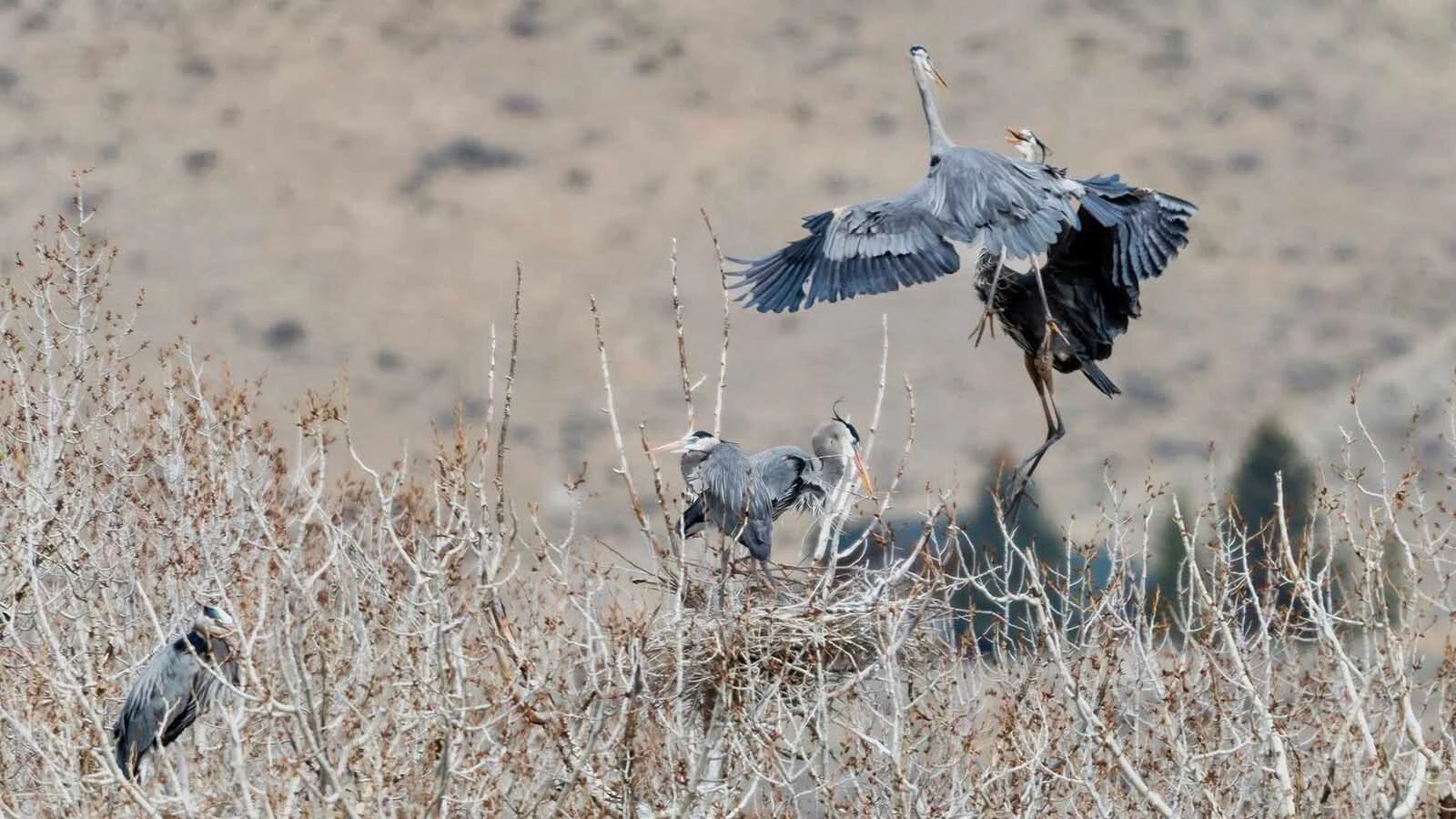
The herons have been raising a ruckus as they build their nests, competing for the best spots in a huge tree at the heart of the rookery.
Hilson said he stays back, observing and photographing the birds through a huge telephoto lens.
“They’re really going to town, going down to the ground to collect stick for their nests,” he said.
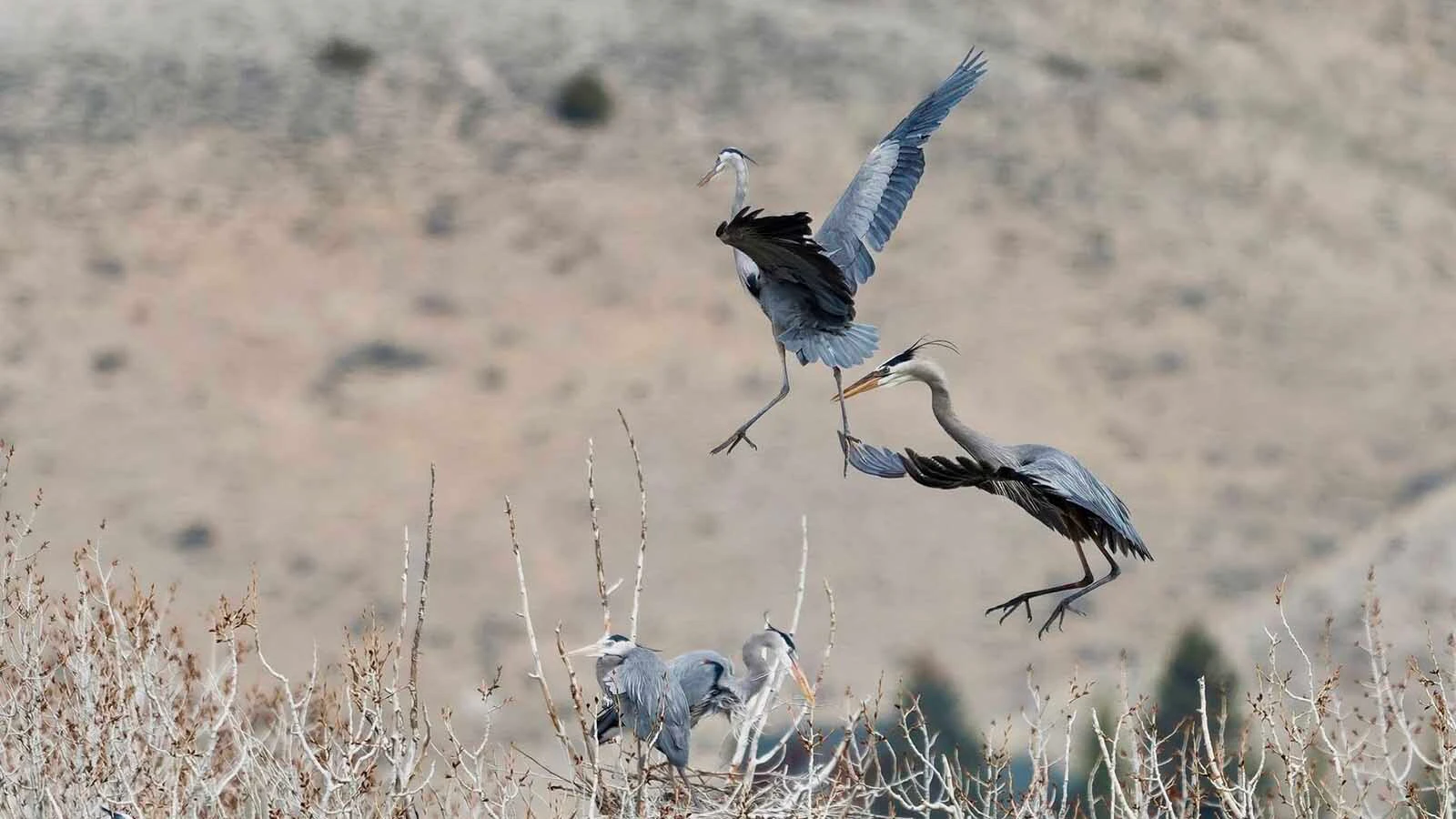
There’s a lot of squawking and other vocalizations, particularly when herons irritate each other, Hilson said. That usually happens when a heron flies too low over another pair’s nesting spot.
"It’s almost as if the herons are saying, ‘You flew too close over my nest. You invaded my air space,’” he said.
That can lead to tussles and some mid-air action.
“These two that I got a photo of, they were clashing in mid-air,” he said.
While wild and noisy, the tussles aren’t violent, and the herons don’t seem to be trying to hurt each other, he said.
‘Uncommon’
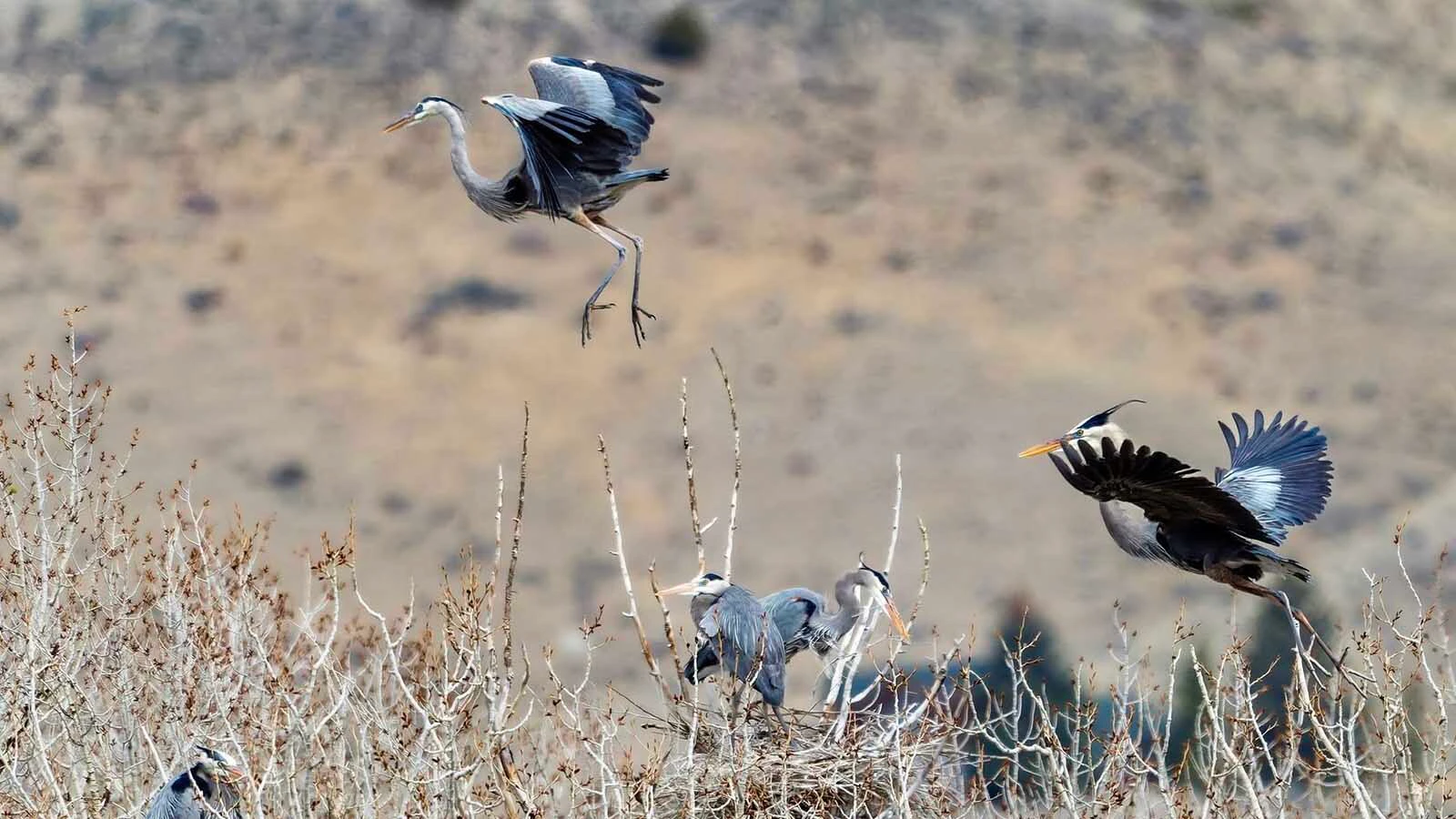
Great blue herons can be found in suitable habitat near water across Wyoming, according to the Wyoming Game and Fish Department.
Hower, they’re listed as “uncommon” in the Cowboy State, because their numbers are relatively low.
"A great blue heron is easily identifiable in the field by its large size, long legs and neck, gray upperparts, white head with a broad blue stripe running from the eyes to the back of the head, and yellowish eyes and bill. Its legs are greenish or brownish,” according to Game and Fish.
“(The) great blue heron eats a wide variety of organisms including mammals, fish, amphibians, birds, insects, and crustaceans,” the agency adds.
However, herons must be cautious about how much they try to cram down at once.
“Death by choking can occur when herons try to consume large prey items,” according to Game and Fish.
The highest concentration of breeding heron populations in Wyoming can be found along the major river drainages, such as the Bighorn, Green, North Platte, Powder, and Snake rivers, according to the agency.
“The lowest densities occur in Yellowstone National Park and in arid regions, such as the Great Divide Basin,” Game and Fish states.
Things Get Quieter
The nest-building and mating season at the rookery are chaotic, with lots of activity to watch, Hilson said.
Things calm down once the next generation of herons hatches.
“Pretty soon, a month or two from now, you start to see little babies sticking their heads out of the nests,” he said.
From what he can tell, the herons near Buffalo Bill Reservoir feed fish to their young.
“I think they chew the fish up and then regurgitate it so the chicks can eat it,” he said.
As the chicks start to mature and colder weather sets in, the show is over, Hilson said.
“In the fall, everybody leaves,” usually in late September or October, he said.
There are a few herons that stay in Wyoming year-round, according to Game and Fish.
Mark Heinz can be reached at mark@cowboystatedaily.com.