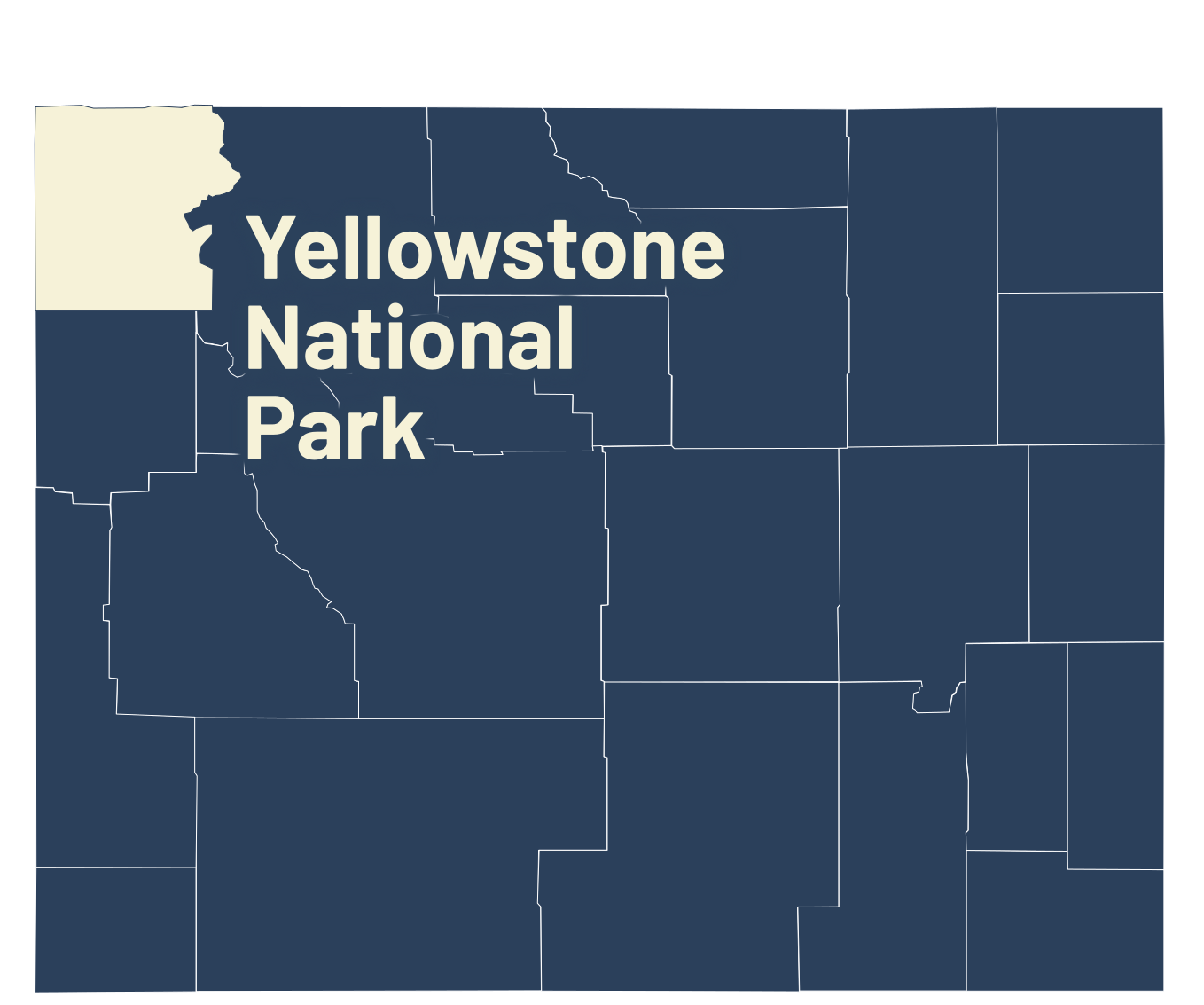
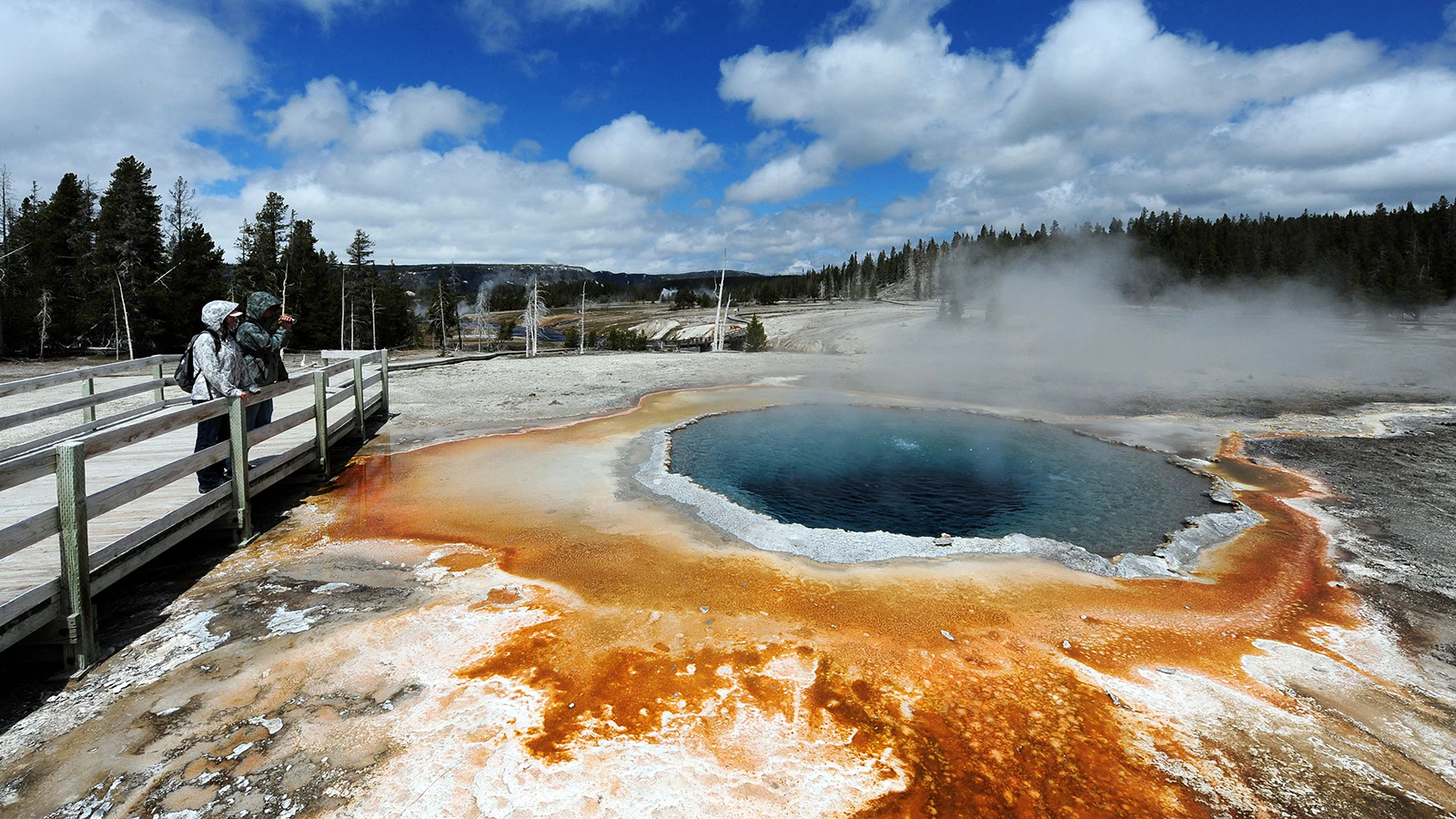
Author and historian Jeff Henry just finished his 48th season as a winter keeper in Yellowstone National Park. His job is to ensure the buildings at Old Faithful and other locations don’t collapse under the weight of several feet of snow.
After nearly 50 years of Yellowstone winters, the 2025-2026 winter season was unlike any other in Henry's firsthand experience. It wasn’t the least snowy, but it was definitely the warmest.
“It was off-the-charts warm,” he told Cowboy State Daily. “I’ve seen winters that were lighter than this one, but the temperatures were unprecedented. Absolutely unprecedented.”
A Lax Wax Winter
Henry moved into his winter cabin at Old Faithful in mid-October, just as he’s done every year since 1978. Winter keeping, he said, is “the hardest work in Wyoming.”
“Right now, we do the Yellowstone General Stores and the four post offices,” he said. “That’s somewhere in the vicinity of 20 buildings around the park.”
Using shovels, saws, wires, and gravity, Henry and the other winter keepers remove accumulated snow from the roofs of these buildings to ensure they don’t sag or collapse under the weight.
The deeper the snow, the harder it is to remove, so Henry knows that a good winter keeper is always proactive.
“Our philosophy is to start clearing the snow as soon as possible,” he said. “The first snow is usually soft and powdery and won't hold together. As soon as it bonds, we try to get it off, because it comes down fast, and soon all of your buildings are alarmingly loaded.”
In mid-April, Henry moved out of his winter cabin and back to his home in Paradise Valley, Montana. In retrospect, the winter was already off to a bad start when he moved in.
“We didn't start till pretty late this year, for obvious reasons,” he said.
Henry didn’t have “the facts and figures at the tip of my fingers,” but he has plenty of anecdotal evidence telling him how unusually warm this winter was. One thing he cited was his ski wax.
“Ski waxes are colored coated according to the temperature range where they are useful,” he said. “I buy an assortment of warm and cold waxes, and I usually use up all my cold waxes while my warm waxes remain untouched. That wasn’t the case this winter.”
The Toll Of Temperature
This wasn’t the driest winter in Henry’s time as a winter keeper. He could think of several seasons where there was much less snow for him to clear.
What struck him about this past season was how warm it was — and stayed that way.
“Yellowstone used to be a really harsh place in the winter,” he said. “The temperature would frequently go far below zero, as much as 50 degrees below zero, and stay there for extended periods of time. In contrast, this winter had many nights that barely froze.”
Henry noted that there were several consecutive days where overnight temperatures would barely dip below freezing, only 28 degrees, during “the heart of winter.”
Considering Old Faithful is over 7,000 feet in elevation, that's notable.
Meanwhile, daytime temperatures often crept into the 40s and even the 50s at places like Canyon Village. That’s warmer than Henry ever experienced — a lot warmer.
“My rough estimate is that daytime temperatures were often 20 to 30 degrees warmer than my memory says they used to be,” he said. “Nighttime temperatures were probably about the same.”
Bad Made Worse
As far as snowfall, Herny said this wasn’t the worst winter he’s ever experienced. He could think of several seasons with less snow.
“I would say there was a total of four or five winters that have been drier than this one in my time,” he said. “The winner of 1980-1981 was lighter than this. The winner of 1986-1987 was lighter than this, but this one was definitely on the light side.”
However, temperature had an unprecedented impact on the snow that did fall over Yellowstone. Many days were so warm that much of the snowfall melted before it reached the ground.
Henry went about his duties as usual, traveling through the park via snowmobile to clear roofs. He found some days concerningly easy and others much more difficult.
“Some of the buildings we customarily shovel had essentially no snow on them,” he said. “Others had maybe up to 4 feet, which doesn't sound like much by Yellowstone standards, but it was very dense because the moisture content was so high.”
For reference, Henry can recall winters when he was regularly removing more than 12 feet of snow from Yellowstone roofs.
Why was the snow’s moisture content so high? Winter rainstorms, something that was “unheard of” when Henry started winter keeping.
“These midwinter rains are becoming more and more common,” he said. “We had a very heavy rain on Christmas this year, and you can't get much more middle of the winter than Christmas.”
Overall, Henry’s assessment was that this wasn’t the lowest snowfall he has ever seen in Yellowstone, but there was no escaping the impact of overly warm temperatures.
“I definitely wouldn’t call it a healthy amount of snow,” he said. “It was definitely on the low side, but the paucity of snow was exacerbated by the warm weather.”
The Numbers
Henry’s on-the-ground experience is backed up by hard data collected by the National Weather Service (NWS).
According to the NWS office in Riverton, the average temperature at Lake Yellowstone between Dec. 13 and 27 was 26.2 degrees. That’s nearly 14 degrees warmer than average.
The average temperature at Lake Yellowstone on Dec. 24 is 23 degrees. On Dec. 24, 2025, it was 39 degrees, which would explain the Christmas rainstorm Henry experienced at Old Faithful.
Many places in Wyoming broke 150-year-old records on Christmas Day. Yellowstone was among them, breaking its previous record of 32 degrees with a daytime high of 37 degrees.
Between December and March, average temperatures at Lake Yellowstone were nearly 8 degrees warmer than average. According to the NWS Riverton, it was the warmest period on record since 1998.
The website precip.ai had an even starker assessment of the seasonal snowfall.
According to its data, Yellowstone’s 30-year average liquid equivalent for November is 2.28 inches. In November 2025, there was only 0.46 inches, less than 80% of the average.
March was even worse. Yellowstone received 0.24 inches of its average 2.29 inches in March, a deficit of 89%.
The liquid equivalent for six of the eight months from September 2025 to March 2026 was below the 30-year average, with deficits ranging from 64% to 89%.
That corroborates Henry’s experience this winter.
“I don't think I'm just some old guy with a faulty memory,” he said. “I remember many things by association, and some of these things were unheard of in my early days.”
A Warmer, Drier Change
The 2025-2026 winter season was one of, if not the warmest, winter on record for most of the Western U.S. Major metropolitan areas like Salt Lake City and Denver received an alarmingly low fraction of their seasonal snowfall.
The short-term culprits were a series of long-lasting high-pressure ridges in the Arctic Circle that blocked cold air and moisture from the western half of the U.S. and siphoned it to the eastern half.
Each "logjam" lasted between one and two weeks, with only a few days relief before another logjam formed to take its place.
How does one explain the abnormally warm temperatures and paucity of snow over Yellowstone’s winter?
For Henry, it’s the elephant — or woolly mammoth — in the room.
“It’s climate change," he said. "For me, the trends are pretty obvious."
Once again, Henry has independent information to back up his half-century of anecdotal experience.
Several organizations, including the University of Wyoming, collaborated to release the first volume of the Greater Yellowstone Climate Assessment in June 2021, directly addressing the possible impacts of climate change.
“The widespread consensus that the effects of climate change are increasingly apparent in all parts of the planet motivated us to analyze the potential impacts on the climate and water resources of the Greater Yellowstone Area,” the study reads.
The 260-page document is dense with statistical analyses and historical records. Among its major takeaways was that every basin within the Greater Yellowstone Ecosystem saw a 11% to 44% loss of snowpack and a 0.89- to 3-degree increase in temperature between 1950 and 2018.
If those trends continue, the same basins could see an up to 44% loss of snowpack and a temperature increase of over 5.5 degrees by 2100.
The authors of the research conclude that Yellowstone will experience warmer days, warmer nights, warmer winters, and hotter summers as the 21st century progresses.
That would have a profound impact on the park's flora and fauna, some thermal features, and the local economies that support the park and its ever-increasing visitation.
“More winter precipitation will fall as rain instead of snow, and the amount of water stored annually in snowpack will decline,” the study concludes. “Snowmelt and runoff will occur earlier in the spring, and higher evapotranspiration and reduced runoff will create water shortages in the summer.”
Serious Summer
In early March, Yellowstone began its multi-month snow removal operation. A convoy of heavy machinery left Mammoth Hot Springs to break up and clear the snowpack covering the roads in the park’s interior.
Henry was winding down his winter season right as the snow removal began. He knew they were making more progress than usual because there was less to remove.
“The roads were very lean in terms of snow cover and very icy this winter,” he said. “When I get around in my snowmobile, I pull sleds behind me to haul my gear. Around March 15, the road from West Yellowstone to Old Faithful was so rough it tore a ski off one of my sleds.”
Henry, who used to traverse the snow-covered park for winter carcass surveys, knows how a lean winter can affect the summer season. He already anticipates some significant changes that will impact Yellowstone’s wildlife and visitors.
“Historically and climatologically, it never has rained that much in the summer in this part of the world,” he said. “I would be very surprised if we get enough rain from this date till the end of the summer season to make a substantial difference in the availability of moisture.”
The obvious concern is increased fire danger.
Henry vividly remembers the 1988 Yellowstone wildfires, the largest in the park’s recorded history, and is worried that this summer could be dry enough to turn any spark into a potential powder keg.
“I think the fire danger is going to be extreme,” he said. “I can't imagine that we'll get enough rain to preclude the possibility of wildfire.”
Many people flock to Yellowstone for the fishing. If anyone’s planning a fishing trip this year, Henry believes sooner might not only be better, because it might be their only option.
“My prediction is that stream flows are going to be very low, and when they’re low, the water temperature is going to be warm,” he said. “For that reason, fishing will probably be shut off in many park streams and other streams in the region, and probably pretty early in the summer.”
Henry believes some of the streams he saw had already reached their peak runoff for the season. If so, that would be between two and three months earlier than usual.
After 48 years of harsh winters in Yellowstone, Henry wouldn’t say the 2025-2026 winter season was “the worst,” but that’s hardly a comforting thought. Unless something changes drastically between now and June, Yellowstone will be dangerously dry.
“There are exceptionally dry winters that stand out to me, but even those winters were much colder than this one,” he said. “I've never seen the snow go as fast or as early as I've seen it go this year.”
Andrew Rossi can be reached at arossi@cowboystatedaily.com.